
Trademark infringement in Bangladesh ranges from blatant counterfeit goods in local markets to look-alike packaging, confusing business names and fake online stores. The Trademarks Act 2009 gives registered owners strong civil and criminal remedies, while passing off protects unregistered brands with established goodwill. Acting quickly, with good evidence, is the key to stopping infringers before they damage a brand's reputation and sales.
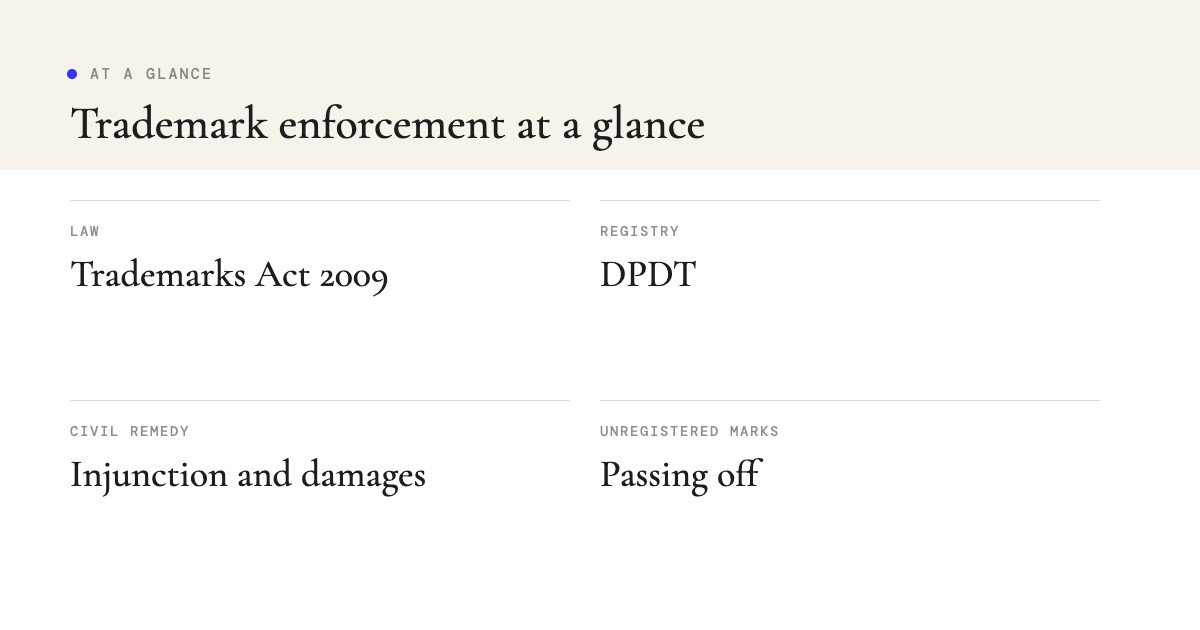
- A registered trademark under the Trademarks Act 2009 gives the owner the exclusive right to use the mark for the registered goods or services and to sue for infringement.
- Unregistered marks can be protected through a passing off action if the owner proves goodwill, misrepresentation and damage.
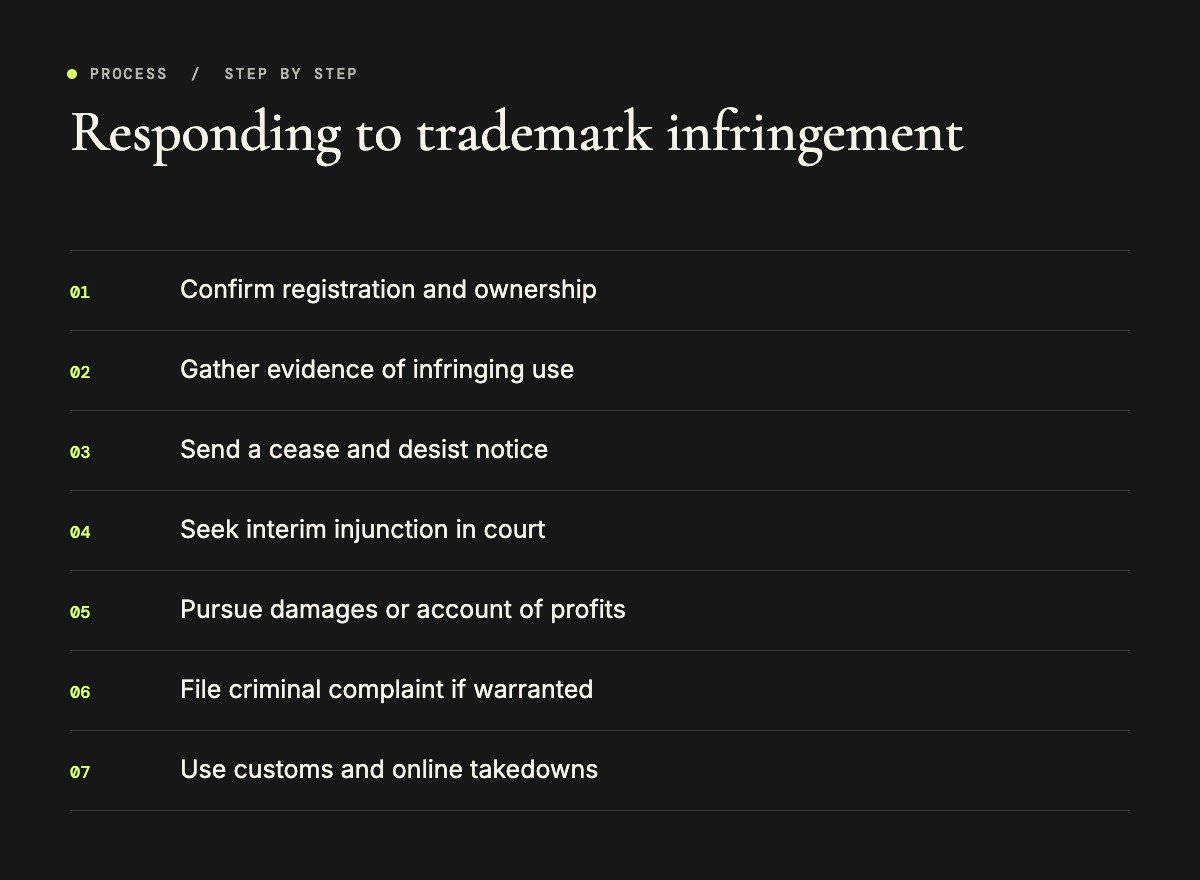
- Courts can grant temporary and permanent injunctions, damages or an account of profits, and orders for delivery up or destruction of infringing goods.
- Falsifying trademarks and selling counterfeit goods are criminal offences under the Trademarks Act and the Penal Code.
- Customs border measures and online platform takedowns help stop counterfeits before they reach consumers.
What counts as infringement
Trademark infringement in Bangladesh occurs when someone, without the owner's consent, uses in the course of trade a mark identical or deceptively similar to a registered trademark for goods or services covered by the registration, in a way likely to cause confusion. Infringement can also arise where a similar mark is used for related goods or services, and well-known marks receive broader protection. Common examples include counterfeit products, imitation packaging and trade dress, misleading business names, and unauthorised use of a brand in advertising or online.
Our intellectual property practice acts for local and international brand owners in enforcement actions.
Registration as the foundation
Registration is the best defence against trademark infringement in Bangladesh. Registration with the Department of Patents, Designs and Trademarks (DPDT) gives the clearest and strongest rights. Registered owners do not need to prove reputation or goodwill to establish infringement; they need to show the registration, the infringing use and likelihood of confusion. Applications can take time, so brand owners should file early, ideally before entering the market. See our guide to trademark registration in Bangladesh.
Remedies available
| Remedy | Forum | Purpose |
|---|---|---|
| Temporary injunction | District Court | Stop infringement quickly while the case proceeds |
| Permanent injunction | District Court | Prohibit future infringing use |
| Damages or account of profits | District Court | Compensate for losses or recover infringer's profits |
| Delivery up and destruction | District Court | Remove infringing goods and labels from the market |
| Criminal prosecution | Magistrate's court | Punish falsification and sale of counterfeit goods |
| Rectification or cancellation | Registrar or High Court Division | Remove conflicting registrations |
| Customs border measures | Customs authorities | Detain suspected counterfeit imports |
Civil action for infringement
Suits for trademark infringement in Bangladesh are filed in the District Court, which has jurisdiction over infringement and passing off claims. The plaintiff typically seeks a temporary injunction at the outset, supported by evidence of registration, the infringing products or materials, test purchases and market reports. Courts consider whether there is a prima facie case, irreparable harm and balance of convenience. Well-prepared applications can secure injunctions early, which often ends the dispute.
Make test purchases with receipts, photograph shop displays, keep samples sealed and record dates and locations. Evidence collected properly by an investigator or notary is far more persuasive than screenshots gathered informally.
Passing off for unregistered marks
Passing off fills gaps in protection against trademark infringement in Bangladesh. Where a brand is not registered, or the infringer's use falls outside the registration, the owner may sue for passing off. The owner must prove goodwill in Bangladesh, a misrepresentation by the defendant likely to deceive the public, and damage or likely damage. International brands with reputation through spillover advertising and online presence have succeeded in some cases, but proving goodwill is easier with local sales evidence.
Criminal remedies
Serious trademark infringement in Bangladesh can be a crime. The Trademarks Act 2009 makes it an offence to falsify a trademark, apply a false trademark, or sell goods bearing a false trademark, with penalties including imprisonment and fines. The Penal Code also contains offences relating to property and counterfeit marks. Brand owners can file complaints with the police or directly before a magistrate, and law enforcement can conduct raids and seize counterfeit goods. Criminal action creates strong deterrence, particularly against organised counterfeiters.
Customs and border enforcement
Many counterfeits enter Bangladesh through ports and land borders. Customs law and IPR border enforcement rules allow rights holders to record their trademarks with customs and request suspension of clearance of suspected infringing goods. Rights holders must usually provide information to identify genuine goods, respond quickly when customs detains shipments and, where required, provide security. Working with customs is an efficient way to tackle trademark infringement in Bangladesh at scale.
Online infringement
Online trademark infringement in Bangladesh is growing fast. E-commerce sites and social media marketplaces are major channels for fake goods. Brand owners can use platform reporting and takedown procedures, send notices to sellers and, for persistent infringers, take legal action. Domain name disputes involving .bd domains or international domains can be handled through registrar procedures or dispute resolution policies. Monitoring online channels regularly is now an essential part of brand protection.
Cease and desist letters
A well-drafted cease and desist letter is often the first step against trademark infringement in Bangladesh. It identifies the registered mark, describes the infringing use, demands that the infringer stop, withdraw products, disclose sources and give a written undertaking, and warns of legal action. Many small infringers comply quickly. Letters should be carefully worded to avoid allegations of groundless threats, and should be sent only after evidence has been secured, since the infringer may otherwise destroy stock or records.
Damages and account of profits
Courts can award damages to compensate the owner's losses or order the infringer to account for profits made from the infringement. Proving damages requires evidence of lost sales, price erosion or reputational harm, which can be difficult. An account of profits depends on the infringer's records. In practice, many cases end with injunctions and settlements that include payment of costs and compensation. Realistic expectations about monetary recovery help brand owners decide how far to pursue trademark infringement in Bangladesh through the courts.
Well-known marks
Famous brands get extra protection against trademark infringement in Bangladesh. Bangladesh, as a member of the Paris Convention and the WTO TRIPS Agreement, protects well-known trademarks, including against use on dissimilar goods in some circumstances and against bad-faith registrations. Owners of famous international brands can oppose or seek cancellation of conflicting local registrations, even if their own mark was not yet registered locally, by proving reputation. Evidence of advertising, sales, registrations abroad and media coverage supports these claims.
Oppositions and cancellation
Preventing problems at the registry is cheaper than litigating later. Brand owners should monitor the Trademarks Journal for applications that conflict with their marks and file oppositions within the deadline. Registered marks that conflict with earlier rights, were registered in bad faith or have not been used for a prolonged period may be removed through rectification or cancellation proceedings. These tools complement court action against trademark infringement in Bangladesh.
Licensees and distributors
Former distributors and licensees sometimes continue using a brand after their agreements end, or register the brand in their own names. Licence and distribution agreements should confirm the owner's ownership, require the partner to stop use and transfer any registrations on termination, and allow the owner to record or cancel registered user entries. When disputes arise, a combination of contractual claims and infringement actions is usually most effective.
Building an enforcement strategy
- Register core marks and key variations, including Bangla versions and logos, to prevent trademark infringement in Bangladesh.
- Record marks with customs and monitor imports.
- Watch the Trademarks Journal and online marketplaces.
- Prioritise targets by scale and harm, using civil, criminal and administrative tools.
- Keep evidence and enforcement records organised for future cases.
- Coordinate with distributors and law enforcement agencies.
Mobile courts and administrative action
Mobile courts operating under the Mobile Court Act 2009, together with the Directorate of National Consumer Rights Protection and BSTI, regularly act against counterfeit and adulterated products, particularly in food, cosmetics and pharmaceuticals. While these actions focus on consumer protection rather than trademark rights, brand owners can share information with authorities to prompt action against fake products. Administrative routes are a useful supplement when dealing with trademark infringement in Bangladesh involving consumer safety.
Pharmaceuticals and consumer goods
Counterfeit medicines, cosmetics and fast-moving consumer goods pose health risks as well as commercial harm. The Directorate General of Drug Administration acts against counterfeit and unregistered medicines, and food safety authorities deal with fake food products. Brand owners in these sectors should combine trademark infringement in Bangladesh actions with regulatory complaints, which can lead to faster seizures and closure of illegal manufacturing units.
Timing and limitation
Delay can weaken a case. Courts may refuse interim relief if the owner waited too long after learning of the infringement, and limitation periods apply to damages claims. Brand owners should act promptly once evidence is collected. Fast action on trademark infringement in Bangladesh also limits the spread of counterfeits and the damage to consumer trust.
Settlement and undertakings
Many cases of trademark infringement in Bangladesh end in settlement. A good settlement agreement includes the infringer's undertaking to stop use permanently, surrender or destroy infringing stock and materials, disclose suppliers and customers, pay costs or compensation, and accept a penalty for future breaches. Where litigation is pending, the settlement can be recorded as a consent decree, making it enforceable by the court. Settlements save time and money while still delivering strong protection for the brand.
Costs and timelines
The cost of tackling trademark infringement in Bangladesh depends on the scope of action. Cease and desist letters and customs recordals are relatively inexpensive, while full litigation involves court fees, lawyers' fees, investigators and expert evidence. Interim injunctions can be obtained within weeks in urgent cases, but final judgments in contested suits can take much longer. Budgeting for a phased strategy helps brand owners allocate resources to the most harmful infringers first.
Frequently asked questions about trademark infringement in bangladesh
Which law governs trademark infringement?
The Trademarks Act 2009, together with the Penal Code for criminal matters and common law passing off for unregistered marks.
Where are infringement suits filed?
In the District Court, which hears infringement and passing off claims.
Can I get an injunction quickly?
Yes, a temporary injunction can be sought at the start of the suit with strong evidence.
Can unregistered brands be protected?
Yes, through passing off, if goodwill, misrepresentation and damage are proved.
Is counterfeiting a crime?
Yes. Falsifying trademarks and selling counterfeit goods are offences under the Trademarks Act and the Penal Code.
Can customs stop counterfeit imports?
Yes, under border enforcement rules when rights holders cooperate with customs.
How we can help
We act for brand owners against trademark infringement in Bangladesh: investigations, cease and desist letters, injunctions, damages claims, criminal complaints and raids, customs recordals and online takedowns. Learn more about our intellectual property practice.
Found counterfeits or a copycat brand?
We gather evidence, act fast in court and coordinate with enforcement agencies to protect your brand.
Book a consultationIP practicePrimary sources: the Trademarks Act 2009 and Penal Code 1860 on the Laws of Bangladesh portal; trademark registration at the Department of Patents, Designs and Trademarks; customs information from the National Board of Revenue.
This article is general information about Bangladeshi trademark law as of October 2026 and is not legal advice. Remedies depend on the facts and evidence; take advice before acting.


0 Comments