
FCPA compliance in Bangladesh matters for any company with links to the United States, while UK-connected businesses face the Bribery Act 2010 and every business faces Bangladesh's own anti-corruption laws. Interactions with customs, tax, licensing and procurement officials create real bribery risk. A practical anti-bribery programme protects the company, its directors and its staff from prosecution, debarment and reputational harm.
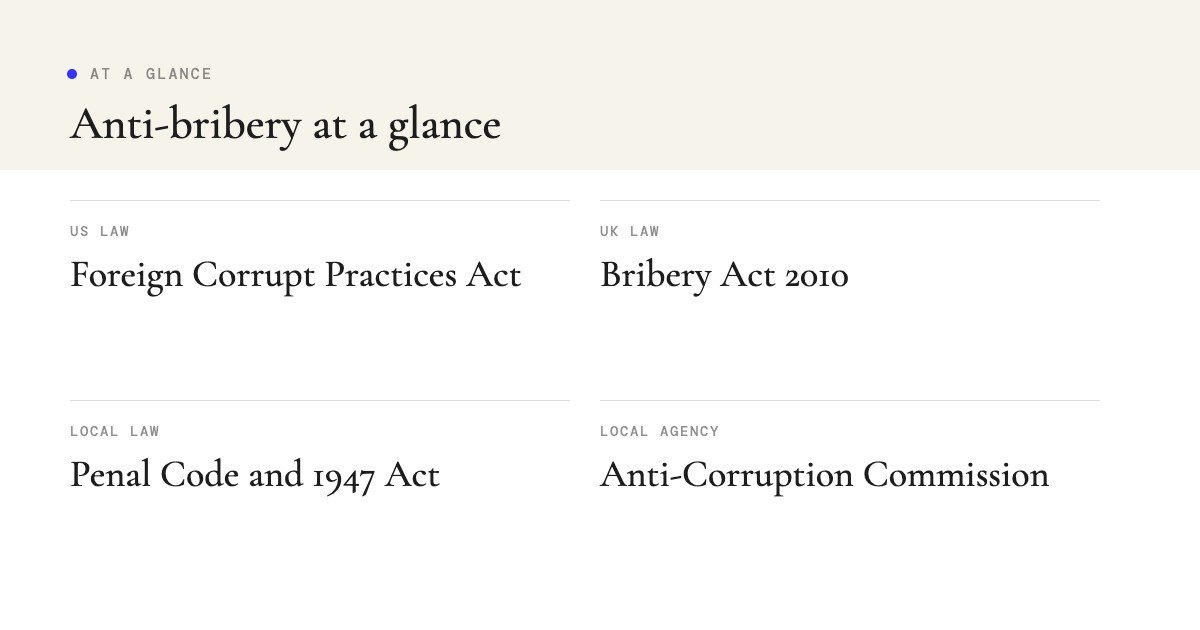
- The US Foreign Corrupt Practices Act prohibits bribing foreign officials and requires accurate books and internal controls for issuers; it can reach Bangladeshi subsidiaries, agents and partners of US-connected companies.
- The UK Bribery Act 2010 covers private and public bribery and makes companies liable for failing to prevent bribery unless they have adequate procedures.
- In Bangladesh, bribery is criminalised under the Penal Code 1860 and the Prevention of Corruption Act 1947, and investigated by the Anti-Corruption Commission under the ACC Act 2004.
- Third parties such as customs agents, distributors and consultants are the most common source of bribery risk.
- US enforcement priorities shifted in 2025, but the FCPA remains in force and the statute of limitations is long, so compliance remains essential.
Why FCPA compliance in Bangladesh matters
Businesses in Bangladesh regularly deal with government officials for import clearance, tax assessments, utility connections, licences, land records and public tenders. Facilitation demands and informal payments are a known risk. For a company listed in the US, or with US nexus, a payment by a local employee or agent to a Bangladeshi official can trigger FCPA liability for the parent company. FCPA compliance in Bangladesh is therefore a board-level issue for multinational groups and their local partners.
Our anti-corruption and bribery practice advises companies on programmes, due diligence and investigations.
The laws that apply
| Law | Who it covers | Key features |
|---|---|---|
| US FCPA | US issuers, domestic concerns and persons acting in US territory, and their agents | Anti-bribery of foreign officials; books and records and internal controls for issuers |
| UK Bribery Act 2010 | UK companies and companies carrying on business in the UK | Public and private bribery; corporate offence of failing to prevent bribery |
| Penal Code 1860 | Everyone in Bangladesh | Offences by and relating to public servants taking gratification |
| Prevention of Corruption Act 1947 | Public servants and those who abet | Criminal misconduct and corruption offences |
| Anti-Corruption Commission Act 2004 | Investigations and prosecutions | ACC powers to inquire, investigate and prosecute corruption |
| Money Laundering Prevention Act 2012 | Everyone | Laundering proceeds of corruption |
An amendment ordinance to the ACC framework issued in December 2025 lapsed in April 2026, so the ACC Act 2004 continues to govern the Commission, and a new commission took office in August 2026.
Key FCPA concepts
FCPA compliance in Bangladesh starts with the basic rule. The FCPA prohibits offering, promising or giving anything of value, directly or indirectly, to a foreign official to obtain or retain business or secure an improper advantage. "Foreign official" includes employees of government agencies and state-owned enterprises, such as state banks, utilities and port authorities in Bangladesh. "Anything of value" includes cash, gifts, travel, jobs for relatives and donations. The accounting provisions require issuers to keep accurate books and maintain internal controls, so disguising improper payments as consultancy fees or miscellaneous expenses is itself a violation.
The FCPA has a narrow exception for facilitating payments for routine governmental action, but the UK Bribery Act and Bangladeshi law have no such exception. Most multinationals therefore prohibit facilitation payments entirely in Bangladesh.
High-risk areas in Bangladesh
- Customs and imports. Clearance at ports and land borders, valuation and classification disputes.
- Tax and VAT. Assessments, audits and refunds.
- Licences and permits. Trade, environmental, factory, fire and sector licences.
- Public procurement. Tenders with government agencies and state-owned enterprises.
- Land and property. Registration, mutation and records.
- Utilities. Power, gas and water connections.
- Third parties. Agents, distributors and consultants acting for the company.
Third-party due diligence
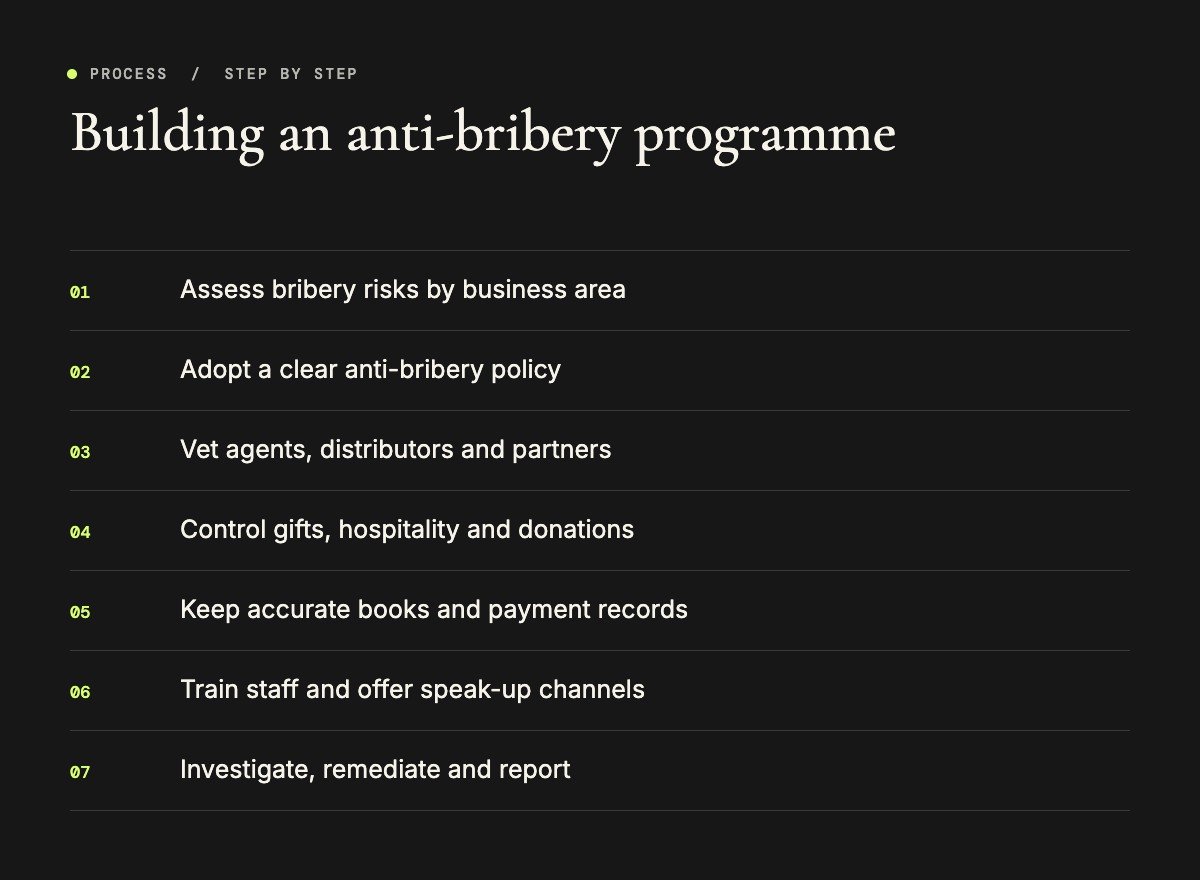
Third parties are the main risk for FCPA compliance in Bangladesh. Most bribery cases involve intermediaries. Before engaging agents, customs brokers, distributors, consultants or joint venture partners, companies should conduct risk-based due diligence: ownership and government connections, reputation, qualifications, reasonableness of fees and references. Contracts should include anti-bribery representations, audit rights, termination rights and payment only to bank accounts in the third party's name. Ongoing monitoring is essential. Strong third-party controls are at the heart of FCPA compliance in Bangladesh.
Gifts, hospitality and donations
Gifts are a frequent test of FCPA compliance in Bangladesh. Modest, transparent hospitality can be appropriate, but gifts to officials, lavish entertainment, travel for officials and their families, and donations at the request of officials carry high risk. Companies should set clear limits, require pre-approval for anything involving public officials and record all expenditure accurately. Charitable and community contributions should be made to legitimate organisations, approved centrally and publicly recorded.
Investigations and response
Responding well to allegations is part of FCPA compliance in Bangladesh. When allegations arise, companies should act promptly: preserve documents, engage independent counsel, conduct a privileged investigation, take disciplinary action where warranted and remediate control failures. Self-reporting to US or UK authorities may bring credit but must be considered carefully, together with potential exposure in Bangladesh before the ACC. Coordinated advice across jurisdictions is vital.
The UK Bribery Act and adequate procedures
For UK-connected companies, section 7 of the Bribery Act 2010 creates strict corporate liability for failing to prevent bribery by associated persons, including employees, agents and subsidiaries, with a defence of adequate procedures. UK guidance describes six principles: proportionate procedures, top-level commitment, risk assessment, due diligence, communication and training, and monitoring and review. Since September 2025, UK companies also face a new failure-to-prevent-fraud offence under the Economic Crime and Corporate Transparency Act 2023. A programme designed for FCPA compliance in Bangladesh should therefore also meet UK standards if there is UK nexus.
Books, records and payments
Accurate accounting is a core FCPA requirement and a powerful detection tool. Companies should require supporting documents for all payments, prohibit off-book accounts and cash payments to officials, review unusual entries such as "miscellaneous", "facilitation" or "speed money", and reconcile agent commissions against services actually provided. Finance teams should be trained to spot red flags. Strong financial controls make FCPA compliance in Bangladesh measurable and auditable.
Customs and import controls
Customs clearance is one of the highest-risk areas. Companies should use reputable clearing and forwarding agents, require itemised invoices, compare fees to market rates, and investigate unexplained "expedite" charges. Classification and valuation disputes should be handled through formal channels, with legal support where needed. Planning shipments to avoid urgent clearance pressure also reduces the temptation to pay. These steps are central to FCPA compliance in Bangladesh for importers and manufacturers.
Joint ventures and acquisitions
Multinationals entering Bangladesh through joint ventures or acquisitions inherit the conduct of their partners and targets. Pre-transaction anti-corruption due diligence should review government interactions, licences, tenders won, agents used, donations and past investigations. Post-closing integration should extend the group's policies, training and controls to the new business quickly. Weak diligence can expose the acquirer to liability for past or continuing misconduct, undermining FCPA compliance in Bangladesh.
Speak-up channels and culture
Employees often know about problems before management does. A confidential, trusted reporting channel, available in Bangla and English, with protection against retaliation, encourages early reporting. Leaders must show that refusing to pay a bribe will be supported even if it delays a shipment or contract. Culture, not just policies, determines whether FCPA compliance in Bangladesh works in daily operations.
Public procurement and state-owned enterprises
Bidding for contracts with ministries, utilities, state banks or other state-owned enterprises raises specific risks, including requests for payments to evaluators, inside information about competitors, or pressure to use particular subcontractors. Public procurement in Bangladesh is governed by the Public Procurement Act 2006 and the Public Procurement Rules 2025, which include integrity provisions and debarment for corrupt practices. Development partner-funded projects add the anti-corruption rules of lenders such as the World Bank and Asian Development Bank, whose sanctions can bar companies worldwide. Bid teams need specific guidance as part of FCPA compliance in Bangladesh.
Monitoring and testing
Programmes must be tested to be credible. Internal audit should periodically review high-risk payments, third-party files, gifts registers and customs costs, and management should track key indicators, such as agent commission levels and exceptions approved. Lessons from audits and investigations should feed back into policies and training. Regulators and prosecutors in the US and UK look at whether a programme actually works, not just whether it exists on paper.
Practical checklist
- Map where your business interacts with public officials.
- Adopt a zero-tolerance policy, including on facilitation payments.
- Vet and monitor every third party who deals with government on your behalf.
- Set clear limits and approvals for gifts and hospitality.
- Keep accurate books with full supporting documents.
- Train staff and provide a safe speak-up channel.
- Investigate allegations promptly and fix control gaps.
Following this checklist provides a solid foundation for FCPA compliance in Bangladesh and for meeting UK and local anti-corruption requirements.
Extortion and duress
Employees sometimes face demands accompanied by threats to safety, such as detention or violence. Most enforcement authorities distinguish genuine duress, where a payment is made to avoid imminent harm to a person, from ordinary commercial pressure. Policies should explain that employees may make a payment to protect their personal safety, must report it immediately, and that the company will record it accurately and review the circumstances. Commercial delays, lost contracts or fines are not duress. Clear guidance helps staff respond appropriately in difficult situations without abandoning the company's anti-bribery commitments or its FCPA compliance in Bangladesh.
Board oversight
Boards of Bangladeshi subsidiaries and local companies working with multinationals should receive regular reports on bribery risks, third-party reviews, investigations and training. Directors who ignore red flags may face personal exposure under local and foreign law. Active board oversight is one of the clearest signs of genuine FCPA compliance in Bangladesh.
Frequently asked questions about fcpa compliance in bangladesh
Does the FCPA apply to Bangladeshi companies?
It can, if they are agents or subsidiaries of US issuers or domestic concerns, or act within US territory, such as by using US banking channels in some cases.
Are facilitation payments allowed?
The FCPA has a narrow exception, but the UK Bribery Act and Bangladeshi law do not, so most companies ban them.
Who investigates corruption in Bangladesh?
The Anti-Corruption Commission under the ACC Act 2004.
Are employees of state banks public officials?
Generally yes for FCPA purposes, as employees of state-owned enterprises.
What is the UK failure-to-prevent offence?
A company is liable if an associated person bribes to benefit it, unless the company had adequate procedures.
Has US enforcement stopped?
Priorities changed in 2025, but the law remains in force and violations can be prosecuted for years afterwards.
How we can help
We help multinationals and local businesses with FCPA compliance in Bangladesh: risk assessments, policies, third-party due diligence, training, internal investigations, ACC proceedings and coordination with foreign counsel. Learn more about our anti-corruption and bribery practice.
Strengthening anti-bribery controls?
We build practical programmes that work on the ground in Bangladesh and satisfy global standards.
Book a consultationAnti-corruption practicePrimary sources: the Penal Code 1860, Prevention of Corruption Act 1947, Anti-Corruption Commission Act 2004 and Money Laundering Prevention Act 2012 on the Laws of Bangladesh portal; information from the Anti-Corruption Commission.
This article is general information about anti-bribery law as of October 2026 and is not legal advice. Foreign laws and enforcement priorities change; take advice from qualified counsel in each relevant jurisdiction.


0 Comments