
When two or more parties invest in a Bangladeshi company, the articles of association rarely capture their whole bargain. A shareholders agreement in Bangladesh sets out who controls what, how shares can be transferred, how deadlocks are broken and how investors exit. But unless key terms are also reflected in the articles, the company and third parties may not be bound by them.
- A shareholders agreement in Bangladesh is a private contract between shareholders, and sometimes the company, governed by the Contract Act 1872.
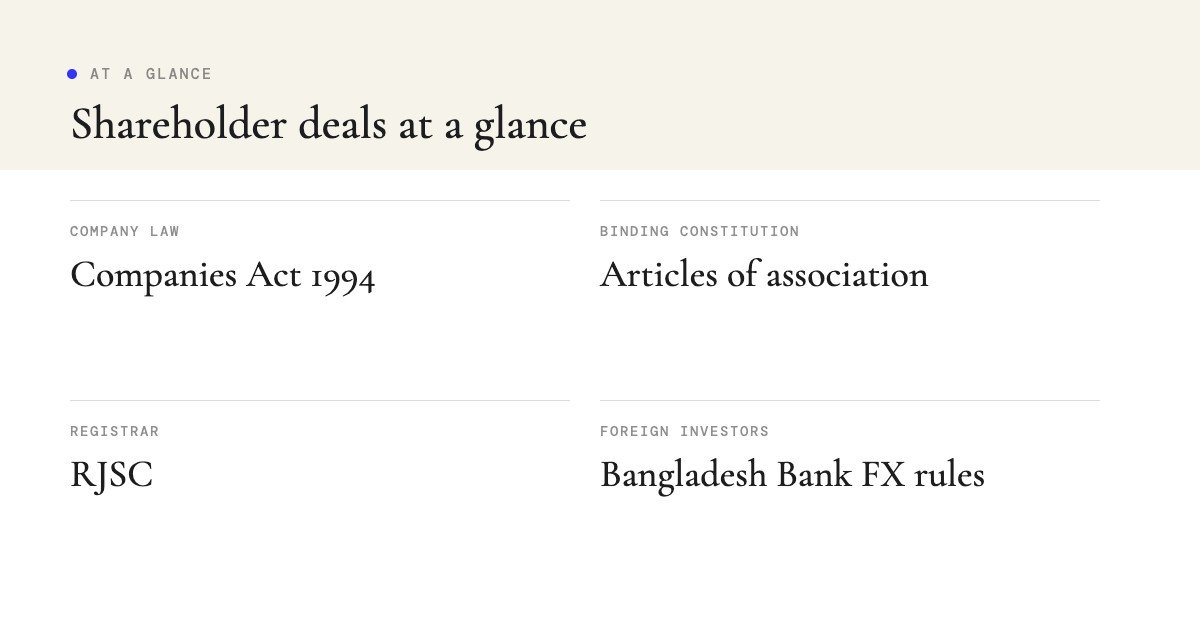
- Under the Companies Act 1994, the memorandum and articles bind the company and its members; provisions only in a shareholders agreement may not bind the company.
- Transfer restrictions, reserved matters and board appointment rights should be mirrored in the articles to be fully effective.
- Deadlock, exit and valuation mechanisms are essential, especially in joint ventures with foreign investors.
- Share transfers involving non-residents must comply with Bangladesh Bank foreign exchange rules.
Why you need a shareholders agreement in Bangladesh
The default rules in the Companies Act 1994 and standard articles give control to the majority. A minority investor with 30% or 40% of the shares may have little say over budgets, borrowing, new share issues or the appointment of the managing director. A shareholders agreement in Bangladesh allows the parties to agree a more balanced arrangement, with veto rights and protections tailored to the investment.
It also helps founders. Clear vesting, transfer and exit provisions prevent disputes when a co-founder leaves or a new investor joins. Our corporate practice drafts and negotiates these agreements for local and foreign clients.
The relationship with the articles of association
Section 22 of the Companies Act 1994 provides that the memorandum and articles, when registered, bind the company and the members as if signed by each member. The articles are therefore the company's binding constitution. A shareholders agreement in Bangladesh, by contrast, binds only those who sign it.
Courts in the subcontinent have held that restrictions on share transfers which are not contained in the articles do not bind the company. If a shareholder transfers shares in breach of a pre-emption right that appears only in a shareholders agreement, the company may be obliged to register the transfer, leaving the other shareholders with only a damages claim. This is why key provisions must be incorporated in the articles.
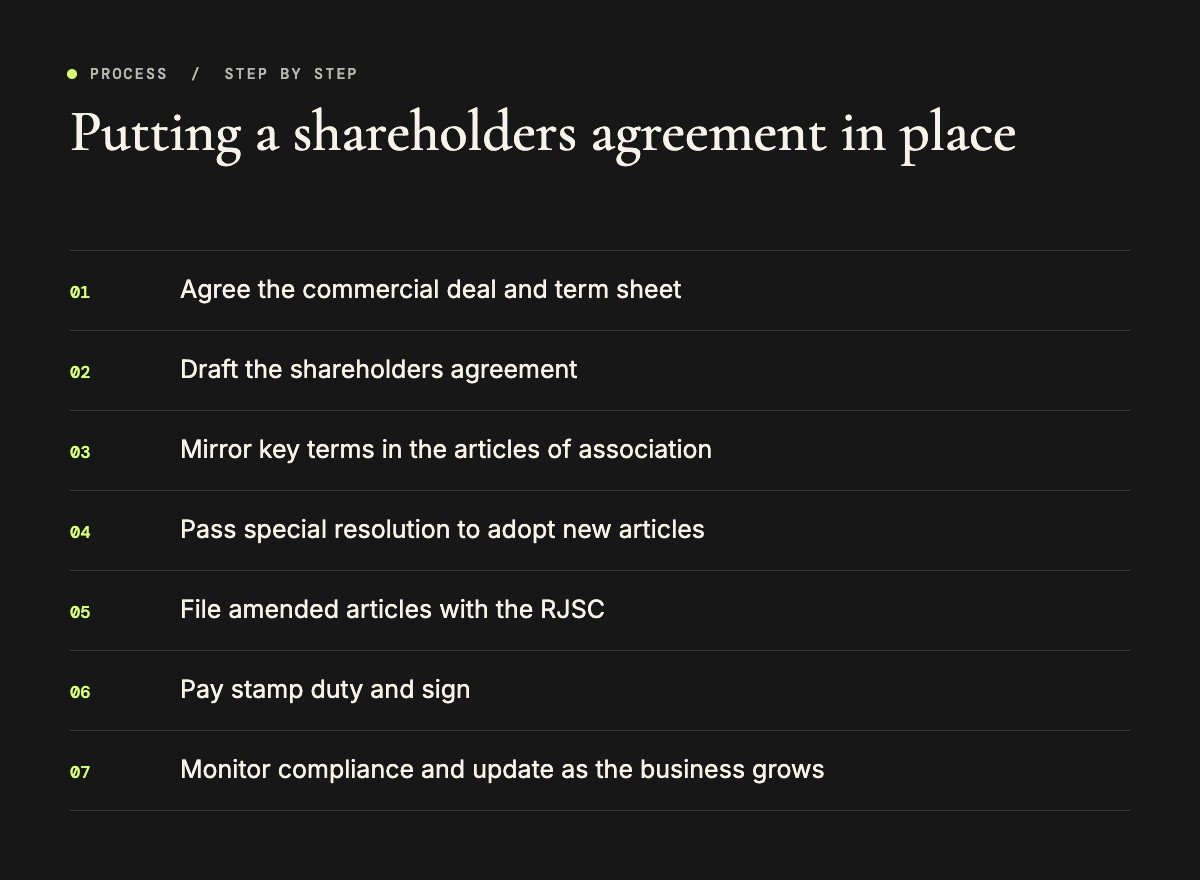
The safest approach is to mirror the essential terms in amended articles, adopted by special resolution and filed with the Registrar of Joint Stock Companies and Firms. The agreement should also state that if there is a conflict, the shareholders will vote to amend the articles to reflect the agreement.
Essential clauses
| Clause | Purpose |
|---|---|
| Board composition | Each shareholder's right to appoint directors and the chair |
| Reserved matters | Decisions requiring unanimous or super-majority approval |
| Pre-emption on transfer | Existing shareholders' right of first refusal |
| Tag-along and drag-along | Minority right to join a sale; majority right to force a sale |
| Deadlock resolution | Escalation, mediation, buy-sell or put and call options |
| Non-compete and confidentiality | Protecting the business during and after involvement |
| Dividend policy | How profits will be distributed or retained |
| Exit and valuation | IPO, trade sale, buy-back or put option, and how price is set |
Reserved matters
Reserved matters are the heart of minority protection in a shareholders agreement in Bangladesh. Typical items include changes to the articles, new share issues, borrowing above a threshold, major acquisitions or disposals, related-party transactions, approval of the annual budget and business plan, appointment of the chief executive and auditors, and any decision to wind up the company.
Some reserved matters must be decided at board level and others by shareholders. The agreement should make clear which body decides each matter, and the articles should require the relevant consent, so that a decision taken without it is not valid as a matter of company law.
Transfer restrictions
Private companies in Bangladesh must restrict the right to transfer shares under section 2(1)(q) of the Companies Act. Beyond this statutory requirement, shareholders typically agree a lock-in period, pre-emption rights, permitted transfers to affiliates and restrictions on transfers to competitors.
Share transfers are registered by the company and filed with the RJSC. See our guide to share transfer in Bangladesh for the procedure, including stamp duty and documentation.
Deadlock and exit
- Escalation. Refer the dispute to senior executives or principals of each shareholder.
- Cooling-off. Allow a period for negotiation.
- Mediation. Use a mediator to explore settlement.
- Buy-sell mechanism. A "Russian roulette" or "Texas shoot-out" clause forces one party to buy or sell.
- Put and call options. One party can require the other to buy or sell at a set valuation.
- Arbitration. Resolve legal disputes under the Arbitration Act 2001 or institutional rules.
- Winding up. As a last resort, a just and equitable winding up under the Companies Act.
Put and call options involving foreign shareholders must be workable under Bangladesh Bank rules on share pricing and repatriation. A guaranteed exit price may conflict with valuation requirements for transfers between residents and non-residents. Draft valuation mechanisms that will satisfy the authorised dealer bank and the central bank.
Foreign investors and foreign exchange rules
Where a foreign investor subscribes for or acquires shares, the inward remittance must come through banking channels, and share issues and transfers must be reported. Bangladesh Bank's Foreign Exchange Investment Department issued a master circular in March 2026 on transfers of shares in unlisted companies between residents and non-residents and repatriation of sale proceeds, giving authorised dealer banks more autonomy and simplifying valuation.
A shareholders agreement in Bangladesh for a foreign-invested company should anticipate these rules, particularly for exit, dividends and any guaranteed returns. Our foreign investment team advises on structuring.
Enforceability and remedies
A shareholders agreement in Bangladesh is enforceable as a contract. Remedies for breach include damages and, in appropriate cases, specific performance or injunctions under the Specific Relief Act 1877. Courts are more willing to grant injunctions to restrain a transfer in breach of an agreement where the restriction also appears in the articles.
Shareholders who suffer oppression or mismanagement may apply to the High Court Division under section 233 of the Companies Act for relief. Agreements commonly include arbitration clauses, and awards are enforceable under the Arbitration Act 2001, including foreign awards under the New York Convention.
Stamp duty and formalities
Shareholders agreements may attract stamp duty under the Stamp Act 1899 as agreements. Amended articles must be adopted by special resolution and filed with the RJSC within the prescribed time. Board and shareholder resolutions should be properly minuted. See our guide to board resolutions.
Founders and vesting
Start-ups often use a shareholders agreement in Bangladesh to set founder vesting, so that a founder who leaves early does not keep a large stake without contributing. Since Bangladeshi law does not have a dedicated vesting framework, vesting is usually implemented through leaver provisions that oblige a departing founder to transfer some or all of their shares at a set price. Good leaver and bad leaver definitions should be precise, and the price mechanism must be lawful and practical.
Employee share schemes are less developed in Bangladesh than in some markets, particularly for private companies, so founders should take advice before promising equity to staff.
Information rights and governance
Minority investors should negotiate rights to receive monthly management accounts, annual audited accounts, budgets and access to records. The Companies Act gives members certain inspection rights, but a shareholders agreement in Bangladesh can expand them significantly. Investors often also require compliance covenants on anti-bribery, environmental and labour standards, which are increasingly important for international funders.
Common drafting mistakes
- Leaving key protections out of the articles.
- Copying foreign templates that do not fit Bangladeshi company law or foreign exchange rules.
- Vague reserved matter thresholds that invite dispute.
- No workable deadlock or exit mechanism.
- Failing to update the agreement after new investment rounds.
Avoiding these mistakes makes a shareholders agreement in Bangladesh a durable foundation rather than a source of litigation.
Listed companies and public companies
A shareholders agreement in Bangladesh is most common in private companies. In public and listed companies, agreements among sponsors and directors are subject to securities laws, including disclosure obligations, minimum shareholding requirements for sponsors and directors under BSEC rules, and restrictions on insider dealing. Agreements that give certain shareholders control rights may need to be disclosed and can affect takeover analysis. Any shareholders agreement in Bangladesh for a company planning an IPO should include a mechanism to terminate or amend provisions that are inconsistent with listing requirements.
Joint ventures with government or state entities
Joint ventures with state-owned enterprises raise additional issues, such as government approval for share transfers, public procurement rules and audit by the Comptroller and Auditor General. A shareholders agreement in Bangladesh involving a state partner should address these constraints realistically and allow enough time for approvals at each stage.
Updating the agreement as the company grows
Businesses change. New investors, new products, acquisitions and changes in management can make the original document outdated. A shareholders agreement in Bangladesh should include a clear process for admitting new shareholders through a deed of adherence, so that every incoming investor is bound by the same rules. Founders and investors should review the agreement at each funding round and after major events, and amend the articles at the same time.
Regular review keeps the shareholders agreement in Bangladesh aligned with the real governance of the company, and reduces the risk that a forgotten clause becomes the trigger for a dispute years later.
Dividends and funding obligations
Disputes often arise over whether profits should be paid out or reinvested, and over who must provide further funding. The agreement should set a dividend policy, explain how additional capital will be raised, and state what happens if a shareholder does not contribute its share of new funding, for example dilution or conversion of loans into equity. Shareholder loans to the company may need to comply with foreign exchange rules where the lender is non-resident, so funding mechanisms should be checked with the authorised dealer bank before they are relied upon.
Frequently asked questions about shareholders agreement in bangladesh
Is a shareholders agreement legally binding in Bangladesh?
Yes, as a contract between the parties who sign it.
Does it bind the company?
Not fully unless its terms are reflected in the articles of association.
What if the agreement and articles conflict?
The articles govern the company; the agreement should require shareholders to amend the articles to match.
Can foreign investors have veto rights?
Yes, through reserved matters in the agreement and articles.
Are put options enforceable?
Generally yes as contracts, but transfers involving non-residents must comply with Bangladesh Bank rules.
Should disputes go to arbitration?
Arbitration is common and often preferable, especially with foreign shareholders.
How we can help
We draft, negotiate and enforce shareholders agreement in Bangladesh arrangements for founders, joint venture partners and foreign investors, and align them with the articles. Learn more about our corporate practice and our corporate governance team.
Bringing in a partner or investor?
We document the deal so it works in practice and in court.
Book a consultationCorporate practicePrimary sources: the Companies Act 1994, Contract Act 1872 and Specific Relief Act 1877 on the Laws of Bangladesh portal; filings with the Registrar of Joint Stock Companies and Firms; foreign exchange circulars from Bangladesh Bank.
This article is general information about Bangladeshi company law as of October 2026 and is not legal advice. Each investment needs tailored documentation.


0 Comments