
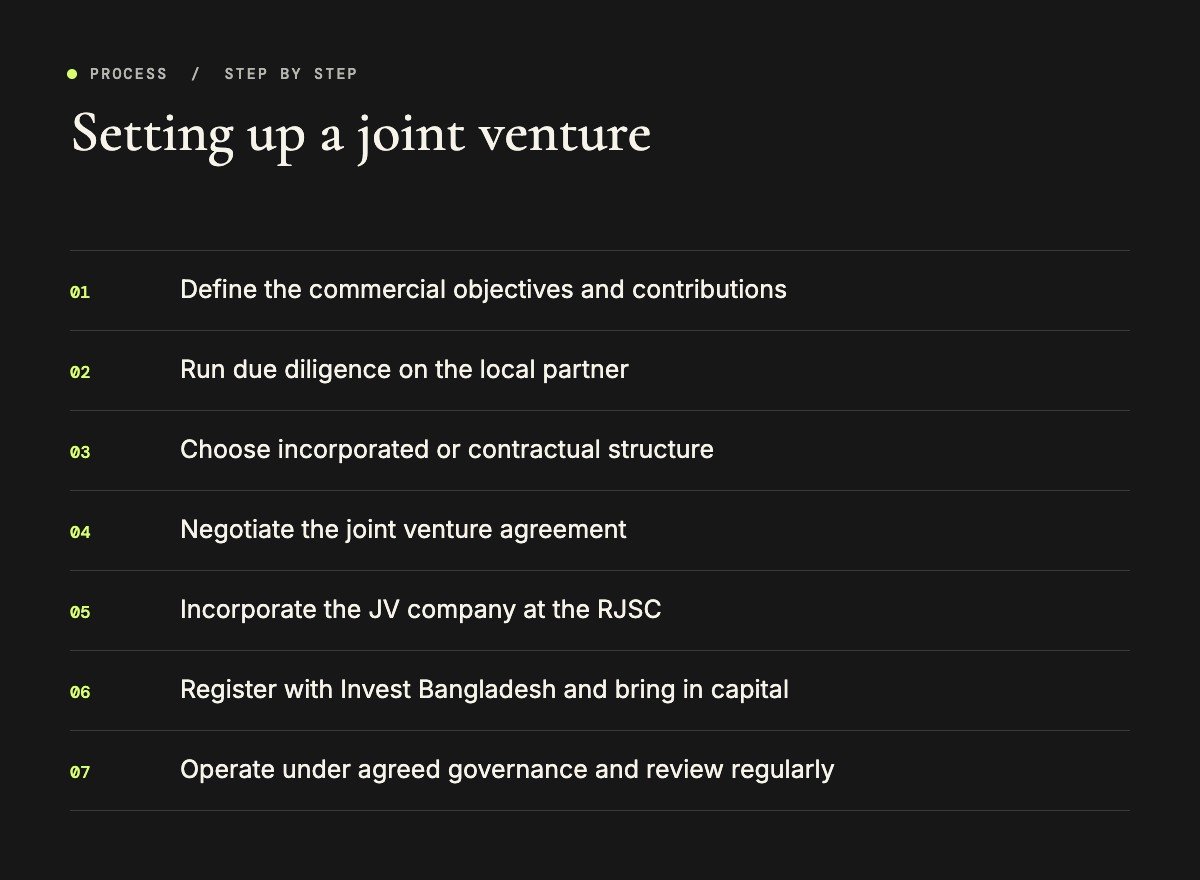
Many foreign investors enter Bangladesh with a local partner who brings market knowledge, land, licences or relationships. A carefully negotiated joint venture agreement in Bangladesh turns that partnership into a durable structure, setting out contributions, control, profit sharing, deadlock resolution and exit. Without it, even promising partnerships can collapse into costly disputes.

- A joint venture agreement in Bangladesh may set up an incorporated JV company or a contractual JV for a specific project.
- Most sectors allow foreign ownership up to 100%, but some sectors have restrictions, so check the current investment policy before agreeing shareholdings.
- Key terms should be mirrored in the JV company's articles of association to bind the company.
- Deadlock, exit and valuation provisions must work within Bangladesh Bank rules on share transfers and repatriation.
- Arbitration, often seated in Singapore or Dhaka, is the usual dispute resolution choice.
Why joint ventures are common in Bangladesh
Local partners can offer land, distribution networks, government relationships, existing licences and an understanding of how business is done. Foreign partners usually bring capital, technology, brands and international markets. A joint venture agreement in Bangladesh allocates these contributions and the rewards that flow from them.
Joint ventures are particularly common in manufacturing, energy, infrastructure, construction, healthcare, logistics and technology. Public-sector joint ventures with state-owned enterprises also occur in energy and infrastructure. Our foreign investment practice advises foreign and local partners on structuring and negotiation.
Incorporated or contractual joint venture?
| Feature | Incorporated JV | Contractual JV |
|---|---|---|
| Structure | New private limited company owned by the partners | Contract between partners, no new company |
| Liability | Limited to the company's assets | Partners may be jointly liable to third parties |
| Duration | Long-term business | Often a single project or tender |
| Tax | Company taxed separately | Each partner taxed on its share |
| Typical use | Manufacturing, services, long-term operations | Construction tenders, consortium bids |
Public procurement tenders frequently require a joint venture or consortium agreement between bidders, with joint and several liability to the procuring entity. A long-term operating business usually needs an incorporated JV and a full joint venture agreement in Bangladesh, combined with appropriate articles.
Partner due diligence
Choosing the right partner is the most important decision. Before signing a joint venture agreement in Bangladesh, investigate the partner's ownership, financial position, tax compliance, litigation history, reputation, political exposure and any links to sanctioned or debarred persons. Verify title to any land or assets the partner will contribute, and confirm that licences are valid and transferable.
Anti-corruption due diligence is especially important for partners dealing with government. Foreign investors subject to the US Foreign Corrupt Practices Act or the UK Bribery Act can be liable for their partners' conduct.
Ownership limits and approvals for a joint venture agreement in Bangladesh
Bangladesh generally welcomes foreign investment, and most sectors allow up to 100% foreign ownership. Some sectors are restricted or reserved, and others require sector regulator approval, for example banking, insurance, telecommunications and certain media. The investment policy and the restricted list should be checked for the specific activity.
Since August 2026, investment registration and related services are handled by Invest Bangladesh, which merged BIDA, BEZA and the PPP Authority. Projects in export processing zones follow BEPZA procedures. Inward remittance of share capital must come through banking channels and be reported, and an encashment certificate is needed for share issuance to foreign shareholders.
Key terms of a joint venture agreement in Bangladesh
- Purpose and scope. Define the business the JV will carry on and any restrictions on competing activities.
- Contributions. Specify cash, land, technology, licences and services each partner provides, and their valuation.
- Shareholding and funding. Set initial shareholdings and how future funding will be provided.
- Governance. Board composition, chair, managing director appointment, quorum and reserved matters.
- Related agreements. Technology licences, supply, distribution and management services agreements.
- Deadlock and exit. Escalation, buy-sell mechanisms, put and call options, and termination events.
- Disputes and governing law. Arbitration, seat, rules and language.
Land contributed by a local partner is often the most contentious asset. Decide whether land will be transferred to the JV company, leased to it, or held by the partner, and make sure title, mutation and any registration costs are dealt with before the JV starts operating.
Governance and control
Control in a JV company is exercised through the board and shareholder meetings. A joint venture agreement in Bangladesh usually gives each partner the right to appoint directors in proportion to its shareholding, with a list of reserved matters requiring the consent of both. Typical reserved matters include budgets, borrowing, new share issues, related-party transactions, changes to the business and appointment of senior management.
The articles must reflect these rights, because under section 22 of the Companies Act 1994 the articles bind the company and its members. Provisions found only in the agreement may not bind the company or third parties.
Deadlock and exit
In 50:50 joint ventures, deadlock is a real risk. Effective mechanisms include escalation to senior executives, mediation, a casting vote for a chair rotating between partners, and buy-sell clauses that let one partner buy out the other. Exit mechanisms such as put and call options, tag and drag rights and pre-emption rights should be workable under Bangladesh Bank rules on pricing and repatriation for transfers between residents and non-residents.
A March 2026 Bangladesh Bank master circular simplified share transfers between residents and non-residents in unlisted companies, giving authorised dealer banks more autonomy. Even so, a joint venture agreement in Bangladesh should include a valuation method that will satisfy the bank processing the remittance.
Dispute resolution in a joint venture agreement in Bangladesh
Foreign partners usually prefer international arbitration, for example at SIAC or the ICC, with Singapore or London as the seat. Bangladesh is party to the New York Convention, and foreign awards are enforceable under section 45 of the Arbitration Act 2001. Domestic arbitration in Dhaka, including under the Bangladesh International Arbitration Centre rules, is also common.
Courts can grant interim relief in support of arbitration under section 7A of the Arbitration Act. See our guide to arbitration in Bangladesh.
Technology and brand licensing
Foreign partners often contribute technology, know-how or brands under separate licence agreements with the JV company. Royalty and technical fee payments abroad are subject to foreign exchange rules and withholding tax, and may require registration or approval depending on the amounts and the sector. A joint venture agreement in Bangladesh should explain how these licences interact with the JV, what happens to them on exit, and who owns improvements developed by the JV.
Protecting intellectual property by registering trademarks and patents in Bangladesh before the JV begins operations reduces the risk of disputes if the partnership ends.
Tax structuring
Tax affects the choice of holding structure, the split between equity and shareholder loans, the treatment of royalties and management fees, and the repatriation of dividends. Bangladesh has double taxation treaties with many countries, which may reduce withholding tax on dividends, interest and royalties. Transfer pricing rules under the Income Tax Act 2023 apply to transactions between the JV and its foreign shareholders. A joint venture agreement in Bangladesh should allocate tax responsibilities clearly.

Employees and management
The agreement should state who appoints the managing director, chief financial officer and other key managers, and how expatriate staff will be employed. Expatriates need work permits, and the Bangladesh Labour Act 2006 governs local employees. Secondment arrangements from the foreign partner should be documented to avoid permanent establishment and employment law issues.
When joint ventures fail
Common causes of failure include misaligned objectives, disputes over contributions, lack of transparency, cultural differences and changes in partners' strategies. A joint venture agreement in Bangladesh cannot prevent every disagreement, but clear information rights, regular reviews and fair exit mechanisms make it easier to resolve problems without litigation or damaging the business.
Joint ventures with state-owned enterprises
A joint venture agreement in Bangladesh with a state-owned enterprise involves additional layers: approval from the relevant ministry, compliance with public procurement rules where applicable, audit by the Comptroller and Auditor General, and sometimes cabinet or committee approval for major decisions. Transfers of the state partner's shares may also require government consent. These factors affect timelines and should be built into the deal plan.
Public-private partnership projects follow their own framework, now administered within Invest Bangladesh after the merger of the PPP Authority. Investors should identify early whether a project is a PPP or a conventional joint venture, because the approval path differs substantially.
Practical negotiation tips
Negotiating a joint venture agreement in Bangladesh takes time. Start with a detailed term sheet covering contributions, control, funding and exit, so that both partners agree the fundamentals before lawyers draft the full documents. Prepare bilingual summaries for key decision-makers where helpful, and involve local counsel early to identify regulatory and land issues.
Agree a realistic timetable for approvals, incorporation and capital injection. A well-run negotiation builds the trust that the partnership will need during difficult periods.
Funding and dilution
Joint ventures often need more capital than originally planned. The agreement should set out how additional funding will be requested, whether partners must contribute pro rata, and what happens if one partner cannot or will not contribute. Common solutions include dilution through new share issues at a fair price, shareholder loans with agreed terms, or conversion of loans into equity. For foreign partners, shareholder loans must comply with Bangladesh Bank rules on foreign borrowing, and new share issues must follow the procedures for inward investment and reporting. Clear funding rules prevent one partner from being squeezed out through unexpected capital calls, and they give lenders confidence that the venture can raise money when needed.
The agreement should also address dividend policy, so partners know when profits will be distributed and when they will be retained for growth. Disagreement on this point is one of the most common sources of tension between foreign and local partners with different investment horizons.
Reporting and information rights
Each partner should receive regular management accounts, budgets, audit reports and board papers. Access to books and the right to appoint an auditor or conduct a special audit protect the minority partner and build trust. These rights should be written into the agreement and the articles.
Frequently asked questions about joint venture agreement in bangladesh
Can a foreign company own 100% of a Bangladeshi company?
In most sectors yes, but some sectors are restricted or need regulator approval.
Should a JV be a company or a contract?
Long-term businesses usually use a company; single projects and tenders often use contractual JVs.
Does the JV agreement bind the company?
Only fully if key terms are reflected in the articles of association.
How are deadlocks resolved?
Through escalation, mediation, casting votes or buy-sell and option mechanisms.
Which agency registers foreign investment?
Invest Bangladesh, which replaced BIDA in 2026; BEPZA for EPZ projects.
Where should disputes be resolved?
Arbitration in Singapore, London or Dhaka is common, with enforcement under the New York Convention.
How we can help
We negotiate and draft every joint venture agreement in Bangladesh with the related articles, licences and approvals, and advise on disputes and exits. Learn more about our foreign investment practice, our corporate team and our guide to company formation.
Partnering in Bangladesh?
We structure joint ventures that protect your investment and your exit.
Book a consultationForeign investmentPrimary sources: the Companies Act 1994 and Arbitration Act 2001 on the Laws of Bangladesh portal; investment registration with Invest Bangladesh; foreign exchange rules from Bangladesh Bank.
This article is general information about Bangladeshi law as of October 2026 and is not legal advice. Investment rules and sector restrictions change; check the current position.




0 Comments