
In crowded markets for garments, furniture, packaging, electronics and household goods, the look of a product is often what sells it. Industrial design registration in Bangladesh protects that look, giving the owner exclusive rights to stop others copying the shape, pattern or ornamentation of a product. The Industrial Design Act 2023 modernised the law, replacing the colonial-era provisions that had governed designs for more than a century.
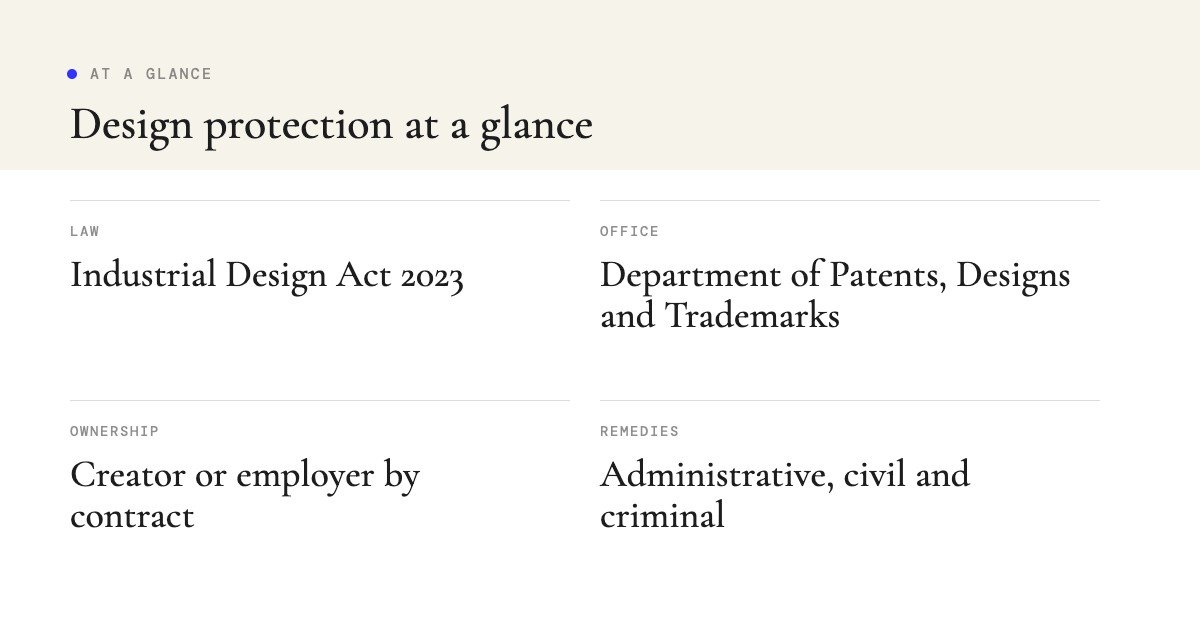
- Industrial designs are now governed by the Industrial Design Act 2023, administered by the Department of Patents, Designs and Trademarks (DPDT).
- A design must meet the registrability conditions in the Act, broadly that it is new and original, and certain designs are excluded.
- Designs created by employees under a contract can belong to the employer unless the contract provides otherwise.
- Unauthorised commercial use of a registered design is infringement, with administrative, civil and other remedies available.
- Filing before public disclosure is essential, because disclosure can destroy novelty.
What an industrial design is
An industrial design is the ornamental or aesthetic aspect of a product: its shape, configuration, pattern, lines, colours or ornamentation, as applied to an article by an industrial process. It protects appearance, not technical function. A new bottle shape, a fabric print, a furniture profile or a mobile phone casing can all be protected designs.
Industrial design registration in Bangladesh complements other intellectual property rights. Trademarks protect brand identifiers, patents protect technical inventions, and copyright protects artistic works. Our intellectual property practice advises on choosing the right combination of protection.
The legal framework for industrial design registration in Bangladesh
Designs were historically protected under the Patents and Designs Act 1911. Bangladesh replaced the patent provisions with the Patents Act 2022 and the design provisions with the Industrial Design Act 2023. The 2023 Act sets out what may be registered, exclusions, ownership, rights, exceptions, infringement and remedies, and is supported by rules governing procedure and fees.
Commentators have noted that the Act may need future amendment to align with the WIPO Riyadh Design Law Treaty adopted in November 2024, which aims to simplify design filing procedures internationally. Applicants should check the latest rules before filing.

What industrial design registration in Bangladesh covers
| Registrable | Not registrable |
|---|---|
| New and original shapes and configurations | Designs that are not new or are commonplace |
| Patterns, prints and ornamentation applied to products | Features dictated solely by technical function |
| Packaging, containers and product casings | Designs contrary to public order or morality |
| Textile and garment designs | Designs excluded under section 4 of the Act |
Section 5 of the Act sets the conditions for registrability, and section 4 lists exclusions. Because the details matter, applicants should review the statutory criteria with counsel before investing in an application.
Novelty and disclosure
Novelty is central to industrial design registration in Bangladesh. If the design has been published, sold or displayed publicly before filing, it may no longer be considered new. Some laws allow limited grace periods for disclosures at recognised exhibitions; applicants should confirm whether and how such a grace period applies under the current Act and rules.
Businesses should file before launching products, posting images online or showing samples to buyers without confidentiality agreements. Where foreign filings exist, priority under the Paris Convention may allow a Bangladeshi filing to claim an earlier date if made within the permitted period.
Ownership
The creator of a design is generally its owner. Under section 6 of the Act, where a design is created by an employee under a contract, the employer may register it unless the contract provides otherwise. Joint ownership is also possible. Businesses commissioning designs from freelancers or agencies should obtain written assignments to avoid disputes.
Industrial design registration in Bangladesh step by step
- Assess novelty. Confirm the design is new and has not been disclosed.
- Search. Check existing registrations and published designs.
- Prepare representations. Produce clear drawings or photographs showing the design from relevant angles.
- Classify. Identify the product and class under the applicable classification.
- File with DPDT. Submit the application, representations, applicant details and fee.
- Examination. Respond to any objections from the examiner within the time allowed.
- Registration and maintenance. Obtain the certificate and pay renewal fees on time.
The quality of drawings or photographs often determines the scope of protection. Show the design clearly, consistently and without unnecessary elements. Ambiguous representations make enforcement harder later.
Term of industrial design registration in Bangladesh
Design protection is limited in time and must be maintained by paying renewal fees. Under the previous regime, protection lasted five years and could be extended twice for further five-year periods, giving up to fifteen years. Applicants should confirm the duration and renewal procedure under the Industrial Design Act 2023 and current rules, and diarise renewal deadlines carefully, because missing a renewal can end protection.
Rights and exceptions
A registered design gives the owner the exclusive right to make, sell, import and otherwise commercially use products bearing the design. Under section 14, certain uses are excepted, such as use in educational or research institutions for teaching or research and other non-commercial uses. These exceptions are narrow and do not permit commercial copying.
Enforcing industrial design registration in Bangladesh
Using a registered design for commercial purposes without the owner's authorisation is infringement. Sections 22 to 26 of the Act provide administrative, civil and other remedies, including injunctions and damages. Owners can also work with customs to stop imports of infringing goods and with law enforcement in cases of large-scale counterfeiting.
Effective enforcement of industrial design registration in Bangladesh depends on good evidence: registration certificates, product samples, purchase receipts and photographs of infringing goods.
Designs in the garment and textile sector
Bangladesh's garment industry produces vast numbers of designs each season. Many manufacturers work to buyers' designs, which belong to the buyers, but a growing number develop their own prints, embroidery and product lines for domestic and export markets. Industrial design registration in Bangladesh can protect original prints and garment designs from local copying, although fast fashion cycles mean businesses should prioritise designs with longer commercial life.
Manufacturers should also respect buyers' design rights. Using a buyer's design for other customers without permission can breach contracts and infringe intellectual property, damaging valuable relationships.
Designs, copyright and trademarks together
A product may be protected by several rights at once. An artistic print may attract copyright under the Copyright Act 2023, a distinctive product shape may in some cases function as a trademark, and the overall appearance may be protected through industrial design registration in Bangladesh. Using these rights together creates layered protection, but each has different requirements, durations and enforcement procedures, so strategy matters.
International protection
Businesses exporting products should consider design protection in key markets. Filing in Bangladesh first and claiming Paris Convention priority abroad within the permitted period can secure an early date. Applicants should check whether Bangladesh participates in international design registration systems, because filing strategies differ significantly depending on available routes.
Why businesses should register designs
Unregistered designs are difficult to protect. Without registration, an owner may have to rely on copyright, passing off or unfair competition arguments, which are harder to prove and slower to enforce. Industrial design registration in Bangladesh gives a clear, public record of ownership and a presumption of validity, making it easier to send cease and desist letters, negotiate with infringers and obtain court orders.
Registered designs are also valuable business assets. They can be licensed, assigned, used as security and taken into account in valuations, investment rounds and acquisitions. For consumer brands and manufacturers, a portfolio built through industrial design registration in Bangladesh can strengthen bargaining power with distributors and retailers.
Licensing and assignment
Design owners can license others to manufacture or sell products using the design, in exchange for royalties or other benefits. Licences should be in writing, specify territory, duration, quality control and royalties, and be recorded where the rules require. Assignments of designs, for example when a business is sold, should also be documented and recorded with DPDT so that the register reflects the current owner. Foreign licensors receiving royalties must consider foreign exchange approvals and withholding tax.
Common mistakes
- Launching or publicising a product before filing.
- Using poor-quality or inconsistent drawings.
- Failing to secure ownership from freelance designers.
- Missing renewal deadlines.
- Assuming design registration protects technical features.
Avoiding these mistakes makes industrial design registration in Bangladesh a reliable tool rather than a paper right that fails when tested in a dispute.
Counterfeits and online marketplaces
Copies of popular products often appear quickly on e-commerce platforms and social media. Registered owners can use platform reporting tools, send notices to sellers and, where necessary, pursue legal action. Evidence of industrial design registration in Bangladesh strengthens takedown requests, because platforms are more responsive to clear registered rights than to general claims of copying.
Defending against infringement claims
Businesses accused of infringing a registered design should not ignore the claim. First, check whether the registration is valid and in force, whether the accused product actually uses the protected design or is sufficiently different, and whether any exception applies. Prior designs that were public before the registrant's filing date may show that the registered design was not new, which can support an application to cancel the registration. Responding through counsel, with evidence of independent design development and dates, often resolves disputes without litigation. Where a product line is commercially important, it may be worth negotiating a licence or redesigning the product to avoid a protracted dispute.
Cost and timing
Official fees for design applications are modest compared with the commercial value of protecting a successful product. Timelines depend on DPDT workload and any objections raised during examination. Filing early, with complete and clear documents, reduces delays.
Building a design portfolio
Companies that launch products regularly benefit from a design protection policy: reviewing new products at an early stage, deciding which designs justify registration, filing before launch and tracking renewals. Keeping a design log with dates, drafts and designer names also helps prove creation and ownership if disputes arise later. Over time, a well-managed portfolio becomes a strategic asset rather than a set of isolated filings.
Frequently asked questions about industrial design registration in bangladesh
Which law governs industrial designs?
The Industrial Design Act 2023, administered by DPDT.
Can I register a design after selling the product?
Public sale before filing may destroy novelty; file before disclosure.
Who owns an employee's design?
The employer may register it under section 6 unless the contract provides otherwise.
Does design registration protect function?
No, it protects appearance; technical features need patent protection.
How long does protection last?
Protection is time-limited with renewals; confirm the current term under the 2023 Act and rules.
What remedies are available?
Administrative, civil and other remedies under sections 22 to 26, including injunctions and damages.
How we can help
We handle industrial design registration in Bangladesh, from novelty assessments and filings to oppositions, renewals and enforcement. Learn more about our intellectual property practice, our guide to trademark registration and our guide to patent registration.
Launching a new product design?
We protect your designs before they reach the market.
Book a consultationIP practicePrimary sources: the Industrial Design Act 2023 on the Laws of Bangladesh portal; filing information from the Department of Patents, Designs and Trademarks.
This article is general information about Bangladeshi intellectual property law as of October 2026 and is not legal advice. Confirm current rules, terms and fees with DPDT before filing.




0 Comments