
Authorised capital is the maximum share capital a company may issue under its memorandum. When a company needs to raise funds, admit a new investor or capitalise loans, it often must first complete an increase of authorised capital in Bangladesh. The process involves board and shareholder approvals, amendments to the constitutional documents, filings with the Registrar of Joint Stock Companies and Firms and payment of fees.
- Authorised capital is set in the memorandum of association; a company cannot issue shares beyond it.
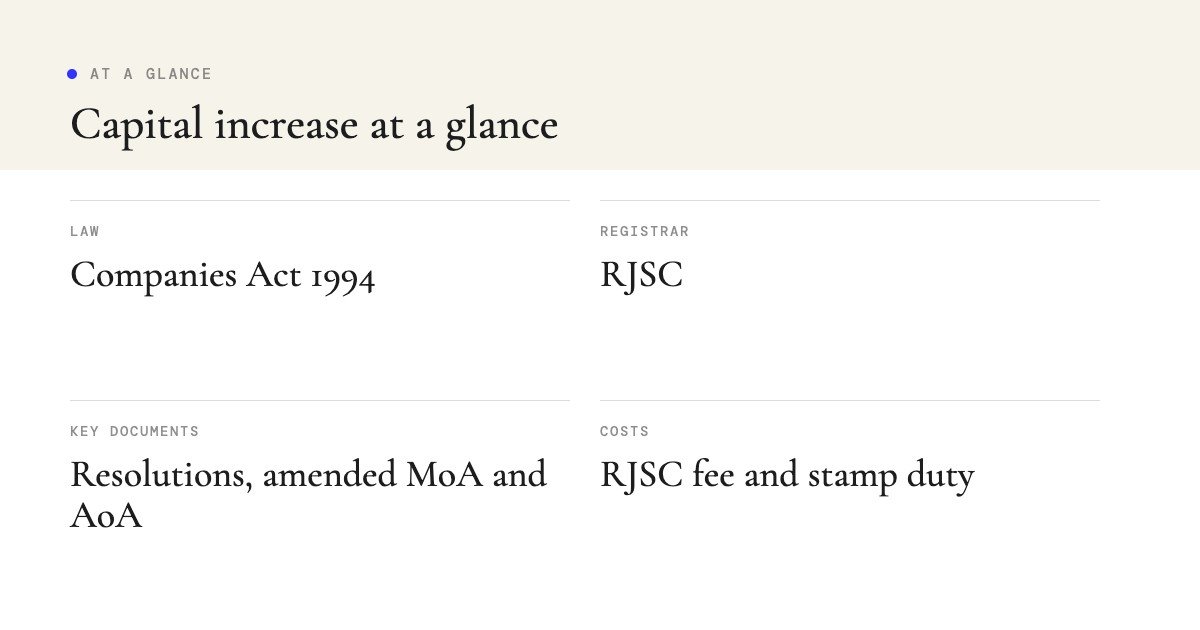
- Under the Companies Act 1994, a company may increase its share capital if authorised by its articles, by resolution in general meeting.
- The memorandum and articles must be amended, and notice of the increase filed with the RJSC within the statutory period.
- RJSC registration fees and stamp duty are payable, and costs rise with the amount of the increase.
- Foreign investment and capital raising may involve additional Bangladesh Bank or BSEC requirements.
Authorised, issued and paid-up capital
Authorised capital is the ceiling on the shares a company can issue. Issued capital is the amount actually issued to shareholders, and paid-up capital is the amount shareholders have paid for those shares. A company can issue new shares freely up to its authorised capital, subject to its articles and any shareholder rights, but must increase the authorised capital before issuing beyond that limit.
An increase of authorised capital in Bangladesh does not itself bring money into the company; it creates headroom for future share issues. Our corporate practice handles capital changes for private and public companies.
The legal framework for increase of authorised capital in Bangladesh
The Companies Act 1994 allows a limited company, if authorised by its articles, to alter the conditions of its memorandum to increase its share capital by issuing new shares of such amount as it thinks expedient. The alteration is made by resolution in general meeting, of the type required by the articles. The company must give notice of the increase to the Registrar within the period specified in the Act, and the Registrar records the increase.
The company's articles may impose additional requirements, such as a special resolution or the consent of particular shareholders under a shareholders agreement.
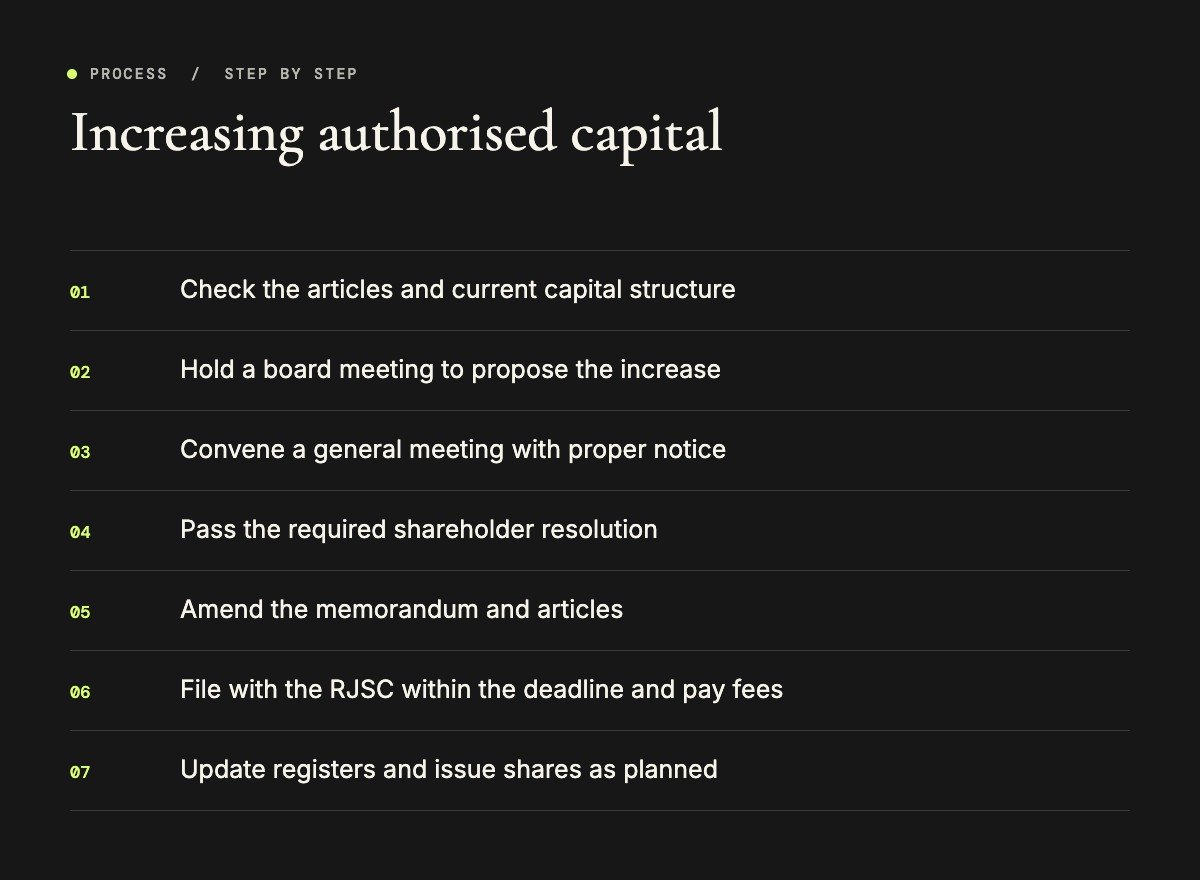
Increase of authorised capital in Bangladesh step by step
- Review documents. Check the memorandum, articles and any shareholders agreement.
- Board meeting. The board approves the proposal and convenes a general meeting.
- Notice. Send notice of the general meeting with the proposed resolution, observing notice periods or obtaining consent to short notice.
- General meeting. Pass the ordinary or special resolution as the articles require.
- Amend documents. Prepare the amended capital clause of the memorandum and any related article changes.
- File with RJSC. Submit the notice of increase, resolution and amended documents within the deadline, and pay fees and stamp duty.
- Update records. Update statutory registers and proceed with share allotment as planned.
Plan ahead. RJSC fees for an increase of authorised capital in Bangladesh are calculated on the amount of the increase and can be significant. Increasing by more than needed wastes money, while increasing too little may require a second filing later.
RJSC documents for increase of authorised capital in Bangladesh
| Document | Purpose |
|---|---|
| Notice of increase in share capital | Statutory notification to the Registrar |
| Certified copy of the resolution | Evidence of shareholder approval |
| Amended memorandum of association | Reflects the new authorised capital |
| Amended articles, if relevant | Where the articles also state capital |
| Evidence of fee and stamp duty payment | Required for registration |
Filings are now largely made through the RJSC online system. After registration, obtain certified copies of the updated memorandum for banks, investors and regulators.
Fees for increase of authorised capital in Bangladesh
The RJSC charges registration fees calculated on a sliding scale according to the amount of the increase, and stamp duty may be payable on the amended memorandum and articles. Rates are set by the government and revised from time to time, so check the current schedule before planning an increase of authorised capital in Bangladesh. Professional fees for preparing documents and handling the filing are additional.
Issuing the new shares
After increasing authorised capital, the company issues new shares by board resolution, in line with the articles and the Companies Act. Existing shareholders may have pre-emption rights under the articles or a shareholders agreement. The company must file a return of allotment with the RJSC within the statutory period after allotment and update its register of members.
See our guide to share transfers in Bangladesh and our guide to board resolutions.
Foreign investors and share issues
When new shares are issued to foreign investors after an increase of authorised capital in Bangladesh, the subscription money must be remitted through banking channels and converted into taka, with an encashment certificate issued by the receiving bank. The company must report the share issue to Bangladesh Bank through its authorised dealer bank as required, and may need to update its investment registration with Invest Bangladesh. Pricing of shares issued to non-residents should be supported by a valuation where the rules require.
Failing to follow these steps can complicate future dividend remittances and repatriation of sale proceeds, so they should be completed carefully at the time of issue.
Public and listed companies
Public companies, especially listed ones, face additional rules. Raising capital through rights issues, private placements or public offers requires compliance with BSEC rules, including the Public Offer of Equity Securities Rules 2025 for public offers. Listed companies must disclose price sensitive information about capital changes promptly. An increase of authorised capital in Bangladesh for a listed company is therefore usually part of a wider capital raising plan subject to regulatory approvals.
Converting loans into equity
Companies sometimes convert shareholder loans into shares, which may require an increase of authorised capital first. Conversion of foreign loans into equity involves foreign exchange approvals and reporting. Tax and accounting implications should also be considered, and the valuation of shares issued on conversion should be documented.
Common mistakes
- Issuing shares before the increase is approved and registered.
- Missing the RJSC filing deadline.
- Ignoring pre-emption rights in the articles or shareholders agreement.
- Underestimating fees based on the size of the increase.
- Forgetting foreign investment reporting.
When to increase authorised capital
Companies typically consider an increase of authorised capital in Bangladesh when admitting a new investor, launching a rights issue, converting debt into equity, meeting regulatory minimum capital requirements, or preparing for listing. Regulated businesses, such as finance companies, insurers, MFS providers and payment service providers, must maintain minimum paid-up capital set by their regulators, which may require higher authorised capital first.
Banks and lenders sometimes require borrowers to strengthen equity as a loan condition. Planning the capital structure with future funding rounds in mind avoids repeated filings and fees.
Board and shareholder documentation
Good documentation protects the company if the increase is later questioned. Board minutes should record the reasons for the proposal, the amount, and the decision to convene a general meeting. The general meeting minutes should record attendance, quorum, the resolution passed and the voting. Where shareholders consent to short notice or pass written resolutions as permitted by the articles, keep signed consents. Accurate records make the RJSC filing smoother and support future due diligence by investors examining the history of every increase of authorised capital in Bangladesh.
Reducing capital
Reducing share capital is far more complex than increasing it, usually requiring a special resolution and confirmation by the High Court Division to protect creditors. Companies should therefore avoid increasing authorised capital far beyond foreseeable needs, although unissued authorised capital itself does not create liabilities for shareholders.
Timeline
A straightforward increase of authorised capital in Bangladesh can be completed within a few weeks, depending on the notice period for the general meeting, document preparation and RJSC processing. Online filing has made processing faster, but errors in documents or fee calculations can cause delays. Starting early is especially important when the increase is a condition for completing an investment.
Classes of shares
Some companies create different classes of shares, such as preference shares with fixed dividends or shares with special voting rights for investors. Creating new classes usually requires amendments to the memorandum and articles beyond a simple increase in the amount of capital, and existing shareholders' class rights must be respected. Preference shares issued by companies may also be subject to rules on redemption and dividends under the Companies Act. Investors often negotiate class rights in a shareholders agreement, which should be reflected in the articles so that they bind the company. Where class rights are varied, the consent of the affected class is usually required in the manner set out in the articles.
Tax considerations
Increasing authorised capital itself generally has limited tax consequences apart from fees and stamp duty. However, the subsequent issue of shares, conversion of loans or capitalisation of reserves through bonus shares may have tax effects for the company and shareholders under the Income Tax Act 2023. Take tax advice when planning significant capital transactions.
Bonus shares and capitalisation of reserves
Companies with accumulated profits may issue bonus shares by capitalising reserves, which also requires sufficient authorised capital. Bonus issues by listed companies are subject to BSEC rules and stock exchange procedures, and boards should consider dividend policy, regulatory expectations and the impact on share price. For private companies, a bonus issue can be a simple way to align share capital with the company's growth, but it still requires an increase of authorised capital in Bangladesh first if the existing ceiling is too low. The articles must permit capitalisation, and the resolution should specify the reserves to be capitalised and the ratio of new shares.
Return of allotment filings with the RJSC apply to bonus shares just as they do to shares issued for cash.
After registration
Once the RJSC records the increase, update the company's website, letterheads and bank records where authorised capital is stated, inform lenders if loan agreements require notice of capital changes, and keep the certified documents with the statutory records for future audits and due diligence.
Frequently asked questions about increase of authorised capital in bangladesh
Who approves an increase of authorised capital?
Shareholders in general meeting, by the resolution required by the articles.
Is RJSC filing required?
Yes, notice of the increase must be filed within the statutory period with the required documents and fees.
Does increasing authorised capital bring money in?
No, it only allows the company to issue more shares later.
Are fees based on the amount?
Yes, RJSC fees use a sliding scale based on the increase.
Do foreign investors need approvals?
Share issues to non-residents must comply with Bangladesh Bank foreign exchange rules and reporting.
Can a private company increase capital easily?
Yes, subject to its articles, shareholder approval and filings.
How we can help
We manage every increase of authorised capital in Bangladesh, from resolutions and amended documents to RJSC filings, share allotments and foreign investment reporting. Learn more about our corporate practice and our foreign investment team.
Raising new capital?
We handle the corporate steps so you can focus on the deal.
Book a consultationCorporate practicePrimary sources: the Companies Act 1994 on the Laws of Bangladesh portal; filing services of the Registrar of Joint Stock Companies and Firms; foreign exchange rules from Bangladesh Bank.
This article is general information about Bangladeshi company law as of October 2026 and is not legal advice. Fees and procedures change; confirm current RJSC requirements.




0 Comments