
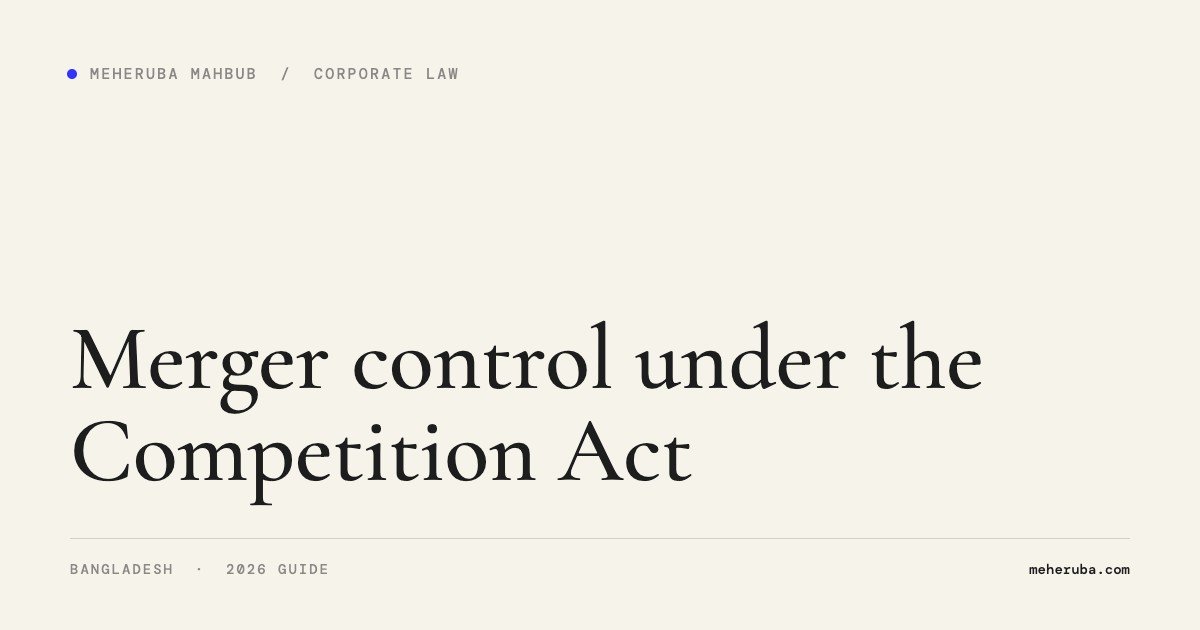
As deal activity grows in Bangladesh, buyers increasingly ask whether they need competition commission merger approval before completing an acquisition. The Competition Act 2012 gives the Bangladesh Competition Commission power over combinations that may adversely affect competition, but detailed merger control regulations were still described as draft in late 2025. Parties therefore need a careful, case-by-case approach.
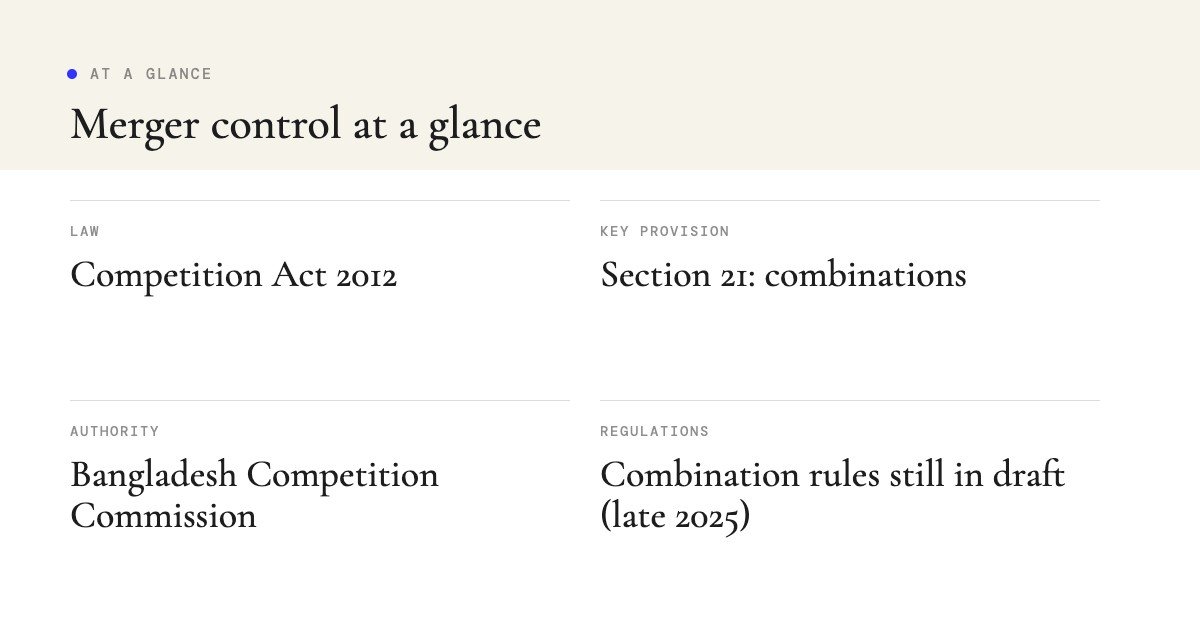
- Section 21 of the Competition Act 2012 deals with combinations, including mergers, amalgamations and acquisitions of control, shares or voting rights.
- The Act prohibits combinations that cause or are likely to cause an appreciable adverse effect on competition in Bangladesh.
- Detailed regulations on thresholds, filing procedures and timelines were still in draft form in late 2025, so practice continues to evolve.
- Deals with significant overlaps or high market shares in Bangladesh should be assessed early for merger control risk.
- The Commission can investigate and impose penalties for anti-competitive conduct and combinations.
The legal framework for competition commission merger approval
The Competition Act 2012 established the Bangladesh Competition Commission and prohibits anti-competitive agreements, abuse of dominant position and anti-competitive combinations. Section 21 addresses combinations, giving the Commission power to examine mergers and acquisitions and to prohibit or impose conditions on those likely to harm competition.
Unlike jurisdictions with mature, threshold-based notification systems, Bangladesh's merger control framework has developed slowly. The Commission has prepared draft combination regulations, but as of late 2025 these were still described as draft. Anyone considering competition commission merger approval should check the current status before signing. Our mergers and acquisitions practice advises on these issues.
What counts as a combination
| Transaction | Potential combination |
|---|---|
| Merger or amalgamation of companies | Yes |
| Acquisition of control of an enterprise | Yes |
| Acquisition of shares or voting rights giving significant influence | Potentially |
| Acquisition of assets of a business | Potentially, depending on scope |
| Joint ventures creating a new market player | Potentially |
Whether a particular deal is caught depends on the definitions in the Act, any regulations in force and the Commission's interpretation. Global transactions with Bangladesh subsidiaries or sales may also have local competition implications.
How competition commission merger approval is assessed
The Commission's central question is whether the combination causes or is likely to cause an appreciable adverse effect on competition in a relevant market in Bangladesh. Relevant factors typically include market shares and concentration, barriers to entry, the degree of competition from imports, the likelihood of price increases, effects on innovation and consumer choice, and countervailing efficiencies.
Horizontal mergers between competitors raise the greatest concern, especially where the merged entity would hold a high market share. Vertical mergers can raise foreclosure issues, for example where a supplier acquires a major distributor. A careful economic analysis supports any request for competition commission merger approval.
Practical steps for dealmakers
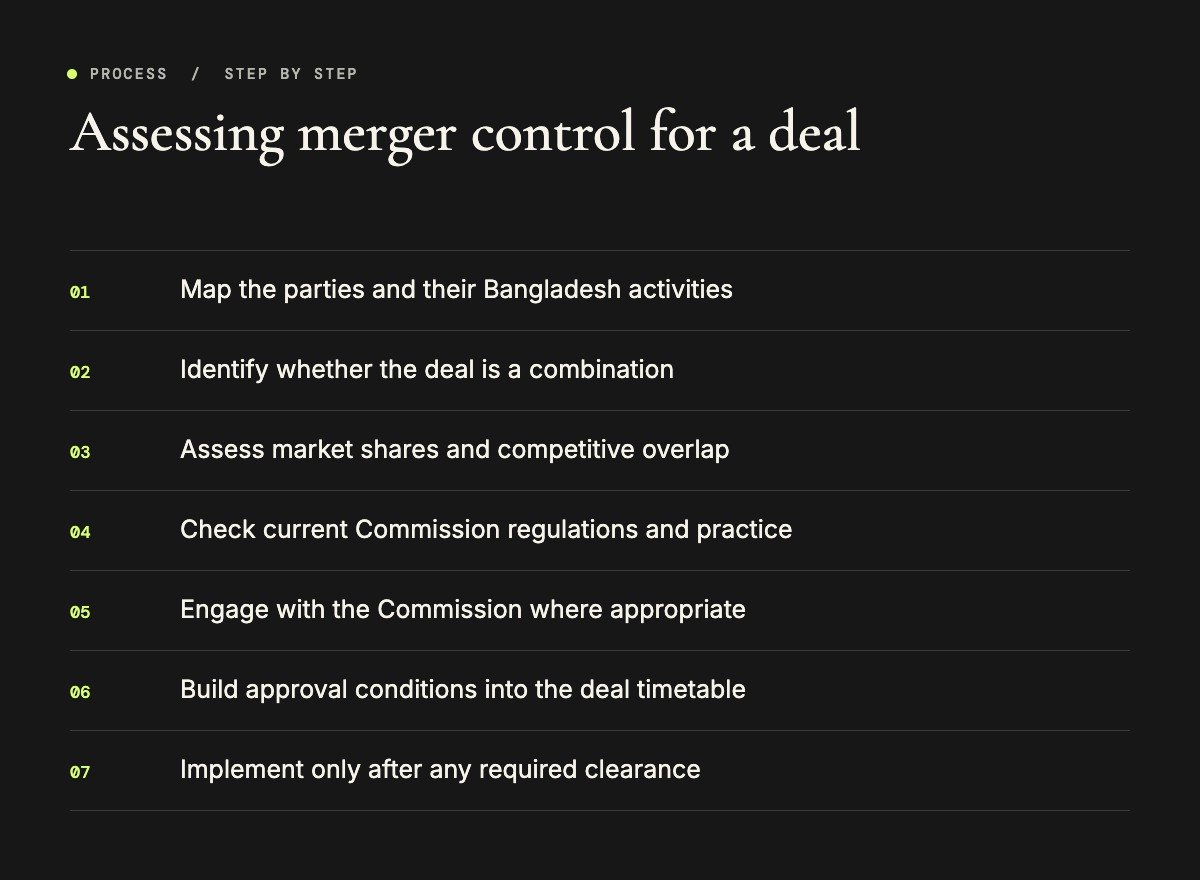
- Map activities. Identify each party's products, services and market shares in Bangladesh.
- Classify the deal. Determine whether it is likely to be a combination under the Act.
- Assess overlaps. Analyse horizontal and vertical relationships.
- Check regulations. Confirm whether combination regulations and thresholds are in force.
- Engage early. Where risk is significant, consider informal engagement with the Commission.
- Allocate risk. Include conditions precedent, cooperation clauses and long-stop dates.
- Implement carefully. Avoid gun-jumping where approval is required.
Even where filing is uncertain, document the competition analysis in the deal file. If the Commission later questions the transaction, evidence that the parties considered competition issues in good faith is valuable.
Sector regulators and competition commission merger approval
Some sectors have their own regulators whose approval is needed for changes of control, such as Bangladesh Bank for banks and finance companies, the Insurance Development and Regulatory Authority for insurers, BTRC for telecom operators, and BSEC for listed companies and takeovers. These approvals are separate from competition commission merger approval and may take longer. Coordinating all approvals in one timetable avoids surprises.
Penalties and enforcement
The Commission can investigate on its own initiative or on complaint, order parties to cease anti-competitive conduct, impose financial penalties and, in the case of combinations, potentially order modification or unwinding. The Commission has been more active in investigating cartels and abuse of dominance than in merger control, but its enforcement capacity is growing.
Why competition commission merger approval matters now
Consolidation is increasing in sectors such as banking, pharmaceuticals, consumer goods, cement, steel, telecommunications and digital services. Some deals combine market leaders, and regulators and consumer groups pay closer attention to market concentration and prices. As the Commission's capacity grows and regulations are finalised, competition commission merger approval is likely to become a routine part of deal planning in Bangladesh, as it is in many other jurisdictions.
International buyers familiar with merger control elsewhere often expect a clear filing regime. Explaining the current Bangladeshi position, and its uncertainty, helps them assess risk and design appropriate contract protections.
Bank mergers and restructuring
Bangladesh Bank has encouraged consolidation of weak banks, and bank resolution legislation passed by Parliament in April 2026 provides tools for restructuring and resolving distressed banks. Bank mergers involve Bangladesh Bank approval, and competition issues may also arise where the merged bank would hold a large market share in certain segments. Coordination between the central bank and competition authority on such deals is an evolving area, and parties should consider whether competition commission merger approval is relevant alongside banking approvals.
Information exchange and gun-jumping
During due diligence and integration planning, competitors must be careful not to exchange competitively sensitive information, such as pricing or customer strategies, beyond what is necessary, and must not coordinate commercial behaviour before completion. Clean team arrangements and confidentiality protocols reduce the risk of breaching the Competition Act's prohibition on anti-competitive agreements, even if the merger itself is cleared later.
Contract protections when the rules are uncertain
Because the filing regime is still developing, transaction documents should address competition risk explicitly. Buyers may seek a condition precedent requiring competition commission merger approval if the Commission's regulations require it at completion, or if the Commission initiates a review. Sellers may want the buyer to bear the risk of remedies, such as divestments, through a "hell or high water" clause or a reverse break fee. Cooperation clauses should oblige both parties to provide information and respond promptly to the Commission.
Long-stop dates should allow realistic time for any review. Where the parties decide not to seek competition commission merger approval because they conclude the deal is not caught, the reasoning should be documented and warranties should allocate the risk of later challenge.
Preparing a submission
If the parties seek competition commission merger approval, the submission typically describes the parties, the transaction, the relevant markets, market shares, competitors, customers and suppliers, and explains why the combination will not harm competition. Supporting documents may include financial statements, internal analyses and industry data. A clear, well-evidenced submission reduces follow-up questions and shortens the review.
Confidential business information should be marked and protected. The Commission may consult competitors, customers or other regulators, so parties should prepare for third-party views.
Remedies
Where a combination raises concerns, the Commission may accept remedies rather than prohibit the deal. Structural remedies, such as selling a business line or brand, directly address overlaps. Behavioural remedies, such as commitments on supply, pricing or access, require ongoing monitoring. Negotiating remedies early, with a clear understanding of what the business can accept, helps secure competition commission merger approval without unacceptable conditions.
Abuse of dominance after the deal
Even if a merger proceeds, a merged entity with a dominant position must avoid abusing it, for example through exclusionary pricing, refusal to supply or tying. The Competition Act's prohibition on abuse of dominance applies independently of merger control. Integration plans should include a competition compliance programme, particularly where the deal significantly increases market share.
Cross-border filings
Global deals often require filings in several jurisdictions with established merger control regimes. Coordinating the Bangladesh analysis with filings elsewhere ensures consistent market definitions and arguments. Where competition commission merger approval in Bangladesh is uncertain, international filing counsel should still be informed of the local position so that global timetables account for any potential review.
Defining the relevant market
Market definition is the foundation of any competition analysis. The relevant product market includes products that customers regard as interchangeable because of their characteristics, prices and intended use. The relevant geographic market is the area in which competitive conditions are sufficiently similar, which may be national, regional or local in Bangladesh, or even wider where imports constrain local prices. A narrow market definition can make market shares appear high, while a broad one may understate concentration. Parties should support their proposed definitions with evidence, such as customer switching data, price comparisons and industry reports, because the Commission may take a different view. Economic advisers can help prepare this analysis for complex deals.
Small deals and start-up acquisitions
Acquisitions of small companies or start-ups rarely raise competition concerns, but in digital markets, large firms acquiring emerging competitors can attract scrutiny worldwide. Buyers in technology sectors should consider whether a target, though small in revenue, has strategic importance that might interest the Commission.
Public interest and industrial policy
Competition authorities sometimes consider broader public interest factors, such as employment, export competitiveness or national industrial policy, although the core test remains the effect on competition. In Bangladesh, government priorities in sectors such as energy, banking and essential commodities can influence how regulators view consolidation. Parties should be ready to explain how a deal benefits consumers and the economy, for example through efficiencies, investment, improved quality or better access to products. Such arguments are most persuasive when supported by concrete commitments and evidence rather than general claims. Engaging constructively with regulators and addressing concerns transparently tends to produce better outcomes than a purely adversarial approach.
Keeping up with developments
Because the regime is changing, parties should monitor the Commission's website, notifications and enforcement actions, and seek updated advice before signing major transactions. Regulations, once finalised, may introduce filing thresholds, standstill obligations and review timelines that apply to deals signed after their effective date.
Building competition analysis into the earliest stage of deal planning, rather than treating it as a last-minute formality, gives buyers and sellers the best chance of completing transactions smoothly and on schedule.
Frequently asked questions about competition commission merger approval
Is merger control mandatory in Bangladesh?
The Act regulates combinations, but detailed filing regulations were still in draft in late 2025; assess each deal carefully.
Which provision covers mergers?
Section 21 of the Competition Act 2012.
What test does the Commission apply?
Whether the combination causes or is likely to cause an appreciable adverse effect on competition.
Do global deals need approval?
Possibly, if they affect markets in Bangladesh; analyse local activities.
Are sector approvals separate?
Yes, regulators such as Bangladesh Bank or BTRC may also need to approve.
What are the risks of ignoring competition law?
Investigation, penalties and possible orders affecting the transaction.
How we can help
We advise on competition commission merger approval, competition risk assessments and coordination with sector regulators for domestic and cross-border deals. Learn more about our M&A practice, our regulatory compliance team and our corporate practice.
Planning an acquisition?
We assess competition risk and plan the approval path.
Book a consultationM&A practicePrimary sources: the Competition Act 2012 on the Laws of Bangladesh portal; guidance from the Bangladesh Competition Commission.
This article is general information about Bangladeshi competition law as of October 2026 and is not legal advice. Merger control regulations may have been finalised since; confirm the current position.




0 Comments