
Selling packaged food, cosmetics, electrical goods or construction materials in Bangladesh often requires a BSTI mark on the product. BSTI certification in Bangladesh is mandatory for a published list of products, and manufacturers and importers who sell listed products without a Certification Marks licence risk seizure, fines and prosecution. This guide explains who needs a licence and how to obtain one.
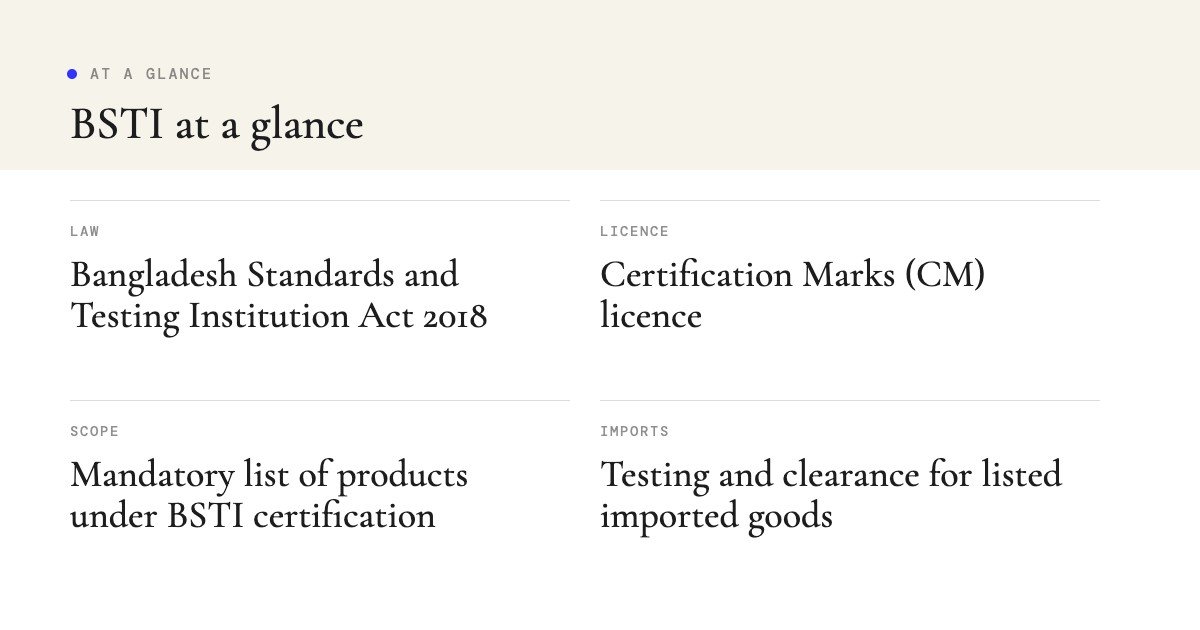
- The Bangladesh Standards and Testing Institution (BSTI) administers product standards under the Bangladesh Standards and Testing Institution Act 2018.
- Products on the government’s mandatory list cannot be manufactured, sold or imported without BSTI certification.
- Manufacturers obtain a Certification Marks (CM) licence after inspection and laboratory testing against the relevant Bangladesh Standard.
- Importers of listed products need BSTI testing and clearance before goods are released by customs.
- Selling listed products without a licence can lead to mobile court action, fines, imprisonment and seizure.
What BSTI certification in Bangladesh covers
BSTI is the national standards body. It formulates Bangladesh Standards (BDS), certifies products, tests samples and oversees weights and measures. Certification confirms that a product meets the relevant BDS for quality, safety and labelling. While BSTI certification is voluntary for many products, it is mandatory for products on the list published by the government, which has grown over the years to include a wide range of food, agricultural, chemical, electrical, electronic, engineering and textile products.
Our regulatory compliance practice helps manufacturers and importers navigate BSTI requirements.
The legal framework for BSTI certification in Bangladesh
The Bangladesh Standards and Testing Institution Act 2018 replaced the earlier ordinance and gives BSTI powers to set standards, issue licences, inspect premises, collect samples and take enforcement action. Weights and measures are governed by the Standards of Weights and Measures Act 2018. Food safety is also regulated by the Bangladesh Food Safety Authority under the Food Safety Act 2013, so food businesses often deal with both bodies. The statutes are available on Laws of Bangladesh, and the product list and procedures on the BSTI website.

Products requiring mandatory BSTI certification in Bangladesh
| Category | Examples |
|---|---|
| Food and beverages | Bottled water, edible oils, flour, biscuits, juices, milk powder, spices |
| Personal care | Soaps, shampoos, toothpaste, skin creams and cosmetics |
| Electrical and electronic | Cables, switches, bulbs, fans and certain appliances |
| Construction materials | Cement, steel bars and other building products |
| Chemicals and others | Selected chemicals, LPG cylinders and other listed items |
The list is updated from time to time, so manufacturers and importers should check the current list before launching or importing a product.
Getting a BSTI CM licence step by step
- Check the list. Confirm whether the product is subject to mandatory certification.
- Identify the standard. Obtain the relevant Bangladesh Standard and review requirements.
- Prepare documents. Trade licence, TIN, factory layout, machinery and quality control details, and testing facilities.
- Apply. Submit the application to BSTI, increasingly online, and pay fees.
- Inspection. BSTI officials inspect the factory and collect samples.
- Testing. Samples are tested in BSTI laboratories against the standard.
- Licence and marking. On passing, BSTI issues the CM licence and the product can carry the mark; renew before expiry.
Most delays come from failed tests or incomplete in-house quality control. Run pre-tests at an accredited laboratory and fix formulation or labelling issues before BSTI collects samples.
BSTI certification in Bangladesh for imported products
Importers of listed products must ensure their goods meet the relevant Bangladesh Standard. At import, BSTI collects samples or reviews test reports, and customs releases the goods only after BSTI clearance. Importers should check labelling requirements, such as Bengali labelling, ingredients, net quantity, manufacturing and expiry dates and importer details, because non-compliant labels are a common reason for holds. Some products may be accepted on the basis of recognised foreign certificates, subject to verification, but this should not be assumed.
Planning BSTI certification in Bangladesh before shipment avoids demurrage and storage costs at the port while goods wait for testing.
Labelling requirements linked to BSTI certification in Bangladesh
Labels on certified products must comply with the BDS and related labelling rules. Typical requirements include the product name, BSTI mark and licence number, list of ingredients, net weight or volume, maximum retail price, manufacturing and expiry dates, batch number, and manufacturer name and address. Packaged food also needs to meet food labelling rules of the Bangladesh Food Safety Authority. Misleading claims on labels can lead to action under consumer protection law as well.
Surveillance, renewal and changes
A CM licence is not a one-time approval. BSTI conducts surveillance through market sampling and factory visits, and licences must be renewed before they expire. Changes to the product formulation, factory location or brand name may require notification or a new licence. Keeping a compliance calendar for renewals and surveillance helps maintain BSTI certification in Bangladesh without interruption.
Enforcement of BSTI certification in Bangladesh
BSTI conducts market monitoring and, together with executive magistrates, mobile courts that can fine sellers and manufacturers on the spot, seize non-compliant goods and seal premises. The BSTI Act 2018 provides for fines and imprisonment for producing or selling listed products without a licence, misusing the BSTI mark, or selling products that fail standards. Retailers can also be penalised for stocking uncertified listed products, so supply chain checks matter.
A business facing action should collect its licence documents, test reports and invoices quickly, and consider appeals or legal remedies where enforcement is excessive or mistaken.
Halal and voluntary certification
Beyond mandatory certification, BSTI offers voluntary certification for many products and has introduced halal certification, which can help exporters and domestic brands reach consumers who prefer certified products. Voluntary certification can also support marketing and procurement bids where buyers require certified goods.
Factory readiness
BSTI inspectors look for a production process capable of consistently meeting the standard. That means suitable premises and hygiene, calibrated equipment, documented raw material controls, in-process checks, and an in-house laboratory or arrangements with an accredited laboratory for routine testing. Records of batch testing and complaints handling are often reviewed. Preparing these systems before applying makes BSTI certification in Bangladesh smoother and also improves product quality and consistency.
For food factories, compliance with good manufacturing practice and hygiene requirements of the Bangladesh Food Safety Authority is equally important, and inspections by the two agencies often look at overlapping issues.
Contract manufacturing and brand owners
Many brands outsource production to third-party manufacturers. In such cases, the question of who holds the licence matters: the CM licence is generally linked to the manufacturing premises, so each factory producing a listed product needs to be covered. Brand owners should ensure that their contract manufacturers hold valid licences for each product and brand, and that supply agreements allocate responsibility for BSTI certification in Bangladesh, testing failures and enforcement costs.
Costs and timelines
Costs include application and licence fees set by BSTI, testing charges, inspection costs and internal compliance expenses. Fees vary by product category and production volume. Timelines depend on how quickly inspection and testing are scheduled and whether samples pass at the first attempt. Businesses should build BSTI timelines into product launch plans and import schedules, rather than treating certification as a last-minute formality.
Common reasons applications fail
Typical problems include samples failing one or more parameters of the standard, inadequate quality control facilities, incomplete documents, incorrect labelling, and discrepancies between the brand name applied for and the product label. Addressing these issues early reduces the number of re-tests and inspections. Businesses that repeatedly fail tests should review their formulation, raw material sources and process controls, rather than simply re-submitting samples.
Why BSTI certification in Bangladesh is a commercial asset
Beyond legal compliance, the BSTI mark signals quality to consumers, retailers and institutional buyers. Supermarkets, e-commerce platforms and government purchasers increasingly require proof of certification. Maintaining BSTI certification in Bangladesh therefore protects market access and brand reputation, and reduces the risk of costly product recalls or public enforcement action that can damage trust.
Weights, measures and packaged commodities
Separate from product certification, BSTI enforces the Standards of Weights and Measures Act 2018. Businesses using weighing scales, fuel dispensers and measuring instruments must have them verified and stamped, and packaged commodities must show accurate net quantity. Packers of certain goods may need registration for packaged commodities. Shortfalls in declared quantity can lead to fines even where the product itself meets quality standards, so quantity control is as important as quality control.
E-commerce and online sellers
Online marketplaces and social media sellers are subject to the same rules as physical shops. Selling listed products without the BSTI mark online can attract enforcement, and platforms are increasingly asked to remove non-compliant listings. Sellers sourcing products from abroad for resale should check that each listed product has cleared BSTI at import and carries compliant labels. Marketplaces should build certification checks into seller onboarding to manage their own risk.
Responding to a BSTI notice or mobile court
If BSTI issues a notice, collects samples or a mobile court visits, stay calm and cooperative, check the officials’ identification and authority, and ask for copies of seizure lists, sample receipts and orders. Provide licence copies and test reports promptly. If a sample fails, the business may be able to request re-testing or challenge the result through the procedures available. Legal advice early in the process helps protect rights and reduce penalties.
Exporters and international standards
Exporters usually need to meet the standards of the destination market rather than BDS, but BSTI certification can still be relevant where products are also sold domestically or where buyers request it. BSTI’s participation in international and regional standards bodies, and accreditation of its laboratories, helps Bangladeshi products gain acceptance abroad. Exporters should align their quality systems with both domestic and export requirements to avoid running two separate compliance programmes.
Keeping one integrated quality manual, with BDS requirements mapped alongside buyer specifications, is usually the most efficient approach for manufacturers serving both markets.
Frequently asked questions about bsti certification in bangladesh
Is BSTI certification mandatory?
It is mandatory for products on the government’s list and voluntary for others.
What is a CM licence?
A Certification Marks licence allowing a manufacturer to use the BSTI mark on a product.
Do importers need BSTI clearance?
Yes, listed imported products must be tested and cleared before release.
How long does it take?
Timing depends on inspection and testing, typically weeks to a few months.
Does the licence expire?
Yes, licences must be renewed periodically and are subject to surveillance.
What are the penalties?
Fines, imprisonment, seizure of products and mobile court action under the BSTI Act 2018.
How we can help
We advise manufacturers, importers and retailers on BSTI certification in Bangladesh, licence applications, labelling compliance and enforcement actions. See our regulatory compliance practice, our consumer and retail sector team and our agriculture and food practice.
Launching or importing a product?
We map your BSTI obligations before you go to market.
Book a consultationRegulatory compliancePrimary sources: the Bangladesh Standards and Testing Institution Act 2018 and the Standards of Weights and Measures Act 2018 on Laws of Bangladesh; product lists and procedures from BSTI; food safety information from the Bangladesh Food Safety Authority.
This article is general information about Bangladeshi regulation as of October 2026 and is not legal advice. The mandatory product list and fees change; check the current BSTI requirements.




0 Comments