
Profitable companies in Bangladesh must share a slice of their profits with their workers. The workers participation fund in Bangladesh, commonly called WPPF, requires qualifying companies to set aside 5% of net profit each year and allocate it among a participation fund, a welfare fund and a national workers welfare foundation. Non-compliance is a frequent finding in due diligence, audits and labour inspections.
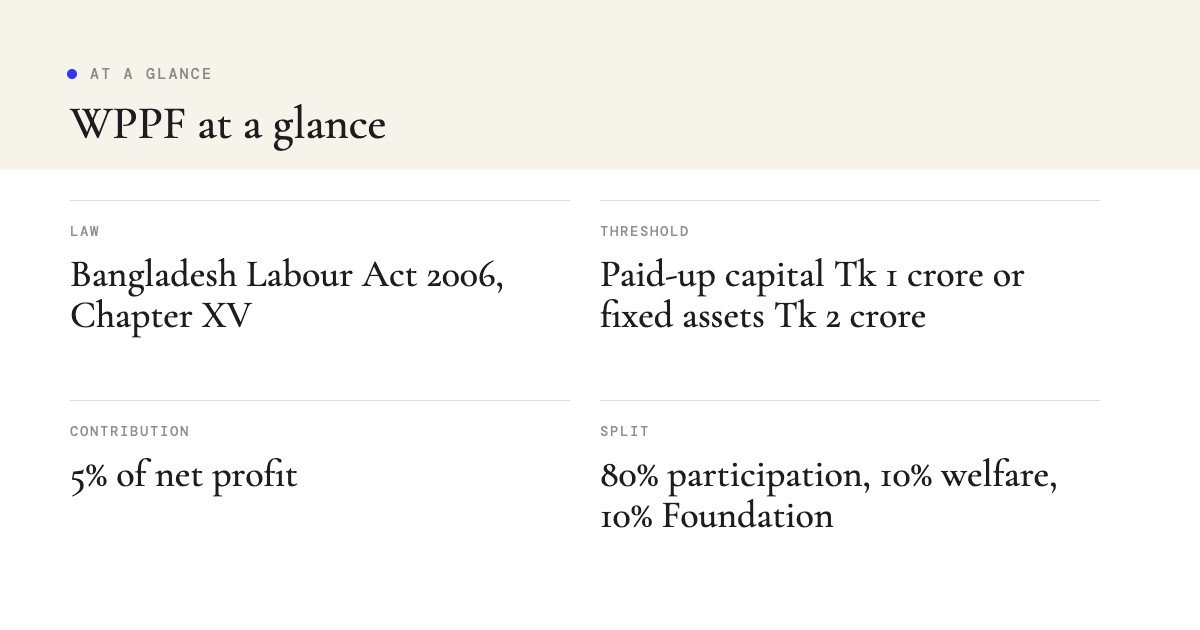
- Chapter XV of the Bangladesh Labour Act 2006 requires qualifying companies to establish a Participation Fund and a Welfare Fund and to contribute to the Bangladesh Workers Welfare Foundation Fund.
- A company qualifies if, on the last day of the accounting year, its paid-up capital is at least Tk 1 crore or the value of its fixed assets is at least Tk 2 crore.
- 5% of net profit must be paid each year, allocated 80:10:10 among the three funds.
- The funds are managed by a trustee board including worker representatives.
- Separate arrangements apply to some 100% export-oriented industries through a central fund.
What the workers participation fund in Bangladesh is
The WPPF regime gives workers a direct share in company profits and supports their welfare. It was introduced under earlier legislation and consolidated in the Bangladesh Labour Act 2006, with significant amendments in 2013. The regime is mandatory for qualifying companies and is enforced by the labour authorities. Our employment and labour practice advises employers on setting up and auditing their funds.
Which companies need a workers participation fund in Bangladesh
The obligation applies to companies meeting either threshold on the last day of the accounting year: paid-up capital of at least Tk 1 crore, or fixed assets valued at at least Tk 2 crore. Both local and foreign-owned companies are covered. The application to some sectors, such as banks and financial institutions, has been the subject of litigation and policy debate, so these businesses should take specific advice. Certain 100% export-oriented industries contribute instead to a central fund under separate provisions.
Contribution and allocation of the workers participation fund in Bangladesh
| Fund | Share of the 5% | Use |
|---|---|---|
| Participation Fund | 80% | Distributed to eligible workers, partly in cash and partly invested as the Act provides |
| Welfare Fund | 10% | Welfare purposes for workers as decided by the trustee board |
| Bangladesh Workers Welfare Foundation Fund | 10% | Paid to the national foundation established under the Bangladesh Workers Welfare Foundation Act 2006 |
The contribution must be paid within the time allowed after the end of the accounting year, commonly understood as nine months. The text of the Labour Act is available on Laws of Bangladesh, and guidance is published by the Department of Inspection for Factories and Establishments.
Eligible workers under the workers participation fund in Bangladesh
Beneficiaries are workers as defined in the Labour Act who have been employed for a minimum period, generally at least six months in the relevant year. Officers in managerial or administrative roles who fall outside the statutory definition of worker are generally excluded. The participation fund amount is typically distributed equally among all eligible beneficiaries, regardless of salary, which is a distinctive feature of the workers participation fund in Bangladesh.
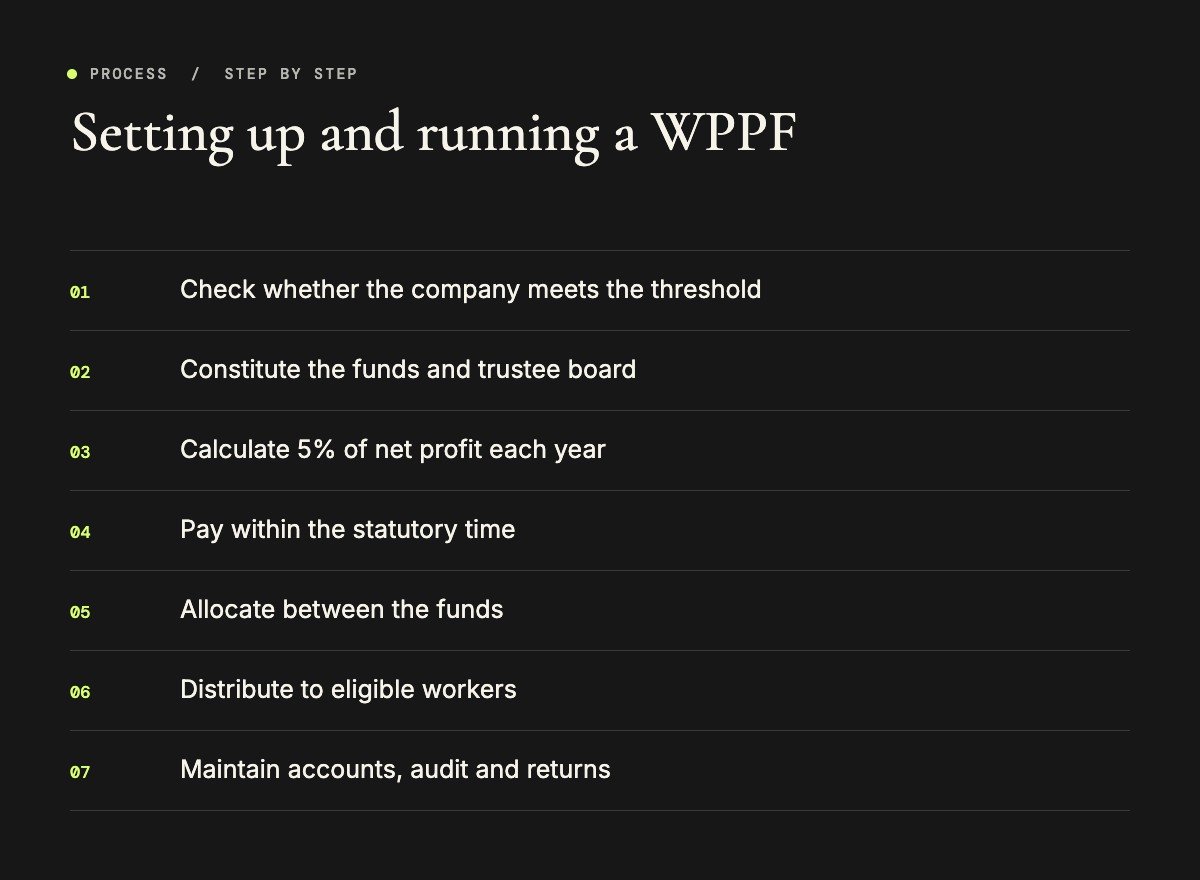
Setting up and running a WPPF
- Check the threshold. Review paid-up capital and fixed assets at year end.
- Establish the funds. Constitute the Participation Fund and Welfare Fund with trust deeds.
- Form the trustee board. Include worker representatives and management nominees as required.
- Calculate the contribution. 5% of net profit as determined under the Act.
- Pay on time. Transfer to the funds within the statutory period.
- Distribute. Allocate and pay entitlements to eligible workers.
- Account and report. Maintain separate accounts, audit them and file returns.
Many companies book the 5% provision in their accounts but never transfer it to a properly constituted trust. In due diligence this is treated as an outstanding liability with interest and penalty risk. Transfer funds to separate bank accounts controlled by the trustee board.
The trustee board of a workers participation fund in Bangladesh
The Participation Fund and Welfare Fund are managed by a board of trustees, typically comprising representatives of workers, often nominated by the collective bargaining agent or elected by workers, and representatives of management. The board holds the funds in trust, invests them as permitted, decides welfare spending and arranges distributions. Proper minutes, separate bank accounts and audited accounts are essential to show that the workers participation fund in Bangladesh is genuinely independent of the company’s own finances.
Calculating net profit
The contribution is based on net profit as determined for the purpose of the Act, generally the profit shown in the audited financial statements before the WPPF charge itself. Disputes can arise over adjustments, such as unrealised gains, exceptional items and group transactions. Companies should apply a consistent and documented method, agree it with auditors and disclose the WPPF provision in their financial statements.
Central fund for export-oriented industries
For certain 100% export-oriented industries, particularly the garment sector, the Act provides for a central fund financed by a small deduction from export proceeds rather than the company-level 5% regime. The central fund supports workers in those industries collectively. Exporters should confirm whether they fall within this scheme and how it interacts with the general workers participation fund in Bangladesh, especially where they have domestic sales or diverse business lines.
Tax treatment of the workers participation fund in Bangladesh
Contributions to the funds are generally treated as deductible expenses for the company if paid within the statutory time, while income of a properly approved fund may enjoy tax benefits. Amounts received by workers from the Participation Fund may have tax consequences in their hands, subject to thresholds and exemptions in the Income Tax Act 2023. Companies should check current tax rules each year, because Finance Acts may change the treatment.
Enforcement and penalties
Labour inspectors can examine WPPF compliance during inspections, and workers or their unions can bring claims before the Labour Court for unpaid entitlements. Penalties under the Labour Act apply for non-compliance, and unpaid amounts may attract interest. For listed companies, non-compliance can also attract scrutiny from auditors and BSEC. Historical non-compliance with the workers participation fund in Bangladesh is a common issue in mergers and acquisitions, often addressed through indemnities, escrow or price adjustments.
Fixing historical non-compliance with the workers participation fund in Bangladesh
Companies that have not complied for past years should quantify the shortfall, establish the funds, transfer the outstanding amounts, and identify and pay former and current workers who were entitled. Locating former workers can be difficult, so the trustee board should keep records and publicise the distribution. Taking these steps voluntarily reduces exposure and demonstrates good faith to regulators and workers.
Trust deed and governing documents
Each fund should be established by a trust deed that sets out its name, objects, trustees, appointment and removal of trustees, meetings and quorum, investment powers, distribution rules, accounts and audit, and winding up. The deed should follow the Labour Act and the Bangladesh Labour Rules 2015, and may need registration or approval depending on the arrangements. A clear deed reduces disputes among trustees and workers and makes the workers participation fund in Bangladesh easier to audit and defend.
Investment of fund money
Amounts not distributed in cash must be invested as permitted by the Act and rules, for example in government securities or other approved instruments, and in some cases a portion may be invested in the company itself on terms that protect workers. Trustees must act prudently, avoid conflicts of interest and keep investment records. Income earned on investments belongs to the funds and should be credited for the benefit of workers.
Due diligence and transactions
Investors and lenders routinely ask for evidence of compliance, including trust deeds, trustee board minutes, bank statements of the fund accounts, audit reports and distribution records. Gaps in the workers participation fund in Bangladesh can affect valuation and transaction timing. Sellers preparing for a sale or listing should conduct a pre-transaction compliance review and remedy any shortfall well before marketing the business.
Practical compliance checklist
Confirm the threshold each year; keep the trust deeds current; hold trustee meetings and record decisions; transfer 5% of net profit on time; keep separate bank accounts; distribute entitlements promptly and keep acknowledgements; obtain annual audits; and respond to inspector queries with full documents. Following this checklist keeps the workers participation fund in Bangladesh compliant and protects the company from claims and penalties.
Disputes between workers and employers
Disputes commonly concern whether a person is a worker entitled to benefit, how net profit was calculated, delays in distribution, and entitlements of workers who left during the year. Workers may raise grievances with management, approach the trustee board, complain to the labour inspectorate or bring a claim before the Labour Court. Employers can reduce disputes by publishing the annual calculation, explaining the distribution formula and paying promptly. Transparent communication builds trust and turns the fund into a genuine engagement tool rather than a compliance burden.
Groups and multiple companies
Each company in a group that meets the threshold must comply separately; the obligation is not consolidated at group level. Workers employed by one group company generally benefit only from that company’s fund. Groups that move staff between entities should track service and eligibility carefully, and should ensure intra-group arrangements do not artificially shift profits away from the companies that employ the workforce.
Recent amendments to watch
The Labour Act has been amended several times, most recently through the Labour (Amendment) Act 2026, which took effect in April 2026 and changed several worker entitlements. Employers should review whether any amendment, rule or government notification affects thresholds, deadlines, distribution rules or the central fund before preparing each year’s calculation, and update trust deeds where needed.
Frequently asked questions about workers participation fund in bangladesh
Which companies need a WPPF?
Companies with paid-up capital of at least Tk 1 crore or fixed assets of at least Tk 2 crore at year end.
How much must be contributed?
5% of net profit each year.
How is it split?
80% to the Participation Fund, 10% to the Welfare Fund and 10% to the Workers Welfare Foundation Fund.
Who benefits?
Workers as defined in the Labour Act who meet the minimum service requirement.
Do loss-making companies contribute?
No contribution arises without net profit, but the funds should still exist once the threshold is met.
What if a company does not comply?
It risks penalties, worker claims and labour court proceedings, and the unpaid amount remains a liability.
How we can help
We help companies establish, restructure and audit the workers participation fund in Bangladesh, resolve historical non-compliance and represent them in labour disputes. Learn more about our employment and labour practice, our regulatory compliance team and our manufacturing sector practice.
Unsure about WPPF compliance?
We review your fund and fix gaps before they become claims.
Book a consultationEmployment and labourPrimary sources: the Bangladesh Labour Act 2006 and the Bangladesh Workers Welfare Foundation Act 2006 on Laws of Bangladesh; guidance from the Department of Inspection for Factories and Establishments and the Ministry of Labour and Employment.
This article is general information about Bangladeshi labour law as of October 2026 and is not legal advice. The Labour Act has been amended, including in 2026; confirm the current provisions.




0 Comments