
Bangladesh pioneered modern microfinance, and today millions of borrowers rely on NGO-run microcredit programmes. Any organisation that wants to lend to the poor and collect savings must hold a microcredit regulatory authority licence under the Microcredit Regulatory Authority Act 2006. The licence brings legitimacy and access to funding, but also strict rules on governance, interest, savings and reporting.
- The Microcredit Regulatory Authority Act 2006 prohibits NGOs from conducting microcredit operations without a licence from the Microcredit Regulatory Authority (MRA).
- Applicants must be registered under a recognised law, such as the Societies Registration Act, the Companies Act (as a not-for-profit company) or the Trust Act, or with relevant registration authorities.
- Eligibility has historically required a minimum loan portfolio or number of borrowers, such as Tk 40 lakh outstanding or 1,000 borrowers.
- Licensed institutions must follow MRA rules on interest rates, member savings, governance, provisioning and reporting.
- Operating without a microcredit regulatory authority licence can lead to penalties and closure of the programme.
Who needs a microcredit regulatory authority licence
Any non-governmental organisation that provides microcredit, meaning small loans to low-income people usually without collateral, together with services such as collecting savings or providing micro-insurance, needs an MRA licence. Banks, including Grameen Bank under its own law, and government programmes are regulated separately. Our banking and financial services practice advises NGOs, investors and donors on microfinance regulation.
The legal framework for a microcredit regulatory authority licence
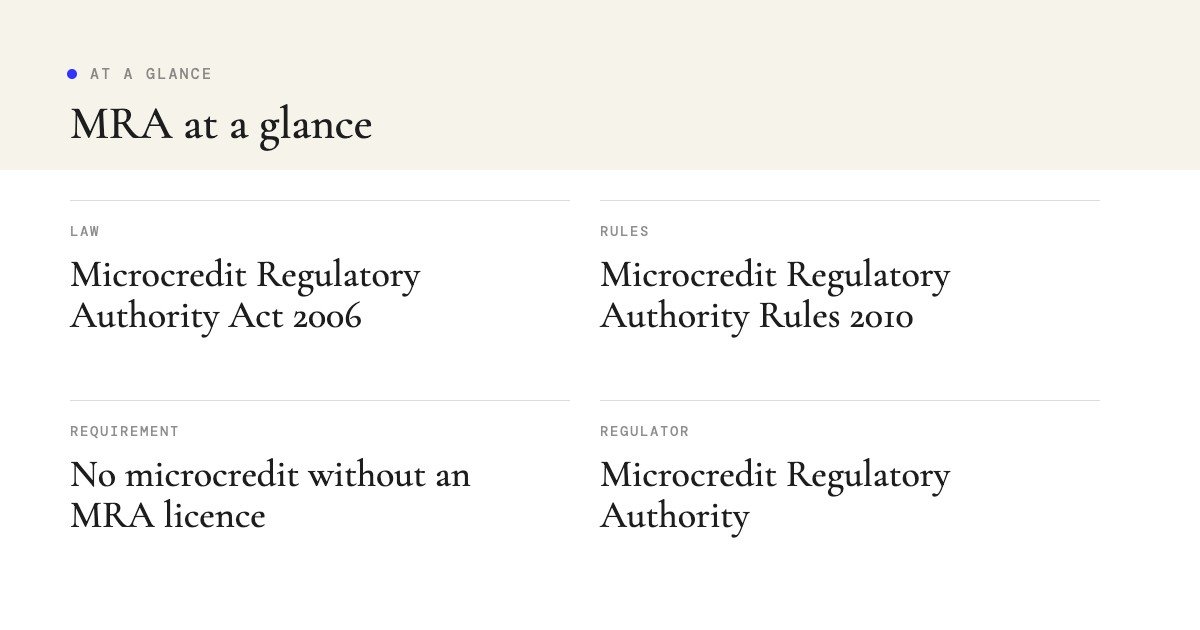
The MRA Act 2006 established the Microcredit Regulatory Authority as the sector regulator, with powers to license, supervise, inspect and sanction microfinance institutions. The Microcredit Regulatory Authority Rules 2010 set detailed requirements on licensing, governance, capital, savings, loan classification and provisioning, accounting, audit and reporting. MRA also issues circulars and directives, including on interest rate ceilings. The laws are available on Laws of Bangladesh, and circulars on the MRA website.
Eligibility for a microcredit regulatory authority licence
| Requirement | Typical position |
|---|---|
| Legal registration | Registered under a recognised law with microcredit within its objects |
| Track record | Existing microcredit operations meeting minimum thresholds, historically Tk 40 lakh outstanding or 1,000 borrowers |
| Governance | Functioning general and executive bodies, no conflicts of interest |
| Financial records | Audited accounts and proper loan records |
| Policies | Credit, savings, human resources and operational manuals |
The MRA may also consider the organisation’s financial sustainability, sources of funds and past compliance before granting a licence.
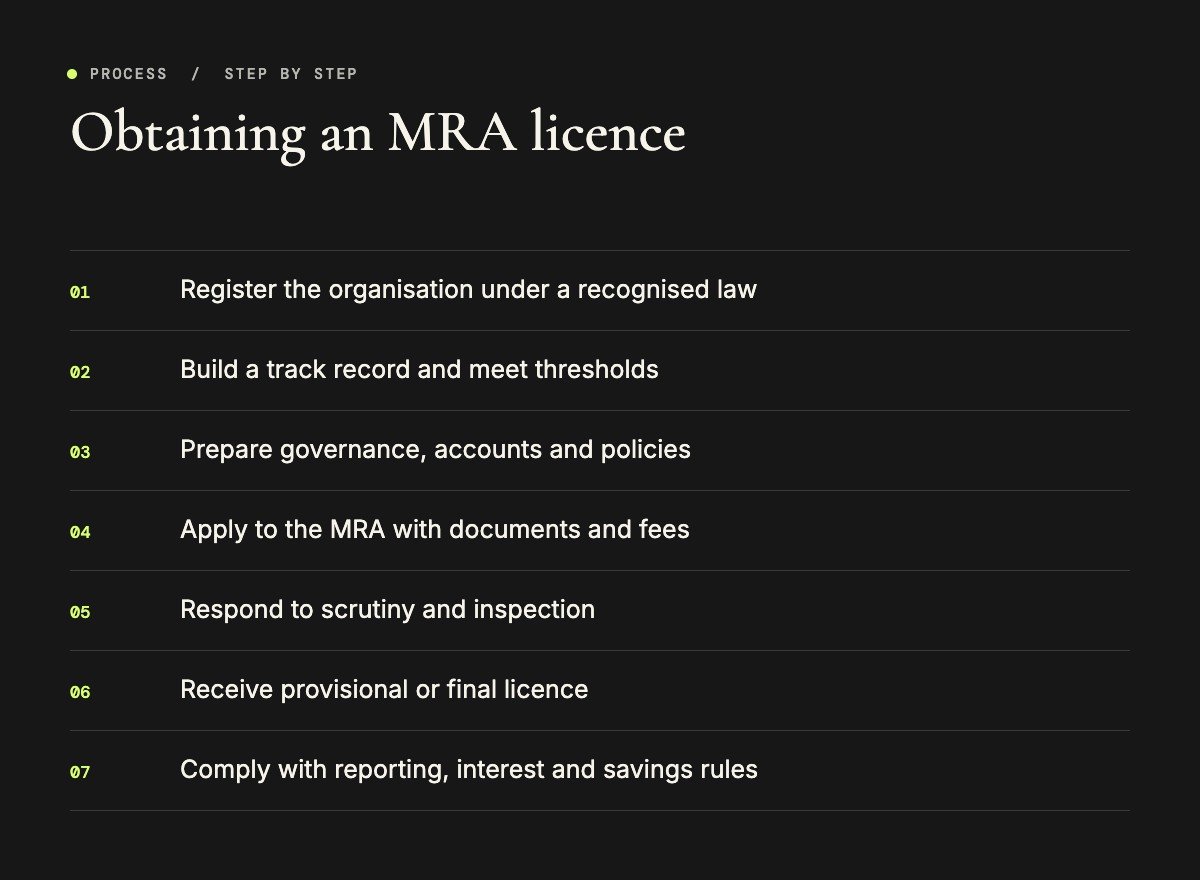
Obtaining an MRA licence step by step
- Register the organisation. Ensure microcredit is within its objects.
- Build operations. Develop a portfolio meeting the thresholds through permitted means.
- Prepare governance. Constitute boards, adopt policies and audit accounts.
- Apply. Submit the application form, registration documents, audited accounts, portfolio data and fees.
- Scrutiny. MRA reviews documents and may inspect field offices.
- Licence. MRA grants a provisional or final licence, possibly with conditions.
- Comply. Follow reporting, interest and savings rules and renew any required approvals.
MRA looks closely at related party lending and governance. Ensure board members and their families are not borrowers or suppliers on preferential terms, and keep minutes showing independent decision-making.
Interest rate rules under a microcredit regulatory authority licence
MRA regulates the maximum service charge that licensed institutions can levy on microcredit loans. After a ceiling of 27% set in 2011, MRA reportedly reduced the maximum effective rate to 24% on a declining balance basis. Institutions must disclose charges transparently, calculate them using approved methods and avoid hidden fees. Breaching the ceiling can lead to sanctions and may affect the microcredit regulatory authority licence itself.
Member savings
Licensed institutions may collect savings from their members, typically compulsory savings linked to loans and voluntary savings, within limits set by MRA, but may not accept deposits from the general public like a bank. MRA has restricted term deposits and requires a portion of savings to be held in liquid form or invested as specified, to protect members. Proper accounting for savings, interest paid on savings and return of savings when members leave are frequent focus areas in inspections.
Governance and capital requirements
MRA expects licensed institutions to have a functioning general body and executive committee, clear separation between governance and management, policies on conflicts of interest, and qualified staff. The Rules require maintenance of capital and reserve funds, loan loss provisioning based on loan classification, and use of surplus for the organisation’s objectives rather than distribution. Founders and board members should understand that microfinance NGOs are not-for-profit and cannot distribute surpluses as dividends.
Reporting and inspection for a microcredit regulatory authority licence holder
Licensed institutions must submit periodic reports to MRA on portfolio, savings, financial position and branch network, and file audited financial statements prepared by auditors from the MRA-approved panel. MRA conducts on-site inspections of head offices and branches and off-site monitoring through reports. Findings may lead to directions to correct practices, fines or, in serious cases, suspension or cancellation of the licence.
Application documents
A typical application for a microcredit regulatory authority licence includes the prescribed form, the certificate of registration and constitution, lists of general and executive body members with their details, audited financial statements for recent years, details of microcredit operations including number of borrowers, loan outstanding and savings, branch information, sources of funds, policy manuals, and evidence of payment of application fees. Inconsistencies between audited accounts and portfolio reports are a common reason for delay, so data should be reconciled carefully before filing.
MRA may ask for additional information or clarifications and may conduct field verification before reaching a decision.
Funding sources and borrowing
Licensed MFIs fund their portfolios through member savings, retained surplus, grants, loans from Palli Karma-Sahayak Foundation (PKSF) and commercial bank borrowing. Holding a microcredit regulatory authority licence is usually a precondition for PKSF partnership and bank financing. Foreign donations and loans may require clearance from the NGO Affairs Bureau and compliance with foreign exchange rules, and foreign borrowing must follow Bangladesh Bank requirements.
Diversified products and services
Beyond traditional group loans, licensed institutions increasingly offer microenterprise loans, agricultural loans, housing and sanitation loans, remittance services, micro-insurance and digital financial services. Some products require additional MRA approval or compliance with other regulators, for example insurance regulation or Bangladesh Bank rules on mobile financial services. Expanding into new products without checking these requirements can put a microcredit regulatory authority licence at risk.
Consumer protection and responsible lending
MRA expects licensed institutions to treat borrowers fairly, avoid coercive collection, prevent over-indebtedness through multiple borrowing, and resolve complaints promptly. Clear disclosure of loan terms in Bengali, respectful collection practices and a functioning grievance mechanism protect both borrowers and the institution’s reputation. Complaints of abusive collection can trigger inspections and sanctions.
Penalties and cancellation
Operating microcredit without a licence, violating MRA rules or directions, misusing member savings, or submitting false information can lead to fines, directions to stop activities, removal of officials and cancellation of the licence. On cancellation, MRA may appoint an administrator or direct how member savings are repaid. Prompt compliance with inspection findings is the best protection for a microcredit regulatory authority licence holder.
Practical compliance checklist
Maintain proper registration and an updated constitution; hold regular board and general meetings; reconcile portfolio and accounts monthly; follow the service charge ceiling; manage member savings within limits; provision for overdue loans; file reports on time; use approved auditors; train staff on fair practices; and respond promptly to MRA correspondence. Following this checklist keeps the microcredit regulatory authority licence secure and supports sustainable growth.
Mergers, transfers and closure
Licensed institutions sometimes merge, transfer portfolios or wind down operations. Such steps generally require MRA approval, protection of member savings and continuity of borrower relationships. A licence is not freely transferable, and an acquiring organisation must hold or obtain its own licence. Donors and investors supporting consolidation should factor in regulatory timelines and the need to reconcile portfolios and savings before completion.
Digital microfinance
Many institutions now disburse and collect loans through mobile financial services and use digital loan management systems. This improves efficiency and transparency but raises data protection, cyber security and consumer protection issues. Under the Personal Data Protection Act 2026, borrower data must be processed lawfully and securely, and transfers of data to overseas technology providers need appropriate safeguards. MRA may also issue guidance on digital operations, which licensed institutions should monitor.
Taxation of microfinance institutions
Tax treatment of microfinance income has been debated over the years, with exemptions or reduced rates for certain income of licensed institutions subject to conditions in the income tax law and Finance Acts. Because the position may change annually, institutions should confirm the current treatment of service charge income, interest on investments and grants with tax advisers and keep the records needed to claim any exemption.
Starting a new programme and seeking a microcredit regulatory authority licence
New organisations face a practical challenge: they need a track record to qualify, yet cannot conduct microcredit without a licence. Founders should seek advice on lawful pathways, such as partnering with an existing licensed institution, beginning with non-credit development activities, or following any transitional arrangements MRA permits. Building governance and systems from the outset positions a new organisation for a successful application.
Role of PKSF and sector bodies
Palli Karma-Sahayak Foundation, a government-established apex funding body, provides wholesale funds, capacity building and programme support to partner organisations, most of which hold MRA licences. Sector networks and associations of microfinance institutions also offer training and advocacy. Engaging with these bodies helps institutions stay current with best practice, funding opportunities and regulatory expectations, and strengthens their case at licence renewal or inspection.
Staff and field operations
Field staff are the face of any microfinance programme. Recruitment, training, codes of conduct, cash handling controls and branch audits reduce fraud and protect borrowers. Employment matters are governed by the Bangladesh Labour Act 2006 and the organisation’s service rules, and MRA inspections often review whether staff follow approved procedures in loan appraisal, disbursement and collection.
Rotating staff between branches and requiring dual control over cash are simple measures that significantly reduce misappropriation risk in field offices.
Frequently asked questions about microcredit regulatory authority licence
Who needs an MRA licence?
NGOs and similar organisations conducting microcredit operations.
What law applies?
The Microcredit Regulatory Authority Act 2006 and the Rules 2010.
Can licensed MFIs take deposits?
They may collect savings from members within MRA limits, not deposits from the general public.
Is there an interest rate cap?
Yes, MRA sets a maximum service charge, reported at 24% on a declining balance basis.
Can a company apply?
A not-for-profit company registered under the Companies Act may apply if it meets requirements.
What if an NGO operates without a licence?
It risks penalties and closure of its microcredit programme.
How we can help
We advise on obtaining and maintaining a microcredit regulatory authority licence, governance restructuring, funding arrangements and regulatory inspections. See our banking and financial services practice, our regulatory compliance team and our NGO registration guide.
Running or planning a microfinance programme?
We help you secure and keep your MRA licence.
Book a consultationFinancial servicesPrimary sources: the Microcredit Regulatory Authority Act 2006 on Laws of Bangladesh; rules and circulars from the Microcredit Regulatory Authority; banking regulation from Bangladesh Bank.
This article is general information about Bangladeshi microfinance regulation as of October 2026 and is not legal advice. MRA thresholds and ceilings change by circular; confirm current requirements.




0 Comments