
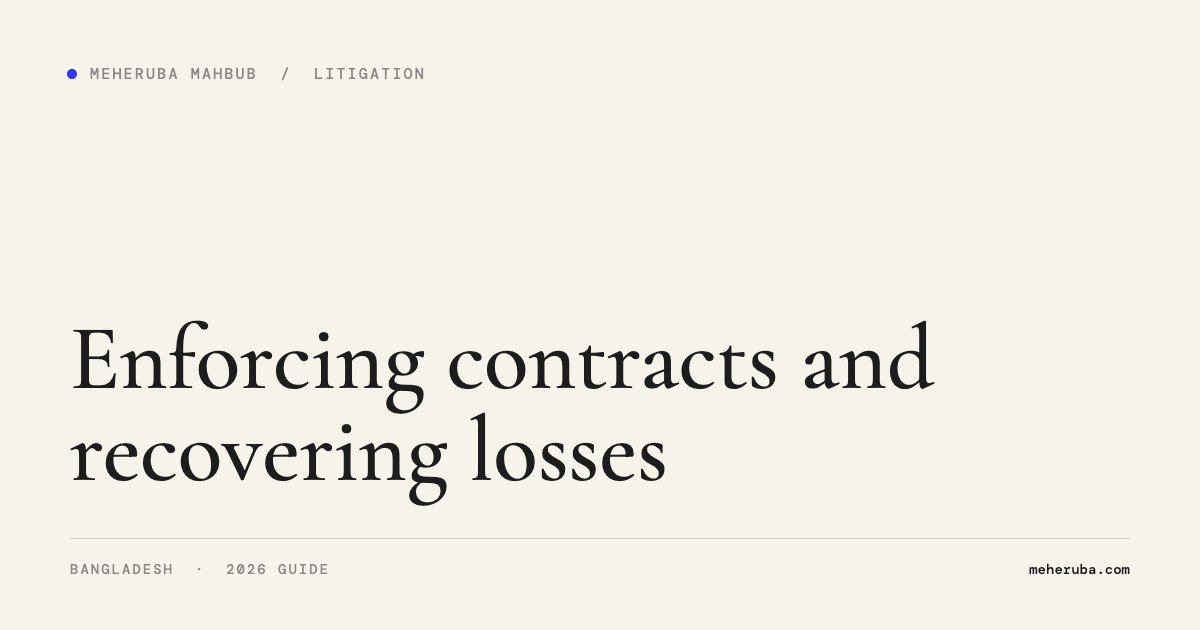
A supplier fails to deliver, a buyer refuses to pay, a seller backs out of a land sale: contract disputes are the most common commercial disputes in Bangladesh. When a breach of contract in Bangladesh occurs, the innocent party can claim damages, seek specific performance or terminate and recover what was paid. The right remedy depends on the contract, the evidence and strict time limits.
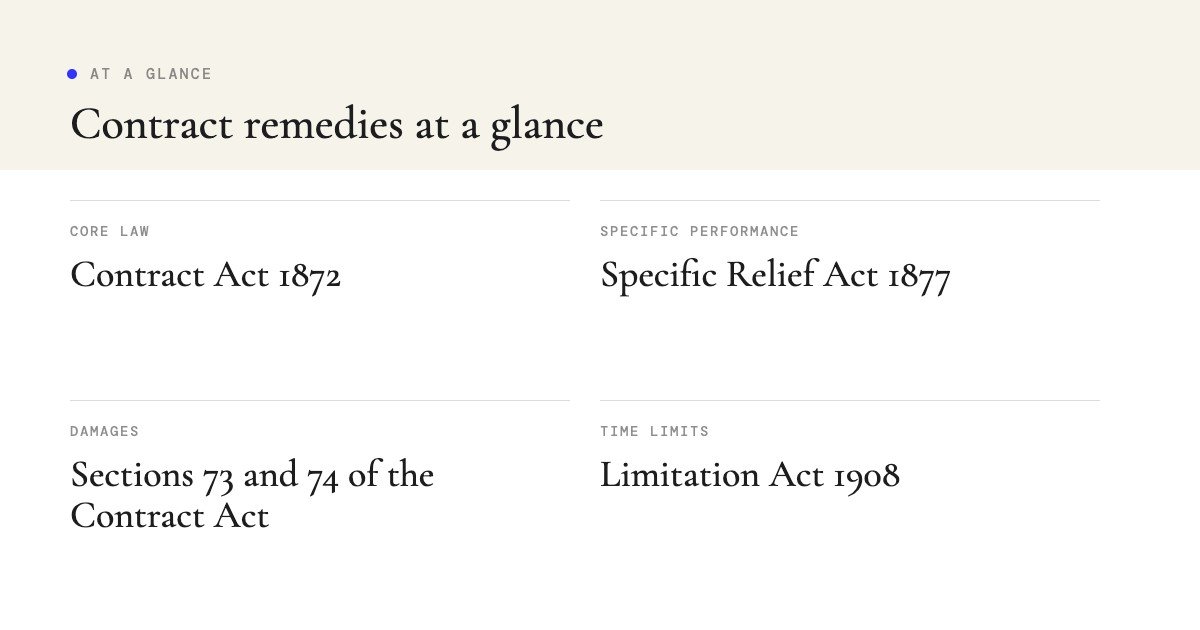
- The Contract Act 1872 governs contract formation, performance and breach, while the Specific Relief Act 1877 governs specific performance and injunctions.
- Section 73 allows compensation for loss that naturally arose from the breach or that the parties knew was likely, but not remote or indirect loss.
- Section 74 limits recovery under penalty or liquidated damages clauses to reasonable compensation not exceeding the stated amount.
- Specific performance is discretionary and is generally refused where damages are adequate.
- Limitation periods under the Limitation Act 1908 are strict, and claims filed late are barred.
What counts as breach of contract in Bangladesh
A breach occurs when a party fails to perform an obligation on time or in the manner agreed, performs defectively, or clearly refuses to perform in advance, known as anticipatory breach. Not every failure is a breach: performance may be excused if the contract becomes impossible or unlawful under section 56 of the Contract Act (frustration), or if the other party’s own default prevented performance. Identifying exactly which obligation was breached, and when, is the first step in any claim.
Our commercial litigation practice advises businesses and individuals on contract disputes from the first notice to enforcement.
Remedies for breach of contract in Bangladesh at a glance
| Remedy | Source | When it fits |
|---|---|---|
| Compensation (damages) | Contract Act, sections 73 and 74 | Most commercial breaches causing financial loss |
| Specific performance | Specific Relief Act 1877 | Unique subject matter, such as land, where money is inadequate |
| Injunction | Specific Relief Act; Code of Civil Procedure | To stop a threatened breach, such as breach of a negative covenant |
| Rescission and restitution | Contract Act, sections 64 and 65; Specific Relief Act | Recovering money paid when the contract ends |
| Quantum meruit | Contract Act, section 70 | Payment for work done or goods supplied without an enforceable contract |
The statutes are published on Laws of Bangladesh.
Damages for breach of contract in Bangladesh
Under section 73, the injured party is entitled to compensation for loss or damage that naturally arose in the usual course of things from the breach, or that the parties knew, when they made the contract, to be likely to result from the breach. Remote and indirect loss is not recoverable. The injured party must also take reasonable steps to mitigate the loss; damages may be reduced if it failed to do so. Proving loss requires documents, such as invoices, market price evidence, lost contracts and accounts.
Section 74 deals with sums named in the contract as payable on breach. Whether described as liquidated damages or a penalty, the court awards reasonable compensation not exceeding the amount named. A carefully drafted liquidated damages clause with a genuine pre-estimate of loss is therefore useful but not a guarantee of the full amount.
Specific performance after breach of contract in Bangladesh
Specific performance orders the defaulting party to perform the contract. It is a discretionary remedy and is usually granted for contracts concerning land or unique goods, where money cannot adequately compensate the buyer. Courts generally refuse it where damages are adequate, where the contract requires continuous supervision, or where it involves personal services. For contracts to sell immovable property, amendments in 2004 require the contract to be registered and the balance price to be deposited in court for a specific performance suit, and the limitation period for such suits is short, so buyers must act quickly.
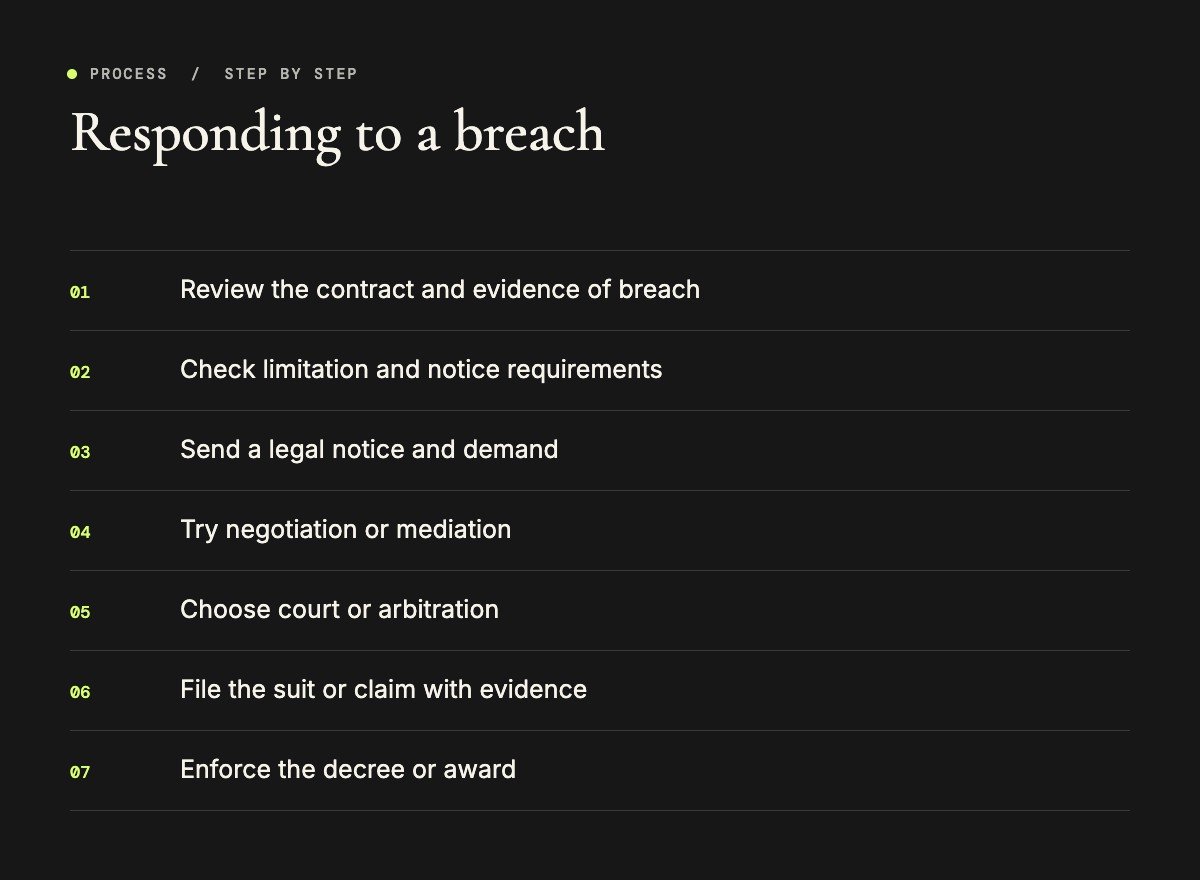
Responding to a breach step by step
- Review. Analyse the contract terms, notices clauses and evidence of breach.
- Check time limits. Calculate the limitation period and any contractual notice deadlines.
- Send notice. Issue a legal notice demanding performance or payment.
- Negotiate. Explore settlement, mediation or a payment plan.
- Choose forum. Court or arbitration, depending on the dispute clause.
- File. Submit the plaint or statement of claim with documents and witnesses.
- Enforce. Execute the decree or enforce the award against assets.
Keep performing your own obligations unless you are sure the breach entitles you to terminate. Wrongful termination can turn the innocent party into the party in breach.
Limitation periods for breach of contract in Bangladesh
The Limitation Act 1908 sets time limits for contract claims. Suits for compensation for breach of an unregistered contract must generally be brought within three years from the breach, and longer periods apply to some registered contracts. Suits for specific performance of contracts for sale of land face a much shorter period following the 2004 amendments. Arbitration claims are also subject to limitation. Because time often runs from the date of breach or refusal, claimants should calculate limitation as soon as a dispute arises and file protectively if negotiations drag on.
Legal notice before suit
A legal notice is not always legally required between private parties, but it is good practice and often expected by courts. A clear notice identifies the contract, the breach, the loss and the demand, and gives a reasonable deadline. It can prompt settlement, establish that the other side was given an opportunity to perform, and sometimes trigger interest or termination rights under the contract. For suits against government bodies, section 80 of the Code of Civil Procedure requires prior notice. A well-drafted notice is often the first effective step in resolving a breach of contract in Bangladesh.
Termination after breach of contract in Bangladesh
Not every breach allows termination. Under the Contract Act, a party may treat the contract as ended where the other refuses to perform altogether or commits a breach going to the root of the contract, or where time is of the essence and performance is late. Many contracts contain express termination clauses with notice and cure periods, which must be followed precisely. After lawful termination, the innocent party can claim damages and recover benefits conferred, subject to returning benefits received.
Court or arbitration
Where the contract has an arbitration clause, the dispute generally goes to arbitration under the Arbitration Act 2001, and courts will stay a suit filed in breach of the clause on application. Otherwise, money suits are filed in the civil courts according to their pecuniary jurisdiction, with the Commercial Court or specialised forums in some contexts. Court proceedings in Bangladesh can be lengthy, so parties often use mediation under the Code of Civil Procedure to reach earlier settlement. The choice of forum shapes cost, time and enforcement for any breach of contract in Bangladesh.
Interest and costs
Courts may award interest on sums due, including interest from the date of suit until decree and from decree until payment, under the Code of Civil Procedure. Contractual interest clauses can also be enforced subject to reasonableness. Costs are awarded at the court’s discretion and rarely cover full legal fees, which is a factor in deciding whether to litigate a smaller claim.
Evidence that wins contract cases
Contract disputes are won on documents. The signed contract and any amendments, purchase orders, delivery challans, invoices, emails, meeting minutes, bank statements and correspondence about the breach should be collected and preserved. Oral agreements are enforceable in many cases, but proving their terms is harder, so contemporaneous messages and witness evidence become critical. Electronic records are admissible under the Evidence Act 1872 as amended, provided their authenticity can be shown. Organising evidence early strengthens any claim for breach of contract in Bangladesh and supports settlement negotiations.
Force majeure and frustration
Defaulting parties often argue that events beyond their control, such as floods, political unrest, pandemics, import restrictions or exchange shortages, excused performance. The answer depends first on the contract’s force majeure clause, which may suspend obligations or allow termination for specified events, subject to notice requirements. Without a clause, the party must rely on frustration under section 56, which applies only where performance becomes impossible or radically different, not merely more expensive. Courts interpret frustration narrowly in commercial cases.
Breach by government entities
Claims against ministries, statutory bodies and state-owned enterprises raise special issues, including the requirement of prior notice under section 80 of the Code of Civil Procedure, public procurement rules, and sometimes the availability of writ jurisdiction where public law elements exist. Many public contracts contain arbitration clauses. Contractors facing a breach of contract in Bangladesh by a public entity should follow contractual claims procedures carefully, because missing a notice deadline can defeat an otherwise strong claim.
Enforcing judgments and awards
Winning a decree is only half the battle. Execution proceedings under the Code of Civil Procedure allow attachment and sale of the debtor’s property, garnishment of bank accounts and, in limited cases, arrest. Arbitral awards are enforced as decrees after any challenge period. Identifying the debtor’s assets early, and considering interim attachment before judgment where there is a risk of dissipation, improves the chance of actual recovery.
Drafting contracts to reduce disputes
Many disputes stem from vague drafting. Clear specifications, delivery schedules, acceptance procedures, payment terms, liquidated damages, limitation of liability, termination rights, force majeure, governing law and dispute resolution clauses reduce uncertainty. Requiring written variations and notices helps prove what was agreed. Investing in careful drafting at the outset is the cheapest way to avoid a costly breach of contract in Bangladesh later, and makes remedies easier to enforce when breaches do occur.
Businesses using standard terms should review them periodically to reflect changes in law and commercial practice, and ensure counterparties actually accept them.
Where contracts are negotiated in both English and Bengali, state which language prevails, because inconsistencies between versions are a recurring source of argument in Bangladeshi courts and arbitrations.
Frequently asked questions about breach of contract in bangladesh
Which law governs contract breaches?
The Contract Act 1872, with the Specific Relief Act 1877 for specific performance and injunctions.
Can I recover lost profits?
Yes, if they arose naturally from the breach or were within the parties’ contemplation, and are proven.
Is a liquidated damages clause enforceable?
Courts award reasonable compensation up to the stated amount under section 74.
How long do I have to sue?
Generally three years for compensation claims on unregistered contracts, with other periods for specific claims; check the Limitation Act.
Can I force a seller to transfer land?
Through a specific performance suit, subject to registration, deposit and limitation requirements.
Can contract disputes go to arbitration?
Yes, if the contract contains an arbitration clause or the parties agree.
How we can help
We act on every type of breach of contract in Bangladesh, including supply, construction, distribution, real estate and service contracts, in courts and arbitration. See our commercial litigation practice, our mediation and ADR team and our guide to civil cases.
Has a contract been broken?
We assess your remedies and protect your deadline.
Book a consultationCommercial litigationPrimary sources: the Contract Act 1872, the Specific Relief Act 1877, the Limitation Act 1908 and the Code of Civil Procedure 1908 on Laws of Bangladesh; court information from the Supreme Court of Bangladesh.
This article is general information about Bangladeshi contract law as of October 2026 and is not legal advice. Limitation periods are strict; take advice promptly.




0 Comments