
Behind every well-run board is someone making sure meetings are properly called, minutes are accurate and filings reach the regulator on time. A company secretary in Bangladesh plays that role. For listed companies the position is mandatory under BSEC governance rules, and for private companies, banks, multinational subsidiaries and growing businesses, a capable secretary is the simplest way to stay compliant with the Companies Act 1994.
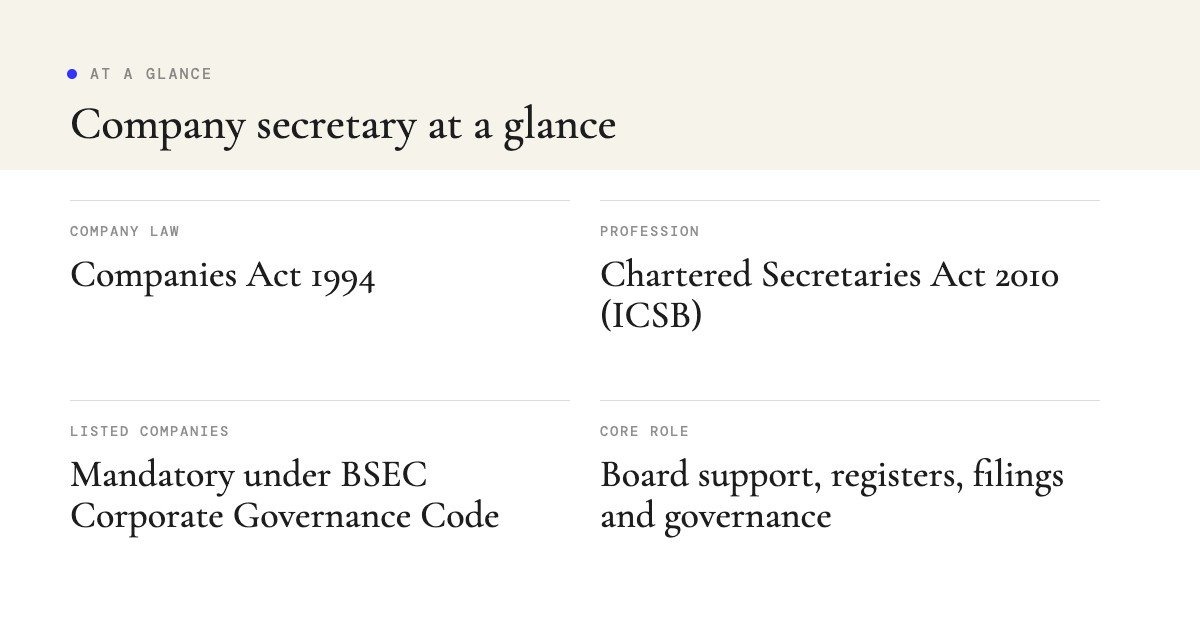
- The Companies Act 1994 recognises the company secretary as an officer, and companies must keep records of their secretaries in their registers.
- Listed companies must appoint a company secretary, separate from the managing director, CFO and head of internal audit, under the BSEC Corporate Governance Code.
- The Institute of Chartered Secretaries of Bangladesh (ICSB), established under the Chartered Secretaries Act 2010, regulates the profession.
- Core duties include organising board and general meetings, maintaining statutory registers, filing returns with the RJSC and advising on governance.
- A compliance calendar is the company secretary’s most important tool.
When a company secretary in Bangladesh is required
For private limited companies, the Companies Act 1994 does not impose a general requirement to appoint a professionally qualified secretary, but many companies appoint one to manage compliance. Listed companies must appoint a company secretary under the Corporate Governance Code issued by the Bangladesh Securities and Exchange Commission, and banks, insurers and financial institutions face regulator expectations for a dedicated secretary. Subsidiaries of multinational groups usually appoint a secretary to meet group governance standards.
Our corporate governance practice provides company secretarial support and advises boards on governance.
Qualifications and appointment of a company secretary in Bangladesh
The Chartered Secretaries Act 2010 established ICSB and regulates chartered secretaries. Listed companies are expected to appoint a secretary with relevant professional qualifications, such as membership of ICSB or another recognised professional body, and the BSEC Code sets out the role and its separation from other key positions. The appointment is made by board resolution, which should set out the secretary’s duties, reporting line and terms. The company records the appointment in its registers and notifies the RJSC where required.
The BSEC Corporate Governance Code is available from the BSEC website, and company law materials from the RJSC.
Core duties of a company secretary in Bangladesh
| Area | Typical duties |
|---|---|
| Board support | Calling meetings, preparing agendas and papers, recording minutes, tracking actions |
| General meetings | Notices, AGM and EGM arrangements, resolutions, attendance records |
| Statutory records | Registers of members, directors, charges and share transfers |
| Filings | Annual returns, director changes, allotments, charges and other RJSC filings |
| Governance | Advising on law, articles and codes, conflicts of interest and disclosures |
| Listed company obligations | BSEC and stock exchange disclosures, price sensitive information, corporate governance reports |
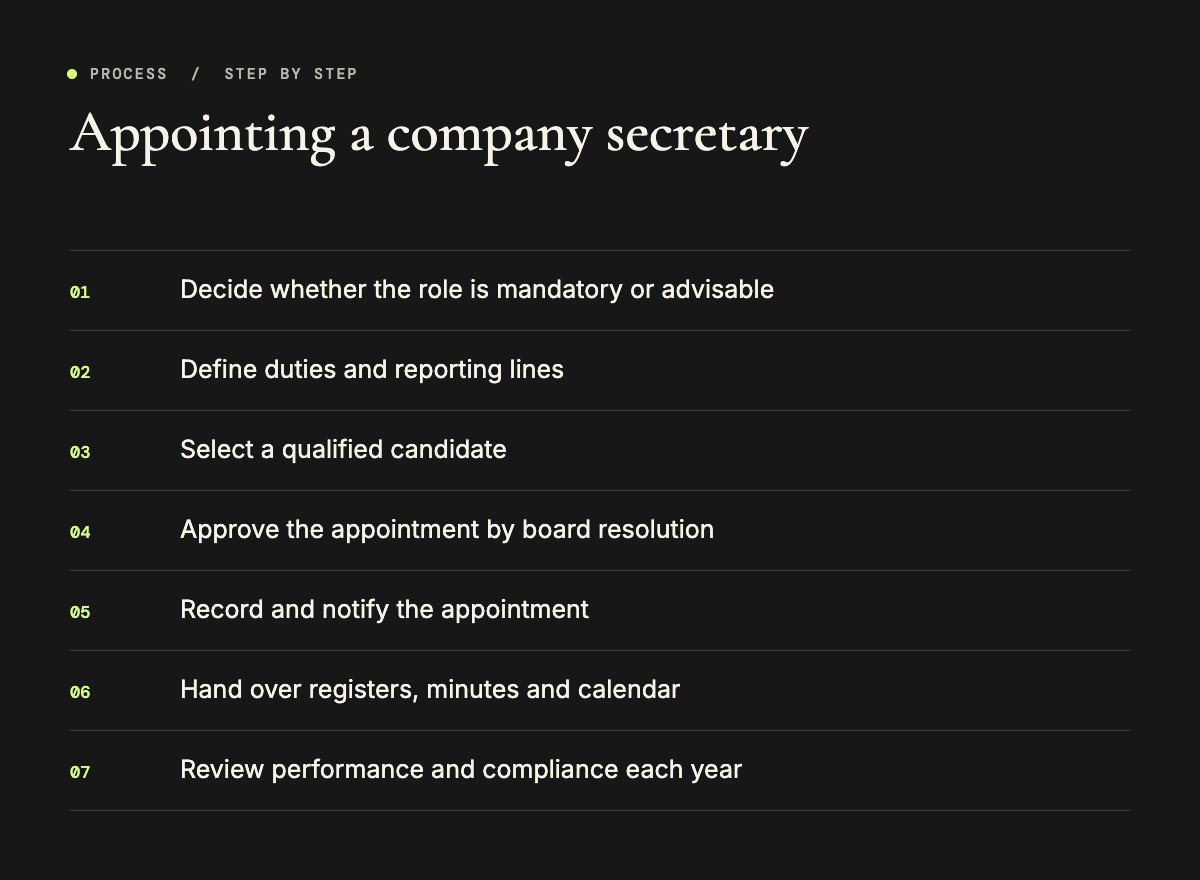
Appointing a company secretary step by step
- Assess the need. Determine whether the role is mandatory or simply advisable.
- Define the role. Set duties, authority and reporting to the board and chair.
- Select. Choose a qualified employee or an external secretarial provider.
- Approve. Pass a board resolution appointing the secretary.
- Record and notify. Update registers and make any required RJSC filings.
- Handover. Transfer minute books, registers, seals and the compliance calendar.
- Review. Evaluate compliance and governance performance annually.
Minutes drafted months after a meeting are a common weakness exposed in due diligence and disputes. Circulate draft minutes within days and have them signed at the next meeting.
The annual compliance calendar
The most practical contribution a company secretary in Bangladesh makes is a compliance calendar. Key items under the Companies Act 1994 include holding the first AGM within 18 months of incorporation and subsequent AGMs at least once every calendar year and within 15 months of the previous one, filing the annual return with the RJSC within the prescribed time after the AGM, holding board meetings regularly, often at least quarterly, filing notices of changes in directors and allotments of shares within the statutory periods, and registering charges within the time allowed. The calendar should also include tax returns, VAT returns, trade licence renewals and sector licences.
For listed companies, the calendar adds quarterly and annual financial reporting, price sensitive information disclosures, corporate governance compliance reports and dividend distribution timelines set by BSEC and the stock exchanges.
Board meetings and minutes
The secretary ensures meetings are properly convened under the articles, with adequate notice, quorum and agenda. Board papers should reach directors in time to allow informed decisions. Minutes must record attendance, declarations of interest, discussions in summary, decisions and dissent. Accurate minutes are evidence in disputes, regulatory inspections and due diligence, and can protect directors by showing they acted with care. Written resolutions, where permitted, also need proper records.
Statutory registers kept by a company secretary in Bangladesh
Companies must keep registers of members, directors and other officers, charges, share transfers and debentures where applicable. The company secretary in Bangladesh keeps these registers up to date and available for inspection as required by law. Errors in the register of members can lead to disputes over ownership and voting, and incomplete charge registers can affect lenders’ security.
Listed company duties of a company secretary in Bangladesh
In listed companies, the secretary acts as the link between the board, BSEC, stock exchanges and shareholders. Responsibilities include disclosure of price sensitive information, coordinating AGMs including digital platforms where permitted, handling shareholder queries, overseeing dividend distribution and unclaimed dividend rules, and preparing the corporate governance compliance report included in the annual report. The BSEC Code requires the secretary to attend board meetings and to be distinct from other key officers.
Share transfers and allotments
When shares are issued or transferred, the secretary checks compliance with the articles, pre-emption rights, board approvals, stamp duty and, for foreign shareholders, exchange control requirements such as encashment certificates and Bangladesh Bank reporting. Allotment returns must be filed with the RJSC within the statutory period, and share certificates issued. Errors here are common sources of later disputes and can delay transactions. A careful company secretary in Bangladesh prevents those problems by following a checklist for every share movement.
Our guide to company share transfer explains the process in more detail.
Changes in directors and officers
Appointment, resignation and removal of directors, managing directors and other officers must follow the Companies Act and the articles, and notices must be filed with the RJSC within the time allowed. Directors must hold qualification shares if the articles require them, and must disclose interests in contracts. The secretary ensures consents, resolutions and filings are completed promptly so that the public record accurately reflects who controls the company.
Advising the board
Beyond administration, an experienced company secretary in Bangladesh advises directors on their legal duties, conflicts of interest, related party transactions, board committee structures and governance best practice. The secretary can help the chair plan the board’s annual agenda, organise director induction and training, and coordinate board evaluations. In regulated sectors, the secretary also helps the board respond to regulator inspections and directives.
Outsourced versus in-house secretaries
Smaller private companies often outsource secretarial work to law firms or chartered secretary practices, which provide expertise without a full-time salary. Larger companies, banks and listed companies usually employ an in-house secretary supported by external advisers for complex matters. Either model can work if responsibilities are clear and the calendar is maintained.
Penalties for non-compliance
Failure to hold AGMs, file returns or maintain registers can lead to fines under the Companies Act for the company and its officers in default. Persistent defaults can block RJSC services, affect the company’s standing with banks and regulators, and create problems in fundraising or sale. For listed companies, BSEC can impose penalties for governance and disclosure failures. A diligent company secretary in Bangladesh is a low-cost safeguard against these risks.
Charges, borrowing and the company secretary in Bangladesh
When a company borrows against its assets, the charge must be registered with the RJSC within the statutory time, or it may be void against a liquidator and other creditors. The secretary coordinates with lenders and lawyers to file particulars of the charge, keeps the register of charges updated and files satisfaction of charges when loans are repaid. Board resolutions authorising borrowing and security should be carefully drafted and minuted, as lenders will ask for certified copies.
Foreign-owned companies
Subsidiaries of foreign companies face additional coordination: board meetings with overseas directors, often held virtually where the articles allow, documents signed abroad and attested, exchange control filings for share capital and dividends, and reporting to group headquarters. Expatriate directors’ work permits and visas also need tracking. A company secretary familiar with both local law and group requirements keeps the subsidiary compliant in both directions.
Digital tools and record keeping
Board portals, digital minute books and electronic registers improve efficiency and security, provided they meet legal requirements for signatures and record keeping. The RJSC’s online filing system has made many filings faster. Companies should back up records securely and control access, since registers and minutes contain sensitive information about shareholders and directors.
Choosing the right person
A good company secretary in Bangladesh combines legal knowledge, attention to detail, discretion and the confidence to remind senior directors of their obligations. Professional qualifications from ICSB or an equivalent body, experience in corporate law or governance, and familiarity with RJSC and BSEC procedures are valuable. Independence matters too: the secretary should be able to raise concerns with the chair and board without fear, which is why listed company rules emphasise the secretary’s direct access to the board.
Clear terms of reference, adequate resources and regular training help the secretary keep pace with changes in law and regulation.
Dividends and shareholder communications
The secretary coordinates dividend declarations, ensuring the board recommends and shareholders approve dividends in line with the articles and law, that withholding tax is deducted, and that payments reach shareholders through banking channels. Foreign shareholders’ dividends require exchange control documentation. Clear, timely communication with shareholders builds trust and reduces disputes.
Unclaimed dividends in listed companies are subject to specific BSEC rules on transfer and reporting, which the secretary should track carefully.
Frequently asked questions about company secretary in bangladesh
Must a private company have a company secretary?
There is no general mandatory requirement for a qualified secretary, but appointing one is good practice.
Must a listed company have one?
Yes, under the BSEC Corporate Governance Code.
Can the CFO also be company secretary?
For listed companies the roles must be held by different individuals.
Who regulates chartered secretaries?
The Institute of Chartered Secretaries of Bangladesh under the Chartered Secretaries Act 2010.
Can the role be outsourced?
Many private companies use external secretarial providers or law firms.
What is the most important tool?
A compliance calendar covering meetings, filings and renewals.
How we can help
We provide outsourced company secretary in Bangladesh services, governance reviews and board advisory support for private, listed and foreign-owned companies. See our corporate governance practice, our corporate team and our guide to the board resolution process.
Need reliable secretarial support?
We keep your board compliant and your records clean.
Book a consultationCorporate governancePrimary sources: the Companies Act 1994 and the Chartered Secretaries Act 2010 on Laws of Bangladesh; the Corporate Governance Code from BSEC; filings with the RJSC.
This article is general information about Bangladeshi company law as of October 2026 and is not legal advice. Regulatory requirements vary by sector and listing status.




0 Comments