
Buying an existing company is often the fastest way for a foreign investor to enter Bangladesh, gaining licences, staff, customers and market share in one step. A foreign acquisition of Bangladeshi company shares is generally permitted, but it involves careful due diligence, compliance with Bangladesh Bank rules on valuation and remittance, sector approvals and correct filings. Getting these right protects the investor’s ability to repatriate profits and exit later.
- Foreign investors may acquire shares in most Bangladeshi companies, with 100% ownership permitted in most sectors.
- Share transfers between residents and non-residents in unlisted companies follow Bangladesh Bank rules, consolidated in a master circular issued in March 2026.
- Consideration must be remitted through banking channels and supported by valuation and encashment documentation.
- Regulated sectors such as banking, insurance, telecoms and broadcasting require regulator approval for changes in ownership.
- Thorough due diligence is essential because title, tax and compliance issues are common in Bangladeshi targets.
Structuring a foreign acquisition of Bangladeshi company
Most deals are share purchases, where the investor buys existing shares from the sellers, sometimes combined with subscription for new shares to inject capital. Asset purchases are less common because transferring land, licences and contracts is cumbersome. Investors can acquire directly or through an offshore holding company, which may offer treaty, tax or exit advantages. The structure should be decided early, because it affects approvals, tax and the documentation needed for remittance.
Our mergers and acquisitions practice advises foreign buyers from structuring to completion.
Regulatory framework for a foreign acquisition of Bangladeshi company
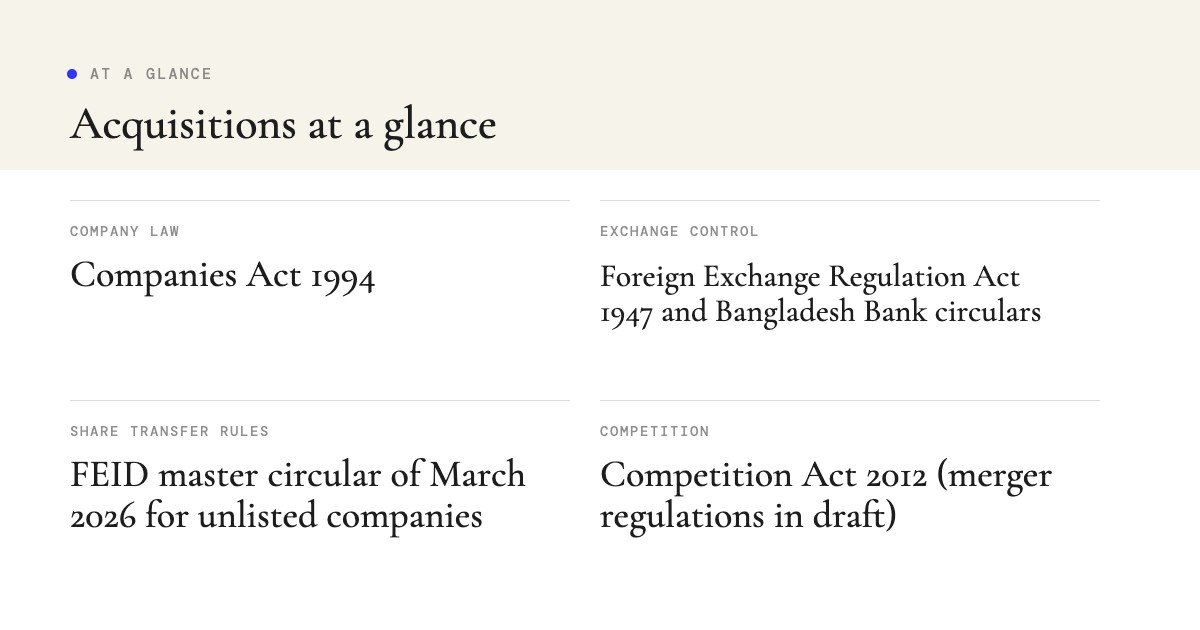
| Area | Key law or regulator | Relevance |
|---|---|---|
| Company law | Companies Act 1994; RJSC | Share transfers, filings, articles and board approvals |
| Exchange control | Foreign Exchange Regulation Act 1947; Bangladesh Bank | Valuation, remittance of consideration, reporting |
| Investment registration | Invest Bangladesh (formerly BIDA), BEPZA, BEZA | Recording foreign investment and work permits |
| Sector approvals | Bangladesh Bank, IDRA, BTRC and others | Change of control in regulated sectors |
| Competition | Competition Act 2012; Bangladesh Competition Commission | Anti-competitive combinations |
| Capital markets | BSEC | Acquisitions of listed companies and takeover rules |
Exchange control materials are published by Bangladesh Bank, and company filings by the RJSC.
Bangladesh Bank rules on foreign acquisition of Bangladeshi company shares
Transfers of shares in unlisted companies from residents to non-residents, and the remittance of sale proceeds when non-residents sell, are governed by Bangladesh Bank’s foreign exchange rules. In March 2026, Bangladesh Bank’s Foreign Exchange Investment Department issued a master circular consolidating these rules, giving authorised dealer banks more autonomy, raising thresholds and simplifying valuation requirements. Valuation is typically supported by a report from an independent valuer or auditor using recognised methods. Investors should work closely with their bank to confirm the documents needed before signing.
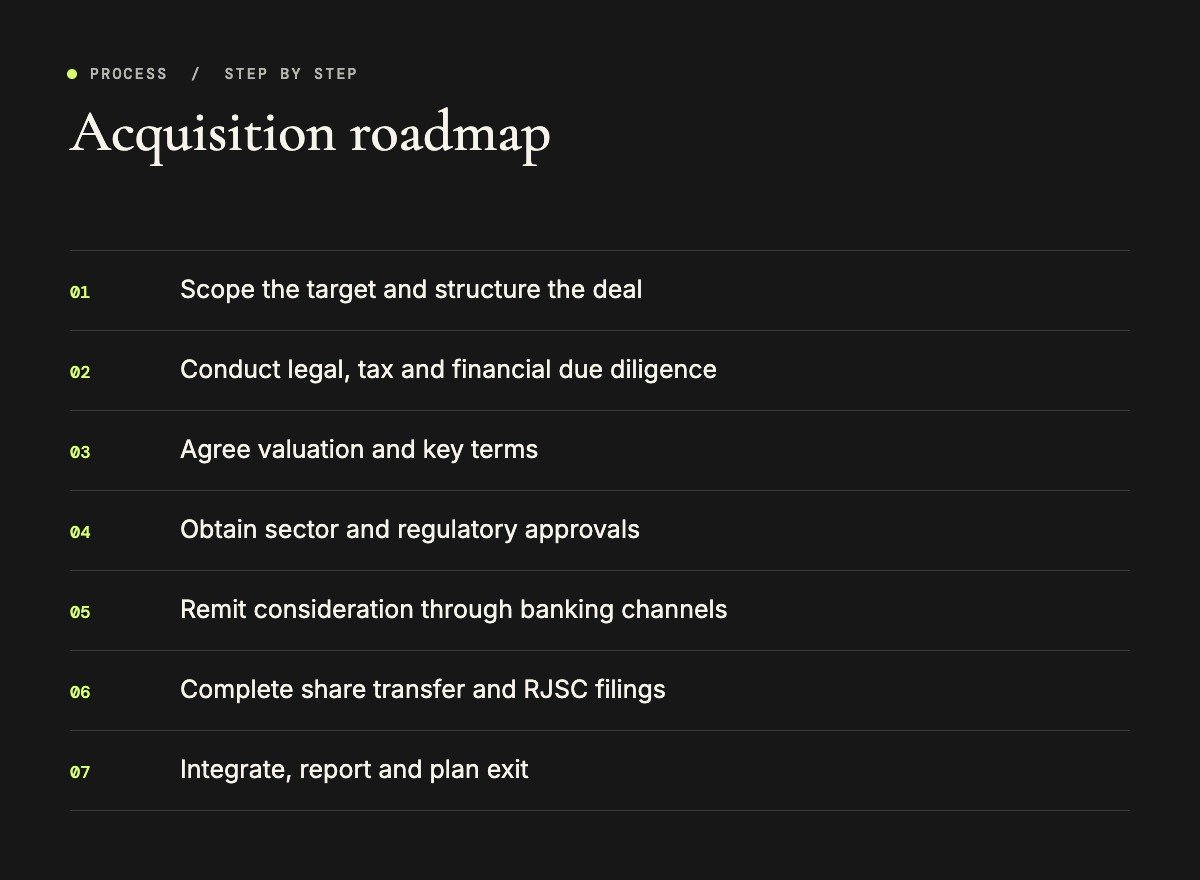
Acquisition roadmap
- Scope and structure. Define the target, stake and holding structure.
- Due diligence. Investigate legal, tax, financial, regulatory and operational issues.
- Terms. Agree price, conditions, warranties, indemnities and governance rights.
- Approvals. Obtain sector, competition and other required consents.
- Remittance. Remit consideration through an authorised dealer bank with valuation support.
- Completion. Execute transfer instruments, update registers and file with the RJSC.
- Post-closing. Register with investment authorities, integrate and plan reporting and exit.
Make the bank’s confirmation of remittance documents a condition precedent. Deals have stalled at completion because the authorised dealer bank requested additional valuation or tax documents that the parties had not anticipated.
Due diligence priorities
Due diligence in a foreign acquisition of Bangladeshi company targets should focus on corporate records and share title, including whether past share issues and transfers were properly filed with the RJSC and supported by exchange control documents; land title and lease arrangements; licences and their transferability on change of control; tax assessments, disputes and withholding compliance; employment matters such as the workers participation fund, gratuity and union issues; environmental clearances; material contracts with change of control clauses; related party transactions; and litigation. Many Bangladeshi companies have informal practices that need regularising before closing.
Findings feed into the price, conditions precedent, specific indemnities and pre-closing covenants.
Valuation and pricing in a foreign acquisition of Bangladeshi company
Price negotiations must reconcile commercial value with exchange control valuation requirements. If the agreed price differs significantly from the regulatory valuation, the bank may question the remittance or require additional justification. Earn-outs, deferred consideration and price adjustments are possible but need careful structuring so that later payments can be remitted without difficulty. Tax authorities may also scrutinise prices that appear to undervalue shares for capital gains purposes.
Sector approvals for a foreign acquisition of Bangladeshi company
Certain sectors require prior approval for changes in ownership or have foreign ownership limits, including banking and financial institutions, insurance, telecommunications, broadcasting, and some security-sensitive industries. Approval timelines can be long, so the share purchase agreement should provide realistic long-stop dates. For listed targets, BSEC rules on substantial acquisition and takeovers may require public offers or disclosures.
Competition law
The Competition Act 2012 prohibits combinations that substantially lessen competition and gives the Bangladesh Competition Commission powers over mergers and acquisitions. Detailed combination regulations had been described as still in draft in late 2025, creating uncertainty about mandatory filing thresholds. Parties to significant transactions, especially between competitors, should assess competition risk and consider engagement with the Commission.
Tax on a foreign acquisition of Bangladeshi company
Sellers generally face capital gains tax on the sale of shares, and buyers may have withholding obligations on payments to non-resident sellers. Stamp duty applies to share transfer instruments. Indirect transfers through offshore holding companies may raise questions under the Income Tax Act 2023. Tax treaties can affect the outcome. Tax structuring should be considered from the outset rather than at signing.
Transaction documents
The share purchase agreement sets out the price, conditions precedent, warranties, indemnities, limitations of liability, pre-closing conduct and completion mechanics. A shareholders’ agreement governs the relationship where the seller retains a stake, covering board composition, reserved matters, transfer restrictions, tag and drag rights and exit. Because Bangladeshi courts give weight to the articles of association, key shareholder rights should also be reflected in amended articles. Governing law and dispute resolution, often arbitration seated in Singapore or London, need careful thought in every foreign acquisition of Bangladeshi company shares.
Escrow arrangements, retentions or warranty and indemnity insurance can help secure indemnity claims against sellers who may otherwise be difficult to pursue after closing.
Completion mechanics
At completion, the parties sign share transfer instruments, pay stamp duty, deliver share certificates and resignation letters of outgoing directors, appoint new directors, update statutory registers and file the required returns with the RJSC. The buyer’s bank completes the remittance and the seller’s bank issues encashment certificates. The investment should then be recorded with Invest Bangladesh or the relevant zone authority. Each step must be properly documented so that the investor can later prove the investment when repatriating dividends or sale proceeds.
Employees and labour issues
A share acquisition does not change the employer, so employment contracts continue, but the buyer inherits existing liabilities, including unpaid benefits, gratuity, workers participation fund obligations and pending labour disputes. Changes to terms after acquisition must comply with the Bangladesh Labour Act 2006. Integration plans involving restructuring or retrenchment should be designed with legal advice to avoid disputes and reputational harm.
Post-acquisition integration
After closing, the buyer should align governance, internal controls, accounting, tax compliance and anti-corruption policies with group standards, while respecting local law. Regular board meetings, proper minutes and timely filings maintain a clean record. Dividend repatriation requires audited accounts, tax payment and bank documentation, so integration should establish these processes early to deliver the returns that justified the foreign acquisition of Bangladeshi company assets.
Exit planning after a foreign acquisition of Bangladeshi company
Exit should be planned at entry. The investor’s ability to sell to another non-resident, to a resident buyer or through a listing, and to remit sale proceeds, depends on having complete records of the original investment and compliance with exchange control rules throughout. Shareholders’ agreements should include exit mechanisms such as put options, drag-along rights and IPO cooperation. Valuation methods for future transfers should be compatible with Bangladesh Bank requirements to avoid disputes when the time comes to sell.
Anti-corruption and sanctions compliance
Foreign buyers subject to laws such as the US Foreign Corrupt Practices Act or the UK Bribery Act should conduct anti-corruption due diligence on the target’s dealings with officials, agents and government customers. Bangladeshi law, including the Penal Code, the Prevention of Corruption Act 1947, the Anti-Corruption Commission Act 2004 and the Money Laundering Prevention Act 2012, also applies. Sanctions screening of sellers, customers and suppliers is equally important. Findings may require remediation before or after closing.
Timeline and costs of a foreign acquisition of Bangladeshi company
A straightforward acquisition of a private company in an unregulated sector can close within a few months, while deals requiring sector approvals or complex restructuring can take much longer. Costs include legal, financial and tax due diligence, valuation reports, stamp duty, regulatory fees and bank charges. Building realistic timelines into the share purchase agreement avoids pressure to close before all approvals and documents are ready.
Land and property issues
Where the target owns land, buyers must verify title, mutation records, land development tax payments and compliance with any conditions of allotment, especially for land in industrial estates or economic zones. Leasehold interests may require lessor consent on change of control. Because foreign-owned companies can generally own land through the Bangladeshi company, a share purchase avoids the need to transfer land itself, but defects in title remain the buyer’s problem after closing.
Title insurance is not widely available in Bangladesh, so buyers rely on thorough searches at sub-registry offices, land records and court registries, backed by specific warranties and indemnities from sellers.
Site visits and interviews with neighbouring landowners can also reveal boundary disputes or occupation issues that documents do not show.
Frequently asked questions about foreign acquisition of bangladeshi company
Can a foreigner buy 100% of a Bangladeshi company?
Yes in most sectors, subject to sector restrictions and approvals.
Does Bangladesh Bank approve share transfers?
Transfers follow Bangladesh Bank rules, largely handled through authorised dealer banks under the March 2026 master circular.
Is a valuation required?
Yes, transfers involving non-residents require valuation support under exchange control rules.
Is competition approval needed?
The Competition Act prohibits anti-competitive combinations; detailed merger control regulations remain in draft, so take advice on filing.
How is the purchase price paid?
Through banking channels into Bangladesh, with encashment documentation.
What taxes apply?
Capital gains tax on the seller, stamp duty on transfer instruments and possible withholding obligations.
How we can help
We advise on every stage of a foreign acquisition of Bangladeshi company shares or assets, including due diligence, transaction documents, approvals and remittance. See our mergers and acquisitions practice, our foreign direct investment team and our private equity practice.
Planning an acquisition in Bangladesh?
We take you from term sheet to closing with confidence.
Book a consultationMergers and acquisitionsPrimary sources: the Companies Act 1994, the Foreign Exchange Regulation Act 1947 and the Competition Act 2012 on Laws of Bangladesh; foreign exchange circulars from Bangladesh Bank; investment registration from Invest Bangladesh.
This article is general information about Bangladeshi law as of October 2026 and is not legal advice. Exchange control and sector rules change frequently; confirm current requirements for your deal.




0 Comments