
Many foreign companies start in Bangladesh with a liaison office to explore the market, support local distributors and maintain relationships with suppliers before committing to a full operation. A liaison office in Bangladesh is quick to establish and carries limited legal exposure, but it cannot earn income and its activities are tightly restricted. Understanding those limits avoids tax and regulatory problems.

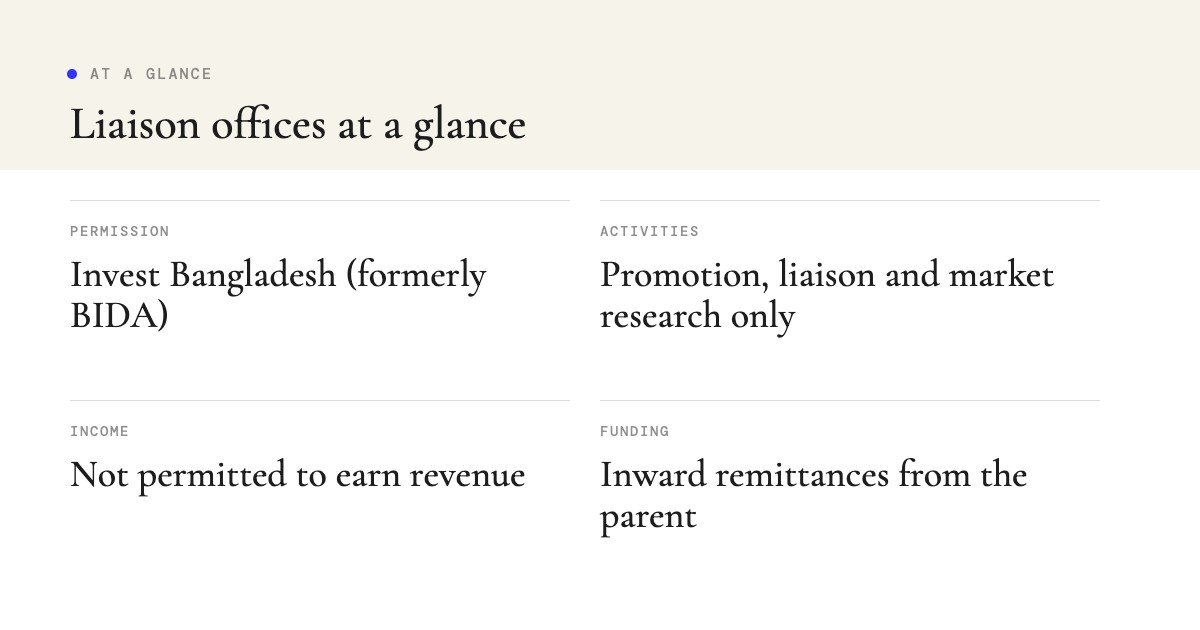
- A liaison office requires permission from Invest Bangladesh (formerly BIDA) and operates as part of the foreign parent.
- Permitted activities are limited to promotion, liaison, communication, market research and coordination; commercial activities are prohibited.
- All expenses must be funded by inward remittances from the parent through banking channels.
- Permission is time-limited and must be renewed, with audited accounts and remittance evidence.
- Exceeding permitted activities can create tax exposure and jeopardise renewal.
What a liaison office in Bangladesh can do
A liaison office acts as a communication channel between the parent company and parties in Bangladesh. Typical activities include promoting the parent’s products and services, conducting market research, liaising with buyers, suppliers, distributors and government agencies, monitoring quality and shipments for sourcing companies, and coordinating the parent’s business. It cannot sign sales contracts on its own behalf, issue invoices, receive income, or engage in trading, manufacturing or service provision for fees.
Our corporate practice advises foreign companies on choosing between liaison offices, branches and subsidiaries.
Liaison office in Bangladesh versus branch or subsidiary
| Feature | Liaison office | Branch office | Subsidiary |
|---|---|---|---|
| Income generation | Not permitted | Permitted for approved activities | Permitted |
| Legal personality | Part of parent | Part of parent | Separate company |
| Funding | Parent remittances only | Remittances and local income | Equity, loans and income |
| Approval | Invest Bangladesh | Invest Bangladesh | RJSC incorporation |
| Typical use | Market entry, sourcing, representation | Projects and contracts | Long-term operations |
Invest Bangladesh permission for a liaison office in Bangladesh
The application includes the parent’s certificate of incorporation and constitutional documents, latest audited accounts, a board resolution approving the office and appointing its head, a description of proposed activities, details of the office address and staffing, and other supporting documents. Foreign documents generally need notarisation and attestation by the Bangladesh mission. Permission is granted for a fixed period with conditions, often including a minimum inward remittance within a set time. Information is available from Invest Bangladesh.
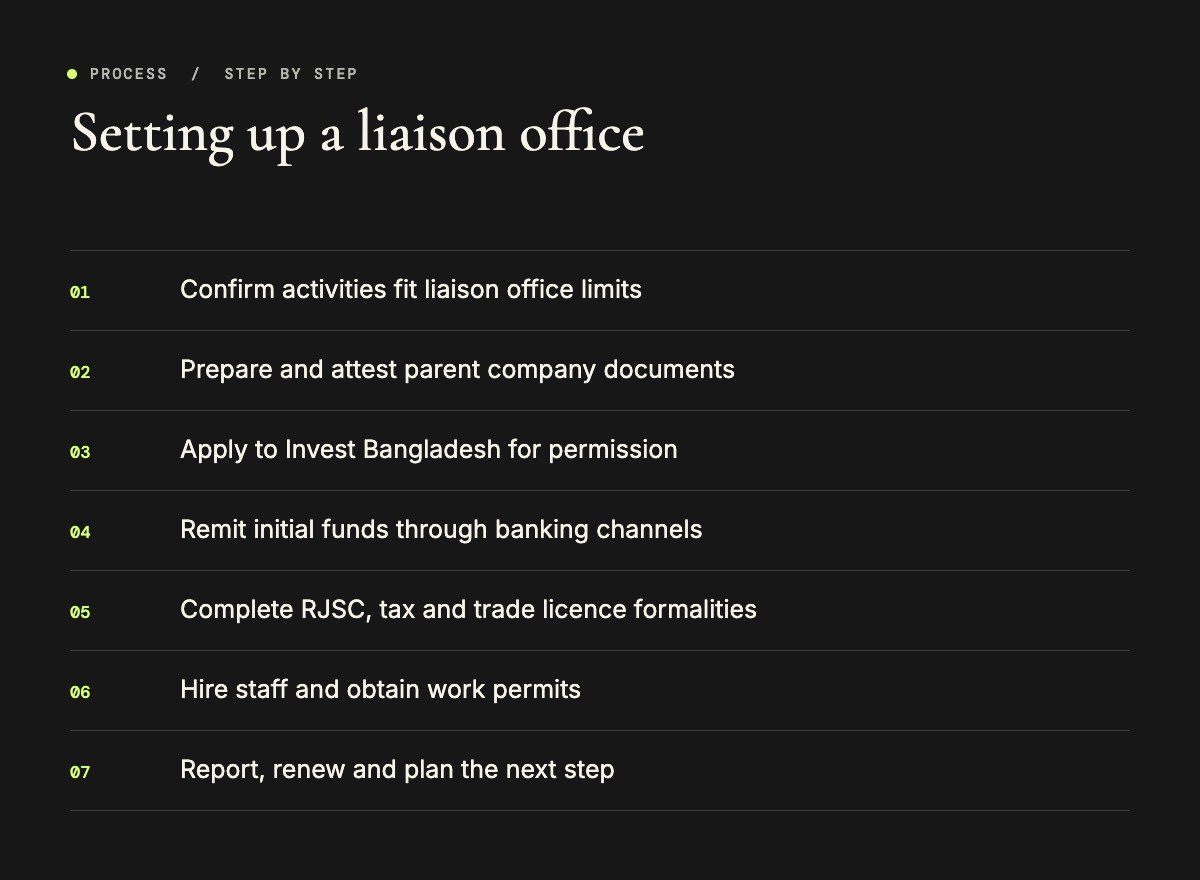
Setting up a liaison office
- Confirm scope. Ensure planned activities fit liaison office limits.
- Prepare documents. Notarise and attest parent company papers.
- Apply. File for permission with Invest Bangladesh.
- Remit funds. Bring initial capital through an authorised dealer bank.
- Local formalities. File required RJSC documents, obtain e-TIN and trade licence.
- Staff. Recruit locally and obtain work permits for expatriates.
- Comply and renew. Keep accounts, submit reports and renew before expiry.
Staff of liaison offices should avoid negotiating prices or concluding contracts on behalf of the parent. Doing so can create a taxable presence and breach permission conditions.
Funding a liaison office in Bangladesh
A liaison office opens a bank account with an authorised dealer bank to receive remittances from the parent and pay local expenses, such as rent, salaries and utilities. It cannot receive payments from customers. Each inward remittance should be supported by encashment certificates, which are needed for renewal applications and to repatriate unused funds on closure. Maintaining clean banking records is a core part of running a liaison office in Bangladesh.
Tax obligations of a liaison office in Bangladesh
Because a liaison office does not earn income, it generally does not pay corporate income tax on profits, but it must register for e-TIN, deduct tax at source on salaries, rent and payments to suppliers, deposit the tax and file withholding returns. Expatriate and local employees pay income tax on their salaries. If the office strays into commercial activities, tax authorities may treat the parent as having a permanent establishment and assess tax on attributed profits. VAT may apply to certain local purchases, and the office should keep proper records.
Staffing and work permits
Liaison offices employ local staff under the Bangladesh Labour Act 2006 or their contracts, depending on the role, and may employ expatriates with work permits from Invest Bangladesh. Permission conditions may limit the number of foreign staff. Employment contracts, payroll tax compliance and statutory benefits must be managed properly, as labour claims can arise even in small offices.
Renewal and reporting
Before permission expires, the office must apply for renewal, typically submitting audited accounts, tax returns and payment evidence, encashment certificates, an activity report and the parent’s confirmation of support. Late renewal can lead to penalties and difficulties with banking. Some permission conditions require periodic reports on activities and remittances. A compliance calendar keeps the liaison office in Bangladesh in good standing.
Who uses liaison offices
Liaison offices are popular with international apparel and footwear buyers that source from Bangladeshi factories, using local teams to monitor quality, compliance and shipments. Machinery and equipment suppliers use them to support local distributors and customers. Pharmaceutical, technology and engineering companies use them to explore market opportunities and maintain relationships with government agencies. In each case, a liaison office in Bangladesh provides presence without the cost and complexity of a fully operating entity.
For sourcing offices, the line between liaison and commercial activity requires care: monitoring factories is permitted, but providing paid services to third parties is not.
Office premises and trade licence
A liaison office needs a registered office address, usually leased commercial premises, and a trade licence from the local authority. Lease agreements should be in the name of the parent company acting through its liaison office, with the head of office authorised to sign. Holding tax and service charges must be accounted for. Moving premises requires updating Invest Bangladesh, the trade licence and bank records.
Compliance pitfalls for a liaison office in Bangladesh
Frequent problems include engaging in prohibited commercial activities, paying staff or rent in cash without records, failing to deduct withholding tax, late renewal, missing encashment certificates and not updating authorities after changes in office head or address. These issues often surface during renewal or when closing the office, causing delays. Regular internal reviews and local professional support help avoid them.
Converting to a subsidiary or branch
When the parent decides to start commercial operations, it usually incorporates a subsidiary or opens a branch, then winds down the liaison office. Staff, leases and assets may be transferred to the new entity. Planning the transition avoids gaps in permissions and ensures that the liaison office does not undertake commercial activities while the new entity is being set up.
Closing a liaison office in Bangladesh
Closure involves settling liabilities, paying staff dues, obtaining tax clearance, closing bank accounts, repatriating remaining funds with Bangladesh Bank documentation, surrendering the trade licence and informing Invest Bangladesh and the RJSC. Tax clearance can take time, so the parent should plan closure early and keep complete records of remittances and expenses throughout the life of the office.
Head of office and authority
The parent appoints a head of the liaison office through a board resolution and power of attorney, authorising them to represent the office before authorities, sign leases and employment contracts, operate bank accounts within limits and handle regulatory filings. The scope of authority should be clearly defined to prevent the head from binding the parent to commercial contracts. Changes in the head of office must be notified to Invest Bangladesh and the bank. Clear governance protects the parent and the office’s compliance record.
Accounting and audit
The office keeps books of account recording remittances received and expenses paid, and prepares annual financial statements audited by a chartered accountant. These accounts support renewal, tax filings and closure. Because the office has no income, the accounts essentially show how parent funds were used, and auditors will check that expenses are consistent with permitted activities.
Timeline and costs
With complete, attested documents, permission can often be obtained within weeks. The main costs are document preparation and attestation abroad, legal and filing fees, office rent, staff costs and audit fees. Compared with a subsidiary, a liaison office in Bangladesh is relatively inexpensive to maintain, which makes it a useful first step for companies testing the market.
Documents checklist
Typical documents include the parent’s certificate of incorporation, memorandum and articles or equivalent, latest audited accounts, a board resolution approving the liaison office and appointing its head, a power of attorney for the head, a company profile, passport copies of key persons, a proposed office lease or letter of intent, and an activity plan. Translations are needed for documents not in English. Notarisation and attestation by the Bangladesh mission are usually required for documents executed abroad, and the process can take several weeks depending on the country.
Preparing a complete, consistent file before applying is the most effective way to avoid queries and delays.
Data protection and communications
Liaison offices often handle personal data of local contacts, suppliers and employees, and share it with the parent abroad. The Personal Data Protection Act 2026 introduces obligations on handling and transferring personal data, so offices should adopt basic privacy policies, secure their systems and ensure that transfers to the parent are covered by appropriate safeguards. This is increasingly expected by multinational groups as part of global compliance programmes.
Practical checklist
Define permitted activities in writing for staff; keep all funding through banking channels with encashment certificates; deduct and deposit withholding tax; maintain audited accounts; diarise renewal dates; update authorities after changes; and review activities regularly to ensure the office stays within its permission. Following this checklist keeps a liaison office in Bangladesh compliant and ready for renewal or conversion when the business grows.
Parent companies should also brief their regional sales teams on the office’s limits, because visiting executives sometimes conclude deals locally in ways that blur the line between liaison and commercial activity, creating tax and regulatory risk for the whole group.
A short written protocol on who may negotiate and sign contracts, shared across the group, is a simple and effective safeguard against that risk.
Review the protocol whenever group structures or regional responsibilities change.
Frequently asked questions about liaison office in bangladesh
Who approves liaison offices?
Invest Bangladesh (formerly BIDA).
Can a liaison office earn income?
No, it must be funded entirely by the parent.
Can it sign contracts?
It should not conclude commercial contracts; it can sign leases and employment contracts for its own operation.
Does it pay tax?
It must comply with withholding and employee tax obligations, and file returns as required.
How long is permission valid?
For a fixed period, renewable on application.
Can it be converted?
Yes, many parents later establish a subsidiary or branch and close the liaison office.
How we can help
We handle permission, renewal, compliance and closure for every liaison office in Bangladesh we support, and advise on conversion to a subsidiary. See our corporate practice, our foreign direct investment team and our guide to business setup requirements.
Entering the Bangladesh market?
We set up your liaison office quickly and correctly.
Book a consultationCorporatePrimary sources: the Companies Act 1994 and the Income Tax Act 2023 on Laws of Bangladesh; permissions from Invest Bangladesh; foreign exchange rules from Bangladesh Bank.
This article is general information about Bangladeshi law as of October 2026 and is not legal advice. Permission conditions change; confirm current requirements with Invest Bangladesh.




0 Comments