
Most land in Bangladesh passes down through inheritance, and within two or three generations a single plot can be owned jointly (ejmali) by dozens of heirs. When co-owners cannot agree on who gets which part, a partition suit in Bangladesh asks the civil court to declare each person’s share and divide the land by metes and bounds, so that every co-sharer receives a separate, identifiable portion (saham) with its own title.
- Any co-sharer can sue for partition of joint property; every other co-sharer must be made a party.
- Partition suits proceed in two stages: a preliminary decree declaring shares and a final decree dividing the land.
- An advocate commissioner usually surveys the land and proposes the division for the court to approve.
- The Partition Act 1893 allows sale instead of physical division in some cases and lets co-sharers buy out a stranger’s share of a family dwelling house.
- A registered amicable partition deed is faster and cheaper where all co-sharers agree.
When you need a partition suit in Bangladesh
Joint ownership causes practical problems. No co-sharer can sell a specific portion with certainty, build safely, obtain a loan against the land or develop it with a developer, because the boundaries of each share are undefined. Disputes arise over who cultivates which part, who receives rent and who pays land development tax. A purchaser who buys from one co-sharer acquires only that co-sharer’s undivided interest, not a defined plot.
A partition suit in Bangladesh resolves these problems by converting undivided shares into separate holdings. It is also the usual route when a stranger has bought into a family property and the remaining heirs want the boundaries fixed, or when one co-sharer is in exclusive possession and refuses to share.
Our civil litigation team, described on our about page, acts for heirs and purchasers in partition and title disputes across Bangladesh.
The legal framework for a partition suit in Bangladesh
| Source | What it does |
|---|---|
| Code of Civil Procedure 1908 | Governs the suit; Order XX rule 18 provides for preliminary and final decrees and Order XXVI for commissions |
| Partition Act 1893 | Allows sale instead of division and buy-out of a stranger’s share in a dwelling house |
| Personal inheritance law | Muslim, Hindu and other personal laws fix each heir’s share |
| State Acquisition and Tenancy Act 1950 | Governs land records, mutation and related rights such as pre-emption |
| Registration Act 1908 | Requires registration of amicable partition deeds |
These statutes are available on Laws of Bangladesh.
Who are the parties to a partition suit in Bangladesh
A partition suit is unusual because every co-sharer has an interest in the outcome. All co-sharers, including purchasers from heirs, must be joined, either as plaintiffs or defendants. A suit that leaves out a necessary co-sharer is defective and the decree may not bind the missing party. Courts often describe partition as a suit in which every party is both plaintiff and defendant, because each defendant can claim their own saham in the same proceeding by paying the appropriate court fee.
Identifying all heirs is often the hardest part of the case. Family trees can span several generations, heirs may live abroad, and some shares may have been sold informally. A careful title search and succession analysis should be done before filing.
Filing a partition suit in Bangladesh step by step
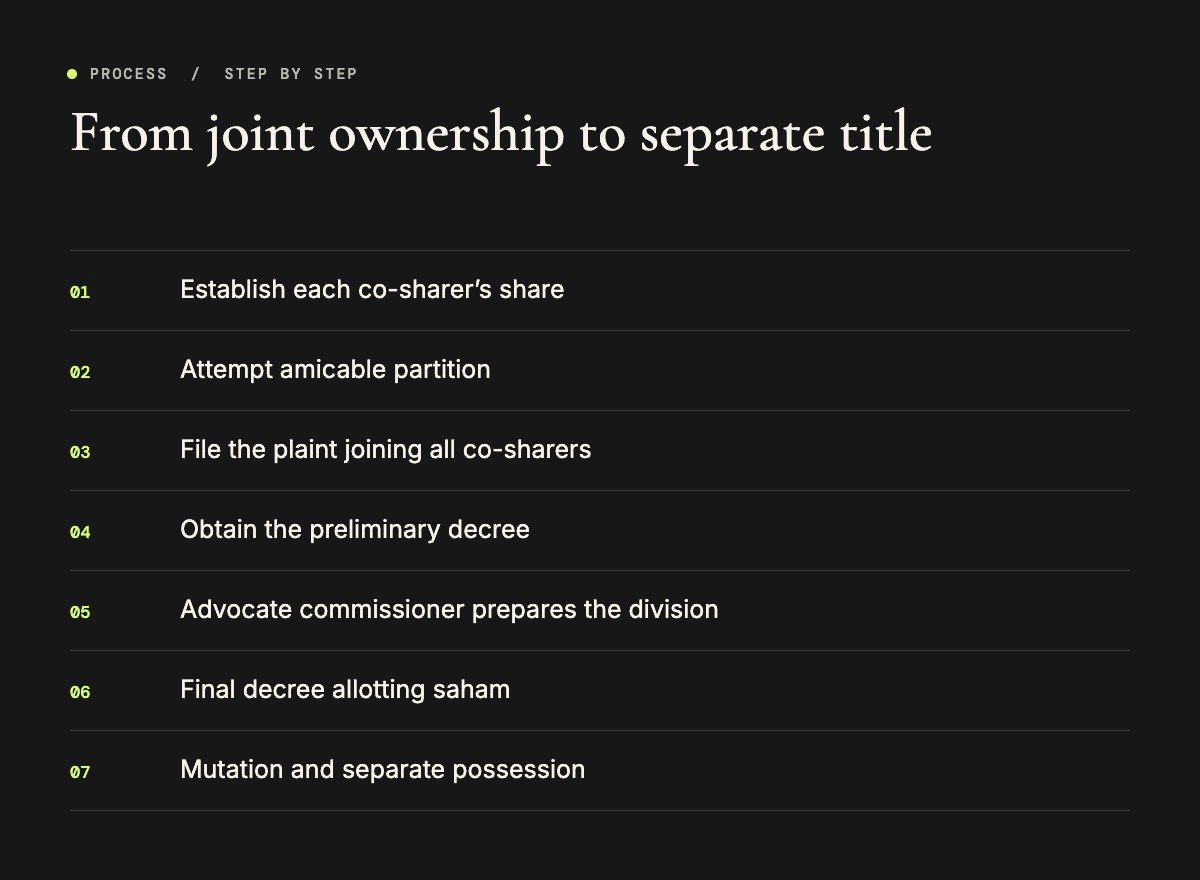
- Establish shares. Trace title through deeds, khatians and succession to calculate each co-sharer’s fraction.
- Try amicable partition. Propose a division and, if agreed, register a batwara deed.
- File the plaint. Join every co-sharer and describe the whole joint property (hotchpotch).
- Preliminary decree. The court determines title and declares each party’s share.
- Commission. An advocate commissioner surveys and proposes the division on the ground.
- Final decree. The court considers objections and allots specific sahams.
- Mutation and possession. Each party mutates their saham and takes separate possession.
Include all joint properties in a single suit. Courts generally require the whole hotchpotch to be partitioned together so that equities can be adjusted, and piecemeal suits are open to objection.
The preliminary decree
At the first stage the court decides questions of title: who the co-sharers are, what each owns, whether any party has acquired title by purchase, gift or adverse possession, and whether any property is excluded from the hotchpotch. Evidence includes deeds, the CS, SA, RS and BS khatians, mutation records and inheritance documents such as succession or warish certificates. The preliminary decree declares the shares and directs that the property be divided accordingly.
A preliminary decree is appealable, and many partition disputes are effectively decided at this stage, because once the shares are fixed the division itself is largely a technical exercise.
The advocate commissioner and the final decree
After the preliminary decree, the court appoints an advocate commissioner, often assisted by a surveyor, to inspect the land, take measurements and prepare a report and map dividing the property. The commissioner tries to give each party land of comparable quality, to allot the portion a co-sharer already possesses or has developed where fair, and to preserve access. Parties may file objections to the report, and the court can confirm, modify or send it back.
The final decree allots specific plots to each party, describing boundaries by dag numbers and measurements. Once the final decree is drawn up on stamp paper as required, it operates as the instrument of partition and is used for mutation of separate holdings.
Equitable adjustments in a partition suit in Bangladesh
Partition is an equitable proceeding, and the court tries to be fair rather than mechanical. A co-sharer who has built a house on part of the land in good faith will usually be allotted that portion, with an adjustment if it exceeds their share. A purchaser from one co-sharer who has been in possession of a particular plot is usually given that plot out of the vendor’s share. Where exact division is impossible, owelty money (a payment to equalise shares) can be ordered.
Sale and buy-out under the Partition Act 1893
Where physical division is impracticable, for example a small house or a shop that cannot be split, section 2 of the Partition Act 1893 allows the court, on request of co-sharers holding a sufficient interest, to order sale and distribute the proceeds. Section 4 gives family members special protection: where a share of a dwelling house belonging to an undivided family has been transferred to a stranger who sues for partition, the other members can buy that share at a value fixed by the court. This keeps family homes from being forcibly divided by outsiders.
Amicable partition by registered deed
If all co-sharers agree, partition can be done without a suit by executing a registered partition (batwara) deed at the sub-registry office. The deed must describe each party’s allotted portion with schedules and maps, and all co-sharers must sign. Registration fees and stamp duty apply. An unregistered family arrangement may still be relevant as evidence of possession, but it does not give the same certainty, and buyers and banks usually insist on a registered deed or a court decree. Our guide to land registration explains the registration process.
How long a partition suit in Bangladesh takes
Contested partition suits are notoriously slow, often running for many years through the preliminary decree, commission, final decree and appeals. Delays come from the number of parties, service on heirs abroad, deaths of parties during the suit requiring substitution, and disputes over the commissioner’s report. A well-prepared case with a complete family tree and title chain, and with cooperative parties, can move much faster. Mediation under the Code of Civil Procedure is available and can resolve the case at any stage.

Costs and court fees in a partition suit in Bangladesh
Court fees in partition suits depend on how the suit is valued and whether the plaintiff claims to be in joint possession, under the Court-fees Act 1870 and related rules. Defendants who seek allotment of their own saham pay fees on their share. Other costs include the commissioner’s fees, survey costs and certified copies of land records. These costs are usually shared by the parties in proportion to their shares, subject to the court’s order.
Heirs living abroad
Many co-sharers in family land live overseas, particularly in the United Kingdom, the Middle East and North America. They can participate through a registered power of attorney executed abroad and attested by the Bangladesh mission, authorising a relative or lawyer to appear, give evidence and accept allotment of their saham. Service of summons on heirs abroad can delay the case, so plaintiffs should collect current addresses early. Our guide to power of attorney explains the process.
Partition and development agreements
Urban land in Dhaka and Chattogram is increasingly developed under joint venture agreements with developers. Developers generally insist that all co-owners sign the development agreement or that the land is first partitioned, because an agreement signed by only some co-sharers can be challenged. Where some heirs refuse to cooperate, a partition suit in Bangladesh may be the only way for the willing co-owners to obtain a defined plot they can develop.
Common mistakes to avoid
Common mistakes include omitting co-sharers, leaving some joint properties out of the hotchpotch, relying on incorrect khatian entries without checking the chain of title, failing to substitute heirs when a party dies, and selling a specific portion of undivided land before partition. Each can derail or delay the case.
Temporary injunctions during a partition suit in Bangladesh
While the suit is pending, a co-sharer may try to build on, sell or change the character of the joint land. The court can grant a temporary injunction to preserve the status quo, or appoint a receiver to collect rents and manage income-producing property until the final decree. Applying early protects every party’s eventual saham.
Frequently asked questions about partition suit in bangladesh
Who can file a partition suit?
Any co-sharer, including a purchaser of an undivided share, can file.
Must all heirs be parties?
Yes, every co-sharer is a necessary party, otherwise the decree may not bind them.
Is there a time limit?
A co-sharer in joint possession can generally sue at any time, but a claim may be lost if another party proves ouster and adverse possession.
Can the court sell the property?
Yes, under the Partition Act 1893 where division is impracticable.
Can we partition without going to court?
Yes, by a registered partition deed signed by all co-sharers.
What happens after the final decree?
Each party mutates their saham and takes separate possession.
How we can help
We act in every stage of a partition suit in Bangladesh, from title research and succession analysis to amicable partition deeds, trial, commission objections, appeals and mutation. Learn more about our practice and our guides to succession certificates and types of civil cases.
Stuck in joint ownership?
We help families divide land fairly and securely.
Book a consultationAbout usPrimary sources: the Code of Civil Procedure 1908, the Partition Act 1893, the Registration Act 1908 and the State Acquisition and Tenancy Act 1950 on Laws of Bangladesh; land records and mutation via Ministry of Land.
This article is general information about Bangladeshi civil law as of October 2026 and is not legal advice. Take advice on your circumstances.




0 Comments