
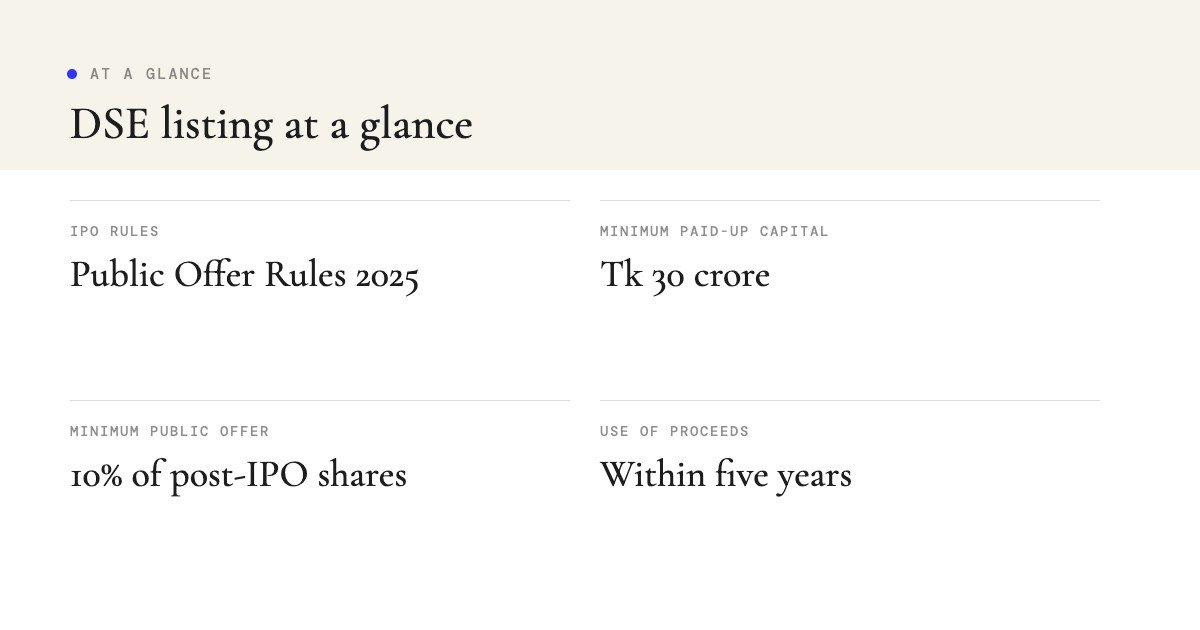
Listing on Dhaka Stock Exchange gives a company access to public capital, liquidity for shareholders and a higher profile with lenders and partners. Since 30 December 2025, IPOs have been governed by the BSEC (Public Offer of Equity Securities) Rules 2025, which set a minimum paid-up capital of Tk 30 crore, require at least 10 percent of post-IPO shares to be offered, and give the stock exchanges a formal role in reviewing applications before BSEC grants final consent.
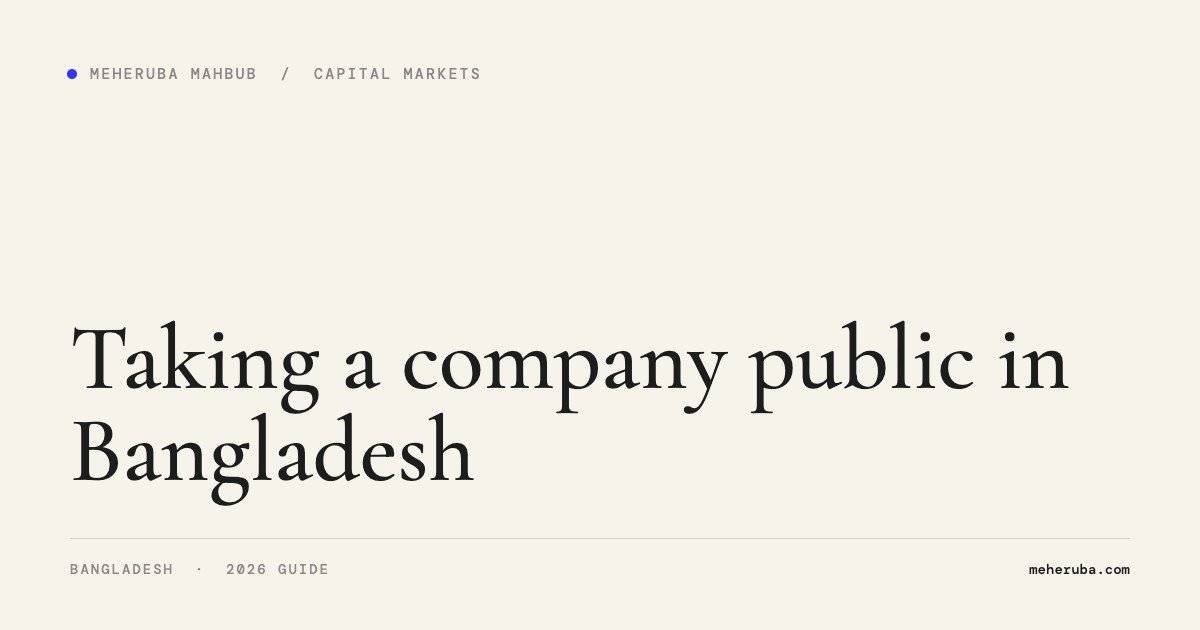
- The BSEC (Public Offer of Equity Securities) Rules 2025, gazetted on 30 December 2025, now govern IPOs and replaced the earlier public issue framework.
- Companies seeking an IPO listing need a paid-up capital of at least Tk 30 crore and must offer at least 10 percent of post-IPO shares to the public.
- The stock exchanges give preliminary approval, and BSEC grants final consent based on their recommendations.
- IPO proceeds must be used within five years of completing the offering, in line with the disclosed plan.
- After listing, companies face continuing disclosure, governance and shareholding obligations under BSEC rules and DSE listing regulations.
Why consider listing on Dhaka Stock Exchange
The Dhaka Stock Exchange is Bangladesh's main securities market. Listing allows a company to raise equity without increasing debt, gives existing shareholders a route to partial exit, improves transparency and can strengthen access to bank finance. It also brings obligations: public scrutiny, regulatory oversight and the discipline of quarterly reporting. Listing on Dhaka Stock Exchange suits companies with a strong track record, sound governance and a clear plan for using new capital.
Many companies list on both the Dhaka and Chittagong stock exchanges. Our capital markets practice and equity capital markets team advise issuers through every stage.
The 2025 rules at a glance
| Requirement | Position under the 2025 rules |
|---|---|
| Legal basis | BSEC (Public Offer of Equity Securities) Rules 2025 |
| Effective date | On gazette publication, 30 December 2025 |
| Minimum paid-up capital | Tk 30 crore |
| Minimum offer size | At least 10 percent of post-IPO shares |
| Approval process | Exchange preliminary approval, then BSEC final approval |
| Use of proceeds | Must be completed within five years of the offering |
The rules also address pricing methods, investor quotas, lock-in of sponsor and pre-IPO shares, disclosure and the responsibilities of issue managers and auditors. Issuers should read the full text, as detailed requirements determine eligibility and timing for listing on Dhaka Stock Exchange.

Eligibility and readiness
Beyond the capital threshold, a company planning an IPO should have audited financial statements for the required number of years, a credible profit track record or business plan as the rules require, clean title to key assets, proper corporate records and compliance with tax, VAT, labour and environmental laws. The company must be a public limited company, so a private company must convert before applying. Related-party transactions, loans to sponsors and contingent liabilities will be scrutinised.
Start a pre-IPO health check at least a year before filing. Fixing title defects, related-party loans, missing licences and governance gaps is far easier before the prospectus is drafted than when regulators raise them.
The IPO process
- Readiness and restructuring. Convert to a public company, clean up the group structure and resolve legal issues.
- Appoint advisers. Engage a BSEC-registered issue manager, auditors, legal counsel, a valuer where required and registrar to the issue.
- Prepare documents. Draft the prospectus, financial statements, valuation reports and due diligence certificates.
- Exchange review. Submit the application to the stock exchange for preliminary review and approval.
- BSEC consent. BSEC reviews the application and the exchange's recommendation before granting consent.
- Subscription. Publish the prospectus summary, open subscription and allot shares according to the rules.
- Listing. Shares are credited to investors' BO accounts and trading begins.
Governance requirements
Listed companies must comply with the BSEC Corporate Governance Code 2018, including independent directors, audit and nomination and remuneration committees, qualified company secretaries and CFOs, and detailed annual report disclosures. BSEC has also required sponsors and directors to maintain minimum shareholdings. Building these structures before listing on Dhaka Stock Exchange makes the transition smoother and reassures investors.
Disclosure and continuing obligations
After listing, companies must publish quarterly and annual financial statements within deadlines, disclose price-sensitive information promptly through the exchanges, hold AGMs on time, distribute dividends according to rules and report on the use of IPO proceeds. Sponsors and directors must declare trades in advance, and insider trading rules apply. Failure to comply can result in fines, trading restrictions or downgrading to a lower market category.
SME and alternative boards
Smaller companies that do not meet main board requirements can consider the SME platform, which uses qualified investor offerings with lower thresholds, or other alternative trading arrangements. These routes provide access to capital markets with lighter requirements, and some SME-listed companies later migrate to the main board.
Legal due diligence before listing
Legal due diligence is the foundation of a credible prospectus. Before listing on Dhaka Stock Exchange, counsel reviews the company's incorporation documents and capital history, share transfers, title to land and buildings, material contracts, licences and permits, loans and security, litigation, intellectual property, employment practices and regulatory compliance. Findings are fixed where possible or disclosed as risk factors. Weak due diligence can lead to regulatory queries, delays and, after listing, liability for misstatements.
Particular attention goes to related-party transactions, which BSEC scrutinises closely, and to any loans or guarantees involving sponsors. Clean, documented arrangements make listing on Dhaka Stock Exchange smoother and build investor trust.
Valuation and pricing
The 2025 rules set out how offer prices are determined, including fixed price and market-based methods and the role of eligible investors in price discovery. Valuation reports, peer comparisons and earnings projections must be prepared carefully and disclosed accurately. Overpricing has historically damaged investor confidence and led to regulatory intervention. A realistic price supports good after-market performance, which benefits the company's reputation following listing on Dhaka Stock Exchange.
Sponsor lock-in and shareholding rules
Sponsors, directors and pre-IPO investors are subject to lock-in periods on their shares after listing, so they cannot sell immediately. BSEC rules also require sponsors and directors to maintain minimum shareholdings and to declare trades in advance. Pre-IPO placements must follow rules on pricing and disclosure. Sponsors should plan their holdings before listing on Dhaka Stock Exchange, including any family or group restructuring, to avoid breaching these requirements later.
Liability for the prospectus
The company, its directors, the issue manager, auditors and other experts can be liable for untrue or misleading statements in the prospectus under securities laws. BSEC can impose penalties, and investors may bring claims. Directors should take the verification process seriously, check every material statement and ensure that risk factors are complete. Robust disclosure is the best protection for everyone involved in listing on Dhaka Stock Exchange.
Costs of an IPO
IPO costs include issue management and underwriting fees, legal and audit fees, valuation fees, BSEC and exchange fees, CDBL charges, printing and publication costs, and marketing expenses. The rules and market practice limit some fees, and costs are disclosed in the prospectus. Ongoing listing costs include annual fees, enhanced audit and governance costs and investor relations. Companies should budget for these when deciding whether listing on Dhaka Stock Exchange makes financial sense.
Foreign investors and multinational subsidiaries
Subsidiaries of multinational companies in Bangladesh have listed shares to share ownership with local investors and build their brand. Foreign shareholders must comply with foreign exchange rules when selling shares in an offer or receiving dividends. Some regulators have encouraged multinationals to list, and listing can support relationships with government and the public. A multinational considering listing on Dhaka Stock Exchange should coordinate the parent's global governance policies with local rules.
Market categories and investor confidence
Listed companies are classified into market categories based on factors such as dividend payment, AGM compliance and financial performance. Falling into a lower category can reduce investor interest and restrict margin lending on the shares. Maintaining regular dividends where possible, holding AGMs on time and keeping disclosure current protect a company's standing after listing on Dhaka Stock Exchange. Investor relations, including clear communication about strategy and results, also supports a stable share price.
Delisting and voluntary exit
A company that fails to meet listing requirements persistently may face suspension or delisting under exchange regulations and BSEC directions. Voluntary delisting is possible in limited circumstances, usually requiring a buy-back offer to public shareholders at a fair price and regulatory approval. Because delisting is difficult, companies should treat listing on Dhaka Stock Exchange as a long-term commitment.
Practical timeline
A well-prepared company can move from adviser appointment to listing in around a year, but timelines vary with the readiness of financial statements, the complexity of restructuring, regulatory queries and market conditions. Early preparation of audited accounts, legal clean-up and governance changes is the best way to shorten the path to listing on Dhaka Stock Exchange.
Checklist for boards
- Confirm the company meets the Tk 30 crore capital and 10 percent offer requirements.
- Commission a legal and financial health check.
- Appoint experienced, BSEC-registered advisers.
- Establish independent directors and board committees.
- Plan the use of proceeds and the timeline for deploying them within five years.
- Prepare systems for quarterly reporting and continuous disclosure.
Tax and dividend considerations
Listed companies have historically enjoyed a lower corporate tax rate than non-listed companies, subject to conditions such as a minimum free float, though rates and conditions are set in each year's Finance Act and should be checked. Dividend income is subject to withholding tax for shareholders. Capital gains on listed shares have had specific tax treatment for individuals. These tax features can make listing on Dhaka Stock Exchange more attractive, but they should be confirmed with tax advisers because they change frequently. A clear dividend policy, disclosed in the prospectus, helps investors understand what to expect.
Working with the regulators
Under the 2025 framework, the exchange's review and BSEC's final consent both involve queries and clarifications. Prompt, complete responses keep the timetable on track. Treating listing on Dhaka Stock Exchange as a partnership with regulators, rather than a box-ticking exercise, usually produces faster approvals.
Frequently asked questions about listing on dhaka stock exchange
Which rules govern IPOs now?
The BSEC (Public Offer of Equity Securities) Rules 2025, gazetted on 30 December 2025.
What is the minimum paid-up capital?
Tk 30 crore for companies seeking an IPO listing.
How much must be offered to the public?
At least 10 percent of post-IPO shares.
Who approves an IPO?
The stock exchange gives preliminary approval and BSEC grants final consent.
How long can IPO proceeds be used?
Utilisation must be completed within five years of the offering.
Can small companies list?
Yes, through the SME platform with lower thresholds, subject to its rules.
How we can help
We advise issuers, sponsors and underwriters on listing on Dhaka Stock Exchange: pre-IPO restructuring, legal due diligence, prospectus disclosure, BSEC and exchange approvals, governance and post-listing compliance. Learn more about our capital markets practice.
Considering an IPO?
We assess your readiness, fix legal issues early and guide you through the 2025 rules to a successful listing.
Book a consultationCapital markets practicePrimary sources: the BSEC (Public Offer of Equity Securities) Rules 2025 and Corporate Governance Code published by BSEC; listing regulations of the Dhaka Stock Exchange; securities laws on the Laws of Bangladesh portal.
This article is general information about Bangladeshi capital markets regulation as of October 2026 and is not legal or investment advice. Rules and thresholds may change; confirm current requirements with BSEC or a qualified lawyer.


0 Comments