
BSEC approval is required far more often than most company owners expect. It is not only for IPOs: an unlisted public company raising capital from new investors, a company issuing bonds, an acquirer crossing takeover thresholds and every market intermediary all need the consent of the Bangladesh Securities and Exchange Commission first.
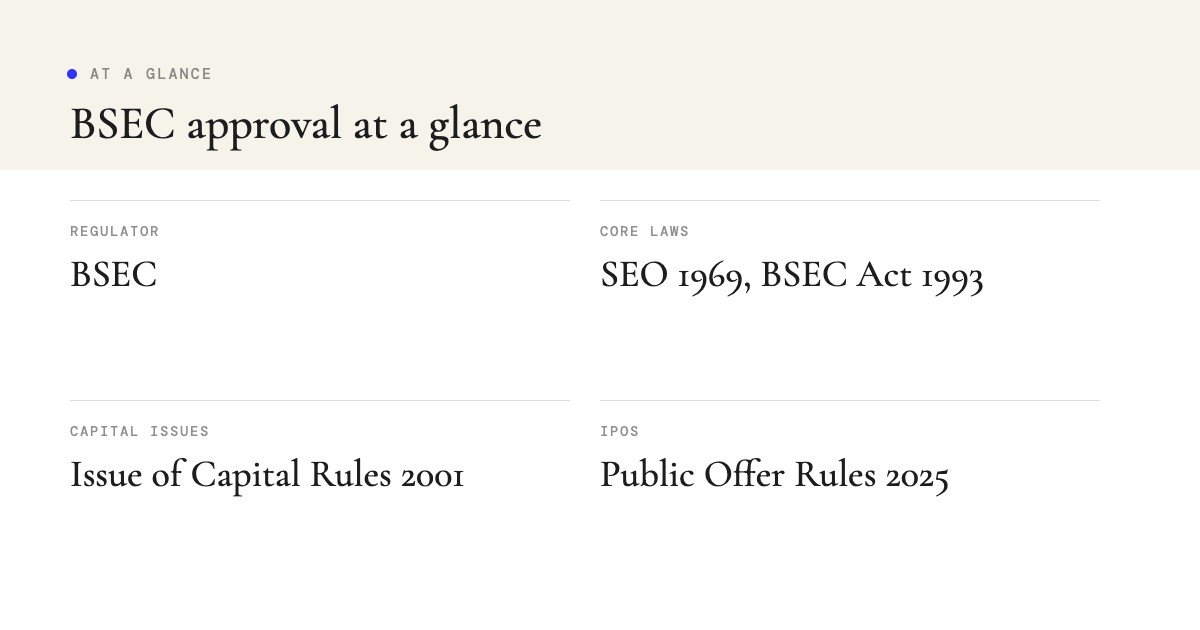
- BSEC's consent powers come mainly from the Securities and Exchange Ordinance 1969 and the Bangladesh Securities and Exchange Commission Act 1993, implemented through transaction-specific rules.
- Section 2A of the Ordinance and the Issue of Capital Rules 2001 require public companies to obtain consent before raising paid-up capital beyond the exempted limit.
- IPOs are now governed by the Public Offer of Equity Securities Rules 2025, gazetted on 30 December 2025, under which stock exchanges give preliminary approval and BSEC gives final approval.
- Bonds and other debt securities, including privately placed issues, need consent under the Debt Securities Rules 2021.
- Raising money first and seeking post-facto approval later has led to penalties; plan consent into the transaction timetable.
What BSEC approval means
The Bangladesh Securities and Exchange Commission (BSEC) regulates the issue of securities, the stock exchanges, market intermediaries and collective investment schemes. When a law or rule says a step needs the Commission's consent, the company must apply, satisfy BSEC's disclosure and eligibility requirements, and receive a consent letter before acting.
BSEC approval is usually conditional. The consent letter typically sets the amount and purpose of the issue, the period within which it must be completed, lock-in requirements for sponsors, and reporting obligations afterwards. Breaching those conditions is itself a violation, even when the original consent was properly obtained.
The legal framework
Two statutes underpin the system. The Securities and Exchange Ordinance 1969 contains the core rules on issue of capital, disclosure and enforcement, including the Commission's power to make rules and impose penalties. The Bangladesh Securities and Exchange Commission Act 1993 establishes BSEC and sets out its functions. Detailed requirements sit in rules made under them, several of which have been replaced since 2024 as part of a broader reform of the capital market.
The Companies Act 1994 also matters. A private company must, by its articles, prohibit invitations to the public to subscribe for its shares, so any public offering requires conversion to a public limited company first.
When BSEC approval is needed
The table below maps the most common transactions to the rules that require BSEC approval. It is a starting point; the exact rule depends on the issuer, the instrument and the investors.
| Transaction | Main rules | Who approves |
|---|---|---|
| Capital raising by an unlisted public company | Ordinance s.2A; Issue of Capital Rules 2001 | BSEC |
| Initial public offering | Public Offer of Equity Securities Rules 2025 | Stock exchange (preliminary), BSEC (final) |
| Small capital company offer to qualified investors | Qualified Investor Offer by Small Capital Companies Rules 2022 | Stock exchange recommendation, BSEC consent |
| Rights issue by a listed company | Rights Issue Rules 2006 | BSEC |
| Bonds and other debt securities | Debt Securities Rules 2021 | BSEC |
| Sukuk | Investment Sukuk Rules 2019 | BSEC |
| Substantial acquisitions and takeovers of listed companies | Substantial Acquisition of Shares and Takeovers Rules 2018 | BSEC |
| Mutual funds and alternative investment funds | Mutual Fund and Alternative Investment rules | BSEC registration |
| Brokers, merchant bankers, asset managers, rating agencies | Licensing rules for each intermediary | BSEC registration |

BSEC approval for capital raising by unlisted public companies
This is the requirement most often missed. Under section 2A of the Securities and Exchange Ordinance 1969, a public limited company that wants to raise paid-up capital beyond the limit exempted by BSEC must first obtain the Commission's consent. The procedure is set out in the Securities and Exchange Commission (Issue of Capital) Rules 2001, as amended up to 2021.
The application includes the memorandum and articles, certificate of incorporation, list of directors, audited or provisional accounts, the purpose of the issue, the board resolution, and a bank certificate or statement showing the money deposited for the capital. Where capital is issued for consideration other than cash, the vendor agreement is also filed.
Raising capital from new investors
A 2011 BSEC notification adds a further layer. Where an unlisted public company wants to raise capital from persons other than its existing shareholders, it must prepare an offer document or information memorandum through a merchant banker and file it with BSEC for prior consent. In practice, that means a private placement by a public company is a regulated offering, not an informal fundraise.
BSEC has penalised unlisted public companies that raised capital first and then applied for post-facto approval. A penalty order is public, damages credibility with investors and banks, and can complicate a later IPO. The safer course is to treat BSEC approval as a condition precedent in the subscription agreement.
Private limited companies have historically fallen within the exemptions, which is one reason start-ups and joint ventures stay private until a listing is planned. Exemption limits are set by BSEC notification and change over time, so confirm the current position before any allotment by a public company, even a small one.
IPOs under the 2025 public offer rules
The Bangladesh Securities and Exchange Commission (Public Offer of Equity Securities) Rules 2025 were gazetted on 30 December 2025 and took effect on publication, replacing the earlier public issue framework. As reported at the time, the rules require a minimum paid-up capital of Tk 30 crore for a listing, an offer of at least 10 percent of post-IPO shares to the public, and use of IPO proceeds within five years of completion.
The approval route has also changed. The stock exchange now gives preliminary approval and recommends the application, and BSEC gives final approval on the basis of that recommendation. Issuers therefore deal with the Dhaka Stock Exchange or Chittagong Stock Exchange in depth before the file reaches the Commission.
Preparing for the IPO process
- Convert to a public limited company and align the articles with listing requirements.
- Produce audited accounts that meet the rules' age and standards requirements.
- Appoint an issue manager, underwriters where required, and a credit rating company where the rules require a rating.
- Clean up corporate records, including annual returns, charges and related-party transactions.
- Confirm that the company and its directors are not loan defaulters in the Bangladesh Bank credit information bureau report.
In September 2026, BSEC also published draft rules on direct listing of securities without a fresh issue, for public comment. Those rules were not in force at that date, so check their status before planning a listing without an IPO.
Bonds, sukuk and other debt securities
Corporate bonds have become an important funding source, especially for banks raising subordinated capital and for infrastructure. Under the BSEC (Debt Securities) Rules 2021, an issuer needs BSEC approval for a public offer of debt securities and also for privately placed issues, with the trustee, rating, information memorandum and use-of-proceeds requirements the rules set out.
Sukuk follow the Investment Sukuk Rules 2019, which add Shariah supervisory requirements to the usual disclosure package. Green bonds and other labelled issues follow BSEC guidance on top of the general rules. Banks issuing capital instruments also need Bangladesh Bank's regulatory clearance alongside BSEC approval, so the two applications should be planned together.
Our debt capital markets practice advises issuers and trustees on structuring these instruments.
Acquisitions and changes of control in listed companies
A buyer of shares in a listed company is not simply party to a private contract. The Substantial Acquisition of Shares and Takeovers Rules 2018 require disclosure when an acquirer crosses specified thresholds and, at higher levels, a public announcement and an offer to other shareholders, with BSEC overseeing the process. Sponsors and directors of listed companies also face advance-disclosure rules before they buy or sell shares.
These obligations sit alongside insider dealing and price-sensitive information rules. Negotiations to buy a significant stake in a listed company should be run under strict confidentiality, with the disclosure timetable agreed with advisers in advance. For unlisted targets, the share transfer process is simpler and is covered in our guide to company share transfer in Bangladesh.
Where other regulators come in
Acquiring a listed bank, finance company or insurer also needs the sector regulator's consent, and some transactions raise competition questions under the Competition Act 2012. Foreign acquirers must route funds through authorised dealer banks under Bangladesh Bank's foreign exchange rules. BSEC approval is therefore one strand of a wider clearance plan.
Licences for intermediaries and funds
Anyone who wants to operate as a stock broker or dealer, merchant banker, portfolio manager, asset manager, trustee, custodian or credit rating company needs registration from BSEC under the rules for that activity. Mutual funds and alternative investment funds, including private equity and venture capital funds, must also be registered, and their sponsors and managers must meet capital and governance requirements.
The rules for several of these activities have been revised or proposed for revision since 2024. Before applying, check the current rule on the BSEC website, including any draft published for comment, because transitional provisions often apply to pending applications.
How to obtain BSEC approval: step by step
Every consent has its own rule, but most applications follow the same pattern. Good preparation is the main driver of how quickly consent arrives.
- Classify the transaction. Identify which rule applies: issue of capital, public offer, qualified investor offer, rights issue, debt securities, takeover or licensing. Getting this wrong wastes months.
- Assemble the team. Appoint the merchant banker or issue manager, auditor, valuer, trustee or rating agency as the rule requires, and legal counsel to coordinate.
- Pass the resolutions. Obtain board approval and, where the articles or the Companies Act 1994 require it, shareholder approval, including any increase in authorised capital filed with RJSC.
- Prepare the disclosure document. Draft the prospectus, offer document or information memorandum with audited accounts, use of proceeds and risk factors.
- File the application. Submit the application in the prescribed form with the supporting documents and the application fee set by the relevant rule.
- Respond to queries. BSEC, and for public offers the stock exchange, will raise observations. Answer them fully and consistently in a single response where possible.
- Comply after consent. Pay the consent fee within the time allowed, complete the issue within the consent period, observe lock-ins and file post-issue reports.
A practical checklist before filing
- Is the company's RJSC file up to date, including annual returns, charges and any increase in authorised capital?
- Do the audited accounts meet the age limit in the relevant rule, and has the auditor been appointed properly?
- Are the purpose of the issue and the use of proceeds described specifically enough to survive review?
- Have all sponsors and directors confirmed they are not loan defaulters and have no unresolved regulatory issues?
- Is the money held in a separate bank account pending BSEC approval, as most rules expect?
- Has every earlier allotment by the company been properly approved, or does a past issue need regularising first?
An application that answers these questions before filing usually moves through review with one round of observations rather than several. Most delays come from inconsistencies between the application, the accounts and the RJSC record, not from the substance of the transaction.
Timelines and fees
The Issue of Capital Rules 2001 require BSEC to decide a complete application within 60 days, allow it to ask for missing information, and give a right of review against a rejection. Other rules set their own timelines, and the stock exchange stage for public offers adds time.
Fees comprise a non-refundable application fee and a consent fee calculated on the amount raised; the figures are set in each rule and amended from time to time, so check the current schedule before budgeting. Build the BSEC approval period, and any stock exchange stage, into the subscription or underwriting agreement as a long-stop date rather than a fixed closing date.
Consequences of proceeding without consent
Acting without consent exposes the company and its directors to enforcement under the Securities and Exchange Ordinance 1969, including monetary penalties imposed by the Commission. BSEC can also direct corrective action, refuse later applications or attach stricter conditions to them.
The commercial consequences are often worse than the penalty. Investors who subscribed without proper BSEC approval may question the validity of their shares or seek to unwind the investment. Banks and auditors raise the issue in due diligence. And an IPO applicant with an unresolved history of unapproved capital raising faces a much harder review.
Convertible loans and preference shares issued by a public company can also amount to an issue of capital requiring BSEC approval when converted or allotted. Review the conversion mechanics before signing an investment agreement, not at the point of conversion.
Foreign investors and non-resident Bangladeshis
Foreign participation adds a foreign exchange layer to every consent. Non-resident investors buy listed shares through a Non-resident Investor's Taka Account maintained with an authorised dealer bank, which allows dividends and sale proceeds to be repatriated under Bangladesh Bank's foreign exchange rules. Portfolio investment of this kind does not need individual BSEC approval, but the investor remains subject to takeover, disclosure and insider dealing rules.
Where a foreign investor subscribes for new shares in an unlisted public company, two sets of rules apply together. The issuing company needs BSEC approval for the capital issue if it exceeds the exempted limit, and the subscription money must come in through an AD bank and be reported. On exit, a sale of unlisted shares by a non-resident follows Bangladesh Bank's FEID Circular No. 01 of 8 March 2026, which consolidated the earlier instructions on valuation and repatriation of sale proceeds.
Foreign investors should also check whether the target is in a sector with foreign ownership caps or sector licensing, and coordinate the timetable with Invest Bangladesh (formerly BIDA) where registration or work permits are involved.
Frequently asked questions about BSEC approval
Does a private limited company need BSEC approval to issue shares?
Generally not, because private companies cannot invite the public to subscribe and have historically fallen within BSEC's exemptions. Exemption limits change, so confirm the current notification for unusual structures.
Does an unlisted public company need consent to raise capital?
Yes, beyond the exempted limit, under section 2A of the Securities and Exchange Ordinance 1969 and the Issue of Capital Rules 2001. Capital from new investors also requires an offer document through a merchant banker.
Who approves an IPO now?
Under the Public Offer of Equity Securities Rules 2025, the stock exchange gives preliminary approval and BSEC gives final approval based on the exchange's recommendation.
Do privately placed bonds need consent?
Yes. The Debt Securities Rules 2021 require BSEC consent for both public and private issues of debt securities, subject to the rules' requirements on trustees, rating and disclosure.
How long does BSEC approval take?
For capital issues, the Issue of Capital Rules 2001 provide for a decision within 60 days of a complete application. Public offers take longer because of the stock exchange stage and disclosure review.
Can approval be obtained after the money is raised?
BSEC has granted post-facto approvals in some cases but has also penalised companies for raising capital without prior consent. Treat prior approval as mandatory.
How we can help
We advise issuers, investors and intermediaries on BSEC approval: classifying the transaction, preparing applications and disclosure documents with the merchant banker, handling BSEC and stock exchange queries, and managing post-consent compliance. Learn more about our capital markets practice and our BSEC regulatory work.
Planning a capital raise or listing?
We map the consents you need, prepare the BSEC application and keep the transaction on timetable.
Book a consultationCapital markets practicePrimary sources: the Securities and Exchange Ordinance 1969, the Bangladesh Securities and Exchange Commission Act 1993 and the Companies Act 1994 on the Laws of Bangladesh portal; rules, notifications and draft rules published by the Bangladesh Securities and Exchange Commission; listing requirements of the Dhaka Stock Exchange.
This article is general information about Bangladeshi law as of 2026 and is not legal advice. Rules, fees and procedures change; confirm current requirements with BSEC or a qualified lawyer before acting.


0 Comments