
Loan security documents in Bangladesh turn a lender's promise of repayment into rights over real assets: land, stock, receivables, deposits, shares and the guarantees of people who stand behind the borrower. A security that is not properly executed, stamped and registered can fail exactly when it is needed most.

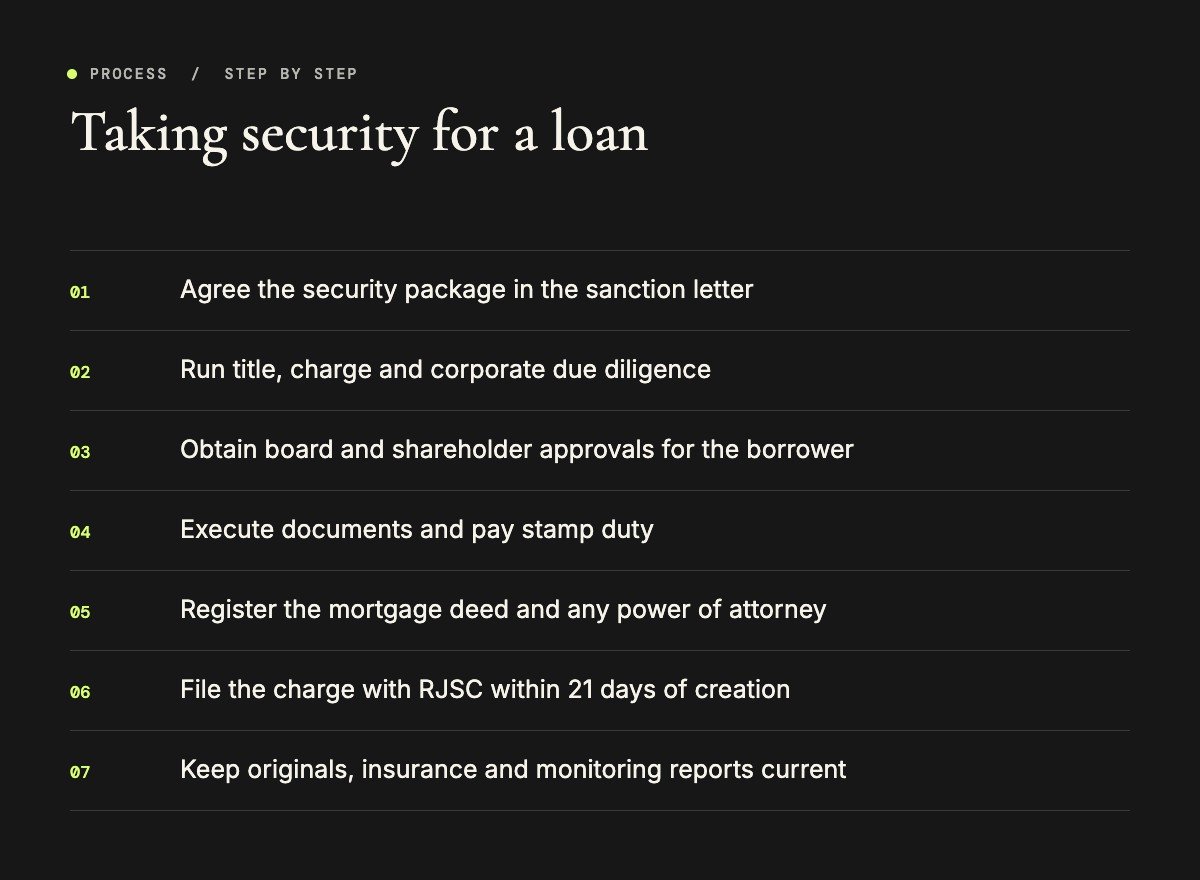
- Land is secured by mortgage under the Transfer of Property Act 1882; since amendment, even a mortgage by deposit of title deeds in favour of a bank or financial institution must be made by registered instrument.
- Movables such as stock, receivables and machinery are usually hypothecated without delivery of possession; goods and securities handed to the lender are pledged under the Contract Act 1872.
- Any charge created by a company must be registered with RJSC within 21 days under section 159 of the Companies Act 1994, or it is void against the liquidator and other creditors.
- Personal and corporate guarantees are contracts under the Contract Act 1872; variations to the loan without the guarantor's consent can discharge the guarantee.
- Enforcement runs mainly through the Artha Rin Adalat Ain 2003, which also gives financial institutions a route to sell security after notice.
What loan security documents in Bangladesh cover
A secured financing rests on two sets of documents. The first is the loan itself: the sanction letter and the facility or loan agreement, which set the amount, pricing, repayment and covenants. The second is the loan security documents in Bangladesh themselves: the documents that give the lender rights over assets or over third parties if the borrower defaults.
Loan security documents in Bangladesh draw on several old but well-tested statutes. The Transfer of Property Act 1882 governs mortgages of land. The Contract Act 1872 governs pledges and guarantees. The Companies Act 1994 requires company charges to be registered. The Registration Act 1908 and the Stamp Act 1899 decide whether a document is properly executed and admissible. And the Artha Rin Adalat Ain 2003 governs how banks and financial institutions recover.
The same principles apply whether the lender is a scheduled bank under the Bank Company Act 1991 or a finance company under the Finance Company Act 2023, the law that replaced the Financial Institutions Act 1993.
The typical security package
| Security | Assets covered | Governing law | Possession |
|---|---|---|---|
| Mortgage | Land, buildings, flats | Transfer of Property Act 1882 | Usually stays with borrower |
| Hypothecation | Stock, receivables, plant and machinery, vehicles | Contract and charge principles; Companies Act 1994 for registration | Stays with borrower |
| Pledge | Goods, share certificates, documents of title | Contract Act 1872 | Delivered to lender |
| Lien and set-off | Fixed deposits and account balances | Contract terms and banking practice | Held by lender bank |
| Assignment | Receivables, contract proceeds, insurance | Transfer of Property Act 1882 and contract | Notice to debtor |
| Guarantee | Personal or corporate covenant to pay | Contract Act 1872 | Not applicable |
| Power of attorney | Authority to sell or deal with secured assets | Power of Attorney Act 2012 | Not applicable |
Mortgage of land and buildings
Section 58 of the Transfer of Property Act 1882 describes several forms of mortgage, including the simple mortgage, mortgage by conditional sale, usufructuary mortgage, English mortgage and mortgage by deposit of title deeds. In commercial lending, banks almost always take either a registered mortgage deed or a mortgage by deposit of title deeds, often both.
Registration is now required for bank equitable mortgages
Under section 59 as it now reads, a mortgage securing a hundred taka or more, other than one by deposit of title deeds, can be made only by a registered instrument signed by the mortgagor and attested by at least two witnesses. Bangladesh has extended the same formality to mortgages by deposit of title deeds in favour of the government, scheduled banks and financial institutions. The old practice of handing over deeds with an unregistered memorandum is no longer enough for these lenders.
A document required to be registered must be presented for registration at the sub-registry within the time allowed by the Registration Act 1908, generally four months from execution. An unregistered mortgage deed does not create a mortgage and cannot be relied on in court as proof of one.
Title due diligence before the mortgage
The mortgage is only as good as the mortgagor's title. Before accepting land as security, the lender's lawyer should check the chain of deeds, the record of rights in each survey, the current mutation khatian and DCR, land development tax payments, encumbrance searches at the sub-registry, and any pending litigation. For flats, check the developer agreement, approved plan and the landowner's share. Loan security documents in Bangladesh that rest on a defective title give the lender nothing to sell.
Inherited land is a frequent trap. After the Ministry of Land's February 2025 instruction, inherited land is mutated jointly in all heirs' names unless a registered partition deed exists. A mortgage signed by only some heirs secures only their undivided shares, which are hard to sell on enforcement. Insist on all co-owners joining or on a registered partition first.
Hypothecation of stock, receivables and machinery
Hypothecation is the workhorse of working-capital lending, and the hypothecation deed is among the most common loan security documents in Bangladesh. The borrower keeps possession of its stock, book debts, machinery or vehicles and continues to trade with them, while the lender holds a charge over them. The hypothecation deed usually gives the lender the right to inspect, to receive regular stock and receivables statements, and on default to take possession and sell.
Hypothecation is not defined in the Transfer of Property Act or the Contract Act, so its effect depends heavily on drafting. Good loan security documents in Bangladesh describe the hypothecated assets clearly, cover present and future assets, require insurance with the lender named as loss payee, and set out the lender's rights to take possession, appoint agents and sell after notice.
Registering the charge with RJSC
Where the borrower is a company, a hypothecation is a charge on its movable property and must be registered with RJSC under section 159 of the Companies Act 1994 within 21 days of its creation. An unregistered charge is void against the liquidator and any creditor of the company, although the debt itself remains payable. The same applies to mortgages of company land and most other charges created by a company.
The 2023 movable assets law
In November 2023, Parliament passed a law on secured transactions in movable assets, reported as the Secured Transactions (Movable Assets) Act 2023. It provides for an electronic registry of financing statements, with priority generally decided by registration, and aims to let lenders accept movables and intangibles as collateral. Confirm whether the registry and implementing rules are fully operational before relying on it as an alternative to existing practice.
Pledge, lien and assignment
Among loan security documents in Bangladesh, the pledge is the oldest. It is a bailment of goods as security for a debt, governed by sections 172 to 179 of the Contract Act 1872. Unlike hypothecation, possession passes to the lender, either physically or through a warehouse or documents of title. On default, the pledgee may sue on the debt and keep the goods as collateral, or sell the goods after giving the pledgor reasonable notice of sale.
Shares and listed securities
Shares in private companies are commonly pledged by delivering the share certificates with signed but undated transfer forms and a board undertaking not to register other transfers. Dematerialised listed shares are pledged through the depository system run by Central Depository Bangladesh Limited, with the pledge recorded in the beneficial owner account. The articles of the company may restrict transfers, so check them before relying on a share pledge.
Lien on deposits and assignment of receivables
A lien over a fixed deposit or account balance with the lending bank, combined with a contractual right of set-off, is the simplest security there is. For contract proceeds, export bills or insurance claims, the lender takes an assignment and gives written notice to the paying party so that payment is made to the lender. Without notice, the debtor can pay the borrower and be discharged.
Guarantees in loan security documents in Bangladesh
A guarantee is a contract to perform the promise, or discharge the liability, of a third person if that person defaults. Section 126 of the Contract Act 1872 defines it, and the following sections decide how far the guarantor, called the surety, is bound.
- Co-extensive liability. Unless the contract provides otherwise, the surety's liability is co-extensive with that of the principal debtor (section 128). The lender need not first sue the borrower.
- Continuing guarantee. A guarantee that extends to a series of transactions is a continuing guarantee (section 129) and suits revolving facilities.
- Discharge by variation. Any variance in the terms of the contract between lender and borrower made without the surety's consent discharges the surety as to later transactions (section 133).
- Release of security. If the lender loses or parts with security without the surety's consent, the surety is discharged to the extent of its value.
Well-drafted guarantees therefore include the guarantor's advance consent to variations, extensions and releases, and keep the guarantee alive despite any time or indulgence given to the borrower. Re-sign guarantees when facilities are restructured, rather than relying on old consents. Borrowers and guarantors, for their part, should read these clauses before signing: they are among the most consequential terms in loan security documents in Bangladesh.
Corporate guarantees
A company can guarantee another's debt only if its memorandum permits it and its board properly approves it, with a clear corporate benefit. Group guarantees for sister concerns are common in Bangladesh and are scrutinised when the group comes under stress. The board minutes approving the guarantee should form part of the loan security documents in Bangladesh that the lender keeps on file.
Perfecting loan security documents in Bangladesh
A security that is signed but not perfected can be worse than useless, because it gives a false sense of protection. For each item of loan security documents in Bangladesh, ask three questions: is it properly stamped, does it need registration, and has every filing been made in time?
| Step | What it involves | Consequence if missed |
|---|---|---|
| Stamp duty | Pay duty under the Stamp Act 1899 as amended by the current Finance Act | Document inadmissible until duty and penalty paid |
| Sub-registry registration | Register mortgage deeds and certain powers of attorney | No valid mortgage; document not admissible as proof |
| RJSC charge filing | File particulars of company charges within 21 days | Charge void against liquidator and creditors |
| Notice of assignment | Notify the debtor of an assigned receivable | Debtor may validly pay the borrower |
| Insurance endorsement | Name lender as loss payee on asset policies | Insurance proceeds go to borrower |
Stamp duty rates on mortgages, hypothecations, guarantees and powers of attorney are fixed in the Stamp Act schedule and revised by Finance Acts, so check the current rates at the time of signing rather than relying on older precedents.
Powers of attorney to sell
Lenders often take an irrevocable power of attorney from the mortgagor authorising sale of the mortgaged property on default. Under the Power of Attorney Act 2012, a power of attorney to sell immovable property must be registered, and a power granted abroad must be authenticated after arrival under the 2015 Rules. Our guide to the power of attorney in Bangladesh explains the formalities.
Step-by-step: putting loan security documents in Bangladesh in place
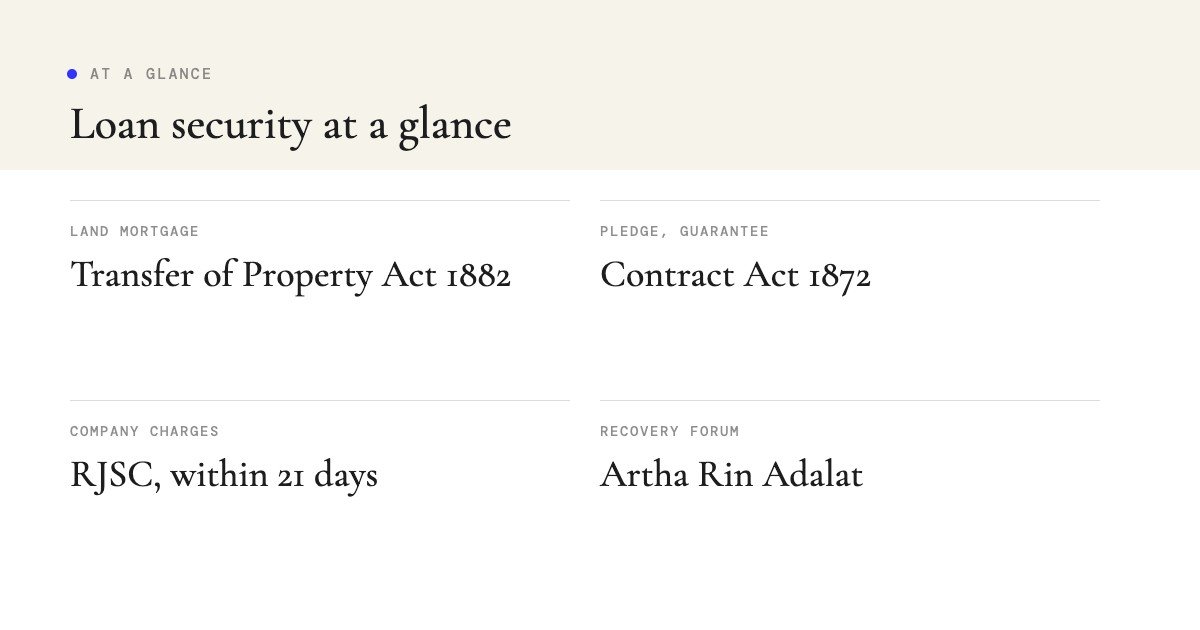
- Agree the package. The sanction letter should list every security item, the assets, the providers and the conditions to drawdown.
- Run due diligence. Check land title, existing charges at RJSC, the borrower's memorandum and articles, and the guarantors' capacity.
- Obtain approvals. Board resolutions for the borrower and each corporate guarantor, and shareholder approval where the articles require it.
- Execute and stamp. Sign the facility agreement and security documents, and pay stamp duty before or at execution.
- Register. Present the mortgage deed and any registrable power of attorney at the sub-registry within time.
- File with RJSC. File particulars of each company charge within 21 days and obtain the certificate of registration.
- Monitor. Keep original deeds safe, renew insurance, collect stock reports and update security when assets change.
Enforcing security when the borrower defaults
For banks and financial institutions, recovery suits based on loan security documents in Bangladesh are filed in the Artha Rin Adalat under the Artha Rin Adalat Ain 2003. The Act sets time limits for each stage, encourages settlement through mediation, and provides for sale of mortgaged and charged property in execution of the decree.
The Act also allows a financial institution, after notice, to sell mortgaged, pledged or hypothecated property without first obtaining a decree in defined circumstances, and requires it in some cases to try that route before suing. Check whether any recent amendment to the Act has taken effect before you rely on a specific timetable.
The Bank Company (Amendment) Act 2023 introduced a statutory framework for wilful defaulters, with restrictions on such borrowers. Security cheques given with loan documents can also lead to proceedings under section 138 of the Negotiable Instruments Act 1881; see our guide to cheque dishonour remedies. Certain public lenders also use the certificate procedure explained in our guide to the Public Demands Recovery Act 1913.
What makes enforcement fail
In practice, enforcement stalls for documentary reasons: a mortgage that was never registered, a charge not filed at RJSC, a guarantee discharged by an unconsented restructuring, a hypothecation that described the wrong warehouse, or land that turned out to be co-owned with heirs who never signed. Each of these is preventable at the documentation stage.
Rescheduling and restructuring are common in Bangladesh. Every time a facility is renewed, enhanced or rescheduled, check whether the existing loan security documents in Bangladesh still cover the new amount and terms, and take fresh guarantor consents and supplemental charges where needed.
Foreign lenders and offshore facilities
Where the lender is outside Bangladesh, loan security documents in Bangladesh must still be taken under Bangladeshi law over assets in Bangladesh. Syndicated and foreign facilities often use a local security agent or trustee to hold the security for all lenders. Long-term foreign borrowing by private companies goes through scrutiny by Invest Bangladesh (formerly BIDA) and Bangladesh Bank, with Bangladesh Bank's consolidated foreign loan instructions setting the conditions, so confirm that the borrowing itself is approved before perfecting security for it.
Enforcement by a foreign lender also raises questions about repatriation of sale proceeds, which must pass through authorised dealer banks under foreign exchange rules.
Frequently asked questions about loan security documents in Bangladesh
Does a bank's equitable mortgage need registration?
Yes. Under section 59 of the Transfer of Property Act 1882 as amended in Bangladesh, a mortgage by deposit of title deeds in favour of the government, a scheduled bank or a financial institution must be made by registered instrument.
What is the difference between hypothecation and pledge?
In a hypothecation the borrower keeps possession of the goods; in a pledge the goods or documents of title are delivered to the lender. Pledges are governed by the Contract Act 1872.
What happens if a company charge is not filed with RJSC?
Under section 159 of the Companies Act 1994, a charge not registered within 21 days is void against the liquidator and creditors of the company, though the debt remains payable.
Can a guarantor escape liability?
A guarantor may be discharged if the loan terms are varied without consent, if security is released, or if the lender acts inconsistently with the guarantor's rights. Well-drafted guarantees include advance consents.
Can a lender sell security without going to court?
The Artha Rin Adalat Ain 2003 allows financial institutions, after notice, to sell mortgaged, pledged or hypothecated property in defined circumstances. A registered power of attorney to sell supports the process.
Who pays stamp duty on security documents?
Normally the borrower, as the facility agreement provides. Rates are set by the Stamp Act 1899 as amended by the current Finance Act.
How we can help
We act for lenders and borrowers on secured facilities: drafting and reviewing facility agreements, mortgages, hypothecations, pledges and guarantees, running title diligence, and completing registration and RJSC filings. We also advise on restructuring and recovery. Learn more about our banking and finance practice.
Need security documents drafted or reviewed?
We prepare and perfect loan security that will hold up on enforcement, from title checks to RJSC charge registration.
Book a consultationBanking practicePrimary sources: the Transfer of Property Act 1882, Contract Act 1872, Companies Act 1994, Registration Act 1908, Stamp Act 1899, Power of Attorney Act 2012 and Artha Rin Adalat Ain 2003 on the Laws of Bangladesh portal; banking regulation from Bangladesh Bank; charge registration with the RJSC.
This article is general information about Bangladeshi law as of 2026 and is not legal advice. Fees, stamp duties and procedures change; confirm current requirements with the relevant authority or a qualified lawyer before acting.


0 Comments