
BSEC beneficial ownership disclosure rules tell the market who really owns and controls listed companies in Bangladesh. Sponsors, directors, substantial shareholders and anyone acting in concert must report holdings and changes, declare certain trades in advance and avoid trading on inside information. Breaches attract heavy fines and reputational damage, and BSEC has stepped up enforcement against hidden holdings and manipulation.
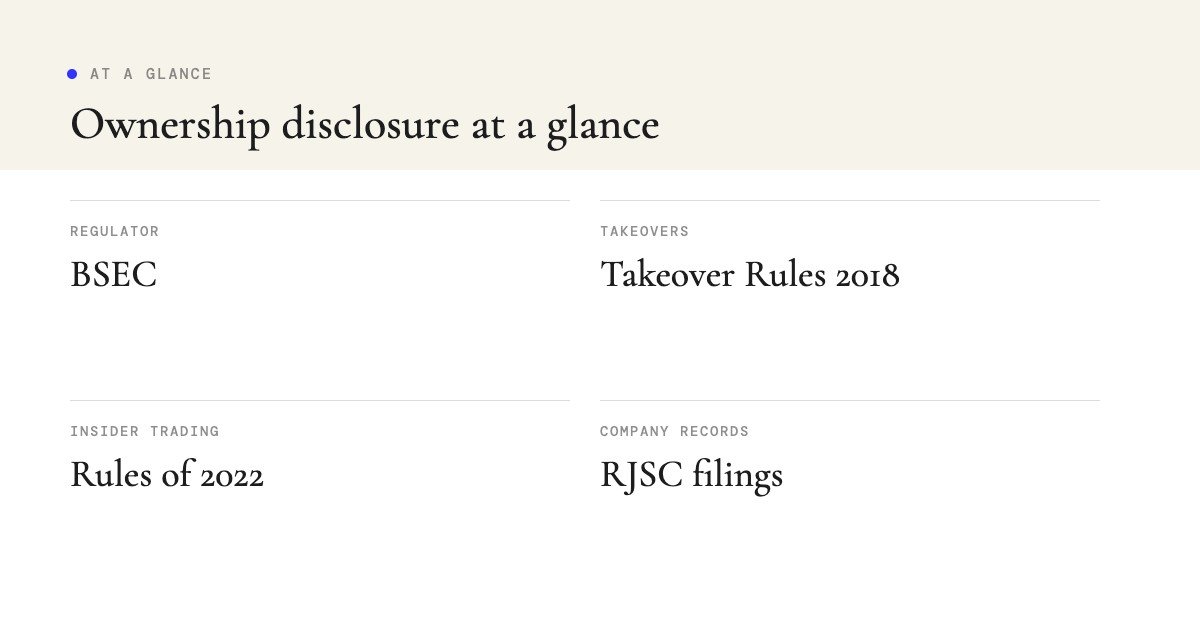
- BSEC requires disclosure of significant shareholdings and changes in them, including holdings through nominees, related companies and concert parties.
- The BSEC (Substantial Acquisition of Shares and Takeovers) Rules 2018 set thresholds for disclosure and for public announcements when control is acquired.
- Sponsors and directors face additional rules, including minimum shareholding requirements and advance declarations before buying or selling.
- The BSEC (Prohibition of Insider Trading) Rules 2022 restrict trading on unpublished price-sensitive information.
- Beneficial ownership information is also increasingly required in company filings and by banks under AML rules.
Why BSEC beneficial ownership disclosure matters
Transparent ownership protects investors. When the market knows who controls a company and when insiders buy or sell, prices reflect better information and manipulation is harder. Bangladesh's capital market has suffered episodes of hidden accumulation, circular trading and insider dealing, and regulators have responded with stricter disclosure rules and enforcement. BSEC beneficial ownership disclosure sits at the centre of that effort.
For investors, sponsors and foreign shareholders, understanding these rules is essential before building a stake, restructuring a group or exiting an investment. Our BSEC regulatory practice advises on disclosure strategy and enforcement matters.
Who is a beneficial owner
A beneficial owner is the person who ultimately owns or controls shares, even if they are registered in someone else's name. Holdings through nominees, family members acting on instructions, companies under common control, trusts or omnibus accounts can all count. BSEC rules and the Takeover Rules also look at persons acting in concert, meaning those who cooperate to acquire or exercise control. For BSEC beneficial ownership disclosure, holdings of the beneficial owner and concert parties are generally aggregated.
The legal framework
| Rule | What it requires |
|---|---|
| Securities and Exchange Ordinance 1969 and BSEC Act 1993 | General disclosure duties and BSEC enforcement powers |
| BSEC (Substantial Acquisition of Shares and Takeovers) Rules 2018 | Disclosure of substantial acquisitions, public announcements and offers on acquiring control |
| BSEC (Prohibition of Insider Trading) Rules 2022 | Restrictions on insiders and disclosure of trading by connected persons |
| BSEC notifications on sponsors and directors | Minimum shareholdings, advance declarations and lock-in periods |
| Listing regulations of DSE and CSE | Continuous disclosure through the exchanges |
| Companies Act 1994 and RJSC filings | Shareholder registers and returns, including beneficial ownership information |
Substantial acquisitions and takeovers
The Takeover Rules require a person who acquires shares or voting rights crossing specified thresholds to disclose the acquisition to the company, the stock exchanges and BSEC within the prescribed time. Further thresholds trigger a requirement to make a public announcement and an offer to other shareholders when a person seeks to acquire control. Exemptions exist for certain transfers, such as among group companies or by inheritance, often subject to BSEC approval. Thresholds and timelines should be checked against the current rules before any trade, because BSEC beneficial ownership disclosure turns on exact percentages.
Acquisitions by related persons count together. Spreading purchases across relatives, companies or nominee accounts to stay below a threshold can itself be a breach and may be treated as manipulation.
Sponsors and directors
BSEC has required sponsors and directors of listed companies to hold a minimum percentage of shares jointly, and individual directors to hold a minimum individual stake, with consequences for companies and directors that fall short. Sponsors and directors must also declare their intention to buy, sell or transfer shares in advance through the stock exchange, complete the transaction within the declared period and report completion. These rules make BSEC beneficial ownership disclosure for insiders particularly demanding.
Lock-in periods apply to sponsor shares after an IPO, and pledges of shares by sponsors and directors may require disclosure. Changes in board composition and nominee directors must be reported. Our corporate governance practice helps boards keep these records straight.
Insider trading and connected persons
The Insider Trading Rules 2022 prohibit insiders and connected persons from trading while in possession of unpublished price-sensitive information, and from communicating such information. Companies must maintain lists of insiders, set trading windows and require pre-clearance for trades by designated persons. Disclosures of trades by insiders support enforcement. A strong BSEC beneficial ownership disclosure programme therefore goes hand in hand with an insider trading policy.
Foreign investors
BSEC beneficial ownership disclosure applies to foreigners too. Foreign portfolio and strategic investors must comply with the same disclosure rules, as well as foreign exchange rules for investing through non-resident investor taka accounts. Custodians and omnibus structures do not remove the obligation to disclose beneficial ownership where thresholds are crossed. Foreign investors planning a significant stake should map disclosure and takeover implications before they start buying. See our capital markets practice for advice.
Enforcement and penalties
Breaches of BSEC beneficial ownership disclosure rules are enforced vigorously. BSEC can investigate suspicious trading, require information from brokers and depository participants, freeze beneficial owner (BO) accounts, impose fines, suspend trading and refer criminal matters. In recent years BSEC has imposed significant penalties for undisclosed acquisitions, manipulation and insider trading, and has frozen accounts linked to suspicious activity. Penalties can also apply to companies that fail to disclose information received from shareholders.
BO accounts and the depository system
In Bangladesh, listed securities are held in dematerialised form in beneficial owner (BO) accounts maintained with depository participants under Central Depository Bangladesh Limited (CDBL). Each BO account must carry accurate KYC information, and BSEC can trace holdings across accounts. Because the system records holdings at the level of individual BO accounts, regulators can aggregate holdings of related persons when investigating. Accurate BO account records are therefore the foundation of BSEC beneficial ownership disclosure, and investors should keep their KYC details current.
Omnibus accounts used by some foreign and institutional investors complicate the picture, but the underlying investors remain responsible for disclosure when thresholds are crossed. Custodians may be asked to provide underlying beneficial owner information to BSEC on request.
Company-level beneficial ownership records
Beyond the capital market, beneficial ownership transparency is a growing theme in company law and anti-money laundering rules. Banks and financial institutions must identify the beneficial owners of corporate customers under BFIU instructions, and RJSC has moved to collect beneficial ownership information in company filings. Listed companies should ensure that what they report to RJSC, to their banks and through BSEC beneficial ownership disclosure is consistent, because regulators increasingly compare these sources.
Group restructurings and inter se transfers
Corporate groups often move shares between holding companies, family members or trusts for succession or tax planning. Such transfers can trigger disclosure and takeover obligations even when ultimate control does not change. The Takeover Rules provide exemptions for some inter se transfers among promoters or group companies, usually conditional on disclosure and, in some cases, BSEC approval. Planning these restructurings with BSEC beneficial ownership disclosure in mind avoids inadvertent breaches and unnecessary mandatory offers.
Pledges, margin loans and forced sales
Sponsors sometimes pledge shares to banks for loans. If the borrower defaults, the lender may sell the pledged shares, changing the ownership picture and possibly reducing sponsor-director holdings below required minimums. Pledges and their enforcement may need disclosure under BSEC rules and exchange regulations. Margin loans from brokers and merchant banks raise similar issues when forced sales occur. A sponsor's compliance plan should cover what happens to BSEC beneficial ownership disclosure if pledged shares are enforced.
Building a compliance programme
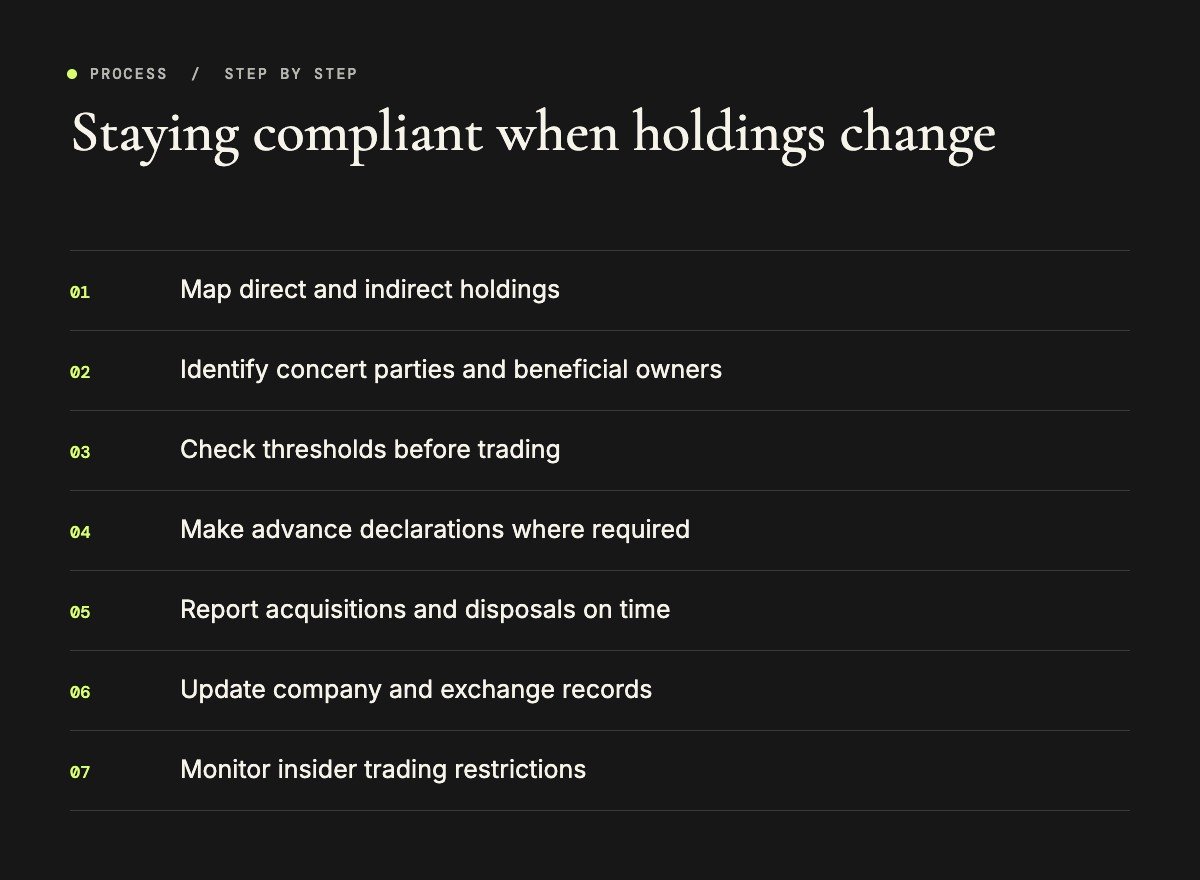
- Maintain a register of all holdings of the investor, family members, related companies and concert parties.
- Set internal alerts well below each disclosure threshold.
- Require pre-clearance of trades by sponsors, directors and designated insiders.
- Prepare template disclosures and advance declarations in advance.
- Train staff and family members on insider trading and concert party rules.
- Review the programme annually and after any change in BSEC rules.
A documented programme helps demonstrate good faith if BSEC questions a transaction, and it keeps BSEC beneficial ownership disclosure routine rather than reactive.
Responding to a BSEC inquiry
BSEC may write to an investor or company asking for explanations of unusual trading, holdings or relationships. The response should be accurate, complete and supported by documents such as BO statements, contracts and board minutes. Inconsistent or late answers often make matters worse. Where a breach has occurred, voluntary corrective disclosure and cooperation can reduce penalties. Legal advice is valuable at this stage, particularly where an inquiry about BSEC beneficial ownership disclosure could lead to findings of manipulation or insider trading.
Mutual funds, institutions and passive investors
Institutional investors such as mutual funds, insurance companies and banks also cross thresholds from time to time. Their holdings in a single company are often limited by their own sector rules, but when they do accumulate significant stakes, the Takeover Rules and BSEC beneficial ownership disclosure apply in the same way. Asset managers handling several funds should aggregate holdings across funds under common management where the rules require, and should not assume that passive intent removes the duty to disclose. Clear internal policies on aggregation help avoid accidental breaches.
Disclosure in IPOs and private placements
When a company prepares for listing, its prospectus must disclose sponsors, directors and significant shareholders, including indirect holdings and related-party relationships. Pre-IPO placements and share transfers are scrutinised, and lock-in requirements apply to sponsor and pre-IPO shares. Errors at this stage carry forward into later BSEC beneficial ownership disclosure and can lead to regulatory action after listing, so the ownership chain should be cleaned up and documented before the prospectus is filed.
Timing and record-keeping
Deadlines for disclosure are short, often counted in days from the trade. Investors should keep trade confirmations, BO statements and copies of every disclosure and exchange acknowledgement. If a disclosure is late, filing it as soon as possible with an explanation is better than staying silent.
Frequently asked questions about bsec beneficial ownership disclosure
Who must disclose shareholdings?
Substantial shareholders, sponsors, directors, insiders and persons acting in concert, according to BSEC rules and thresholds.
Do nominee holdings count?
Yes. Beneficial ownership looks through nominees, related companies and concert parties.
Must directors announce trades in advance?
Yes. Sponsors and directors must declare intended purchases, sales or transfers through the stock exchange before trading.
What happens if I cross a takeover threshold?
You must disclose within the prescribed time and, at higher thresholds, make a public announcement and offer unless exempt.
Do foreign investors have to disclose?
Yes, on the same basis as local investors, in addition to foreign exchange rules.
What are the penalties?
Fines, account freezes, trading suspensions and potential criminal referral.
How we can help
We advise investors, sponsors, directors and listed companies on BSEC beneficial ownership disclosure: threshold analysis, takeover planning, advance declarations, insider trading policies and BSEC investigations. Learn more about our BSEC regulatory practice.
Building a stake or restructuring a listed group?
We map your disclosure duties and help you transact without regulatory surprises.
Book a consultationBSEC practicePrimary sources: the Takeover Rules 2018, Insider Trading Rules 2022 and BSEC notifications published by BSEC; listing regulations and announcements of the Dhaka Stock Exchange; the Securities and Exchange Ordinance 1969 on the Laws of Bangladesh portal.
This article is general information about Bangladeshi securities regulation as of October 2026 and is not legal or investment advice. Thresholds and BSEC requirements change; confirm the current rules with BSEC or a qualified lawyer before trading.




0 Comments