
Civil revision in Bangladesh is the remedy for correcting legal errors in court orders that cannot be challenged by appeal. Under section 115 of the Code of Civil Procedure 1908, the District Judge and the High Court Division can revise decisions of lower courts where an error of law has led to an erroneous decision and a failure of justice. Used well, a revision can stop an unlawful order in its tracks; used poorly, it wastes time and money.
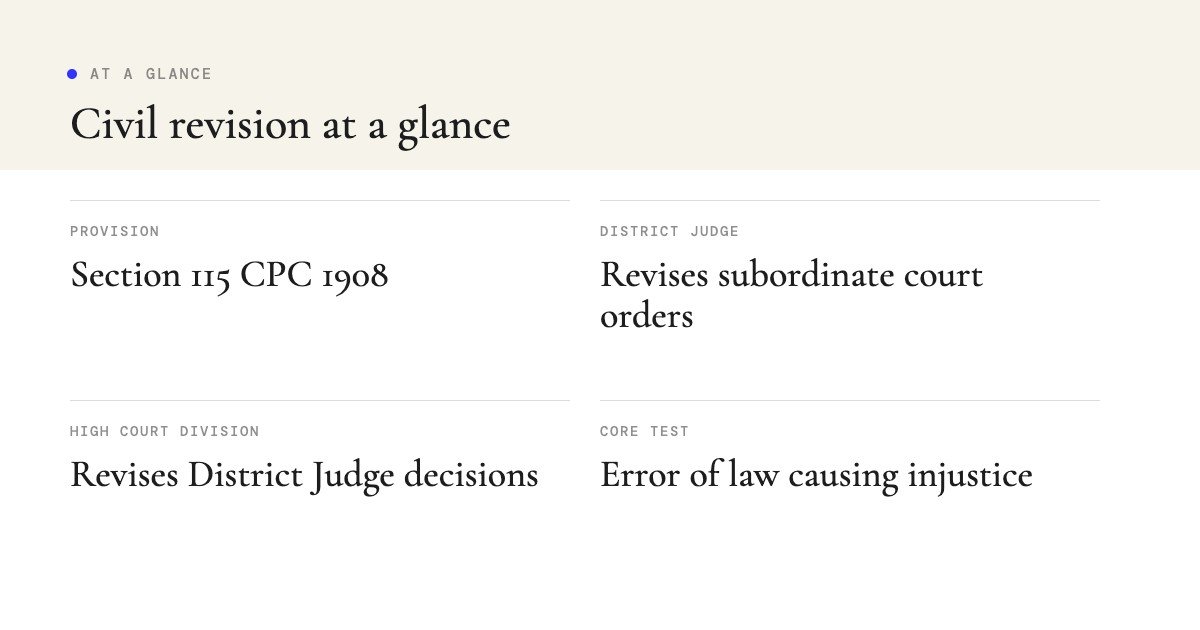
- Section 115 CPC creates a two-tier revisional system: the District Judge revises orders of subordinate courts, and the High Court Division revises decisions of the District Judge or Additional District Judge.
- Revision is generally available only where no appeal lies, and it focuses on errors of law, not re-weighing of evidence.
- The core test is an error of law resulting in an erroneous decision that occasions a failure of justice.
- Revisions must be filed within strict time limits, and orders of the District Judge in revision can reach the High Court Division only with leave.
- The High Court Division may issue a rule and stay proceedings or the impugned order while the revision is pending.
What civil revision in Bangladesh means
An appeal allows a full rehearing of facts and law. A revision is narrower. It allows a superior court to examine whether a subordinate court acted within the law in reaching its decision. Civil revision in Bangladesh is therefore a supervisory remedy: it corrects jurisdictional and legal errors so that justice is not defeated, but it does not give a second chance to argue the facts.
Revisions are common in interlocutory matters, such as orders on temporary injunctions after appeal, amendments of pleadings, addition of parties, rejection of plaints, local investigations and execution issues, as well as in appellate decrees of the District Judge. Our Supreme Court practice regularly files and defends revisions in the High Court Division.
The structure of section 115
| Sub-section | Forum | What it covers |
|---|---|---|
| 115(1) | High Court Division | Decrees or orders of the District Judge or Additional District Judge, typically in appeal or revision, involving an error of law causing a failure of justice |
| 115(2) | District Judge | Orders of subordinate courts against which no appeal lies, on similar grounds |
| 115(4) | High Court Division with leave | Orders made by the District Judge in revision under 115(2) |
This structure was introduced by amendments in 2003, which aimed to reduce the High Court Division's workload by moving first-tier revision of subordinate court orders to the District Judge. A practitioner must therefore start every civil revision in Bangladesh by identifying which court made the order and whether it was appealable.
Grounds for revision
The grounds for civil revision in Bangladesh are narrow. The revisional court interferes where the lower court's decision involves an error of law that results in an erroneous decision occasioning a failure of justice. Typical grounds include:
- Lack or excess of jurisdiction, or failure to exercise jurisdiction that the court has.
- Misreading or non-consideration of material evidence that goes to the root of the decision.
- Misapplication of a statutory provision or binding precedent.
- Procedural irregularity that caused real prejudice, such as deciding without hearing a party.
- Perverse findings that no reasonable court could reach on the record.
Mere disagreement with the lower court's assessment of evidence is not enough. The Appellate Division has repeatedly stressed that civil revision in Bangladesh is not an appeal in disguise.
When revision is not available
Not every order can be the subject of civil revision in Bangladesh. Where the law provides an appeal, the party should appeal rather than seek revision. Orders appealable under section 104 and Order 43 of the CPC, and appellate decrees subject to second appeal, generally fall outside revision. However, courts have accepted revision where an appeal would not be an adequate remedy in special circumstances. Special statutes may also restrict revision, for example in Artha Rin Adalat matters or family court cases, where specific appeal routes apply.
Choosing the wrong remedy is a common mistake. Before drafting, check whether the order is appealable under the CPC or a special law, and whether the time for appeal is still running. A revision filed instead of an available appeal is likely to be discharged.
Time limits
Revisions must be filed within the limitation period prescribed by law, which was tightened by the 2003 amendments. Petitioners should calculate the deadline from the date of the order, allowing for time taken to obtain certified copies as permitted by the Limitation Act 1908. Delay can be condoned only on sufficient cause, and courts take a strict approach. Every civil revision in Bangladesh should be calendared from the day the order is pronounced.
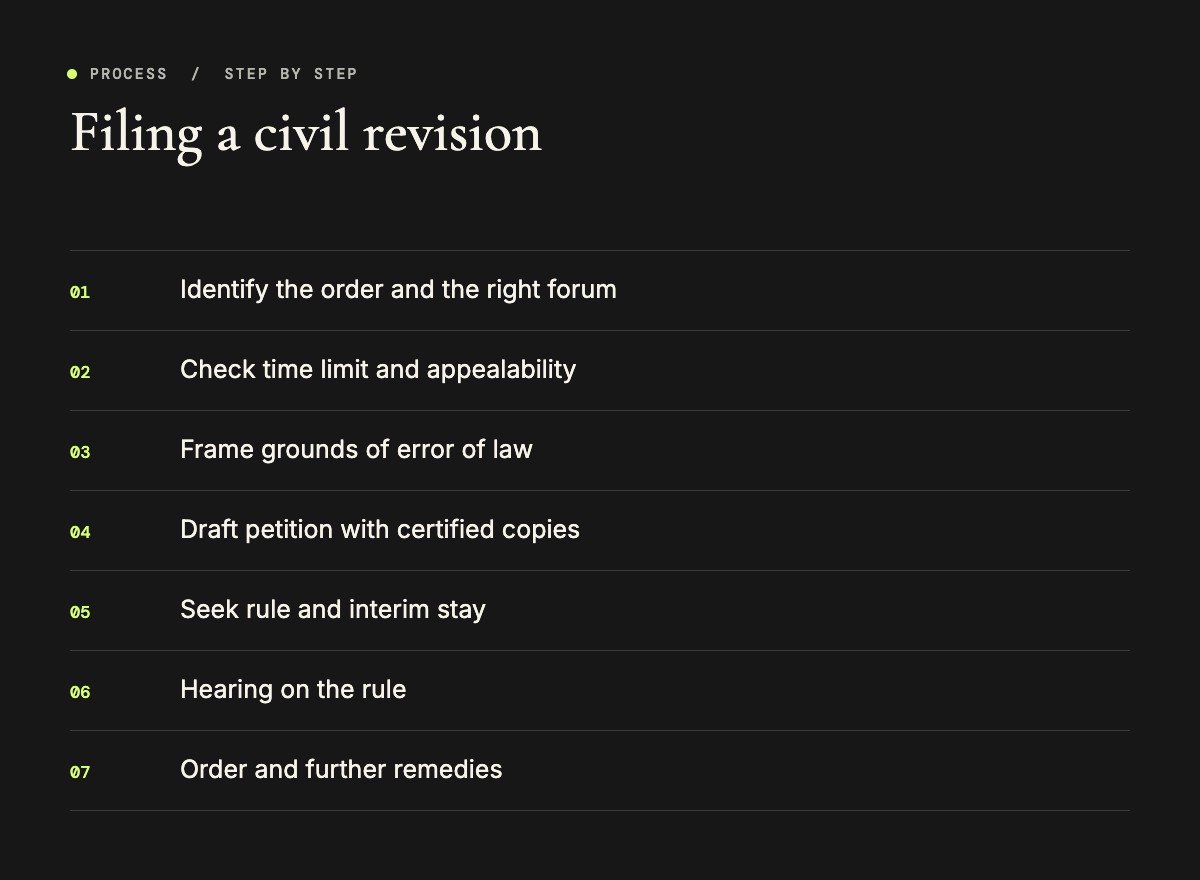
Drafting a revision petition
- Collect certified copies. Obtain certified copies of the impugned order, the lower court order if any, pleadings and key evidence.
- Frame the questions of law. State concisely the legal errors and how they caused a failure of justice.
- Summarise the facts. Give a clear, chronological account without arguing evidence at length.
- Cite authority. Refer to binding decisions of the Appellate Division and High Court Division.
- Seek interim relief. Ask for a stay of the order or proceedings where needed, explaining urgency and prejudice.
- Verify and file. Swear the supporting affidavit, pay court fees and file in the correct bench.
- Serve and prepare. Serve the opposite party after a rule is issued and prepare for the hearing.
Rule, stay and hearing
In the High Court Division, a civil revision in Bangladesh usually begins with a motion hearing. If the bench finds an arguable case, it issues a rule calling on the opposite party to show cause why the impugned order should not be set aside, and may stay the order or further proceedings. The rule is later heard on merits, and the court either makes it absolute, setting aside or modifying the order, or discharges it. Stay orders often have a limited duration and may need extension.
Leave against District Judge revisional orders
A second-tier civil revision in Bangladesh has an extra hurdle. Where the District Judge has decided a revision under section 115(2), a dissatisfied party can approach the High Court Division under section 115(4) only with leave. The petitioner must show that the District Judge's order involves an error of law causing a failure of justice. This added filter means the first-tier revision before the District Judge must be prepared thoroughly.
Revision versus writ
Parties sometimes consider writ petitions under Article 102 of the Constitution against civil court orders. Writ jurisdiction generally does not lie against judicial orders of civil courts where the CPC provides remedies such as appeal or revision. Civil revision in Bangladesh is therefore the normal route for challenging legal errors in civil court orders. See our guide to writs in Bangladesh for when a writ is appropriate.
Common orders challenged in revision
Practitioners see certain types of orders again and again in revision. These include orders allowing or refusing amendment of plaints and written statements, orders adding or striking out parties, orders on applications to reject a plaint under Order 7 rule 11, orders in execution proceedings, orders on applications for local investigation or appointment of commissioners, and appellate orders of the District Judge on temporary injunctions. In each, the question for a civil revision in Bangladesh is the same: did the lower court commit an error of law that caused a failure of justice?
Orders on injunctions deserve special mention. An order of a trial court granting or refusing a temporary injunction is appealable under Order 43, so the first remedy is a miscellaneous appeal to the District Judge. If the District Judge's appellate order is legally flawed, a civil revision in Bangladesh then lies to the High Court Division under section 115(1).
The opposite party's response
When a rule is issued, the opposite party may file a counter-affidavit, challenge the maintainability of the revision, argue that an appeal was available, point out delay, or defend the impugned order on merits. It can also apply to vacate or vary a stay order if the stay is causing serious prejudice. Responding early and precisely often shortens the life of a weak revision. Defending a civil revision in Bangladesh effectively requires the same discipline as filing one.
Costs and outcomes
Court fees for revisions are modest, but the overall cost depends on the complexity of the record and the number of hearings. Outcomes range from discharge of the rule, which leaves the lower order intact, to making the rule absolute, which sets the order aside, sometimes with a direction to the lower court to decide afresh. Courts may also award costs. Because a pending civil revision in Bangladesh can delay the main suit, the court may direct the trial court to proceed while the revision is heard, or set time limits for disposal.
Further remedies after revision
A party aggrieved by the High Court Division's decision in revision can seek leave to appeal to the Appellate Division under Article 103 of the Constitution. Leave is granted only where a substantial question of law or a serious failure of justice is shown. Review of the High Court Division's own order is available on limited grounds, such as an error apparent on the face of the record. Planning the whole route at the start helps a client decide whether a civil revision in Bangladesh is worth pursuing.
Practical tips
- Apply for certified copies immediately after the order.
- Identify whether an appeal lies before choosing revision.
- Keep grounds short, legal and specific.
- Explain clearly why the error causes a failure of justice.
- Track stay expiry dates and seek extensions in time.
- Take specialist advice early, because a civil revision in Bangladesh succeeds or fails on precise legal framing.
Frequently asked questions about civil revision in bangladesh
What is the difference between appeal and revision?
An appeal reopens facts and law; a revision corrects errors of law causing a failure of justice where no appeal lies.
Which court hears a revision?
The District Judge revises subordinate court orders, and the High Court Division revises decisions of the District Judge or Additional District Judge.
Can the High Court Division review a District Judge's revisional order?
Yes, but only with leave under section 115(4).
Is there a time limit?
Yes. Revisions must be filed within the prescribed limitation period, and delay is condoned only on sufficient cause.
Can I get a stay while the revision is pending?
The High Court Division can stay the impugned order or proceedings when issuing a rule, often for a limited period.
Can findings of fact be challenged?
Only where they result from misreading or non-consideration of material evidence or are perverse; ordinary factual disagreements are not grounds.
How we can help
We advise and represent clients in civil revision in Bangladesh before District Judges and the High Court Division: assessing remedies, drafting petitions, obtaining stays, opposing rules and pursuing leave applications. Learn more about our Supreme Court practice and our commercial litigation practice.
Facing an unlawful civil court order?
We assess quickly whether revision, appeal or another remedy is right and act before the deadline passes.
Book a consultationSupreme Court practicePrimary sources: the Code of Civil Procedure 1908 and Limitation Act 1908 on the Laws of Bangladesh portal; court information and cause lists from the Supreme Court of Bangladesh.
This article is general information about civil procedure in Bangladesh as of October 2026 and is not legal advice. Time limits and procedure are strict; take advice from a qualified lawyer as soon as an order is made.

0 Comments