
Corporate bond issuance in Bangladesh is moving from a niche option to a policy priority. With Bangladesh Bank tightening single-borrower limits and BSEC and the stock exchanges cutting costs, more companies are asking how to raise long-term debt directly from investors under the BSEC (Debt Securities) Rules 2021.
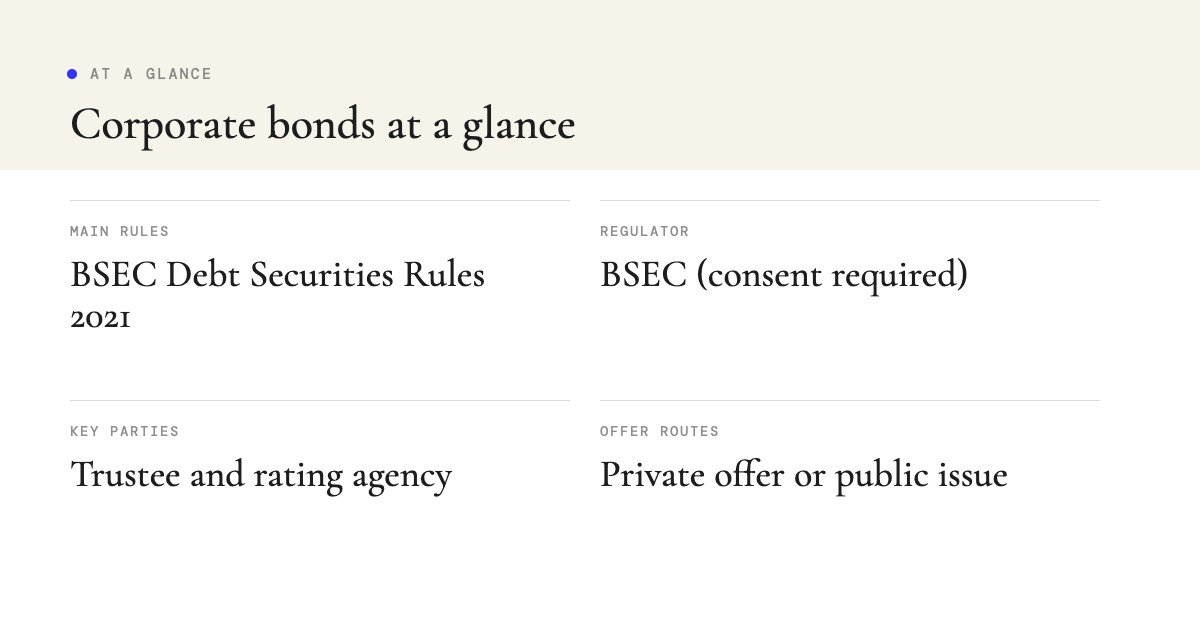
- Bonds, debentures, sukuk and asset-backed securities offered to investors need the consent of the Bangladesh Securities and Exchange Commission (BSEC) under the Debt Securities Rules 2021.
- Issuers choose between a private offer to a limited group of investors and a public issue, which carries stricter eligibility, prospectus and listing requirements.
- Every issue needs a BSEC-registered trustee, a credit rating from a registered rating company, and a trust deed that protects bondholders.
- Banks and financial institutions issuing capital bonds also need Bangladesh Bank approval, and secured issues need charge registration with RJSC.
- BSEC's published consent list for 2025-26 shows private offers dominating the market, while regulators push for more public, listed bonds.
Under the Invest Bangladesh Act 2026, effective 23 August 2026, the Bangladesh Investment Development Authority (BIDA), the Bangladesh Economic Zones Authority (BEZA) and the PPP Authority were merged into a single body, Invest Bangladesh. References below to BIDA, BEZA or the PPP Authority should be read as references to Invest Bangladesh. BEPZA continues as a separate authority.
Non-bank financial institutions are now governed by the Finance Company Act 2023, which replaced the Financial Institutions Act 1993; such institutions are now called finance companies. References below to the 1993 Act should be read accordingly.
Why corporate bond issuance in Bangladesh matters now
Bangladeshi companies have long relied on bank loans for almost all their debt, including long-term project and expansion finance. That mismatch, with banks funding ten-year assets from short-term deposits, is one reason regulators link the bond market to the problem of non-performing loans.
Policy is now pushing the other way. In January 2026 the Governor of Bangladesh Bank said single-borrower exposure limits would be strictly enforced, describing them as a push factor towards bonds. A joint Bangladesh Bank and BSEC task force had earlier proposed capping bank financing per borrower at Tk 1,000 crore, with larger needs met through bonds; that proposal had not been adopted as of our last check.
Costs are also falling. In September 2026 the Dhaka Stock Exchange cut corporate bond listing and related fees by 80 percent, and BSEC has said it wants eligible bonds listed on the main board. For a well-run company, corporate bond issuance in Bangladesh is now a realistic complement to bank debt.
What the numbers show
Corporate bond issuance in Bangladesh is still dominated by private offers. BSEC's published list of consent letters for the 2025-26 period shows ten consents, all for private offers, totalling roughly Tk 6,859 crore, with no public offers. Banks issuing subordinated and perpetual bonds to meet capital requirements make up a large share of that volume.
The legal framework
The core rules for corporate bond issuance in Bangladesh are the Bangladesh Securities and Exchange Commission (Debt Securities) Rules 2021, made under section 33 of the Securities and Exchange Ordinance 1969. They replaced the earlier private placement rules for debt securities and now apply to debt securities and sukuk offered privately or publicly, and to asset-backed securities offered publicly.
Several other laws matter in practice:
- Bangladesh Securities and Exchange Commission Act 1993. Establishes BSEC and its enforcement powers.
- Companies Act 1994. Governs the issuer's power to borrow, board and shareholder approvals, debentures, and registration of charges with RJSC, which under section 159 must be done within 21 days of creation.
- Trusts Act 1882. Underpins the trust deed through which the trustee holds rights and security for bondholders.
- Bank Company Act 1991 and Financial Institutions Act 2023. Apply when the issuer is a bank or a financial institution, alongside Bangladesh Bank's capital rules.
- Stamp Act 1899 and the Income Tax Act 2023. Stamp duty on instruments and the tax treatment of coupons and gains, which change with each Finance Act.
Read the current text of the Rules, any later amendments and BSEC directives on the BSEC website before fixing your timetable. BSEC also publishes consent letters and checklists that show how the Rules are applied.
Instruments you can issue
The Rules are drafted broadly, and BSEC's consent records show a wide range of instruments in use. The right instrument for corporate bond issuance in Bangladesh depends on the issuer's credit, the investor base and, for banks, the regulatory capital the instrument must qualify as.
| Instrument | Typical use | Key point |
|---|---|---|
| Coupon-bearing bond (fixed or floating) | General corporate and expansion funding | Floating rates now reference market benchmarks rather than the abolished SMART rate |
| Zero-coupon bond | Short to medium-term funding sold at a discount | Return comes from the discount; tax treatment needs checking |
| Secured or asset-backed bond | Issuers able to offer mortgages or receivables | Security held by the trustee; charge registration with RJSC |
| Subordinated and perpetual bonds | Bank and financial institution capital | Need Bangladesh Bank approval to count as capital |
| Convertible bonds | Growth companies and listed issuers | Conversion terms and shareholder approval need care |
| Sukuk and mudaraba bonds | Islamic banks and Shariah-sensitive investors | Shariah structure and adviser required |
| Green, social and project bonds | Renewable energy, infrastructure and impact projects | Use-of-proceeds and reporting commitments |
Private offer or public issue?
The most important early decision in any corporate bond issuance in Bangladesh is the offer route. It drives eligibility, documentation, timetable and cost.
Private offer
A private offer is made to a limited number of investors, typically banks, financial institutions, insurance companies, provident and gratuity funds and other institutional buyers. The issuer prepares an information memorandum rather than a full prospectus, and the timetable is shorter. Most BSEC consents for corporate bond issuance in Bangladesh in recent years have been for private offers.
A private offer still needs BSEC consent, a registered trustee, a credit rating and a trust deed. Restrictions apply to the number and type of investors and to onward transfer, so the issue cannot be used as a disguised public offering.
Public issue
A public issue is offered to the general public, including retail investors, through a prospectus and is listed on a stock exchange. The Rules set additional eligibility tests for public issuers, such as being a public limited company, meeting capital and leverage requirements, and holding an investment-grade rating. An issue manager is needed, and the process resembles an equity public offer in its disclosure burden.
The reward is a broader investor base, a listed instrument with secondary trading, and public visibility for the issuer's credit. Regulators are actively encouraging this route, and listing costs fell sharply in 2026.
Many issuers start with a private offer to anchor investors and later list on the exchange. If that is the plan, draft the trust deed, information memorandum and transfer provisions with listing in mind from the start, so the bond does not need restructuring later.
The parties to a bond issue
A successful corporate bond issuance in Bangladesh depends on assembling the right team early. Each party has defined responsibilities under the Rules.
- Issuer. The company raising funds. Its board must approve the issue, and it carries disclosure and payment obligations for the life of the bond.
- Arranger or issue manager. Structures the deal, prepares the offer document and finds investors. A public issue requires a BSEC-registered issue manager.
- Trustee. Represents bondholders, monitors compliance and enforces security. The trustee must be registered with BSEC, independent of the issuer and arranger, and meet capital and staffing requirements; BSEC's registration checklist sets a minimum paid-up capital of Tk 10 crore.
- Credit rating company. Rates the issue and keeps the rating under surveillance. It must be registered with BSEC.
- Legal counsel. Drafts and negotiates the trust deed, security documents and offer document, and issues legal opinions.
- Auditor. Provides audited financial statements and comfort on financial information.
Where the bond is issued in dematerialised form, the issuer also works with the Central Depository Bangladesh Limited and, for a listed bond, with the stock exchange.
Eligibility and key conditions
BSEC looks at the issuer's financial strength and governance before granting consent for corporate bond issuance in Bangladesh. Expect scrutiny of profitability and cash flow, existing leverage, audited accounts prepared under IFRS, any history of default, and the board's approval of the issue.
For public issues, the Rules add stricter thresholds on paid-up capital, debt-to-asset ratios and rating grade. BSEC also attaches conditions to individual consent letters, such as limits on the use of proceeds, reporting requirements, and restrictions on early redemption. Read the consent letter carefully; its conditions are binding for the life of the bond.
Approvals inside the company
The board must approve the issue and the key documents. Whether a shareholder resolution is also needed depends on the articles, the borrowing limits in them, and whether the bond is convertible into shares. Our guide to board resolutions explains how to draft and record these approvals properly.
Corporate bond issuance in Bangladesh: step by step
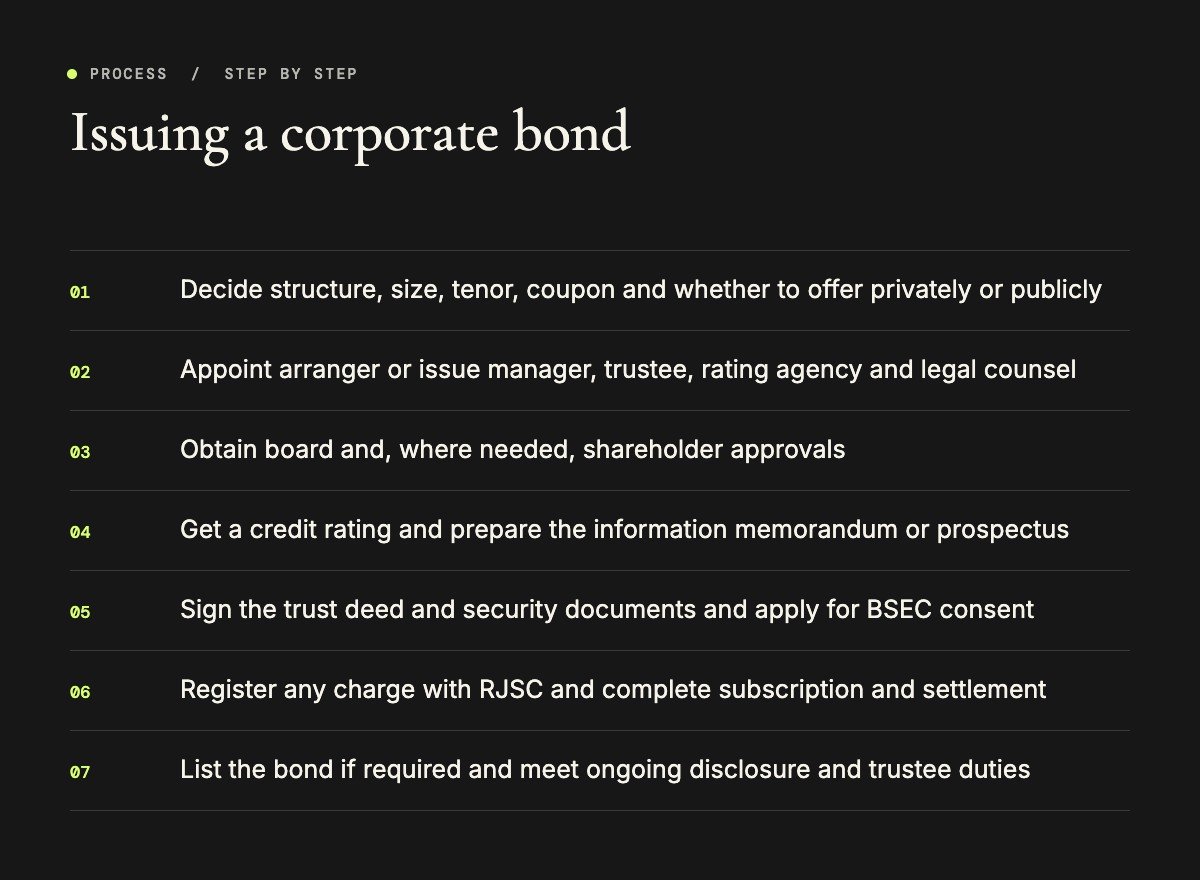
Timetables vary with complexity, but the sequence for corporate bond issuance in Bangladesh is broadly the same for most issuers. These are the steps we follow.
- Define the deal. Decide size, tenor, coupon basis, security, repayment profile and offer route, and model the issuer's ability to pay.
- Appoint the team. Mandate the arranger or issue manager, trustee, rating company, legal counsel and auditor, checking that the trustee is independent.
- Obtain corporate approvals. Pass board resolutions and any shareholder resolution needed under the articles or the Companies Act 1994.
- Get rated. Provide the rating company with financial and business information and agree surveillance arrangements.
- Prepare documents. Draft the information memorandum or prospectus, trust deed, subscription agreement and any security documents.
- Apply for BSEC consent. File the application with the required documents and fee, answer BSEC queries, and accept the consent conditions.
- Close and settle. Complete subscription, receive funds, issue the bonds, register any charge with RJSC within 21 days, and file the required post-issue reports.
- List and comply. Where required, list on the exchange, then meet coupon, disclosure, covenant and trustee reporting obligations until maturity.
BSEC has acknowledged complaints about slow approvals and said complete documentation speeds the process. In our experience, most delay comes from incomplete applications and late changes to the term sheet, not from the regulator.
Documentation that protects issuer and investors
The documents for corporate bond issuance in Bangladesh decide what happens when things go wrong. Investors read them closely, and so does BSEC.
The trust deed
The trust deed appoints the trustee and sets out the terms of the bonds: payment obligations, covenants, events of default, the trustee's powers and the process for bondholder meetings and decisions. Financial covenants, such as debt service coverage and leverage limits, should be realistic for the issuer and measurable from audited accounts.
The offer document
The information memorandum or prospectus must give investors accurate and complete information about the issuer, the risks and the terms. Misstatements expose the issuer and its directors to regulatory and civil liability, so verification of every material statement is essential.
Security documents
For a secured issue, the issuer grants a mortgage, hypothecation or assignment in favour of the trustee. The charge must be registered with RJSC within 21 days under section 159 of the Companies Act 1994, and land mortgages also need registration at the sub-registry. If existing lenders hold security over the same assets, an intercreditor or pari passu arrangement and their consent will be needed.
Trustees, defaults and enforcement
In any corporate bond issuance in Bangladesh, the trustee is the bondholders' guardian. It monitors payments and covenants, receives compliance reports, handles investor grievances and reports to BSEC. If the issuer defaults, the trustee issues default notices, negotiates with the issuer, convenes bondholders and, if needed, enforces security or brings proceedings.
Enforcement routes depend on the security. A mortgage of land is enforced through the courts, and for financial institution creditors the Artha Rin Adalat Ain 2003 may be relevant. Winding-up proceedings are a further option in serious cases. Issuers should understand these consequences before agreeing to covenants they may struggle to meet.
Cross-default clauses in existing loan agreements can be triggered by a bond issue that breaches negative pledge or borrowing limits. Review every facility agreement before the bond is signed, and obtain waivers where needed. A bond that puts the issuer in default with its banks on day one is a costly mistake.
Banks, Islamic issuers and green bonds
Banks and financial institutions are the largest participants in corporate bond issuance in Bangladesh. Subordinated and perpetual bonds issued to strengthen regulatory capital need Bangladesh Bank approval as well as BSEC consent, and must meet the loss-absorption and other features in Bangladesh Bank's capital rules. Check the latest guidance on the Bangladesh Bank website.
Islamic issuers use sukuk or mudaraba-based bonds, which the 2021 Rules cover. They need a Shariah structure, a Shariah adviser and documents that match the underlying assets or partnership. Green and social bonds require a clear use-of-proceeds framework, separate tracking of funds and periodic impact reporting, and BSEC has signalled support for sustainable bonds once the conventional market deepens.
Foreign investors and foreign currency
Foreign investors may buy Bangladeshi taka bonds, but investment and repatriation of coupons and principal must follow Bangladesh Bank's foreign exchange rules. Foreign-currency borrowing by Bangladeshi companies follows a separate regime and, for long-term private foreign loans, involves BIDA and Bangladesh Bank scrutiny. Structure these questions early with your bankers.
Listing and the secondary market
In corporate bond issuance in Bangladesh, public issues are listed, and BSEC is encouraging listing of privately placed bonds on the main board as well. Listing improves price discovery and allows investors to exit, which in turn supports lower coupons over time.
The secondary market is still thin. In September 2026 only around sixteen corporate bonds were listed on the Dhaka Stock Exchange, against more than two hundred government securities. Regulators are working on reforms to institutional investment rules, including for provident and gratuity funds, to widen the buyer base. For issuers, a listed bond brings continuous disclosure duties similar to those of listed equity, so plan the compliance resources accordingly. See our BSEC regulatory practice for support with ongoing obligations.
Frequently asked questions about corporate bond issuance in Bangladesh
Can a private limited company issue bonds?
A private company can raise funds through a private offer of debt securities with BSEC consent, subject to the Rules and its articles. A public issue to retail investors requires a public limited company that meets the Rules' additional eligibility tests.
Is a credit rating mandatory?
Yes. The Debt Securities Rules 2021 require a rating from a BSEC-registered credit rating company, kept under surveillance for the life of the instrument. Public issues need an investment-grade rating.
Who can act as trustee?
Only a company registered with BSEC as a trustee of debt securities, with the required capital and staff, and independent of the issuer, issue manager and arranger.
How long does BSEC consent take?
For corporate bond issuance in Bangladesh, it depends on the quality of the application and the complexity of the issue. Private offers are generally faster than public issues. Complete documents and early engagement with BSEC make the biggest difference.
Do bank subordinated bonds need separate approval?
Yes. Banks and financial institutions need Bangladesh Bank approval for instruments intended to count as regulatory capital, in addition to BSEC consent under the Debt Securities Rules 2021.
Must the bond be listed?
A public issue must be listed on a stock exchange. Listing of privately offered bonds depends on the consent conditions, and BSEC is increasingly encouraging main-board listing.
How we can help
We advise issuers, arrangers, trustees and investors on every stage of corporate bond issuance in Bangladesh: structuring, BSEC consent applications, trust deeds and security documents, Bangladesh Bank approvals for capital instruments, RJSC charge filings, listing and default management. Learn more about our debt capital markets practice.
Planning a bond or debenture issue?
We help you choose the right structure and offer route, prepare the documents and manage BSEC consent from term sheet to closing.
Book a consultationDebt capital marketsPrimary sources: the BSEC (Debt Securities) Rules 2021, trustee registration checklist and consent lists published by the Bangladesh Securities and Exchange Commission; the Securities and Exchange Ordinance 1969 and Companies Act 1994 on the Laws of Bangladesh portal; capital rules of Bangladesh Bank; listing information from the Dhaka Stock Exchange.
This article is general information about Bangladeshi law as of October 2026 and is not legal advice. Rules, fees and regulatory practice change; confirm current requirements with BSEC, Bangladesh Bank or a qualified lawyer before acting.


0 Comments