
A rights issue in Bangladesh lets a listed company raise fresh equity from its existing shareholders in proportion to their holdings. It is often faster and cheaper than a new public offer, but BSEC applies strict conditions on eligibility, pricing, underwriting and use of funds, and it does reject applications that fall short.
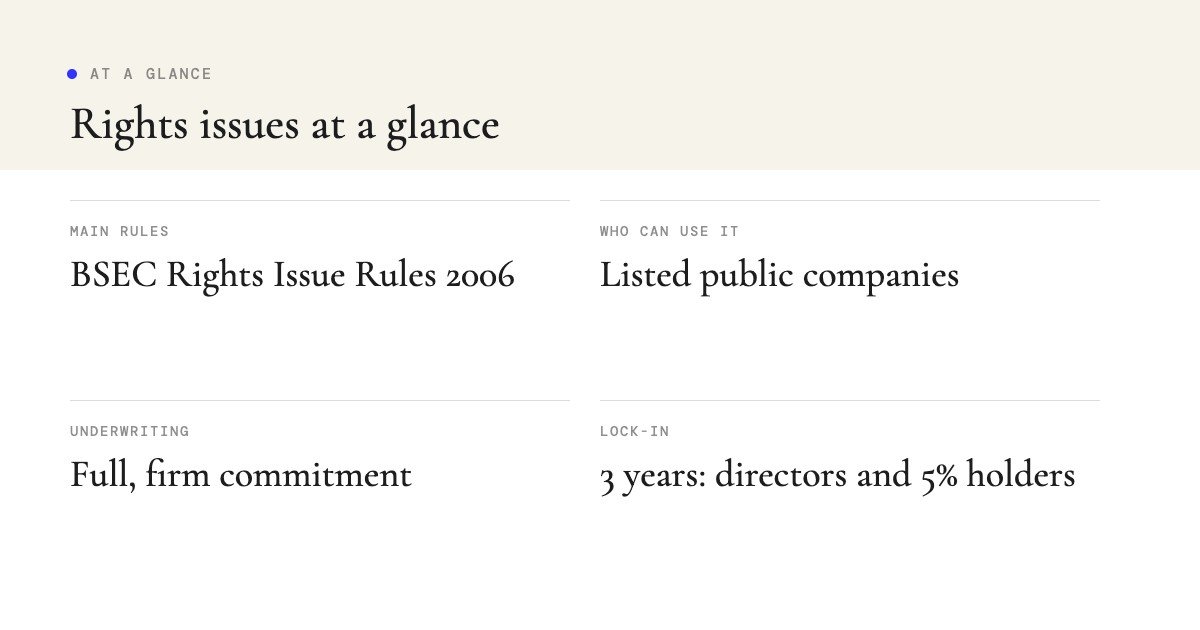
- Rights issues by listed companies are governed by the Securities and Exchange Commission (Rights Issue) Rules 2006, made under section 33 of the Securities and Exchange Ordinance 1969 and amended in 2011 and 2021.
- The issuer needs shareholder approval at a general meeting, a profit record, full use of earlier offer proceeds, no bank-defaulter directors, and full underwriting on a firm commitment basis.
- The application and offer document must reach BSEC within 15 working days after shareholder approval.
- Pricing above par is barred for companies without three years of commercial operation and a profit record, and a premium issue needs a credit rating.
- Directors and shareholders holding 5 percent or more face a three-year lock-in on their rights shares.
What a rights issue in Bangladesh is
A rights issue is an offer of new shares to existing shareholders in proportion to the shares they already hold, for example one new share for every two held. Each shareholder can take up the entitlement, renounce it in favour of someone else, or let it lapse. Shares not taken up are bought by the underwriters, which is why every rights issue in Bangladesh must be fully underwritten.
The Rights Issue Rules define a rights share as a new share offered to the existing shareholders of a public listed company in proportion to their holdings. So, in regulatory terms, a rights issue in Bangladesh is a tool for listed companies. Unlisted companies issue further shares under the Companies Act 1994 and their articles, and where they offer shares to outside investors they need BSEC consent under the capital issue rules instead.
Why companies choose rights over other routes
For a listed company, a rights issue avoids diluting existing shareholders who participate, needs no new investor marketing, and usually moves faster than a fresh public offer. It is common where a company needs capital for expansion, debt reduction or regulatory capital. Banks in particular have used rights issues to meet higher capital requirements; in July 2026, for example, BSEC approved a Tk 775 crore rights issue by a listed private commercial bank at a ratio of one new share for every two held.
The legal framework
The main rules for a rights issue in Bangladesh are the Securities and Exchange Commission (Rights Issue) Rules 2006, issued on 20 February 2006 under section 33 of the Securities and Exchange Ordinance 1969. They replaced the Rights Issue Rules 1998 and have been amended, notably in 2011 and 2021. The consolidated text is available on the BSEC website.
Other rules sit alongside them:
- Companies Act 1994. Governs the company's authorised capital, further issues of shares to existing members, general meetings and the return of allotment filed with RJSC.
- Listing regulations of the stock exchanges. Govern disclosure, record dates and listing of the new shares on the Dhaka Stock Exchange and the Chittagong Stock Exchange.
- Insider trading and disclosure rules. A board decision to propose a rights issue is price-sensitive information that must be disclosed promptly.
- Corporate Governance Code. Shapes board processes, audit committee oversight and related-party scrutiny.
- Sector regulation. Banks, financial institutions and insurers may need clearance from Bangladesh Bank or the Insurance Development and Regulatory Authority before raising capital.
BSEC also issues directives and orders from time to time that affect rights offers. Check for current directives before you fix the timetable for any rights issue in Bangladesh.
Eligibility conditions under the Rules
Rule 3 sets the conditions an issuer must satisfy before it can make a rights issue in Bangladesh. BSEC checks each one, and failing any of them is a common reason for rejection.
| Condition | What it means in practice |
|---|---|
| Shareholder approval | The rights issue must be approved by shareholders at a general meeting. |
| Earlier proceeds used | Funds from any earlier public or rights offer must have been fully used. |
| Regular AGMs | The company must have held its annual general meetings regularly. |
| Full underwriting | The issue must be fully underwritten on a firm commitment basis by licensed underwriters. |
| Audited accounts | Financial statements prepared under the applicable accounting standards and audited under the auditing standards. |
| No bank default | Neither the company nor its directors may be bank defaulters. |
| Profit record | The company must have a profitability record in the immediately preceding year. |
| Credit rating for premium | A credit rating report is required if the shares are offered at a premium. |
The condition that earlier offer proceeds must be fully used is often overlooked. If a company still has unutilised IPO or earlier rights money, BSEC will ask why it needs more. Reconcile the use of proceeds, with auditor confirmation, before the board even proposes the new issue.
Pricing a rights issue in Bangladesh
Under Rule 4 the issuer fixes the offer price together with the issue manager. Many rights issues are priced at face value, usually Tk 10 per share, but a premium is possible if the company qualifies and can justify it.
Since the 2011 amendment, a listed company that has not been in commercial operation for three years with a profit record cannot price rights shares above par. Where a premium is proposed, the offer document must justify it, and a credit rating report is required. BSEC looks closely at the valuation basis, including earnings history and sector price-earnings levels.
Setting the ratio
The ratio determines how many new shares each shareholder can take. It should match the amount the company genuinely needs, with a credible plan for using the money. An oversized issue, particularly at a premium, invites questions from BSEC and from the market about whether the company can deploy the funds productively.
Market conditions
Because shareholders can buy existing shares in the market instead, a rights price close to or above the market price is unlikely to be taken up, leaving underwriters with the shortfall. Companies have sometimes had to revisit pricing after market falls. Build in a realistic discount to the expected market price.
The team: issue manager, underwriters and bankers
A rights issue in Bangladesh needs a licensed issue manager and one or more licensed underwriters, plus bankers to the issue who collect subscriptions.
- Issue manager. Prepares the offer document, conducts due diligence and certifies it in the prescribed form. The issue manager is the company's main interface with BSEC.
- Underwriters. Commit to subscribe for any shares not taken up. Under Rule 6, the issuer must call on the underwriters within 10 days of the subscription closing, and they must subscribe within 15 days of the call. Underwriters also provide a certificate and a statement of their underwriting and portfolio position.
- Bankers to the issue. Receive subscription money during the subscription period.
- Auditors and legal counsel. Auditors certify financial information; counsel reviews the offer document, corporate approvals and material contracts.
Directors also sign a due diligence certificate. Every person who signs a certificate takes on responsibility for the accuracy of the offer document, so the verification process should be thorough.
Rights issue in Bangladesh: the step-by-step process
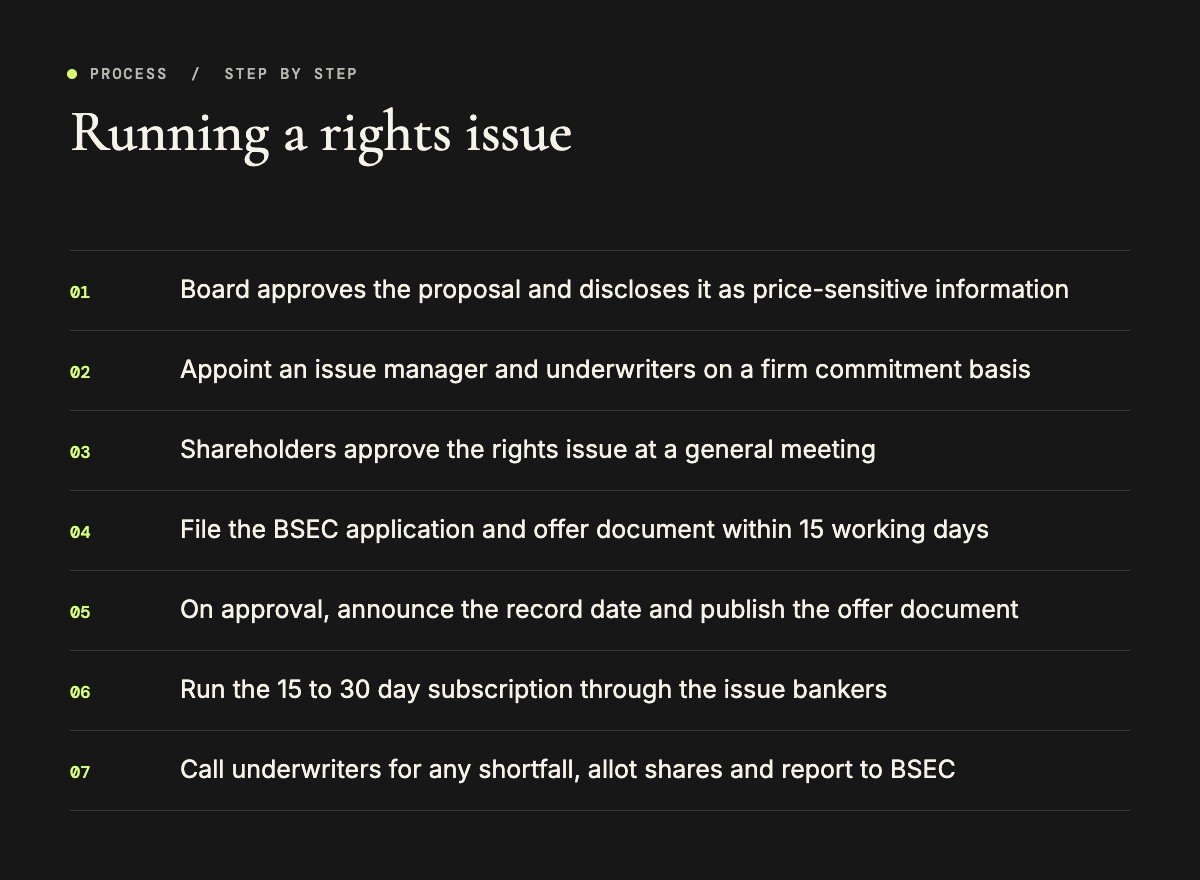
The Rules set a clear sequence for a rights issue in Bangladesh and several hard deadlines. Missing one can mean restarting the process. These are the steps we follow.
- Board decision and disclosure. The board approves the proposed issue, ratio and price, appoints the issue manager and underwriters, and calls a general meeting. The decision is disclosed as price-sensitive information to BSEC and the exchanges.
- Corporate housekeeping. Confirm authorised capital is sufficient; if not, increase it by the required resolution and file with RJSC.
- Shareholder approval. Shareholders approve the rights issue at a general meeting.
- Application to BSEC. Within 15 working days of shareholder approval, file the application with the offer document, underwriting, issue management and banker agreements, audited accounts, meeting extracts, certificates and the fee.
- BSEC review and approval. BSEC reviews the application, may raise deficiencies for correction, and then approves or rejects with reasons.
- Record date and offer document. After approval, the company announces the record date, publishes the offer document online and sends it to entitled shareholders.
- Subscription. The subscription period runs for 15 to 30 days through the bankers to the issue, opening at least 15 days after the record date.
- Underwriting and allotment. Call underwriters for any shortfall, allot the shares in dematerialised form, report the subscription results to BSEC, and file the return of allotment.
Once BSEC approves the offer, the Rules prevent the company from withdrawing, postponing or changing it without the Commission's written consent. Plan carefully before filing.
The offer document
Rule 8 lists what the offer document must contain. It is the main disclosure to shareholders for any rights issue in Bangladesh, and BSEC reviews it in detail.
- The amount and price of the issue, the ratio and the record date.
- Risk factors and management's view of them.
- A detailed plan for use of the funds, with an implementation schedule.
- Justification for any premium.
- Directors' shareholdings and their intention to subscribe.
- Details of underwriters, issue manager and other advisers.
- Material contracts and financial information.
- A statement on the lock-in and on issuing shares in dematerialised form.
Use of proceeds
In a rights issue in Bangladesh, the use-of-proceeds section deserves particular care. BSEC expects a specific, credible plan, and the company must later report on actual use. Diverting rights money to purposes not disclosed, or to related parties, is a serious breach that can lead to enforcement action against the company and its directors.
Lock-in, renunciation and shareholder rights
Under Rule 14, rights shares subscribed by directors and by shareholders holding 5 percent or more are locked in for three years from the close of subscription. Rights shares acquired through renunciation by such persons are subject to the same lock-in. This prevents insiders from using a rights issue to buy cheaply and exit quickly.
Ordinary shareholders can take up their entitlement, renounce it in favour of another person within the period and manner set in the offer document, or let it lapse. Entitlements are handled in dematerialised form through the depository system, so shareholders should keep their beneficial owner accounts and bank details up to date. For how share transfers work more generally, see our guide to share transfers in Bangladesh.
Foreign and non-resident shareholders
Non-resident shareholders can usually subscribe for their entitlement, provided payment is made through proper banking channels in line with Bangladesh Bank's foreign exchange rules, so that later dividends and sale proceeds can be repatriated. Plan the remittance early, because subscription windows are short.
Directors who do not intend to subscribe should say so clearly in the offer document. A director who signals support and then lets the entitlement lapse can damage market confidence and may face questions about disclosure.
Banks, insurers and other regulated issuers
A large share of recent rights issue activity in Bangladesh comes from banks and other regulated companies that need to strengthen their capital. For these issuers, a rights issue in Bangladesh has two regulators: BSEC under the Rights Issue Rules, and the sector regulator under its own capital and shareholding rules.
Banks should confirm with Bangladesh Bank whether its clearance is required for the capital increase and whether any shareholder will cross a shareholding limit under the Bank Company Act 1991 by taking up renounced or underwritten shares. Insurers should check the corresponding requirements of the Insurance Development and Regulatory Authority. Build these clearances into the timetable, because BSEC may ask for them before approving the offer.
Underwriters and shareholding limits
Where a rights issue is undersubscribed, underwriters take up the shortfall. In a regulated company, that can push an underwriter or its group above a shareholding threshold, or create a new substantial shareholder who must be disclosed. Check the likely take-up and agree in the underwriting agreement how any excess holding will be managed.
Alternatives to a rights issue
A rights issue in Bangladesh is not the only way for a listed company to raise equity. Depending on the need and the shareholder base, other routes may be faster or more suitable.
- Private placement of shares. Issuing new shares to selected investors with BSEC consent and shareholder approval, which dilutes non-participating shareholders and is scrutinised closely.
- Repeat public offering. A further public offer to new investors, with a prospectus and a longer process.
- Convertible or subordinated debt. Bonds that add capital without immediate dilution, issued under the BSEC (Debt Securities) Rules 2021.
- Retained earnings and bonus shares. Capitalising reserves strengthens paid-up capital but does not bring in new cash.
The right choice depends on how much money is needed, how quickly, and whether existing shareholders are willing and able to invest.
Why BSEC rejects rights applications
BSEC has rejected or declined to reconsider a number of applications for a rights issue in Bangladesh in recent years. Public reports do not always state the reasons, but in our experience the problems that most often lead to refusal or long delay are these:
- Weak financial position. Losses, falling profits or doubts about the company's ability to use the money productively.
- Governance concerns. Missed dividends, irregular AGMs, downgrades to a lower exchange category or unresolved regulatory issues.
- Unused earlier proceeds. Money from an earlier offer not yet deployed as promised.
- Unjustified premium. A premium not supported by earnings, or a company that does not meet the profit and operating history conditions.
- Vague use of funds. Proceeds aimed at an associate or related company without a clear commercial case.
- Incomplete filings. Missing certificates, inconsistent figures or late submission after shareholder approval.
A rejection is public and can affect the share price, so it pays to stress-test the application before filing. Our BSEC regulatory practice regularly reviews applications before they go in.
Frequently asked questions about rights issue in Bangladesh
Can an unlisted company make a rights issue?
The Rights Issue Rules apply to listed public companies. An unlisted company can offer further shares to its existing members under the Companies Act 1994 and its articles, and needs BSEC consent under the capital issue rules where the offer goes to outside investors.
How soon must the BSEC application be filed?
Within 15 working days after shareholders approve the rights issue at the general meeting, together with the offer document and supporting documents.
Can rights shares be issued at a premium?
Yes, if the company has at least three years of commercial operation with a profit record, justifies the premium in the offer document and obtains a credit rating. Otherwise the shares must be offered at par.
Is underwriting compulsory?
Yes. The issue must be fully underwritten on a firm commitment basis by licensed underwriters, who must take up any shares left unsubscribed.
How long is the subscription period?
Between 15 and 30 days, opening at least 15 days after the record date, with subscriptions collected through the bankers to the issue.
Can a company cancel a rights issue after approval?
Not on its own. Once BSEC has approved the offer, it cannot be withdrawn, postponed or changed without the Commission's written consent.
How we can help
We advise listed companies, issue managers and underwriters on every stage of a rights issue in Bangladesh: eligibility review, corporate approvals, offer document drafting and verification, BSEC applications and responses to queries, sector regulator clearances, and post-issue compliance. We also help shareholders and investors assess their rights and options. Learn more about our equity capital markets practice.
Considering a rights offer?
We test your eligibility against the Rights Issue Rules, prepare the approvals and documents, and manage the BSEC process to allotment.
Book a consultationEquity capital marketsPrimary sources: the Securities and Exchange Commission (Rights Issue) Rules 2006 as amended, published by the Bangladesh Securities and Exchange Commission; the Securities and Exchange Ordinance 1969 and Companies Act 1994 on the Laws of Bangladesh portal; listing regulations of the Dhaka Stock Exchange and the Chittagong Stock Exchange.
This article is general information about Bangladeshi law as of October 2026 and is not legal advice. Rules, directives and fees change; confirm current requirements with BSEC or a qualified lawyer before acting.

0 Comments