
Debt restructuring in Bangladesh usually happens outside court, through negotiation with banks and finance companies under Bangladesh Bank's rescheduling and restructuring policies. With stricter loan classification rules, higher interest rates and pressure on export and import businesses, many companies need to reorganise their borrowing. A well-run workout can save a viable business; a poorly managed one can end in Artha Rin Adalat suits, defaulter status and asset sales.
- Most corporate debt restructuring in Bangladesh is negotiated directly with lenders, using Bangladesh Bank policies on rescheduling, restructuring and one-time exits.
- Bangladesh Bank has tightened loan classification rules, so loans become classified sooner when payments are overdue, raising the stakes for borrowers.
- A standstill, a credible business plan and transparent information are the foundations of a successful workout.
- Where lenders cannot agree, a court-sanctioned scheme of arrangement under section 228 of the Companies Act 1994 can bind dissenting creditors.
- Formal insolvency through winding up or the Bankruptcy Act 1997 is a last resort and rarely preserves value.
Why debt restructuring in Bangladesh matters now
Since 2022, Bangladeshi businesses have faced currency depreciation, high inflation, energy shortages, rising interest rates after the abolition of the SMART reference rate in May 2024, and tighter credit. Bangladesh Bank, under an IMF programme, has moved to stricter loan classification and provisioning and greater transparency about non-performing loans. For borrowers, this means less room for informal forbearance and a greater need for structured solutions. Debt restructuring in Bangladesh has therefore become a core corporate legal skill.
Our restructuring and insolvency practice represents borrowers, lenders and investors in workouts and distressed situations.
Restructuring tools
| Tool | What it does | Key considerations |
|---|---|---|
| Rescheduling | Extends repayment of overdue loans under Bangladesh Bank policy | Down payment, number of past reschedulings, classification |
| Restructuring | Changes tenor, rate or structure of large loans | Policy eligibility, board and Bangladesh Bank approvals |
| One-time exit | Settles debt at agreed amount, sometimes with waiver | Bank approval, tax on waived amounts |
| Security enforcement standstill | Pauses lawsuits and auctions during talks | Contractual agreement among lenders |
| Asset sales | Raise cash to repay debt | Lender consents and release of security |
| Section 228 scheme | Court-sanctioned compromise binding creditors | Three-fourths in value majority |
Bangladesh Bank policies
Bangladesh Bank regularly issues circulars on loan classification, provisioning, rescheduling and restructuring. These set down payment requirements, maximum repayment periods, limits on repeated rescheduling and conditions for upgrading classified loans. In recent years, Bangladesh Bank has tightened classification so that loans are classified sooner when instalments are overdue, while also introducing special arrangements for some distressed borrowers through case-by-case review. Because these policies change frequently, debt restructuring in Bangladesh must always be checked against the latest circulars.
Approach lenders before loans become classified if possible. Once a loan is classified, the borrower may face restrictions on new credit, defaulter reporting in the Credit Information Bureau and less flexible rescheduling terms.
The workout process
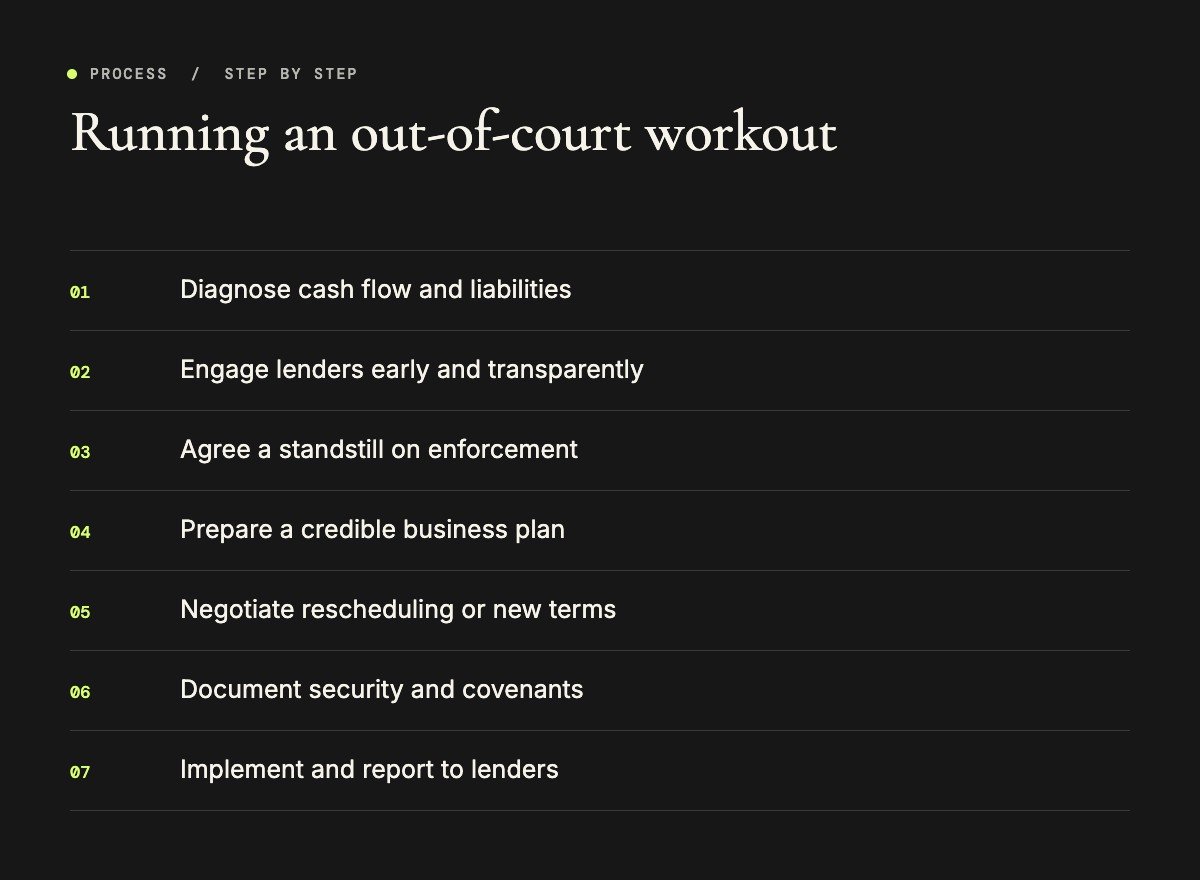
- Diagnosis. Map all borrowings, guarantees, security and cash flows, and identify the core viable business.
- Early engagement. Inform lenders transparently and propose a process.
- Standstill. Agree that lenders will not sue or enforce security for a defined period while proposals are developed.
- Business plan. Prepare a realistic plan, ideally reviewed by an independent adviser, showing how debts can be serviced.
- Negotiation. Agree new terms with each lender or through a lenders' forum, considering Bangladesh Bank policy limits.
- Documentation. Sign rescheduling or restructuring agreements, update security and add monitoring covenants.
- Implementation. Make payments on time, report regularly and rebuild lender confidence.
Multiple lenders and syndicates
Large borrowers often owe money to several banks, sometimes under syndicated facilities. Each bank has its own credit committee and policy constraints, which can make agreement difficult. A lenders' forum with a lead bank, shared information and an intercreditor arrangement on priorities and enforcement can help. Where a small minority refuses a reasonable deal, a scheme of arrangement under section 228 may be considered. Coordination is essential for complex debt restructuring in Bangladesh.
Court-based options
Section 228 of the Companies Act 1994 allows a company to propose a compromise with creditors or a class of creditors. If approved by a majority in number representing three-fourths in value at court-ordered meetings, and sanctioned by the High Court Division, the scheme binds all creditors in that class. This tool is used less often than in some jurisdictions, but it can be valuable. Winding up under the Companies Act and bankruptcy under the Bankruptcy Act 1997 exist but rarely preserve value. See our guide to winding up cases.
Guarantors and personal exposure
Guarantees are a sensitive issue in debt restructuring in Bangladesh. Directors and family members often guarantee company loans. A workout should address guarantees explicitly: whether they continue, are reduced or are released on milestones. Guarantors should take independent advice, because their personal assets may be at risk if the company fails. Debt restructuring in Bangladesh that ignores guarantor issues can leave unresolved liabilities that resurface later.
Tax and accounting effects
Debt restructuring in Bangladesh also has tax effects. Waivers of interest or principal can have tax consequences for the borrower, and lenders' provisioning affects their willingness to agree terms. Changes to loan terms may also require disclosure in financial statements and, for listed companies, announcements to the stock exchanges. Early coordination with auditors and tax advisers avoids surprises.
Warning signs that restructuring is needed
Companies often wait too long. Warning signs include repeated use of forced loans under letters of credit, overdue instalments, reliance on short-term facilities to fund long-term assets, covenant breaches, supplier payment delays and difficulty paying salaries or taxes on time. When these appear, management should consider debt restructuring in Bangladesh before lenders take enforcement steps. Early action keeps more options open, including fresh equity or asset sales on the company's terms.
The business plan lenders want to see
Banks will not agree new terms without a credible plan. A strong plan explains why the business got into difficulty, what has changed, realistic projections for revenue and costs, the capital expenditure needed, how much debt the business can sustainably service and on what timetable. Sensitivity analysis showing outcomes under weaker scenarios builds credibility. Independent review by an accounting firm or turnaround adviser often helps persuade credit committees. In debt restructuring in Bangladesh, the quality of the plan frequently decides whether lenders agree.
New money and priority
A distressed company may need fresh working capital to keep operating during the restructuring. Existing lenders may be reluctant to lend more unless the new money ranks ahead of existing debt or receives additional security. Bangladeshi law does not have a formal debtor-in-possession financing regime, so priority for new money depends on contracts and security arrangements agreed among lenders. Shareholders may also be asked to contribute equity to show commitment. Structuring new money is a delicate but often essential part of debt restructuring in Bangladesh.

Distressed sales and investors
Sometimes the best solution is to sell the business, a division or key assets to a new investor who can recapitalise it. Distressed M&A requires lender consents, releases of security, careful due diligence and attention to liabilities that may follow the assets, such as employee dues and taxes. Investors may buy debt from banks at a discount, though bank loan sales in Bangladesh are less developed than in some markets. Our mergers and acquisitions practice advises on distressed transactions.
Employees, suppliers and tax authorities
Restructuring affects more than banks. Unpaid wages and benefits create legal risks under the Bangladesh Labour Act 2006 and can lead to unrest, especially in factories. Suppliers may stop deliveries unless paid. Tax and VAT arrears can lead to recovery action by NBR. A comprehensive debt restructuring in Bangladesh considers all stakeholders, prioritises payments that keep the business operating and communicates clearly to maintain trust.
Common mistakes
- Waiting until loans are classified and lawsuits are filed.
- Negotiating with banks one by one without a coordinated plan.
- Offering unrealistic repayment schedules that fail within months.
- Ignoring guarantor and security issues in the documentation.
- Failing to report progress to lenders after the deal is signed.
Avoiding these mistakes greatly improves the chances that debt restructuring in Bangladesh succeeds.
Banks under resolution
Some borrowers owe money to banks that are themselves under stress or subject to resolution measures. New bank resolution legislation and Bangladesh Bank interventions, such as board reconstitutions and mergers, can change who the borrower is negotiating with and how decisions are made. Borrowers should keep track of these developments, as a bank in resolution may take a firmer stance on recovery. Debt restructuring in Bangladesh with such banks requires patience and careful documentation of any agreed terms.
Timeline expectations
A simple rescheduling with one bank can be completed within weeks if documents are ready. Multi-lender restructurings typically take several months, as each bank's credit committee and, sometimes, Bangladesh Bank must approve. A standstill agreement provides breathing space during this time. Building realistic timelines into the business plan helps maintain lender confidence throughout debt restructuring in Bangladesh.
Governance during a workout
Directors must take particular care while a company is in financial difficulty. They should hold regular board meetings, record the information considered and the reasons for decisions, avoid paying related parties ahead of other creditors and take professional advice. Transactions that move assets out of reach of creditors can later be challenged and may expose directors to personal liability in a winding up. Good governance also reassures lenders that the company can be trusted to implement agreed terms. Lenders often require monitoring rights, such as monthly reporting, cash flow forecasts and sometimes an observer at board meetings, as part of the new arrangements.
Communication strategy
Rumours of financial trouble can damage relationships with customers, suppliers and employees. A clear communication plan, agreed with lenders where necessary, helps maintain confidence. Listed companies must disclose price-sensitive information about defaults and restructurings through the stock exchanges promptly. Honest, consistent messages support every stage of debt restructuring in Bangladesh.
Frequently asked questions about debt restructuring in bangladesh
Can I restructure my company's bank loans without going to court?
Yes. Most restructurings are negotiated with lenders under Bangladesh Bank policies.
What is rescheduling?
Extending repayment of overdue loans under Bangladesh Bank rules, usually with a down payment.
Can lenders sue during negotiations?
Yes, unless a standstill is agreed, so securing one early is important.
What if one bank refuses?
Lenders' forums and, in some cases, a section 228 scheme can help achieve a binding solution.
Are guarantors released?
Only if the lenders agree; guarantees should be addressed expressly in the workout.
Is bankruptcy a good option?
Usually not; formal insolvency rarely preserves value and is a last resort.
How we can help
We advise borrowers, lenders and investors on debt restructuring in Bangladesh: standstills, lenders' forums, rescheduling and restructuring agreements, schemes of arrangement, guarantor issues, distressed M&A and Artha Rin Adalat strategy. Learn more about our restructuring and insolvency practice and our banking and finance practice.
Under pressure from lenders?
We help you stabilise cash flow, negotiate a workable deal and protect directors and guarantors.
Book a consultationRestructuring practicePrimary sources: the Companies Act 1994, Bankruptcy Act 1997, Artha Rin Adalat Ain 2003 and Bank Company Act 1991 on the Laws of Bangladesh portal; loan classification and rescheduling circulars of Bangladesh Bank.
This article is general information about Bangladeshi restructuring law as of October 2026 and is not legal or financial advice. Bangladesh Bank policies change frequently; confirm current rules before negotiating with lenders.



0 Comments