
An ijarah lease in Bangladesh is one of the most widely used Islamic finance products, letting businesses and individuals use machinery, vehicles, equipment or property in return for rent, without paying interest. Islamic banks, Islamic windows of conventional banks and some finance companies offer ijarah under Bangladesh Bank's Islamic banking guidelines and the rulings of their Shariah boards. The contract must satisfy both Shariah principles and ordinary Bangladeshi law.
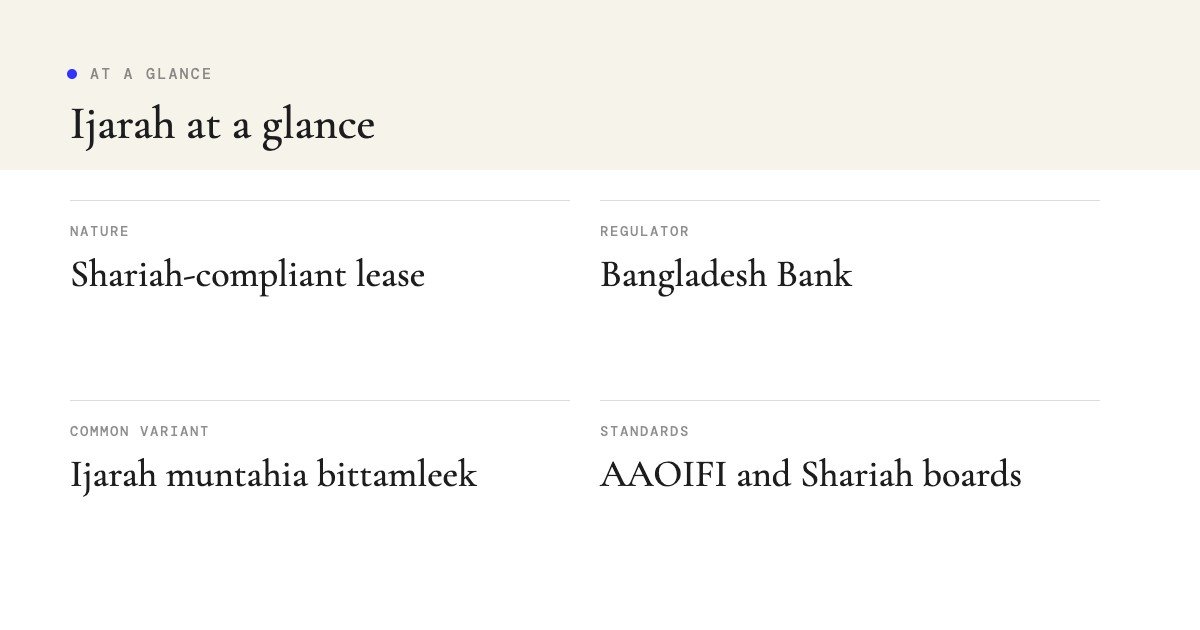
- Ijarah is a lease where the lessor owns the asset and the customer pays rent for its use; ownership risk stays with the lessor.
- Ijarah muntahia bittamleek, an ijarah ending in transfer of ownership, is common for vehicles, machinery and housing.
- Islamic banks follow Bangladesh Bank's Islamic banking guidelines and the decisions of their Shariah supervisory committees, often drawing on AAOIFI standards.
- Lease documents must also comply with the Contract Act 1872, the Transfer of Property Act 1882 and registration and stamp laws where immovable property is involved.
- Tax and VAT treatment, insurance (takaful) and default remedies should be agreed clearly in the documents.
What an ijarah lease in Bangladesh is
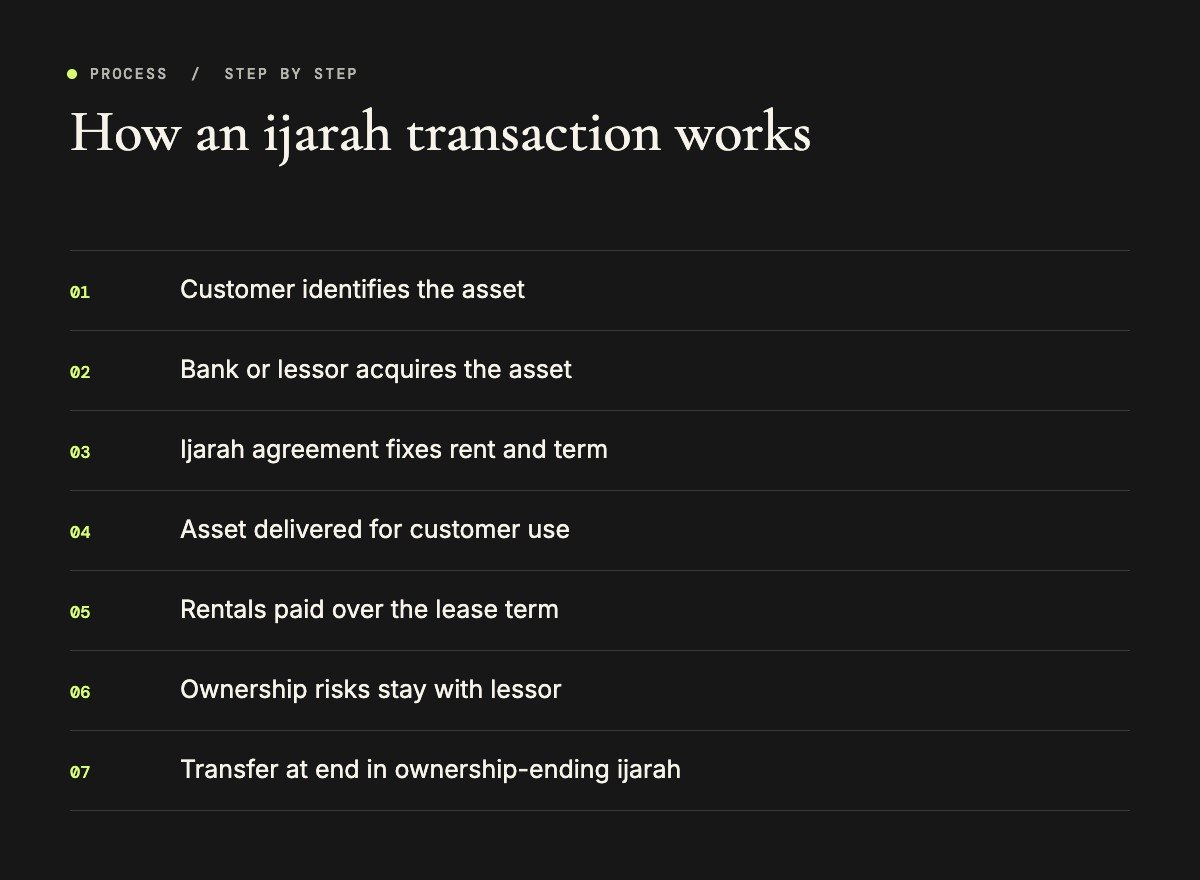
Islamic finance prohibits riba, commonly understood as interest, and requires that returns be linked to real assets or genuine trade. Ijarah meets this by separating ownership from use. The bank or lessor buys an asset the customer needs and leases it to the customer for an agreed rent over an agreed period. Because the lessor owns the asset, it bears ownership risks, such as total loss not caused by the customer, while the customer is responsible for ordinary use and maintenance as agreed.
An ijarah lease in Bangladesh is offered by full-fledged Islamic banks, Islamic banking branches and windows of conventional banks, and some finance companies. Our Islamic finance practice advises lenders and customers on structuring and documentation.
Types of ijarah
| Type | Key feature | Typical use |
|---|---|---|
| Operating ijarah | Asset returns to lessor at the end | Equipment hire, short-term leasing |
| Ijarah muntahia bittamleek | Ownership transfers to customer at the end by sale or gift under a separate promise | Vehicles, machinery, housing |
| Hire purchase under shirkatul melk (HPSM) | Joint ownership with lease of bank's share and gradual purchase | Housing, industrial assets |
| Forward ijarah | Lease agreed before the asset is built or delivered | Projects and construction |
Bangladeshi Islamic banks commonly use HPSM and ijarah muntahia bittamleek for long-term asset finance. The exact structure depends on the bank's Shariah committee approvals.
Regulatory framework
Islamic banks are licensed under the Bank Company Act 1991 and supervised by Bangladesh Bank, which issued guidelines for conducting Islamic banking and requires Shariah supervisory committees. Finance companies offering Islamic products are governed by the Finance Company Act 2023 and Bangladesh Bank rules. There is no separate Islamic finance statute for leasing, so an ijarah lease in Bangladesh relies on general contract and property law, read together with Shariah principles. Bangladesh Bank has also taken action on weak Shariah-based banks, including moves to consolidate several of them, which has increased attention on governance in the sector.
Shariah requirements in practice
Each ijarah lease in Bangladesh should reflect these Shariah requirements:
- Ownership first. The lessor must own the asset, or have constructive possession, before leasing it.
- Clear asset and rent. The asset, its use, rent and lease term must be specified.
- Rent starts with use. Rent is payable once the asset is delivered and available for use.
- Ownership risk. Major maintenance and insurance of ownership risk rest with the lessor, though costs may be reflected in rent.
- Separate transfer. In ownership-ending ijarah, transfer is through a separate promise, not a condition of the lease itself.
- Late payment. Penalties for late payment are typically directed to charity rather than income for the bank.
Ask for the Shariah committee's approval of the product and the full documentation set. Disputes often arise because customers sign standard forms without understanding which costs and risks remain with them.
Documentation
A typical ijarah lease in Bangladesh involves a master agreement, a purchase order or agency agreement under which the customer buys the asset on the bank's behalf, a lease agreement setting rent and term, a promise to purchase or gift for ownership transfer, security documents such as personal guarantees, post-dated cheques or mortgages, and takaful or insurance arrangements. For vehicles, registration with BRTA reflects the bank's ownership interest. For immovable property, leases for more than one year must be registered under the Registration Act 1908, and stamp duty applies.
Tax and VAT
Tax issues affect the cost of an ijarah lease in Bangladesh. Tax treatment of Islamic finance follows the Income Tax Act 2023 and VAT and Supplementary Duty Act 2012, with practice and NBR guidance shaping how rentals, asset transfers and profits are treated. Questions include whether rentals are deductible for the customer, how the bank accounts for depreciation, whether the transfer at the end attracts VAT or stamp duty, and how registration fees apply. Parties should confirm the current position with tax advisers when structuring an ijarah lease in Bangladesh.
Default and remedies
Default under an ijarah lease in Bangladesh has clear consequences. If the customer defaults, the bank may terminate the lease, repossess the asset, claim outstanding rentals and enforce security. Islamic banks can also sue in the Artha Rin Adalat as financial institutions. Repossession should follow the contract and law; self-help measures that breach the peace can expose the lessor to liability. Customers facing difficulty should seek rescheduling early, as Bangladesh Bank policies apply to Islamic banks too.
Ijarah compared with conventional leasing
Conventional leasing in Bangladesh, offered by banks and finance companies, often treats the lease as a financing transaction with an interest-based return, and risks are largely passed to the lessee. An ijarah lease in Bangladesh keeps the lessor's ownership risks real, ties rent to the use of an existing asset and avoids interest. In practice, pricing may be benchmarked against market rates, which Shariah scholars generally accept as a reference provided the contract itself is Shariah-compliant. Customers should compare total costs, risk allocation, flexibility on early termination and the consequences of default when choosing between the two.
Early termination and prepayment
Customers sometimes want to end an ijarah early, for example by buying the asset before the end of the term. Islamic banks usually allow this through the purchase promise, at a price reflecting outstanding rentals and the asset's value, sometimes with a rebate on future rentals. The lease documents should explain how early purchase works, what fees apply and how any rebate is calculated. Clear terms reduce disputes when a business refinances or sells the asset.
Takaful and insurance
Because the lessor owns the asset, it is responsible for insuring against ownership risks, preferably through takaful, the Islamic alternative to conventional insurance. Customers may be responsible for operational insurance, such as third-party motor liability. Takaful providers in Bangladesh are regulated by the Insurance Development and Regulatory Authority. An ijarah lease in Bangladesh should state who arranges each type of cover, who pays, and how proceeds are applied if the asset is lost or damaged.
Ijarah sukuk and the wider market
Beyond individual leases, ijarah structures underpin sukuk issued by the Bangladesh government, which has used ijarah sukuk to fund infrastructure projects and give Islamic banks a liquid, Shariah-compliant investment. Corporate sukuk have also been issued with BSEC approval. These developments show how central ijarah has become to Islamic finance in the country, and they provide benchmarks that can inform pricing of an ijarah lease in Bangladesh.
Common disputes
- Who bears the cost of major repairs or total loss of the asset.
- Whether rent was payable before delivery of the asset.
- Calculation of early purchase prices and rebates.
- Late payment charges and whether they were treated as charity.
- Repossession procedures and valuation of repossessed assets.
Careful drafting and transparent communication prevent most of these disputes and protect both lessor and customer.
Practical tips for customers
- Read the full documentation, not just the offer letter.
- Ask how ownership risks and maintenance are allocated.
- Confirm the total cost over the lease term and any early purchase terms.
- Check insurance or takaful arrangements.
- Keep records of all rental payments and correspondence with the bank.
Ijarah for housing
Home finance is a major use of the ijarah lease in Bangladesh, usually through HPSM or ijarah muntahia bittamleek. The bank and customer jointly own the property or the bank owns it outright, the customer pays rent for the bank's share and gradually buys that share until full ownership passes. Because the transaction involves land and buildings, title verification, registration of deeds and mortgages or equivalent security, mutation and land development tax all matter. Customers should check that the property has clear title and approvals before entering into an ijarah lease in Bangladesh for housing.
Ijarah for SMEs and industry
Small and medium enterprises use the ijarah lease in Bangladesh to acquire machinery, vehicles and equipment without large upfront payments. For imported machinery, the bank may open a letter of credit in its own name, take delivery and lease the machinery to the customer. Customs, VAT and bonded warehouse issues need to be coordinated, and the lease should specify who bears installation and commissioning costs. Well-structured ijarah can match rental payments to the cash flows the asset generates.
Choosing a provider
When comparing providers of an ijarah lease in Bangladesh, look beyond the headline rental. Consider the strength of the bank's Shariah governance, transparency of documents, flexibility on early purchase, service quality and financial stability. Recent problems at some Shariah-based banks show why customers should also consider the institution's soundness, especially for long-term housing finance. Independent legal review of the documents before signing helps you understand exactly what you are agreeing to and how an ijarah lease in Bangladesh will work for your business or family over its full term.
Frequently asked questions about ijarah lease in bangladesh
Is ijarah the same as a conventional lease?
It looks similar, but the lessor must own the asset, bear ownership risk and avoid interest-based terms, as approved by a Shariah committee.
Can I own the asset at the end?
Yes, under ijarah muntahia bittamleek or HPSM, through a separate sale or gift promise.
Who insures the asset?
Ownership risk is the lessor's responsibility, usually covered by takaful, though costs may be built into rent.
Does a property ijarah need registration?
Leases of immovable property for more than one year must be registered, with stamp duty paid.
What happens on default?
The bank can terminate, repossess, claim unpaid rent and sue in the Artha Rin Adalat.
Are late payment penalties allowed?
Usually yes as charity undertakings, rather than income for the bank, depending on Shariah approvals.
How we can help
We advise Islamic banks, finance companies and customers on every ijarah lease in Bangladesh: product structuring, Shariah-compliant documentation, security and registration, tax issues, restructuring and disputes. Learn more about our Islamic finance practice and our asset finance and leasing practice.
Structuring or reviewing an ijarah facility?
We make sure your documents work under both Shariah principles and Bangladeshi law.
Book a consultationIslamic finance practicePrimary sources: the Bank Company Act 1991, Finance Company Act 2023, Contract Act 1872, Transfer of Property Act 1882 and Registration Act 1908 on the Laws of Bangladesh portal; Islamic banking guidelines of Bangladesh Bank; VAT and tax rules from the National Board of Revenue.
This article is general information about Islamic finance law in Bangladesh as of October 2026 and is not legal, tax or religious advice. Product structures depend on Shariah committee approvals; take advice before entering into a facility.


0 Comments