
A limited company protects its shareholders, but its directors are not always so safe. Director liability in insolvency can arise in Bangladesh through fraudulent trading, misfeasance claims, personal guarantees, dishonoured cheques, bank defaulter rules, unpaid taxes and workers’ dues. Directors of struggling companies need to understand these risks before decisions are made, not after.
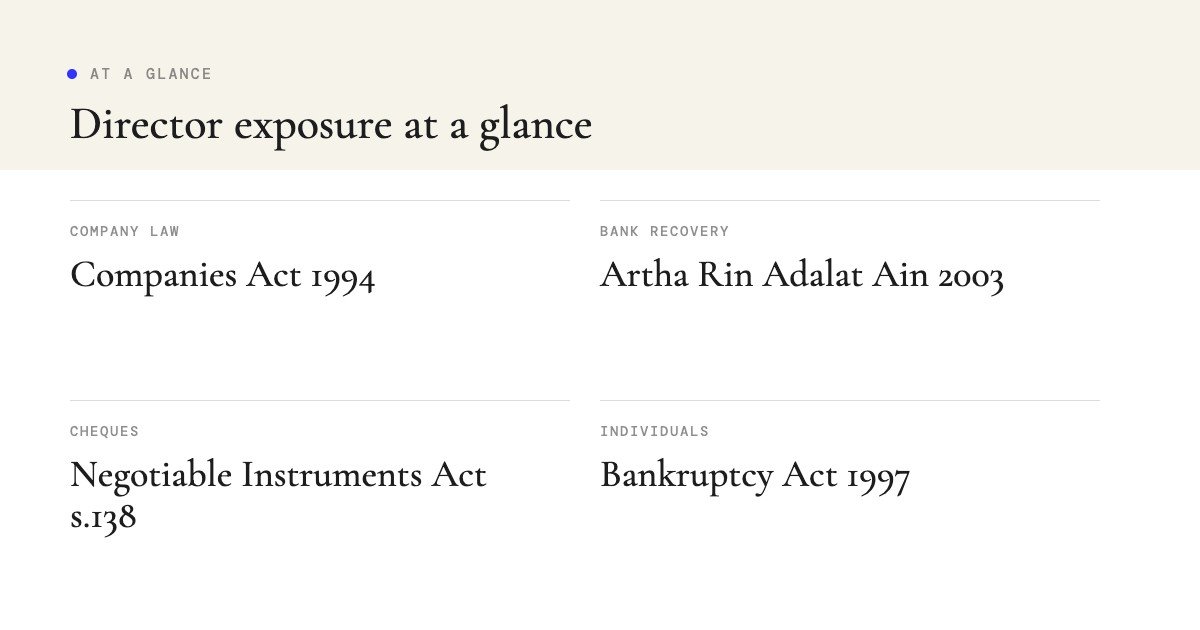
- The Companies Act 1994 allows the court in a winding up to hold directors personally liable for fraudulent trading and misfeasance.
- Personal guarantees given to banks are the most common source of director liability in insolvency in Bangladesh.
- Directors who sign cheques that bounce can face criminal proceedings under section 138 of the Negotiable Instruments Act 1881.
- Directors of companies classified as wilful defaulters face restrictions on directorships, travel and new credit under banking rules.
- Early advice, accurate records and avoiding preferences to connected parties are the best protections.
Why directors face personal risk
In normal times, directors owe their duties to the company and its shareholders. When a company approaches insolvency, the interests of creditors become increasingly important, because creditors, not shareholders, now bear the risk of loss. Decisions that might be acceptable for a healthy company can become improper when it cannot pay its debts.
Bangladesh does not yet have a modern stand-alone corporate insolvency statute of the kind found in many countries, although reform has been discussed for years. As a result, director liability in insolvency comes from several sources: the winding-up provisions of the Companies Act 1994, banking and debt recovery laws, criminal laws and tax and labour statutes. Our restructuring and insolvency practice advises directors, creditors and liquidators.
Fraudulent trading and director liability in insolvency
The Companies Act 1994 provides that if, in the course of winding up, it appears that business has been carried on with intent to defraud creditors or for any fraudulent purpose, the court may declare that any persons knowingly party to it are personally responsible, without limitation of liability, for all or any of the company's debts. Such conduct can also be a criminal offence.
Fraudulent trading requires dishonesty, such as taking customer deposits or supplier credit knowing there is no reasonable prospect of payment, or moving assets beyond creditors' reach. It is the most serious form of director liability in insolvency and can lead to both civil and criminal consequences.
Misfeasance as a source of director liability in insolvency
In a winding up, the liquidator, a creditor or a contributory can apply to the court to examine the conduct of directors who have misapplied or retained company money or property, or been guilty of misfeasance or breach of trust. The court can order them to repay or restore the money or property, or contribute compensation.
Examples include paying excessive remuneration while the company is insolvent, transferring assets to related parties at undervalue, or using company funds for personal purposes. Misfeasance claims are a practical tool for liquidators seeking to increase recoveries for creditors.
Fraudulent preference and transactions at undervalue
Payments or transfers made shortly before winding up that prefer one creditor over others, particularly a connected creditor such as a director or a group company, can be challenged as fraudulent preferences. Transfers made with intent to defeat creditors may also be set aside under the Transfer of Property Act 1882.
Directors who repay their own loans to the company, or release personal guarantees by paying the guaranteed bank first, face particular scrutiny. Avoiding such preferences is central to managing director liability in insolvency.
Personal guarantees and bank debt
| Source of exposure | How it arises |
|---|---|
| Personal guarantees | Directors guarantee company loans; banks sue them directly in the Artha Rin Adalat |
| Mortgages of personal property | Directors' homes or land mortgaged for company borrowing |
| Wilful defaulter rules | Restrictions on directorships, new credit and other consequences under banking rules |
| Dishonoured cheques | Criminal liability under section 138 of the Negotiable Instruments Act 1881 |
The Artha Rin Adalat Ain 2003 (Money Loan Courts Act) allows banks and financial institutions to sue borrowers and guarantors together, and guarantors are generally liable to the same extent as the principal debtor. In practice, personal guarantees mean that a company's failure frequently becomes a director's personal financial crisis.
Wilful defaulters and bank restrictions
The Bank Company Act 1991 and Bangladesh Bank's rules on wilful defaulters impose serious consequences on borrowers who deliberately fail to repay despite having the ability to do so, or who divert loan funds. Consequences can include ineligibility to hold directorships in banks and financial institutions, restrictions on new credit and, under certain rules, travel and licensing restrictions.
Directors of defaulting companies are often named in the Credit Information Bureau, affecting their ability to borrow personally or for other businesses. Managing relationships with banks early can reduce the risk of being labelled a wilful defaulter.
Cheque dishonour
Companies often issue post-dated cheques to suppliers and lenders. If a cheque bounces for insufficient funds, the holder can bring criminal proceedings under section 138 of the Negotiable Instruments Act 1881 after serving notice. Under section 140, every person in charge of and responsible for the company's business at the time can be liable, subject to defences.
Cheque cases are one of the most immediate forms of director liability in insolvency in Bangladesh, because they can proceed quickly and carry the risk of imprisonment and fines. See our guide to cheque dishonour remedies.
Tax and labour liabilities
Tax law may allow the authorities to recover unpaid company taxes from directors in certain circumstances, particularly in a liquidation where directors were responsible for the non-payment. VAT and withholding tax collected but not deposited is a particular risk. Workers' wages, gratuity and other dues under the Bangladesh Labour Act 2006 have priority, and labour authorities may pursue those in control of the business.
Directors should prioritise depositing tax deducted at source and VAT collected, because using such funds for working capital can create personal exposure.
Practical safeguards against director liability in insolvency
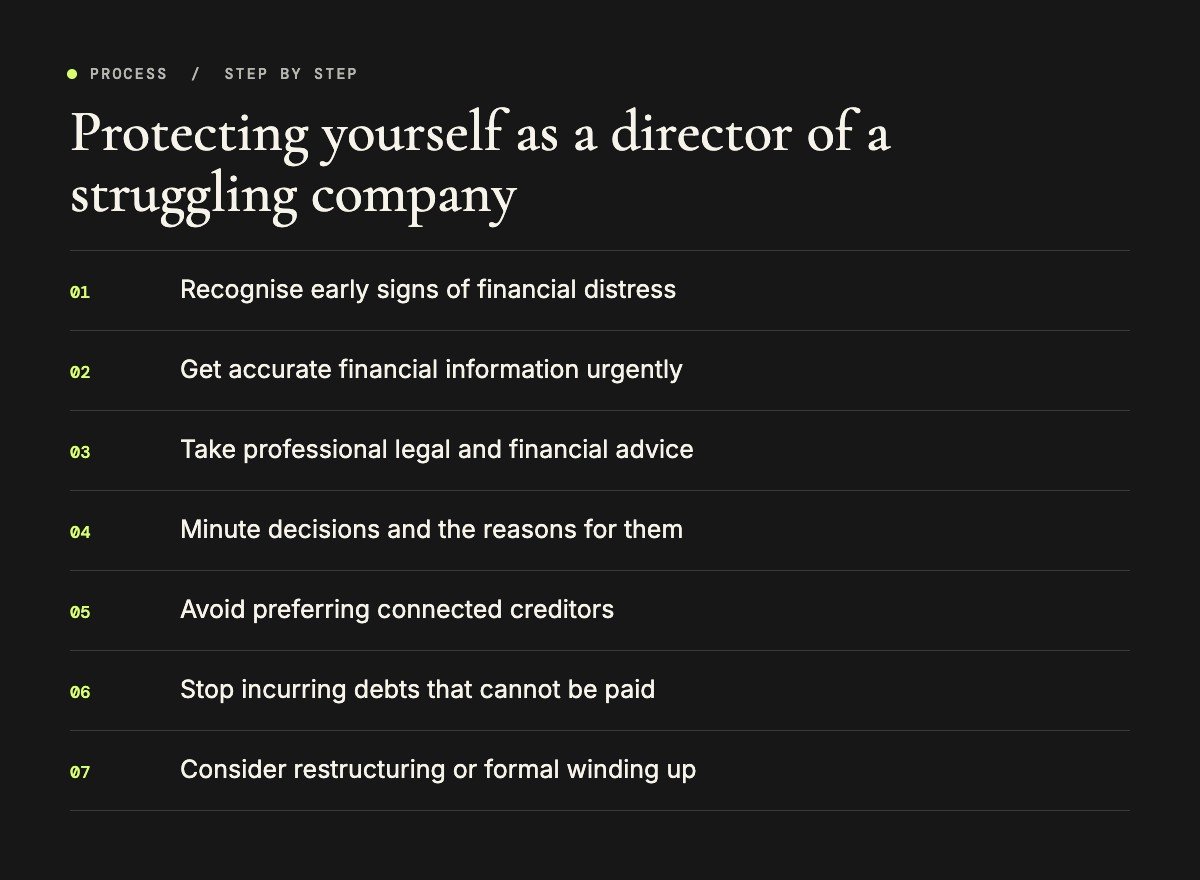
- Monitor solvency. Review cash flow and balance sheet regularly.
- Get information. Insist on accurate, up-to-date management accounts.
- Take advice early. Consult insolvency lawyers and financial advisers at the first signs of distress.
- Minute decisions. Record board discussions, advice received and reasons for decisions.
- Treat creditors fairly. Avoid preferring connected parties or particular creditors.
- Stop unsustainable trading. Do not take on new debts the company cannot reasonably expect to pay.
- Consider formal options. Negotiate restructuring with banks, or consider voluntary winding up.
A director who resigns once the company is already in trouble does not escape liability for decisions taken while in office. Resignation may also be seen as abandoning responsibilities. It is usually better to stay, take advice and document responsible decision-making.
Director liability in insolvency and nominee directors
Investors often appoint nominee directors to company boards. A nominee director owes duties to the company, not only to the appointing shareholder, and faces the same exposure as any other director. Nominee directors should insist on receiving financial information, attend meetings and record their views, especially when the company is struggling.
Non-executive and independent directors are not immune either. While courts consider the role and knowledge of each director, a director who ignores warning signs may still face director liability in insolvency if the company's affairs were mishandled on their watch.
Individual bankruptcy
Where personal guarantees are called and a director cannot pay, creditors may consider proceedings under the Bankruptcy Act 1997, which governs insolvency of individuals and allows adjudication as bankrupt. In practice, banks more commonly pursue guarantors through the Artha Rin Adalat and execution against specific assets. Directors facing large guarantee claims should take advice on negotiation, settlement and the risks of bankruptcy proceedings.
Restructuring as an alternative
Many companies in distress can be saved through negotiated restructuring with banks, including rescheduling or restructuring of loans under Bangladesh Bank policies, conversion of debt, asset sales or new investment. Schemes of arrangement under the Companies Act, sanctioned by the High Court Division, can bind dissenting creditors. Exploring these options early reduces director liability in insolvency by showing that directors acted responsibly to protect creditors' interests.
Directors of foreign-owned subsidiaries
Expatriate and local directors of foreign-owned subsidiaries sometimes assume that the parent company will absorb any problems. In reality, director liability in insolvency attaches to the individuals on the Bangladeshi board. Directors should make sure the parent provides adequate funding or a clear decision to wind down, and should avoid situations where the subsidiary keeps trading on credit while support is uncertain.
Group cash pooling, intercompany loans and transfer pricing arrangements should be reviewed when a subsidiary is in distress, because payments to the parent shortly before failure may be challenged and can increase director liability in insolvency for those who approved them.
Insurance and indemnities
Directors' and officers' liability insurance is available in Bangladesh and can cover defence costs and some liabilities, subject to exclusions for fraud and wilful misconduct. Indemnities from the company are of limited value when the company itself is insolvent. Directors should check the scope of any D&O policy, including whether it covers claims by liquidators and regulators, and keep it in force during periods of financial stress, when the risk of director liability in insolvency is highest.
Warning signs to watch
Directors should act when they see persistent cash shortfalls, reliance on post-dated cheques to keep suppliers happy, missed loan instalments, delayed salary payments, unpaid taxes, mounting legal demands or auditors expressing going concern doubts. These signs suggest the company may be unable to pay its debts as they fall due. At that point, the board should meet more frequently, obtain professional advice and consider whether continuing to trade is in the interests of creditors as a whole. Acting on warning signs early gives the board more options, from refinancing and asset sales to an orderly wind-down, and leaves a record showing that directors took their responsibilities seriously.
Frequently asked questions about director liability in insolvency
Are directors personally liable for company debts?
Not normally, but they can be liable through guarantees, fraudulent trading, misfeasance, cheque cases and some statutory liabilities.
What is fraudulent trading?
Carrying on business with intent to defraud creditors; the court can make those responsible personally liable.
Can banks sue directors directly?
Yes, if directors gave personal guarantees, usually in the Artha Rin Adalat.
Are directors liable for bounced company cheques?
Persons in charge of the company's business can be liable under sections 138 and 140 of the Negotiable Instruments Act.
Does resigning protect a director?
Not for past decisions, and late resignation can look like abandoning duties.
Is there a modern insolvency law in Bangladesh?
Reform has been discussed, but winding up is still largely governed by the Companies Act 1994.
How we can help
We advise directors on director liability in insolvency, negotiate with banks, defend cheque and recovery cases and act in winding-up proceedings. Learn more about our restructuring and insolvency practice, our guide to winding up cases and our litigation team.
Company under financial pressure?
We help directors protect themselves while acting responsibly for creditors.
Book a consultationRestructuring practicePrimary sources: the Companies Act 1994, Artha Rin Adalat Ain 2003, Negotiable Instruments Act 1881 and Bankruptcy Act 1997 on the Laws of Bangladesh portal; wilful defaulter rules from Bangladesh Bank.
This article is general information about Bangladeshi law as of October 2026 and is not legal advice. Liability depends on the facts and the documents signed.




0 Comments