
For power plants, solar parks, ports and industrial facilities, construction is only the beginning. The operation and maintenance agreement decides whether the asset delivers the availability and output that revenues depend on. In Bangladesh, where many projects sell power to the Bangladesh Power Development Board under long-term contracts, O&M performance guarantees and KPIs must mirror the obligations in the power purchase agreement.
- An operation and maintenance agreement allocates responsibility for running, maintaining and repairing a facility after commercial operation.
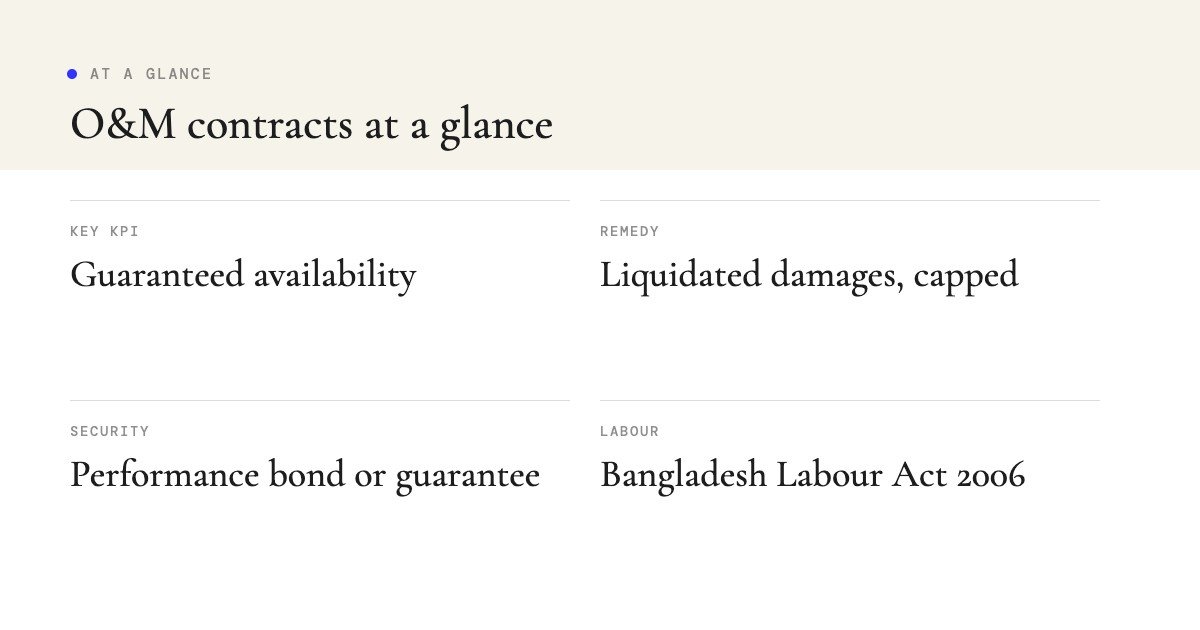
- Key performance indicators usually include availability, net output, heat rate or efficiency, and compliance with environmental and safety standards.
- Liquidated damages for underperformance and bonuses for overperformance should be calibrated to the project's revenue exposure, with caps.
- Lenders expect step-in rights, performance security and alignment with the PPA and EPC warranties.
- Local issues include labour law, work permits for expatriates, VAT and withholding tax on services, and foreign exchange for payments abroad.
Why the O&M contract matters
Project revenues in Bangladesh's power sector typically depend on availability and energy delivered under a power purchase agreement with the Bangladesh Power Development Board or another offtaker. If the plant is unavailable, capacity payments fall and penalties may apply. The operation and maintenance agreement passes part of that risk to a specialist operator who is best placed to manage it.
A well-drafted operation and maintenance agreement also protects the asset's long-term value by requiring proper maintenance, spare parts management and record-keeping. Our EPC and O&M contracts practice advises sponsors, operators and lenders.
Scope of an operation and maintenance agreement
The scope typically covers day-to-day operation, routine and preventive maintenance, major overhauls, spare parts procurement and management, staffing and training, health and safety, environmental compliance, reporting and coordination with the offtaker and grid operator. The contract should say clearly which costs are included in the fixed fee and which are pass-through costs, such as fuel, major spare parts or insurance.
Interfaces with the EPC contractor during the warranty period are a frequent source of dispute. The operation and maintenance agreement should define who is responsible for defects, how warranty claims are coordinated and how handover from construction to operation is managed.
KPIs in an operation and maintenance agreement
| KPI | What it measures | Typical consequence |
|---|---|---|
| Availability | Percentage of time the plant can generate at contracted capacity | LDs below guarantee; bonus above target |
| Net output | Energy delivered compared with expected levels | LDs for shortfall, adjusted for resource or dispatch |
| Heat rate or efficiency | Fuel efficiency of thermal plants | LDs for excess fuel consumption |
| Performance ratio | Solar plant efficiency relative to irradiation | LDs or bonus |
| Response times | Speed of repair and response to faults | Service credits |
| HSE compliance | Safety incidents and environmental breaches | Penalties and termination rights |
KPIs should be measurable from reliable data, adjusted for events outside the operator's control such as grid outages, curtailment, fuel supply interruptions and force majeure.
Liquidated damages, bonuses and caps
Liquidated damages compensate the owner for underperformance without the need to prove actual loss in each case. Under section 74 of the Contract Act 1872, Bangladeshi courts award reasonable compensation not exceeding the stipulated amount, so LDs should be a genuine pre-estimate of loss linked to the revenue impact under the PPA.
Operators will insist on annual and aggregate caps on LDs, often expressed as a percentage of the annual fee. Bonuses for exceeding targets align incentives. The balance between LDs, caps and bonuses is the commercial heart of every operation and maintenance agreement.
Performance security under an operation and maintenance agreement
Owners and lenders usually require a performance bond or bank guarantee from the operator, often for a percentage of the annual fee, and a parent company guarantee where the operator is a local subsidiary. Guarantees issued by foreign banks may need confirmation by a local bank, and local bank guarantees in favour of foreign beneficiaries must follow Bangladesh Bank rules.
Structuring the agreement
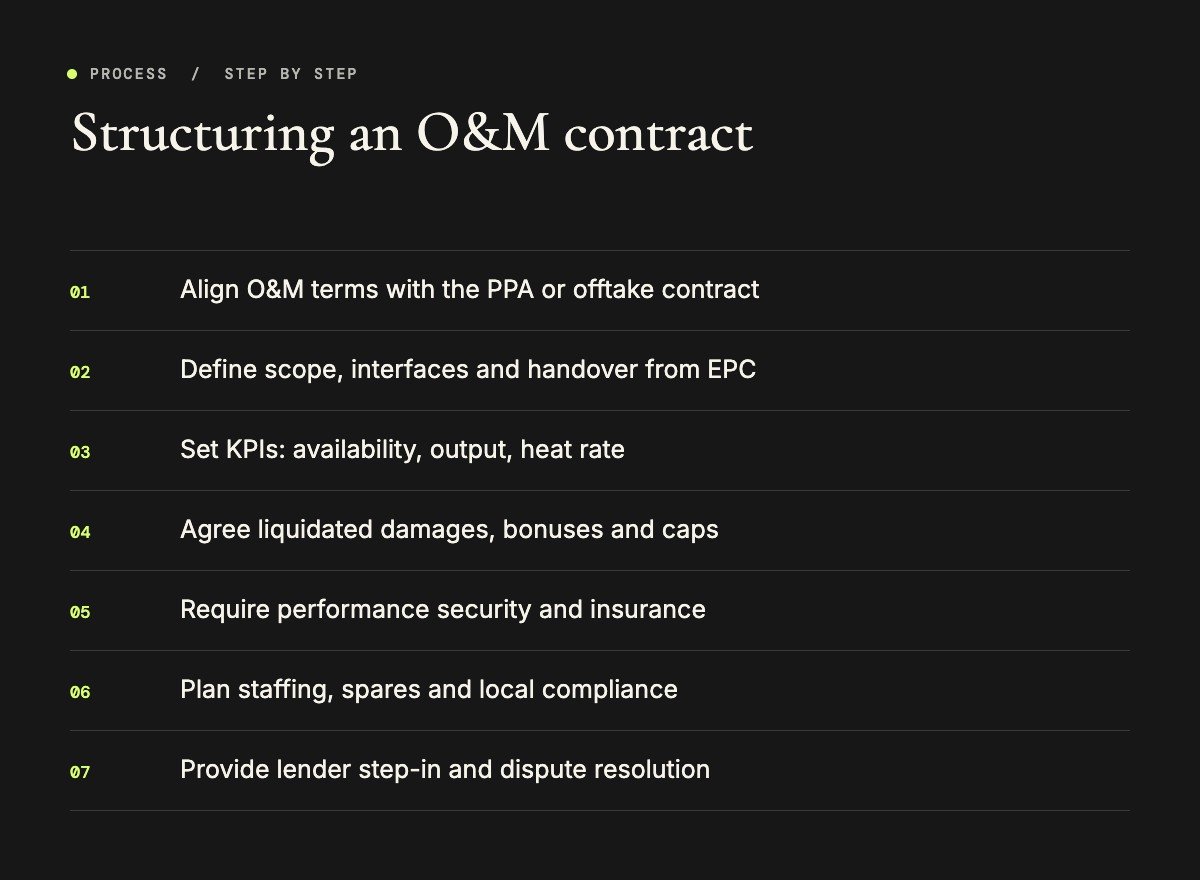
- Align with the PPA. Mirror availability, dispatch and reporting obligations in the O&M contract.
- Define scope. Set out services, exclusions and interfaces with EPC and fuel suppliers.
- Set KPIs. Choose measurable indicators with clear testing and adjustment rules.
- Calibrate remedies. Agree LD rates, bonuses and caps.
- Secure performance. Obtain bonds, guarantees and appropriate insurance.
- Plan resources. Address staffing, training, spares and local compliance.
- Protect lenders. Include direct agreements, step-in rights and dispute resolution.
Check that the O&M contract's force majeure and relief events match the PPA. If the PPA gives the project company relief for an event but the O&M contract does not give the operator the same relief, or vice versa, the project company may be left carrying risk it did not expect.
Staffing, labour and expatriates
Operators must comply with the Bangladesh Labour Act 2006 for local staff, including working hours, overtime, leave, safety and worker participation where applicable. Expatriate specialists need work permits and visas, and their employment terms should account for tax obligations in Bangladesh. Many projects require gradual localisation of skilled positions, which should be planned with training commitments in the operation and maintenance agreement.
Tax and payments
O&M fees may be subject to VAT on services and withholding tax under the Income Tax Act 2023. Payments to foreign operators require compliance with foreign exchange rules, and contracts with non-resident service providers may need registration with or approval of the authorised dealer bank. Gross-up clauses and clear allocation of tax risk avoid disputes. Our tax practice can review the position.
Lenders and step-in rights
Project lenders will require a direct agreement with the operator, allowing them to step in or appoint a substitute operator if the project company defaults, and to receive notice before the operator terminates. The operation and maintenance agreement should be assignable to lenders by way of security and should not be terminable without lender consent in most circumstances.
Fixed fee, cost-plus and hybrid models
Pricing models vary. A fixed-fee operation and maintenance agreement gives the owner cost certainty and places efficiency risk on the operator. A cost-plus model reimburses actual costs plus a margin, giving flexibility but less incentive to control costs. Hybrid models combine a fixed fee for routine services with pass-through costs for major maintenance and an incentive regime linked to KPIs. Indexation for inflation and currency movements is important in long-term contracts, given exchange rate volatility.
Major maintenance and spare parts
Major overhauls of turbines, engines and inverters can be expensive and must be scheduled to minimise lost revenue. The operation and maintenance agreement should set out who plans and pays for major maintenance, how outages are coordinated with the offtaker and how a major maintenance reserve is funded. Spare parts strategy, including critical spares held on site and import lead times through customs, directly affects availability.
Contracts made under the special power law
Many power projects were contracted under the Quick Enhancement of Electricity and Energy Supply (Special Provisions) Act 2010, which was repealed by ordinance in late 2024. Contracts made under it remain valid subject to government review. Operators and owners of such plants should monitor review outcomes, because changes to PPA terms could affect O&M arrangements, budgets and performance incentives.
Term and termination
An operation and maintenance agreement often runs for five to ten years or the life of the financing, with renewal options. Termination rights typically arise for persistent KPI failure, LD cap exhaustion, insolvency, serious HSE breaches and prolonged force majeure. Handback obligations at termination, including transfer of records, spares and know-how, should be clear so a replacement operator can take over smoothly.
Solar and wind projects
Renewable energy projects have different performance drivers. For solar plants, an operation and maintenance agreement focuses on performance ratio, module cleaning frequency, inverter availability, vegetation control and monitoring systems. Bangladesh's dust, humidity and monsoon conditions make cleaning and drainage especially important. For wind projects, turbine availability and response to faults dominate. Weather-adjusted KPIs ensure the operator is not penalised for low irradiation or wind, while still being accountable for equipment performance.
As renewable capacity grows under national energy policies, demand for specialised operators and well-drafted operation and maintenance agreement terms for solar and wind will increase.
Reporting and data
Modern plants generate large amounts of operational data. The operation and maintenance agreement should require the operator to maintain SCADA systems, provide monthly reports on KPIs, incidents, maintenance and spares, and give the owner and lenders access to real-time data. Ownership of data and software, cyber security responsibilities and data retention after termination should also be addressed.
Insurance
Owners usually insure the plant against property damage and business interruption, while the operator carries liability, workers' compensation and other insurances. The operation and maintenance agreement should coordinate these policies, require the owner and lenders to be named where appropriate and include waivers of subrogation to avoid insurers suing one party to recover from another. Deductibles and how they are shared between owner and operator should be agreed in advance, because they can be significant after a major breakdown.
Dispute resolution
Technical disagreements about KPI measurement, root causes of outages or whether an event qualifies for relief are best resolved quickly by an independent expert with relevant engineering experience. Broader legal disputes are usually referred to arbitration, either in Dhaka under the Arbitration Act 2001 or at an international seat for foreign operators. A tiered clause with management escalation, expert determination and arbitration keeps the plant running while disputes are resolved, and the contract should require the operator to continue performing during any dispute.
Clear records of maintenance, outages and communications are the most valuable evidence in any such dispute, so reporting obligations should be strict and consistently enforced from the first month of operation.
Environmental and safety compliance
Operators must comply with the Environment Conservation Act 1995 and the Environment Conservation Rules 2023, including conditions in the environmental clearance certificate, emissions monitoring, waste disposal and noise limits. Fire safety, boiler and electrical safety rules also apply. Breaches can lead to fines, suspension and reputational harm, so the contract should make the operator responsible for day-to-day compliance and prompt reporting of incidents.
Frequently asked questions about operation and maintenance agreement
What KPIs are common in O&M contracts?
Availability, net output, heat rate or performance ratio, response times and HSE compliance.
Are liquidated damages enforceable in Bangladesh?
Courts award reasonable compensation up to the stipulated sum under section 74 of the Contract Act.
Should LDs be capped?
Yes, operators usually require annual and aggregate caps.
Do lenders need step-in rights?
Yes, through a direct agreement with the operator.
Is VAT payable on O&M fees?
Generally VAT and withholding tax may apply; check current rates and exemptions.
How should disputes be resolved?
Escalation, expert determination for technical issues, and arbitration.
How we can help
We draft and negotiate every operation and maintenance agreement for power, renewable and infrastructure projects, aligning it with PPAs, EPC contracts and financing documents. Learn more about our EPC and O&M practice, our energy practice and our project finance team.
Negotiating an O&M contract?
We build performance regimes that work for owners, operators and lenders.
Book a consultationEPC and O&MPrimary sources: the Contract Act 1872 and Bangladesh Labour Act 2006 on the Laws of Bangladesh portal; power sector information from the Bangladesh Power Development Board; contract standards from FIDIC.
This article is general information about Bangladeshi law as of October 2026 and is not legal advice. Each project requires tailored contract drafting.



0 Comments