
For foreign brands entering Bangladesh, a local distributor is often the fastest route to market. A well-drafted distribution agreement in Bangladesh sets the territory, exclusivity, targets and exit rights, and protects the brand if the relationship ends. Because Bangladesh has no special distributor protection law, the contract itself does most of the work.
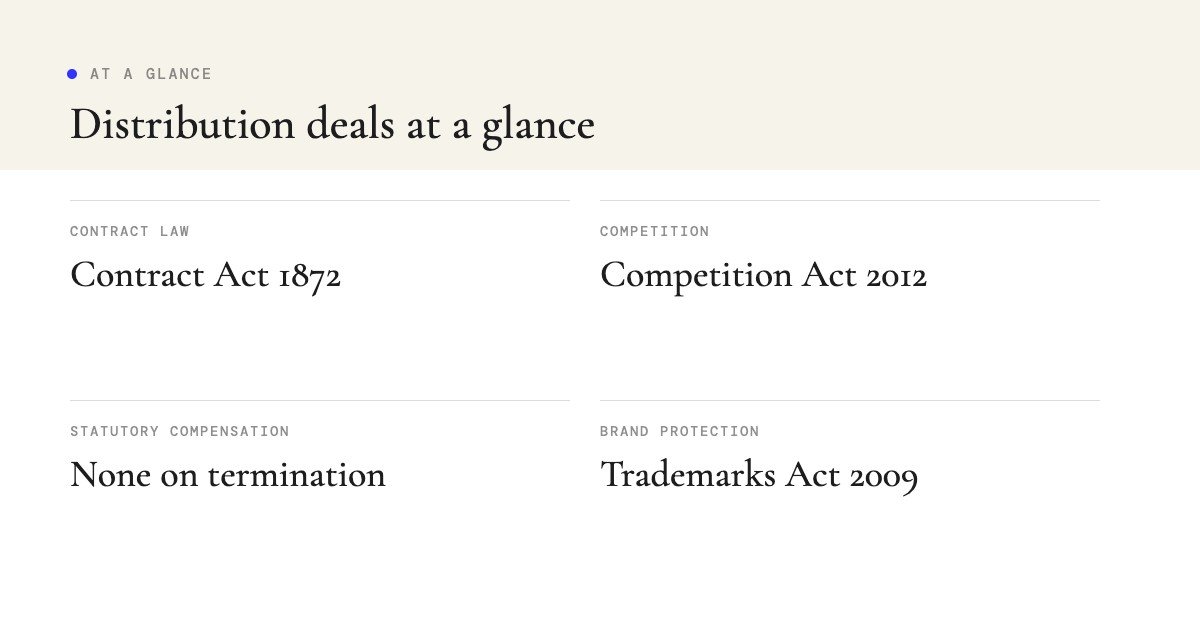
- A distribution agreement in Bangladesh is governed mainly by the Contract Act 1872; there is no statute giving distributors automatic compensation on termination.
- Exclusivity and territorial restrictions are common but must be checked against the Competition Act 2012.
- Restraints on the distributor after termination may be void under section 27 of the Contract Act.
- Courts generally will not specifically enforce a contract that is by its nature determinable, which affects distributor claims to continue a terminated deal.
- Foreign principals should register trademarks, choose arbitration and plan for import and foreign exchange rules.
Distributor, agent or subsidiary?
Before drafting, decide what kind of relationship you need. A distributor buys products and resells them on its own account, taking title and credit risk. A commercial agent sells on behalf of the principal, usually for commission, without taking title. A subsidiary gives full control but requires investment, registration and ongoing compliance.
| Model | Who sells to customers | Key considerations |
|---|---|---|
| Distributor | Distributor in its own name | Less control over pricing; lower principal risk |
| Agent or indenting agent | Principal, through the agent | Agent registration rules; possible permanent establishment tax risk |
| Subsidiary | Principal's local company | Investment, approvals and full compliance |
Many foreign companies start with a distribution agreement in Bangladesh and later move to a subsidiary once volumes grow. Our consumer and retail practice advises brands at each stage.
Exclusivity and territory
Most distributors ask for exclusivity across Bangladesh. Principals should consider whether to grant exclusivity for the whole country, specific divisions or particular channels such as modern trade, pharmacies or online sales. Exclusivity should usually be conditional on meeting minimum purchase targets.
A distribution agreement in Bangladesh can also reserve certain customers, such as government tenders or multinational key accounts, to the principal. Clear definitions prevent disputes about who may sell to whom.
Competition law limits
The Competition Act 2012 prohibits agreements that cause or are likely to cause an appreciable adverse effect on competition. Section 15 covers agreements including those involving exclusive supply or distribution, refusal to deal and resale price maintenance, where they have such an effect. The Bangladesh Competition Commission enforces the Act.
Exclusive distribution is not automatically unlawful, but restrictions should be justified and proportionate. Fixing the distributor's resale prices is particularly risky; recommended retail prices are safer. Principals with significant market share should take particular care when designing a distribution agreement in Bangladesh.
Essential terms of a distribution agreement in Bangladesh
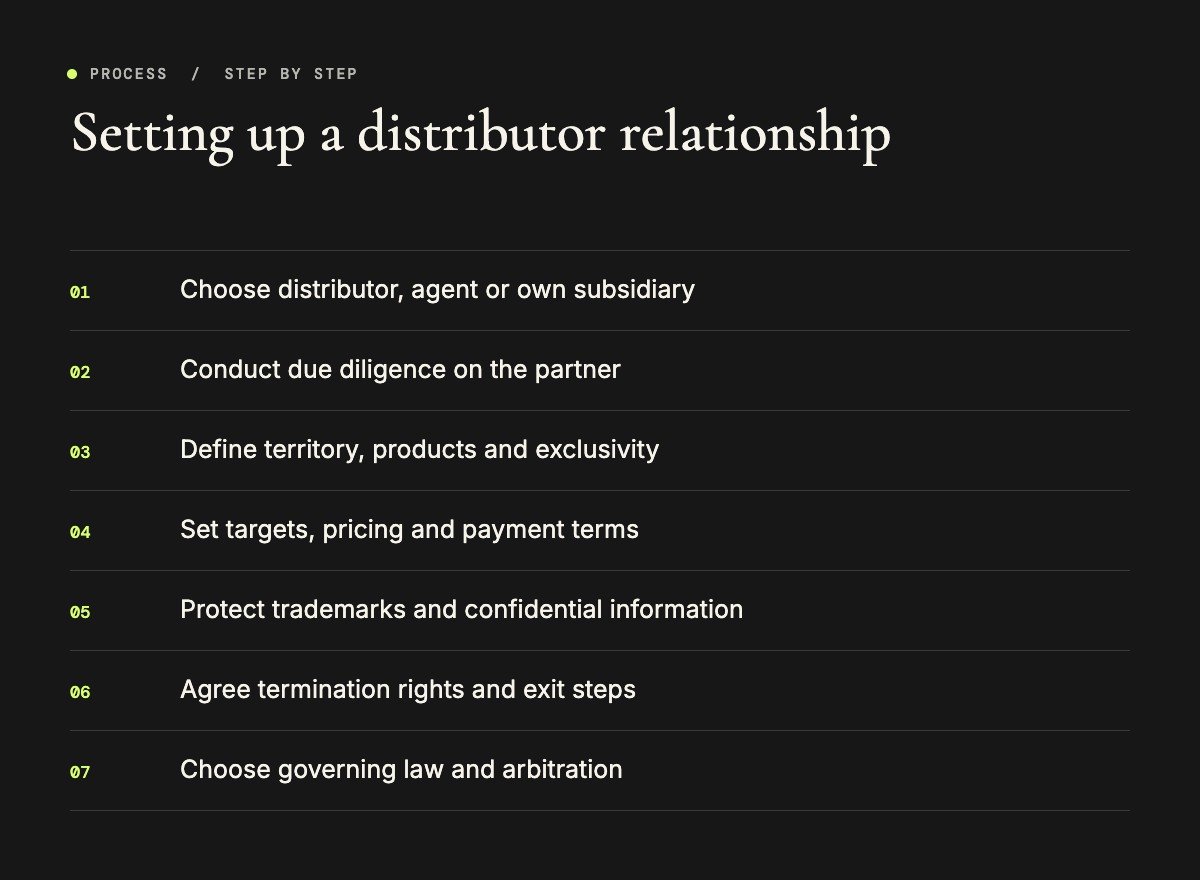
- Appointment and scope. Products, territory, channels and whether exclusive or non-exclusive.
- Minimum targets. Annual purchase or sales targets and consequences of failure.
- Pricing and payment. Price lists, currency, letter of credit or other payment terms, and price changes.
- Orders and delivery. Ordering process, Incoterms, risk and title transfer.
- Marketing and branding. Marketing obligations, approval of materials and use of trademarks.
- Regulatory compliance. Product registration, labelling, import permits and anti-bribery.
- Term, termination and disputes. Duration, renewal, termination rights, post-termination steps and arbitration.
Decide at the outset who holds product registrations, such as DGDA drug registrations or BSTI certifications. If the distributor holds them, switching distributors later can be slow and costly. Where possible, keep registrations in the principal's name or require their transfer on termination.
Ending a distribution agreement in Bangladesh
Bangladesh has no statute equivalent to the commercial agency laws found in some countries that guarantee compensation to agents or distributors on termination. The parties' rights depend on the contract and on the Contract Act 1872.
If a principal terminates in breach of contract, the distributor can claim damages under section 73 for losses that naturally arise from the breach, such as lost profits for the notice period. If the contract allows termination on notice and the principal gives proper notice, the distributor's claim is generally limited. Section 21 and section 56 of the Specific Relief Act 1877 mean courts usually will not force a principal to continue a determinable distribution agreement in Bangladesh, although distributors sometimes seek injunctions.
Clear termination clauses, including notice periods, termination for breach, change of control and insolvency, reduce disputes. Post-termination provisions should cover unsold stock, outstanding orders, transfer of customer lists where lawful and removal of branding.
Non-compete restrictions
Section 27 of the Contract Act 1872 makes agreements in restraint of trade void, with a limited exception for sale of goodwill. Restrictions on the distributor dealing in competing products during the term are generally treated as part of the commercial bargain and are more defensible. Post-termination non-compete clauses are much harder to enforce.
Principals should rely on confidentiality, intellectual property and non-solicitation protections, which are more likely to be upheld, rather than broad post-term restraints in a distribution agreement in Bangladesh.
Trademarks and intellectual property
Register trademarks in Bangladesh before appointing a distributor. Distributors have sometimes registered the principal's mark in their own name, creating leverage in later disputes. The Trademarks Act 2009 allows the owner to record licensed users, and the agreement should confirm that all goodwill belongs to the principal.
See our guide to trademark registration in Bangladesh and our intellectual property practice.
Import, tax and payments
Products imported for distribution must comply with the Import Policy Order, customs requirements and product-specific rules such as BSTI certification or DGDA registration. Payments to foreign suppliers are usually made through letters of credit or other channels permitted by Bangladesh Bank's foreign exchange regulations.
Tax issues include customs duties, VAT, supplementary duty and advance income tax at import, and potential withholding tax on payments for services or royalties. A distribution agreement in Bangladesh should allocate these costs clearly and avoid creating a taxable presence for the foreign principal.
Anti-bribery and compliance
Distributors often deal with government hospitals, regulators and public procurement. Principals subject to the US Foreign Corrupt Practices Act or the UK Bribery Act can be liable for distributor misconduct. Agreements should include anti-bribery warranties, audit rights and termination for breach. Bangladesh's own anti-corruption law, enforced by the Anti-Corruption Commission, also applies.
Governing law and disputes
Foreign principals often prefer English or Singapore law with arbitration at SIAC or ICC. Arbitral awards are enforceable in Bangladesh under the New York Convention, which Bangladesh joined in 1992. If Bangladeshi law governs, arbitration in Dhaka under the Arbitration Act 2001 is a practical option. Court litigation is slower and less predictable for cross-border disputes.
Due diligence on the distributor
Choosing the right partner matters more than any clause. Before signing a distribution agreement in Bangladesh, check the distributor's company records at the RJSC, trade licence, tax and VAT registration, import registration certificate, warehousing and logistics capacity, financial statements and reputation in the market. Speak to other brands it represents and look for litigation history.
Where the distributor will deal with public hospitals or government buyers, check for any past corruption allegations or debarment. A careful review at the start avoids expensive exits later.
Minimum targets that work
Targets should be realistic, measurable and linked to clear consequences. A distribution agreement in Bangladesh might provide that failure to meet the annual target allows the principal to remove exclusivity, reduce the territory or terminate on notice. Targets should take account of regulatory delays, such as product registration, which are outside the distributor's control.
Reviewing targets annually by agreement keeps the relationship commercially sensible as the market develops.
Credit risk and security
Principals selling on credit face the risk of non-payment. Options include letters of credit, bank guarantees, advance payment, credit insurance and retention of title clauses. The enforceability of retention of title against third parties in Bangladesh is uncertain, so financial security is usually more reliable.
A distribution agreement in Bangladesh should set credit limits, payment periods, interest on late payment and the right to suspend supplies when payments are overdue.
Online sales and parallel imports
E-commerce has changed distribution. The agreement should address whether the distributor may sell online, through marketplaces or social media, and on what terms. Parallel imports of genuine products from other countries can undercut the authorised distributor, and trademark law offers only limited tools against them, so pricing strategy and supply controls are important.
Clarifying online rights in the distribution agreement in Bangladesh prevents conflict between channels and protects brand standards.
Change of control and assignment
Principals should be able to terminate if the distributor is acquired by a competitor, and should restrict assignment of the agreement without consent. Distributors, in turn, may want the right to continue if the principal sells the brand. These provisions are often overlooked until a transaction occurs.
Exit planning
The best time to plan the end of a distribution agreement in Bangladesh is at the beginning. Agree how stock will be bought back or sold off, how customer contracts and tenders will be transferred, how product registrations will move and how long the distributor may use the brand after termination. A transition period of a few months often protects customers and the principal's market position.
Sector-specific rules
Some industries carry extra requirements. Pharmaceutical distribution involves DGDA drug registration, licensed premises and pharmacovigilance obligations. Food products need BSTI certification for listed items and compliance with safe food rules. Electronics and telecom equipment may need BTRC type approval, and cosmetics and chemicals have their own labelling and import rules.
A distribution agreement in Bangladesh for regulated products should state which party obtains and maintains each licence, who bears the cost and what happens if a licence is suspended. It should also require the distributor to report complaints, adverse events and recalls promptly, because regulators expect quick action and the principal's reputation is at stake.
Planning these regulatory roles early prevents delays that could otherwise stall the launch for months.
Reporting and audit rights
Principals need visibility of the market. The agreement should require regular sales reports by product and region, stock levels, customer feedback and competitor information where lawful. Audit rights allow the principal to verify reports and compliance, especially where rebates or marketing funds are paid on the basis of distributor data.
Frequently asked questions about distribution agreement in bangladesh
Is a distributor entitled to compensation on termination?
There is no statutory right; compensation depends on the contract and on damages for any breach.
Can I appoint an exclusive distributor?
Yes, subject to the Competition Act 2012 where exclusivity harms competition.
Are post-termination non-compete clauses enforceable?
Generally not, because of section 27 of the Contract Act 1872.
Should trademarks be registered first?
Yes. Register before appointing the distributor to protect your brand.
Which law should govern?
English, Singapore or Bangladeshi law with arbitration are all common choices.
Can a distributor stop termination through the courts?
Courts rarely compel continuation of determinable contracts, but may grant interim relief in some cases.
How we can help
We draft and negotiate distribution agreement in Bangladesh arrangements for foreign brands and local distributors, and handle termination disputes. Learn more about our consumer and retail practice and our foreign investment team.
Entering the Bangladesh market?
We structure distribution deals that protect your brand and your exit.
Book a consultationConsumer and retailPrimary sources: the Contract Act 1872, Specific Relief Act 1877, Competition Act 2012 and Trademarks Act 2009 on the Laws of Bangladesh portal; competition guidance from the Bangladesh Competition Commission; trademark filings at the Department of Patents, Designs and Trademarks.
This article is general information about Bangladeshi law as of October 2026 and is not legal advice. Each distribution arrangement needs tailored drafting.


0 Comments