
When treatment goes wrong, patients and families want answers and accountability. Medical negligence in Bangladesh can lead to civil compensation, criminal prosecution, consumer penalties, professional discipline or High Court intervention. Bangladesh has no single medical negligence statute, so choosing the right route, and gathering the right evidence early, is critical.
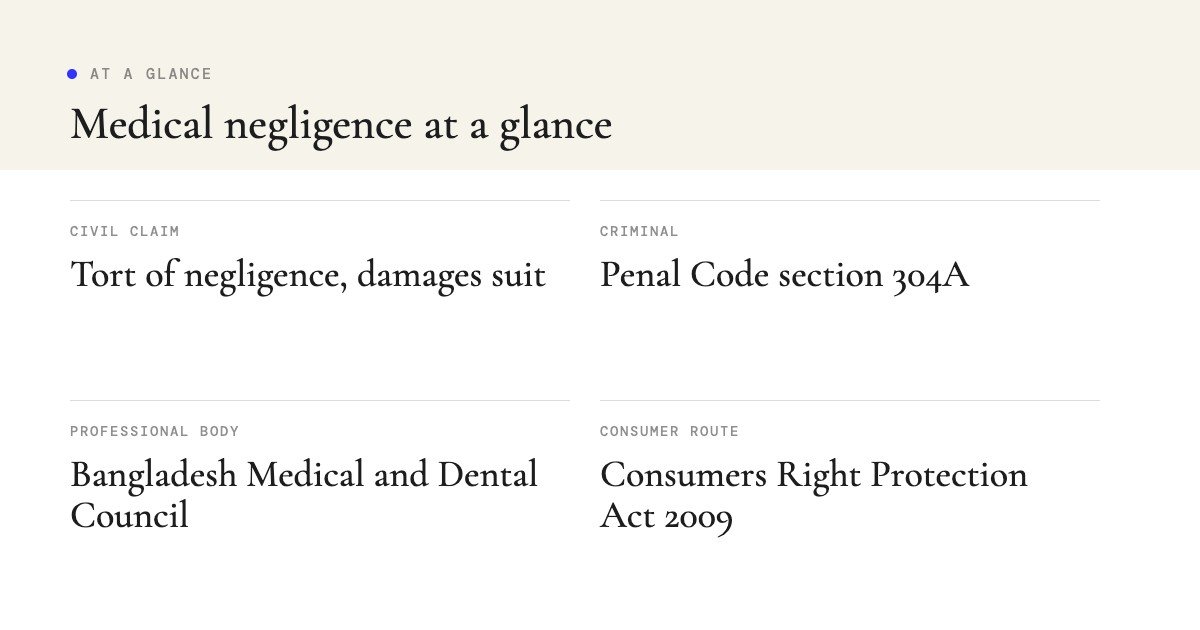
- There is no dedicated medical negligence law; claims rely on the law of tort, the Penal Code 1860, consumer protection law and professional regulation.
- A civil claim must prove a duty of care, breach of the accepted standard, causation and loss.
- Death or injury caused by a rash or negligent act can be prosecuted under sections 304A, 337 and 338 of the Penal Code.
- The Bangladesh Medical and Dental Council can discipline doctors for professional misconduct.
- The High Court Division has awarded compensation in writ petitions for serious failures, particularly involving public hospitals.
What counts as medical negligence
Medical negligence occurs when a doctor, nurse or hospital fails to exercise the degree of skill and care that a reasonably competent professional in the same field would exercise, and that failure causes harm. Not every bad outcome is negligence. Medicine involves risk, and a doctor who follows an accepted practice is not negligent simply because the treatment did not succeed.
Common examples of medical negligence in Bangladesh include misdiagnosis or delayed diagnosis, surgical errors such as operating on the wrong site or leaving instruments inside a patient, wrong medication or dosage, failure to obtain informed consent, inadequate post-operative care and hospital infections caused by poor hygiene. Our healthcare and pharmaceuticals practice advises both patients and providers.
The legal standard
Courts in the subcontinent apply a standard similar to the English Bolam test: a professional is not negligent if they acted in accordance with a practice accepted as proper by a responsible body of medical opinion. Indian Supreme Court decisions such as Jacob Mathew have refined this approach, especially for criminal liability, and are persuasive in Bangladesh.
For criminal liability, courts generally require gross negligence or recklessness, not mere error of judgment. For civil liability, ordinary negligence is enough. This difference matters when deciding which route to take for medical negligence in Bangladesh.
Legal routes for medical negligence in Bangladesh
| Route | Legal basis | Outcome |
|---|---|---|
| Civil suit for damages | Law of tort; Code of Civil Procedure | Compensation |
| Criminal complaint | Penal Code sections 304A, 337, 338 | Imprisonment or fine |
| Consumer complaint | Consumers' Right Protection Act 2009 | Administrative fine; part may go to complainant |
| Professional complaint | Bangladesh Medical and Dental Council Act 2010 | Warning, suspension or deregistration |
| Writ petition | Article 102 of the Constitution | Directions and compensation in public law |
Civil claims for medical negligence in Bangladesh
A civil suit for damages is the main route to compensation. The claimant must prove four elements: the doctor or hospital owed a duty of care, they breached the standard of care, the breach caused the harm, and the claimant suffered loss. Damages can cover medical expenses, loss of income, pain and suffering and, in death cases, loss of dependency for the family.
Hospitals can be vicariously liable for the negligence of doctors and staff they employ, and directly liable for systemic failures such as inadequate equipment or staffing. Suing the hospital as well as the individual doctor often improves the chances of recovering compensation for medical negligence in Bangladesh.
Criminal liability
Section 304A of the Penal Code 1860 punishes causing death by a rash or negligent act not amounting to culpable homicide, with imprisonment of up to five years, fine or both. Sections 337 and 338 cover causing hurt and grievous hurt by acts endangering life or personal safety.
Criminal prosecution requires a high degree of negligence. Families often file first information reports with the police or complaints before a magistrate. Because criminal cases against doctors can be contentious, courts often look for an expert opinion or medical board report before allowing prosecution to proceed.
Consumer protection complaints
The Consumers' Right Protection Act 2009 treats health services as services for consumer purposes. It penalises service providers who cause harm to a consumer's life or health through negligence, irresponsibility or carelessness. Complaints are made to the Directorate of National Consumers' Right Protection, generally within a short period after the cause of action, and the Directorate can impose fines.
This route is faster than a civil suit and may result in a share of the fine being paid to the complainant, but it does not provide full compensation. More information is available from the Directorate of National Consumers' Right Protection.
Professional complaints to the BMDC
The Bangladesh Medical and Dental Council registers doctors and dentists and can take disciplinary action for professional misconduct, including negligence, under the Bangladesh Medical and Dental Council Act 2010. Sanctions range from warnings to suspension or cancellation of registration.
A BMDC complaint does not usually produce compensation, but a finding of misconduct is powerful evidence in civil and criminal proceedings. Patients can also complain to the Directorate General of Health Services about private hospitals and clinics that breach licensing conditions.
Writ petitions and constitutional compensation
The High Court Division, exercising its writ jurisdiction under Article 102, has in several cases directed compensation for deaths or serious harm caused by failures in public hospitals or by state negligence, treating the right to life under Article 32 as engaged. Writ relief is discretionary and usually reserved for clear cases involving public bodies or serious systemic failures.
Writ petitions can also seek directions for investigations, inquiries by medical boards and improvements in hospital practices. Our Supreme Court practice handles such petitions. See also our guide to types of writs in Bangladesh.
Evidence: the key to success
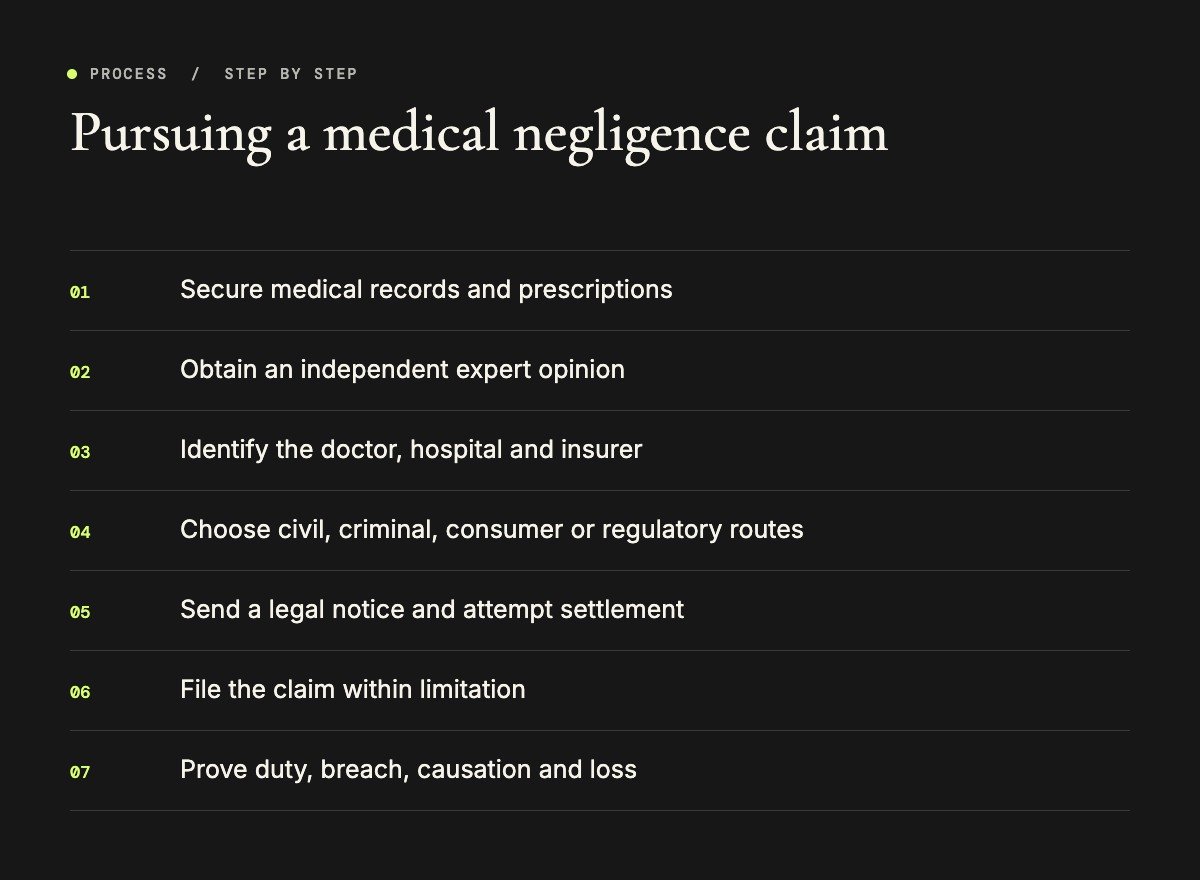
- Secure records. Request copies of admission notes, prescriptions, test reports, operation notes, consent forms and discharge summaries.
- Get an expert opinion. An independent specialist should review the records and explain what went wrong.
- Identify defendants. Name the doctors, the hospital and any laboratory involved.
- Choose the route. Decide on civil, criminal, consumer, regulatory or writ proceedings, or a combination.
- Send a legal notice. Set out the claim and invite settlement or explanation.
- File within time. Check limitation for each route.
- Prove the case. Present records, expert evidence and proof of loss.
Hospitals sometimes delay or refuse to provide records. Make written requests immediately and keep proof of delivery. Courts can order production of records, and refusal can support an inference against the hospital.
Time limits for medical negligence in Bangladesh
Civil suits for compensation for personal injury are subject to the Limitation Act 1908, generally one year from the date of the injury for compensation claims, with different periods for some contractual claims. Consumer complaints must be made within a short period after the cause of action. Criminal complaints should be filed promptly. Families should seek advice quickly, as delay is one of the most common reasons claims fail.
Informed consent
Consent failures are a growing source of medical negligence in Bangladesh claims. Doctors must explain the nature, risks and alternatives of treatment and obtain the patient's consent, or the consent of a guardian for minors and incapable patients. Treatment without valid consent, except in genuine emergencies, may itself amount to negligence or battery. Consent forms should be specific, and a signature on a generic form may not prove that the risks were explained.
Defending medical negligence in Bangladesh claims
Doctors and hospitals facing claims should preserve records, notify insurers, avoid altering documents and respond carefully to legal notices. Strong defences include showing that the treatment followed accepted practice, that the harm was a known risk properly disclosed, or that the injury was caused by the underlying illness rather than the treatment.
Hospitals should have clear protocols for incident reporting, complaint handling and communication with families. Many disputes escalate because families feel ignored rather than because of the clinical error itself.
Private hospitals and diagnostic centres
Many claims for medical negligence in Bangladesh involve private hospitals, clinics and diagnostic laboratories. These are licensed under the Medical Practice and Private Clinics and Laboratories (Regulation) Ordinance 1982 and supervised by the Directorate General of Health Services. Operating without a valid licence, employing unqualified staff or lacking required equipment can support a negligence claim and lead to regulatory action.
Incorrect laboratory reports are a frequent source of medical negligence in Bangladesh. A wrong pathology result can lead to unnecessary surgery or a missed diagnosis, and the laboratory may share liability with the treating doctor.
Proposed patient protection legislation
Draft legislation on the protection of patients and health service providers has been discussed for several years, aiming to set standards for care, complaint handling and compensation, and to protect health workers from violence. Until such a law is enacted, claims for medical negligence in Bangladesh continue to rely on the general law described above. Check the current status before relying on any draft provisions.
Calculating compensation
Damages for medical negligence in Bangladesh are assessed on the evidence. Courts consider actual medical expenses, future treatment costs, lost earnings and earning capacity, and non-financial loss such as pain, suffering and loss of amenity. In death cases, the dependency of the family on the deceased's income is central.
Keeping receipts, salary records and evidence of future care needs strengthens the claim. Settlement negotiations often turn on a realistic, documented assessment of loss rather than headline figures.
Settlement and mediation
Many disputes involving medical negligence in Bangladesh are resolved through negotiation or mediation rather than trial. Hospitals may prefer confidential settlements to protect their reputation, and families often value an apology, an explanation and practical support alongside compensation. A well-drafted settlement should record payment terms, any confidentiality obligations and the withdrawal of pending complaints.
Why expert evidence matters most
Judges are not doctors. In almost every case of medical negligence in Bangladesh, the outcome depends on credible expert evidence explaining what a reasonable practitioner would have done and whether a different approach would have avoided the harm. Choosing an independent, appropriately qualified expert, ideally from the same speciality, is one of the most important decisions in the case.
Frequently asked questions about medical negligence in bangladesh
Is there a specific medical negligence law in Bangladesh?
No. Claims rely on tort, the Penal Code, consumer law and professional regulation.
Can I get compensation for a relative's death?
Yes, through a civil suit for damages, and in some public hospital cases through writ proceedings.
Can a doctor be jailed for negligence?
Yes, under section 304A for death caused by negligence, but courts require a high degree of negligence.
What does the BMDC do?
It can warn, suspend or deregister doctors for professional misconduct.
How do I prove negligence?
Through medical records and independent expert opinion showing breach of accepted practice.
Is there a deadline?
Yes. Limitation periods are short, so act quickly.
How we can help
We act for patients, families, doctors and hospitals in medical negligence in Bangladesh disputes, from record requests and expert evidence to litigation, consumer complaints and writ petitions. Learn more about our healthcare practice and our litigation team.
Harmed by medical treatment?
We review your records and explain your options clearly and sensitively.
Book a consultationHealthcare practicePrimary sources: the Penal Code 1860, Consumers' Right Protection Act 2009 and Bangladesh Medical and Dental Council Act 2010 on the Laws of Bangladesh portal; hospital licensing information from the Directorate General of Health Services.
This article is general information about Bangladeshi law as of October 2026 and is not legal advice. Every case depends on its medical facts and expert evidence.

0 Comments