
Under Muslim law as applied in Bangladesh, a wife is not powerless to end an unhappy marriage. A khula divorce in Bangladesh allows a wife to seek release from the marriage, usually by giving up her dower or other consideration, while a delegated right of divorce in the kabinnama or a court decree under the Dissolution of Muslim Marriages Act 1939 offer other routes. Each route must follow the notice procedure of the Muslim Family Laws Ordinance 1961.
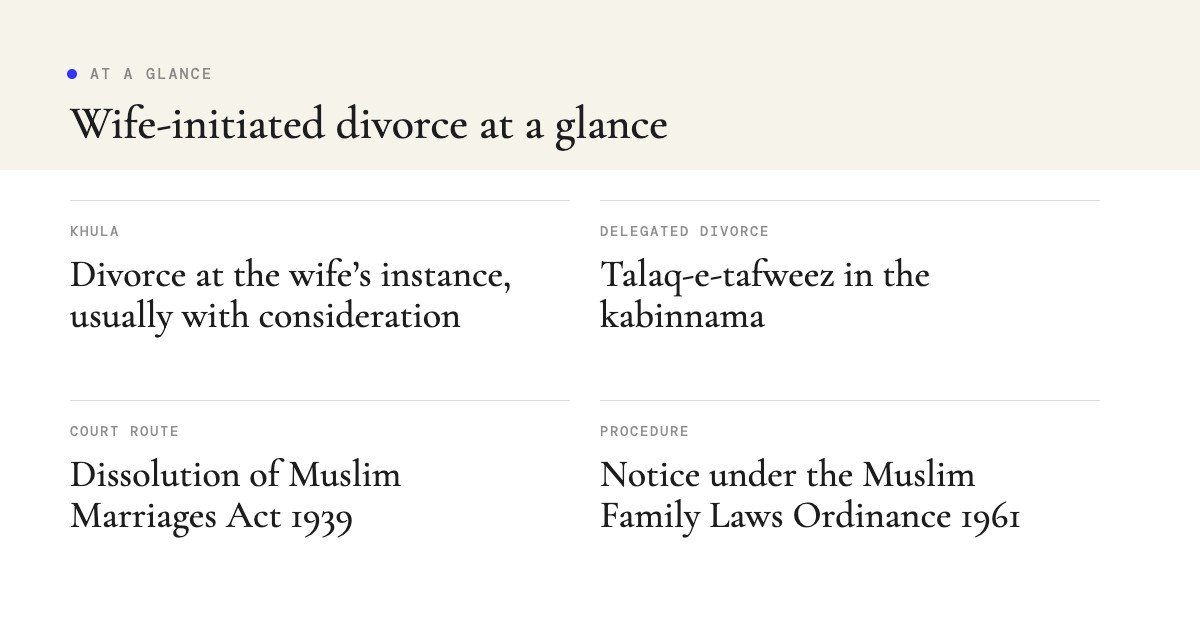
- Khula is a divorce initiated by the wife, traditionally with the husband’s agreement and in return for consideration, often the dower.
- Many kabinnamas grant the wife a delegated right of divorce (talaq-e-tafweez), allowing her to divorce without going to court.
- Where the husband does not agree and there is no delegated right, the wife can seek dissolution in the Family Court on grounds under the Dissolution of Muslim Marriages Act 1939.
- Divorce must be notified to the chairman of the union parishad or the mayor, and to the other spouse, under the Muslim Family Laws Ordinance 1961.
- Divorces should be registered with the Nikah Registrar under the Muslim Marriages and Divorces (Registration) Act 1974.
What khula divorce in Bangladesh means
Khula is a form of divorce in Islamic law where the wife seeks to end the marriage and offers something in return, typically returning or waiving her dower (mohrana). Traditionally, khula requires the husband’s acceptance. In practice in Bangladesh, a wife may achieve the same result by exercising a delegated right of divorce if the kabinnama grants it, by agreement with the husband (mubara’at, mutual divorce), or by applying to the Family Court for dissolution. Understanding these options helps a wife choose the quickest and safest route.
Our family law team, part of the practice described on our about page, advises women on divorce and related claims.
Routes to khula divorce in Bangladesh and alternatives
| Route | Basis | Husband’s consent needed? |
|---|---|---|
| Khula | Wife’s request with consideration | Traditionally yes |
| Mubara’at (mutual divorce) | Mutual agreement | Yes |
| Talaq-e-tafweez | Delegated right in the kabinnama | No, if validly delegated |
| Judicial dissolution | Grounds under the 1939 Act | No |
The relevant statutes are available on Laws of Bangladesh, and our guide to divorce under Muslim law covers the wider picture.
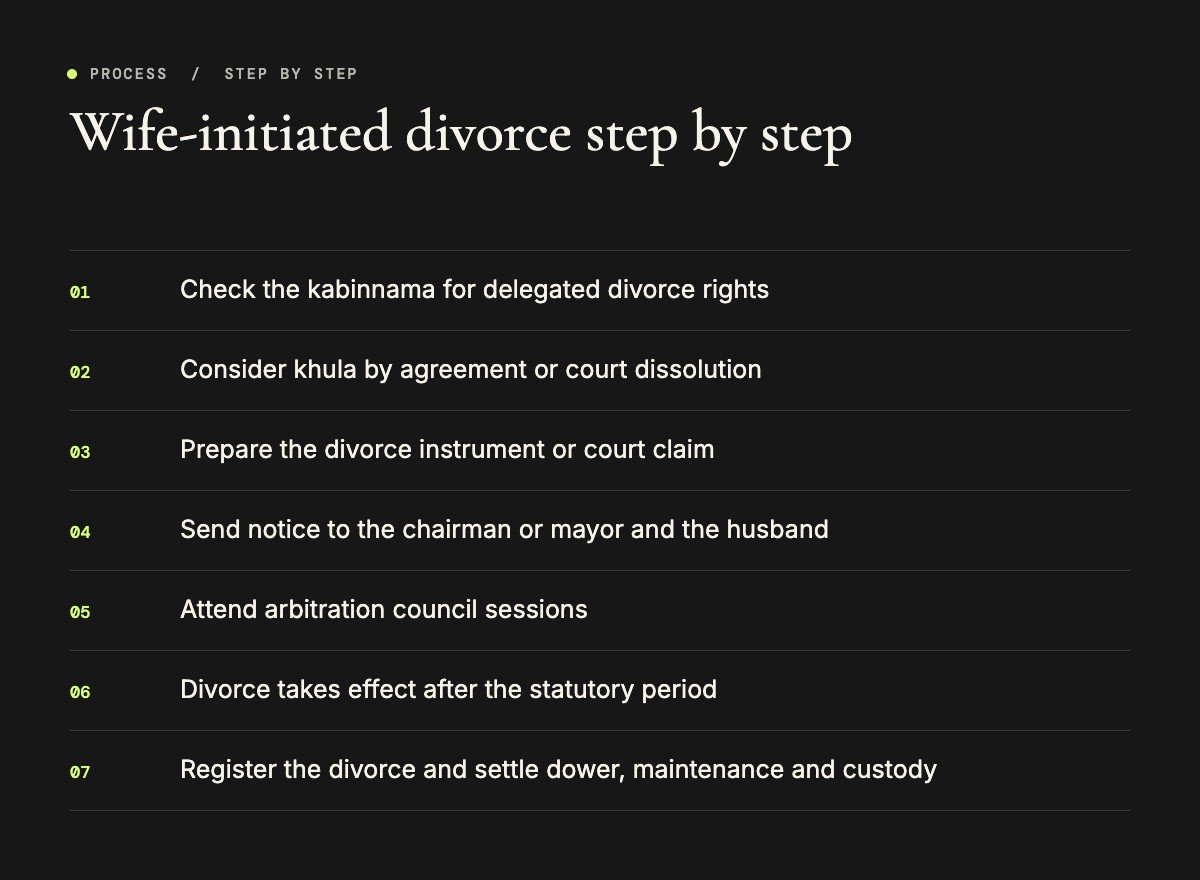
Wife-initiated divorce step by step
- Check the kabinnama. See whether the delegated right of divorce was granted, usually in column 18.
- Choose the route. Khula or mutual agreement, delegated divorce, or court dissolution.
- Prepare documents. Draft the divorce instrument or court plaint with legal help.
- Send notice. Notify the union parishad chairman or city corporation mayor and send a copy to the husband.
- Arbitration council. Attend reconciliation sessions convened by the chairman or mayor.
- Effective date. The divorce takes effect after the statutory period unless revoked.
- Register and settle. Register the divorce and resolve dower, maintenance and custody.
Keep proof that notice was sent to the chairman or mayor and to the husband. Without proper notice, the divorce’s effectiveness can be challenged later, affecting remarriage and property rights.
Delegated divorce as an alternative to khula divorce in Bangladesh
The standard kabinnama form includes a column asking whether the husband delegates the power of divorce to the wife and on what conditions. If the right was delegated, the wife can pronounce divorce herself in accordance with the conditions and then follow the notice procedure. This is often the fastest route, as it does not depend on the husband’s cooperation or a court decree. Women should check their kabinnama carefully, obtaining a certified copy from the Nikah Registrar if necessary, before deciding how to pursue khula divorce in Bangladesh or an alternative.
Court-ordered khula divorce in Bangladesh under the 1939 Act
Where there is no delegated right and the husband will not agree, a wife can apply to the Family Court for dissolution under the Dissolution of Muslim Marriages Act 1939. Grounds include the husband’s whereabouts being unknown for four years, failure to maintain for two years, taking another wife in contravention of the 1961 Ordinance, imprisonment for seven years or more, failure to perform marital obligations for three years, impotence, insanity, cruelty and other grounds recognised as valid under Muslim law. Courts have also accepted irretrievable breakdown and the wife’s strong aversion in certain cases, reflecting the principles behind khula.
Notice and the arbitration council in khula divorce in Bangladesh
Under section 7 of the Muslim Family Laws Ordinance 1961, as applied to divorce by either spouse, written notice must be given to the chairman of the union parishad, municipal mayor or city corporation authority, with a copy to the other spouse. The chairman or mayor constitutes an arbitration council to attempt reconciliation. Unless revoked, the divorce takes effect after ninety days from notice, or after the end of pregnancy if the wife is pregnant. Failure to give notice can carry penalties and may raise questions about the divorce’s effectiveness.
Dower, maintenance and iddat
In a khula divorce in Bangladesh, the wife may agree to waive all or part of her dower as consideration. In other forms of divorce, she remains entitled to unpaid dower. She is also entitled to maintenance during the iddat period, and children are entitled to maintenance from their father. Agreements should state clearly what is waived and what is paid, to avoid later disputes. Claims can be brought in the Family Court if not settled.
Registering a khula divorce in Bangladesh
Divorces should be registered with the Nikah Registrar under the Muslim Marriages and Divorces (Registration) Act 1974. Registration provides official proof of the divorce, which is needed for remarriage, passport and identity document updates, travel, inheritance and other purposes. The registrar requires evidence of the divorce and the notice procedure. A registered divorce certificate is far easier to rely on than informal documents.
Women living abroad may need the divorce registered in Bangladesh and also recognised in their country of residence, which can involve additional procedures.
Custody of children after divorce
Divorce does not decide custody automatically. Under Muslim law, the mother is generally entitled to custody of young children, sons until seven and daughters until puberty, subject to the overriding welfare of the child as held by the Appellate Division. The father remains the natural guardian and is responsible for maintenance. Custody and maintenance can be agreed in a settlement or decided by the Family Court under the Guardians and Wards Act 1890 and the Family Courts Act 2023.
Common concerns for women
Women considering khula divorce in Bangladesh often worry about social pressure, financial security, custody and safety. Practical steps include securing copies of the kabinnama and important documents, documenting any abuse, seeking protection orders under the Domestic Violence (Prevention and Protection) Act 2010 if needed, and contacting legal aid services or women’s rights organisations. Taking advice early helps a woman understand her options and protect her rights during the process.
Negotiating a khula divorce in Bangladesh
When both spouses agree that the marriage should end, a written agreement setting out the terms of the khula or mutual divorce helps avoid future disputes. It should state the consideration, such as waiver of all or part of the dower or return of specified gifts, the arrangements for children’s custody and maintenance, division of personal belongings, and any undertakings about harassment or contact. Both parties should sign before witnesses, and legal advice for the wife is important to ensure that she does not give up more than she intends or than is fair.
The agreement does not replace the notice procedure; notice to the chairman or mayor and registration should still follow.
Revocation and reconciliation
During the notice period, the spouses may reconcile and the divorce can be revoked, in which case the marriage continues. The arbitration council’s role is to explore reconciliation, though it cannot force the parties to stay married. If, after an effective divorce, the parties wish to remarry each other, Muslim law and the 1961 Ordinance set rules about when and how this is possible.
Khula divorce in Bangladesh when a spouse lives abroad
When one spouse lives abroad, sending notice and attending arbitration council sessions can be more complex. Notice can be sent by registered post or other recognised methods, and parties may participate through representatives in some circumstances. Divorces pronounced abroad may need to follow both local law and Bangladeshi procedures to be recognised in Bangladesh. Women in this situation should take advice to ensure that the divorce is effective in both countries.
Evidence for a court dissolution
If the matter goes to court, the wife should gather evidence supporting her grounds, such as proof of non-maintenance, records of the husband’s absence, evidence of cruelty including medical reports or police complaints, and witness statements from family or neighbours. The kabinnama, marriage registration and children’s birth certificates are basic documents. Courts also attempt reconciliation, and many cases settle with an agreed divorce and terms on dower and maintenance.
Legal aid and support services
Women who cannot afford private lawyers can obtain free legal advice and representation through the National Legal Aid Services Organisation and district legal aid offices, which also offer mediation. Several NGOs provide legal support, counselling and shelter for women leaving abusive marriages. Union parishad and city corporation officials handling arbitration councils can also provide information on the notice procedure. Accessing these services early helps women navigate the process safely and with confidence.
Keeping copies of every document sent or received, and noting the dates of each step, makes it easier for any adviser to help.
Women should also update their national identity card, passport and bank records after the divorce is registered, so that official documents reflect their marital status accurately and future applications, including for remarriage or travel, proceed without delay.
Keep certified copies of the divorce certificate in a safe place for future use.
Digital scans stored securely provide a useful backup as well.
Frequently asked questions about khula divorce in bangladesh
Can a wife divorce her husband in Bangladesh?
Yes, through khula, a delegated right of divorce, mutual agreement or court dissolution.
Does khula require giving up dower?
Khula traditionally involves consideration, often waiving dower, but terms can be negotiated.
What is talaq-e-tafweez?
A right of divorce delegated to the wife in the kabinnama.
Is notice required?
Yes, to the chairman or mayor and to the husband under the 1961 Ordinance.
When does the divorce take effect?
After the statutory period following notice, unless revoked, or after pregnancy ends if the wife is pregnant.
Who gets custody of children?
Custody is decided by personal law and the child’s welfare, separately from the divorce.
How we can help
We guide clients through khula divorce in Bangladesh, delegated divorce, court dissolution and related dower, maintenance and custody claims. Learn more about our practice, our guide to the Muslim Family Laws Ordinance 1961 and our mediation services.
Considering divorce?
We provide confidential advice and protect your rights.
Book a consultationAbout usPrimary sources: the Muslim Family Laws Ordinance 1961, the Dissolution of Muslim Marriages Act 1939 and the Muslim Marriages and Divorces (Registration) Act 1974 on Laws of Bangladesh; legal aid from the National Legal Aid Services Organisation.
This article is general information about Muslim family law in Bangladesh as of October 2026 and is not legal advice. Each case depends on its facts; take advice.




0 Comments