
Under Muslim law a husband may divorce his wife by talaq, but in Bangladesh the Muslim Family Laws Ordinance 1961 requires a formal procedure. A talaq notice in Bangladesh must be given in writing to the chairman of the union parishad or the relevant mayor, with a copy to the wife, and the divorce takes effect only after ninety days unless revoked. Skipping the procedure exposes the husband to penalties and creates uncertainty about the divorce.
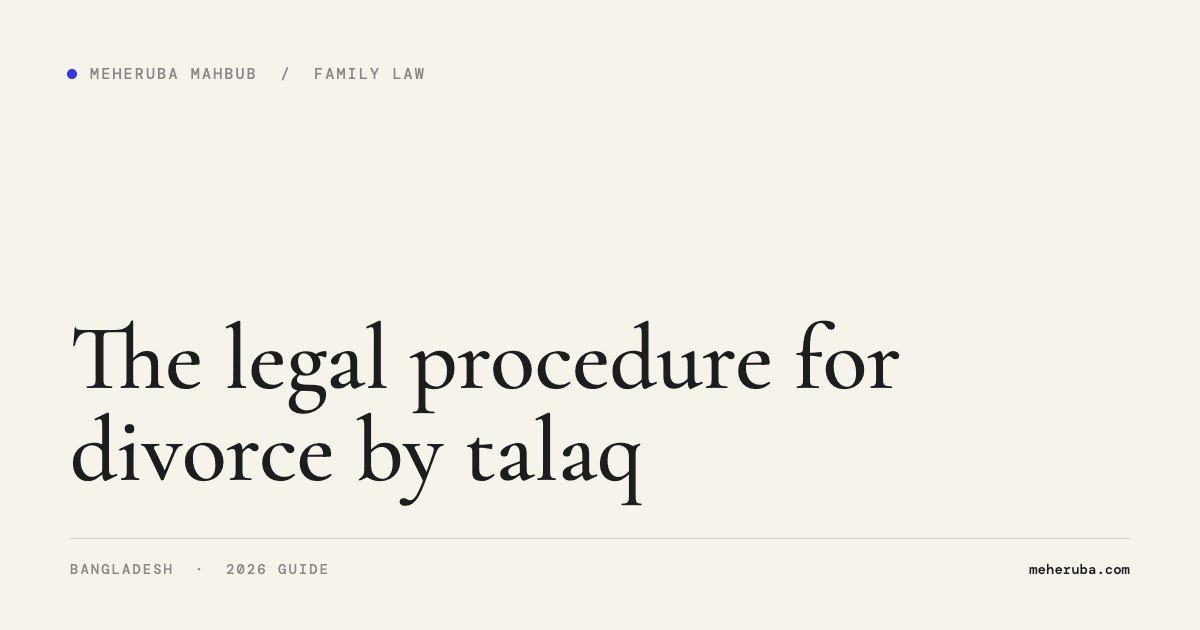
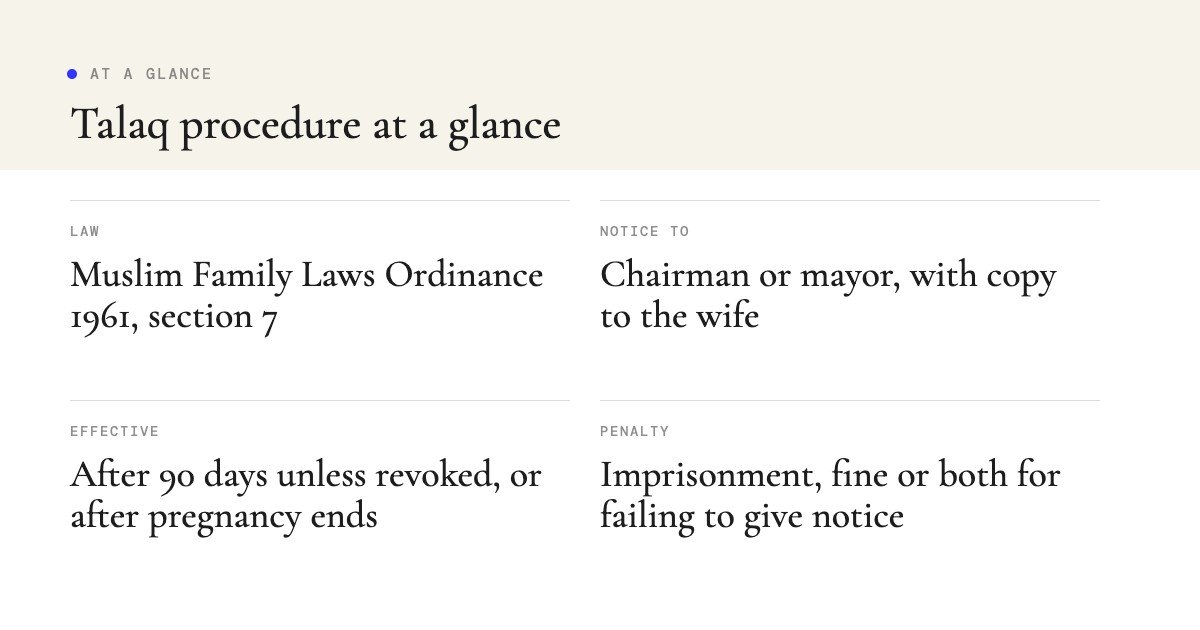
- Section 7 of the Muslim Family Laws Ordinance 1961 requires a husband who pronounces talaq to give written notice to the chairman or mayor and supply a copy to the wife.
- The chairman or mayor constitutes an arbitration council to attempt reconciliation.
- Talaq takes effect after ninety days from notice unless revoked, or after the end of pregnancy if the wife is pregnant.
- Failure to give notice is punishable with imprisonment, fine or both.
- The divorce should be registered, and the wife remains entitled to unpaid dower and iddat maintenance.
Why the talaq notice in Bangladesh matters
Before 1961, a husband could pronounce talaq orally, sometimes triple talaq in one sitting, with immediate effect. The Muslim Family Laws Ordinance 1961 introduced a statutory notice and reconciliation procedure to protect wives from arbitrary divorce and to encourage reconciliation. Bangladeshi courts have treated compliance with the notice requirement as central to an effective divorce, and the procedure also creates an official record useful for remarriage, inheritance and identity documents.
Our family law team, part of the practice described on our about page, advises husbands and wives on divorce procedure.
The section 7 talaq notice in Bangladesh procedure
| Step | Requirement |
|---|---|
| Notice | Written notice of talaq to the chairman of the union parishad, pourashava mayor or city corporation authority |
| Copy to wife | A copy of the notice supplied to the wife |
| Arbitration council | Constituted within thirty days to attempt reconciliation |
| Effective date | Ninety days after notice to the chairman, unless revoked |
| Pregnancy | If the wife is pregnant, divorce takes effect after the end of pregnancy or ninety days, whichever is later |
The Ordinance is available on Laws of Bangladesh, and our guide to the Muslim Family Laws Ordinance 1961 explains its other provisions.
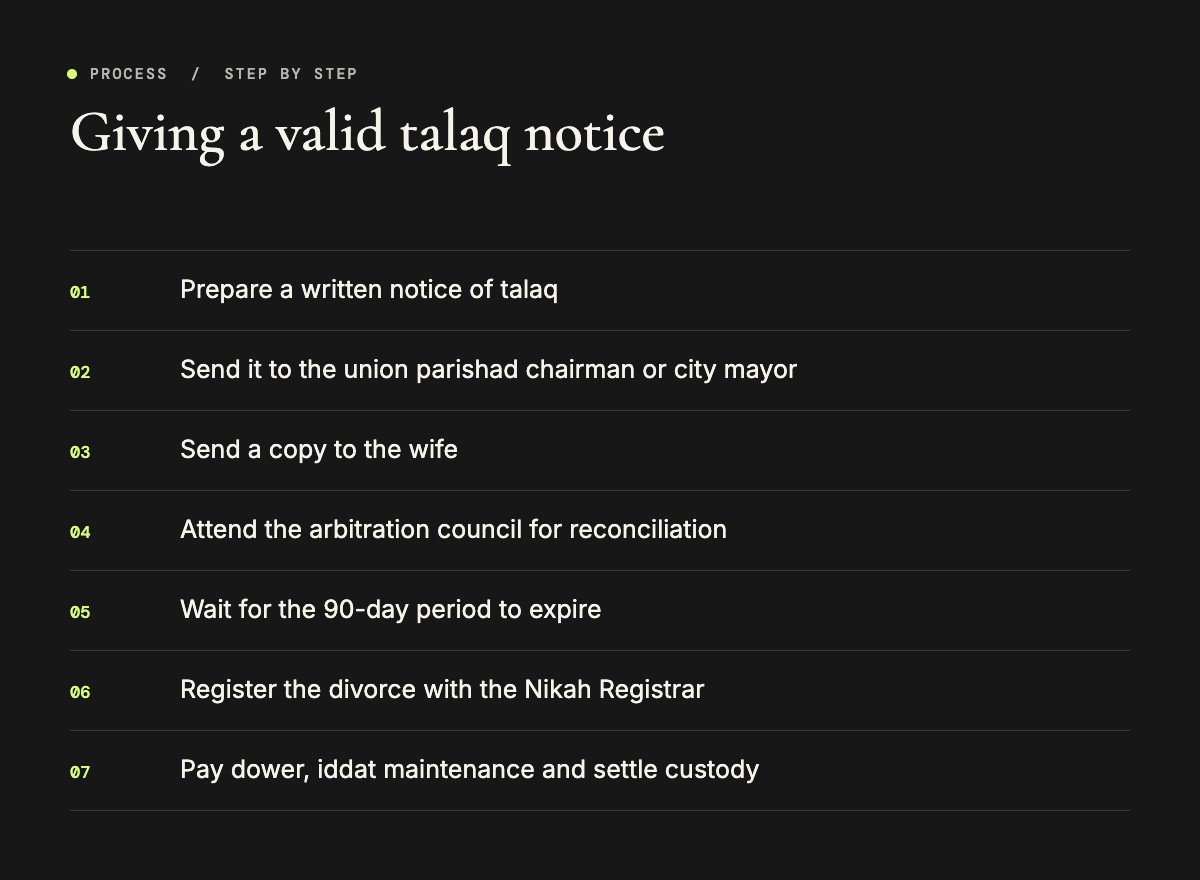
Giving a valid talaq notice step by step
- Prepare the notice. Write a clear notice stating the pronouncement of talaq, with the parties’ details.
- Send to the chairman or mayor. Deliver by registered post or in person and keep proof.
- Copy to the wife. Send a copy to the wife at her current address.
- Arbitration council. Attend sessions convened for reconciliation.
- Wait ninety days. The talaq becomes effective after the period unless revoked.
- Register. Register the divorce with the Nikah Registrar.
- Settle obligations. Pay dower and iddat maintenance and arrange custody and child maintenance.
Which chairman or mayor has jurisdiction depends on where the wife resides, or other rules in the Ordinance. Sending notice to the wrong authority can delay the divorce and invite challenges.
The arbitration council after a talaq notice in Bangladesh
Within thirty days of receiving notice, the chairman or mayor must constitute an arbitration council consisting of the chairman and a representative of each spouse. The council takes steps to bring about reconciliation. It cannot prevent the divorce if reconciliation fails, but its sessions provide an opportunity to resolve disputes about dower, maintenance and children. Parties should attend and keep records of the proceedings. Many families use the arbitration council stage of the talaq notice in Bangladesh process to negotiate an amicable settlement.
Penalties for skipping the talaq notice in Bangladesh
A husband who pronounces talaq without giving the required notice commits an offence under section 7 of the Ordinance and can be punished with simple imprisonment, a fine, or both, within the limits set by the law. The wife or others may also challenge the effectiveness of the divorce, which can affect remarriage, maintenance and inheritance. Complying with the notice requirement is therefore essential.
Effect on dower and maintenance
When a marriage ends by talaq, the wife becomes entitled to any unpaid dower, both prompt and deferred, immediately. She is also entitled to maintenance during the iddat period, and the father must continue to maintain the children. If the husband fails to pay, the wife can claim through the arbitration council or the Family Court. Agreements reached during the process should be in writing and signed by both parties.
Registration after a talaq notice in Bangladesh
After the talaq becomes effective, it should be registered with the Nikah Registrar under the Muslim Marriages and Divorces (Registration) Act 1974. The registrar records the divorce and issues a certificate, which serves as official proof. Registration is particularly important for remarriage, updating national identity cards and passports, and resolving property and inheritance questions.
Drafting the notice
A talaq notice in Bangladesh should include the full names and addresses of both spouses, the date and details of the marriage, including the kabinnama registration number, a clear statement that the husband has pronounced talaq on a specified date, and the husband’s signature. It should be addressed to the correct chairman or mayor. A copy should be sent to the wife at her current address by registered post with acknowledgement due, and proof of posting kept. Clear, accurate notices reduce disputes about whether and when the procedure began.
Using a lawyer to draft the notice helps ensure that all required details are included and that it is sent to the correct authority.
Which authority receives the notice
The Muslim Family Laws Rules specify which union parishad chairman, pourashava mayor or city corporation authority has jurisdiction, generally linked to where the wife resides at the time, or other connecting factors where she lives abroad. In city corporation areas, notice is often given to the ward councillor’s office or the designated authority under local practice. Confirming the correct authority before sending notice avoids delays.
Divorce by the wife and mutual divorce
The same notice procedure applies when a wife exercises a delegated right of divorce, and to divorces by mutual agreement. In those cases, the wife or both parties send notice to the chairman or mayor, and the ninety-day period and arbitration council procedure apply. Court-ordered dissolutions under the Dissolution of Muslim Marriages Act 1939 are communicated through the court process, and the decree is sent to the chairman for registration purposes.
Revoking a talaq notice in Bangladesh
A husband can revoke the talaq before the ninety-day period ends, usually by informing the chairman or mayor in writing and resuming the marital relationship. Once the talaq becomes effective, the spouses can remarry each other only in accordance with the Ordinance and Muslim law. Because revocation and remarriage have important legal and religious consequences, parties should document their decisions clearly and seek advice where there is uncertainty.
Talaq notice in Bangladesh from abroad
Many Bangladeshi husbands working abroad pronounce talaq while overseas. The notice requirement still applies: notice should be sent to the appropriate chairman or mayor in Bangladesh and a copy to the wife. Notices can be sent through registered post, Bangladesh missions or representatives. Divorces conducted under foreign law may also need to comply with Bangladeshi procedure for recognition in Bangladesh. Wives receiving notices from abroad should keep envelopes and documents as evidence of dates.
Protecting the wife’s rights
A wife who receives a talaq notice should promptly secure copies of the kabinnama, gather evidence of unpaid dower and maintenance, and consider her claims for herself and her children. She can participate in the arbitration council, negotiate a settlement, and if necessary bring claims in the Family Court for dower, maintenance and custody. Legal aid offices and women’s rights organisations provide support. Where there is violence or threats, protection orders under the Domestic Violence (Prevention and Protection) Act 2010 may be sought.
Common mistakes with a talaq notice in Bangladesh
Frequent mistakes include pronouncing talaq orally without written notice, sending notice to the wrong authority, failing to send a copy to the wife, remarrying before the divorce becomes effective, and not registering the divorce. Each can lead to legal complications, including criminal liability and disputes over subsequent marriages and inheritance. Following the procedure carefully, with legal advice, avoids these problems.
Second marriage and polygamy rules
The Muslim Family Laws Ordinance 1961 also restricts polygamy: a husband wishing to take another wife during an existing marriage must obtain written permission from the arbitration council, after applying with reasons and the existing wife’s consent being considered. Contracting another marriage without permission is an offence and gives the existing wife grounds for immediate payment of dower and for dissolution under the 1939 Act. Some husbands attempt to avoid these rules by pronouncing talaq informally, but without proper notice the first marriage may still subsist, creating serious legal problems.
Custody and children
Divorce does not settle custody automatically. Under Muslim law, the mother is generally entitled to custody of young children, while the father remains the natural guardian and must provide maintenance, subject always to the welfare of the child as the paramount consideration. Parents can agree on custody, visitation and maintenance during the arbitration council stage, and if they cannot agree, the Family Court decides under the Guardians and Wards Act 1890 and the Family Courts Act 2023.
Putting any agreement on children in writing, signed by both parents and witnessed, reduces future conflict.
Practical checklist
Prepare a written notice with full details; send it to the correct chairman or mayor by traceable means; send a copy to the wife; keep proof of both; attend the arbitration council; wait for the ninety-day period; register the divorce; pay dower and iddat maintenance; arrange custody and child maintenance; and update official records. Following these steps makes the talaq notice in Bangladesh procedure legally sound.
Keep copies of all notices, receipts and the registration certificate together for future use.
Frequently asked questions about talaq notice in bangladesh
Is oral talaq enough in Bangladesh?
No, written notice to the chairman or mayor with a copy to the wife is required.
When does talaq take effect?
Ninety days after notice to the chairman, unless revoked, or after pregnancy ends.
What is the arbitration council?
A body convened by the chairman or mayor to attempt reconciliation.
What if the husband gives no notice?
He can be punished with imprisonment, fine or both, and the divorce may be challenged.
Does the wife lose her dower?
No, unpaid dower becomes payable on divorce by talaq.
Can talaq be revoked?
Yes, during the ninety-day period.
How we can help
We advise on every aspect of a talaq notice in Bangladesh, arbitration council proceedings, registration, dower and maintenance claims, and challenges to defective divorces. Learn more about our practice, our guide to divorce under Muslim law and our mediation services.
Facing a divorce?
We help you follow the law and protect your rights.
Book a consultationAbout usPrimary sources: the Muslim Family Laws Ordinance 1961, the Muslim Family Laws Rules 1961 and the Muslim Marriages and Divorces (Registration) Act 1974 on Laws of Bangladesh; legal aid from the National Legal Aid Services Organisation.
This article is general information about Muslim family law in Bangladesh as of October 2026 and is not legal advice. Take advice on your specific situation.




0 Comments