
Mutual fund registration in Bangladesh is a regulated, multi-party process: a licensed asset manager, a sponsor, an independent trustee and a custodian must all be in place before the Bangladesh Securities and Exchange Commission will register a scheme. Since November 2025 a new rulebook governs every step, and it has changed what funds can be launched.

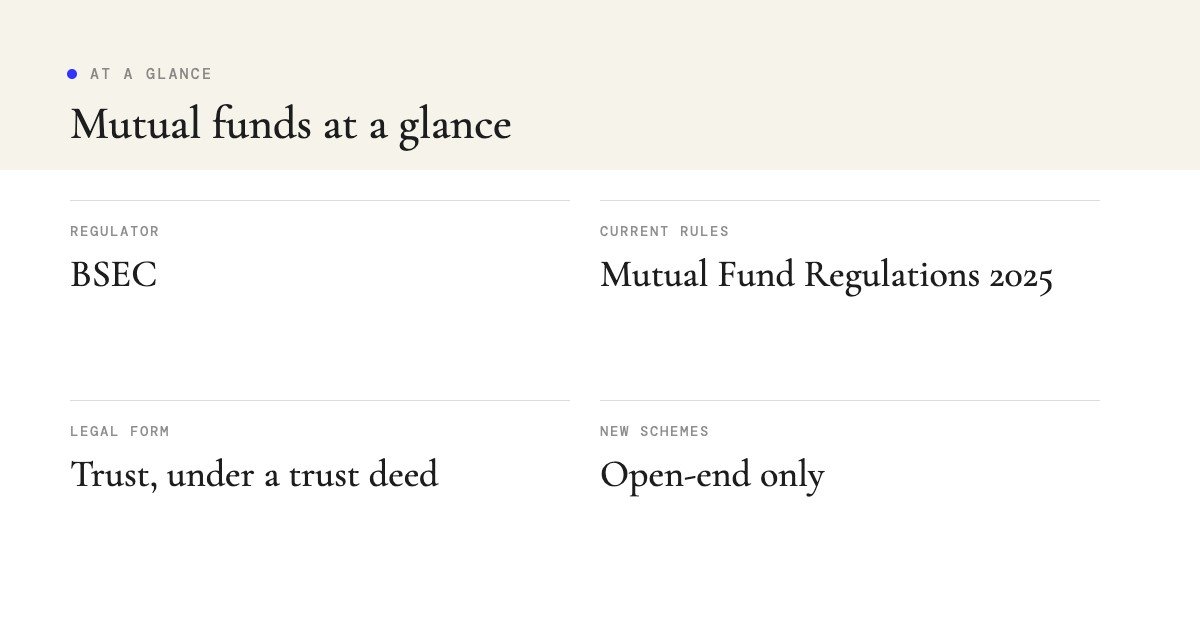
- Public mutual funds are regulated by the Bangladesh Securities and Exchange Commission (BSEC) under the BSEC (Mutual Fund) Regulations 2025, gazetted on 12 November 2025 and effective on publication.
- A fund is constituted as a trust: the trustee is the legal owner of the assets, unitholders are the beneficial owners, and a separate custodian holds the securities and cash.
- Only open-end schemes are now being approved; BSEC has said no new closed-end funds will be registered.
- The asset manager must hold its own BSEC registration before it can apply to register any scheme.
- Private equity and venture capital vehicles follow a separate regime, the Alternative Investment Rules 2015, not the public fund rules.
Under the Invest Bangladesh Act 2026, effective 23 August 2026, the Bangladesh Investment Development Authority (BIDA), the Bangladesh Economic Zones Authority (BEZA) and the PPP Authority were merged into a single body, Invest Bangladesh. References below to BIDA, BEZA or the PPP Authority should be read as references to Invest Bangladesh. BEPZA continues as a separate authority.
What mutual fund registration in Bangladesh involves
A mutual fund pools money from many investors and invests it in a portfolio of listed shares, bonds, government securities and money-market instruments. Each investor holds units, and the value of a unit tracks the net asset value (NAV) of the portfolio.
In Bangladesh a public fund is not a company. It is a trust created by a registered trust deed, and it can only invite the public to subscribe once BSEC has registered the scheme and approved its offer document. That approval is the core of mutual fund registration in Bangladesh, but it sits at the end of a longer chain.
Before any scheme can complete mutual fund registration in Bangladesh, the business that will run it must be licensed, the parties who will safeguard the assets must be appointed, and the trust deed must be settled. Most delays we see come from treating these as afterthoughts rather than as the first workstream.
The four parties behind every scheme
Every public fund rests on four roles. The sponsor initiates the scheme and contributes seed capital. The trustee holds the fund's property for unitholders and supervises the manager. The custodian keeps the securities and cash and settles trades. The asset manager makes investment decisions. The separation is deliberate: no single party can both decide and move the money.
The legal framework for mutual funds in 2026
The governing statute is the Bangladesh Securities and Exchange Commission Act 1993, which gives BSEC power to register and regulate collective investment schemes and the intermediaries who run them. The Securities and Exchange Ordinance 1969 still supplies much of the enforcement framework, including penalties for misleading disclosure.
The detailed rulebook is now the Bangladesh Securities and Exchange Commission (Mutual Fund) Regulations 2025. BSEC published a draft for public comment in October 2025, and the final text appeared in the extraordinary Bangladesh Gazette on 12 November 2025, taking effect immediately. For more than two decades before that, the sector ran on the Securities and Exchange Commission (Mutual Fund) Rules 2001.
Because the 2025 Regulations are new and now govern every application for mutual fund registration in Bangladesh, transitional questions still arise for funds launched under the 2001 Rules. Read the repeal and savings provisions in the gazette text, available on the BSEC website, before relying on any older approval or practice.
Other laws that apply
- Trust Act 1882 governs the duties of the trustee where the trust deed and the regulations are silent.
- Registration Act 1908 applies to registration of the trust deed.
- Companies Act 1994 governs the asset management company itself.
- Income Tax Act 2023 and the annual Finance Act decide how the fund and its unitholders are taxed.
- Money Laundering Prevention Act 2012 imposes customer due diligence on unit sales and redemptions.
Licensing the asset manager
No application for mutual fund registration in Bangladesh can succeed unless the manager already holds a registration certificate from BSEC as an asset manager. In practice that means incorporating a public or private limited company with the RJSC whose objects are limited to fund management and related advisory work, and then applying to the Commission.
BSEC looks closely at the people as well as the paperwork. Expect to show the fitness and experience of directors and the chief executive, an investment committee with qualified members, a compliance function, written investment and risk policies, and systems for valuation and record-keeping. The sponsors of the asset manager must show a clean regulatory and credit history.
Capital requirements
The asset manager must meet a minimum paid-up capital set by BSEC. Under the old regime this was Tk 5 crore. The October 2025 draft proposed raising it to Tk 10 crore, with one year to comply, and also proposed that a shareholder of an asset management company should not serve as its chief executive. Confirm the final figures and the compliance deadline in the gazetted 2025 Regulations before planning capital, because industry groups pressed for changes during consultation.
Foreign-owned asset managers should register the investment with BIDA and bring capital in through banking channels from the outset. That paper trail is what later allows dividends and exit proceeds to be repatriated under Bangladesh Bank's foreign exchange rules.
Sponsor, trustee and custodian: who does what
For mutual fund registration in Bangladesh, the 2025 Regulations put far more weight on the separation of roles than the old rules did. BSEC's stated aim, as its spokesperson explained in 2026, is that an asset manager can no longer move or withdraw fund assets on its own. The custodian makes payments for purchases and receives sale proceeds, and it verifies management fees claimed by the manager before they are paid.
| Party | Main role | Key point for registration |
|---|---|---|
| Sponsor | Initiates the scheme and contributes seed capital | Must meet BSEC eligibility and lock-in conditions for its contribution |
| Trustee | Legal owner of fund assets; supervises the manager for unitholders | Must be registered with BSEC and independent of the manager |
| Custodian | Holds securities and cash, settles trades, verifies fees | Must hold a BSEC custodial licence |
| Asset manager | Makes investment decisions within the trust deed and rules | Must hold BSEC asset manager registration before applying |
| Auditor | Audits the fund's annual accounts | Should be independent of all the parties above |
Choosing the trustee
Trustees are usually banks, insurers, financial institutions or specialist trustee companies. The trustee must be genuinely independent: it represents unitholders against the manager, approves material changes and, under the 2025 Regulations, calls unitholder meetings when a fund breaches key thresholds. A trustee with close commercial ties to the sponsor will attract BSEC queries.
Sponsor eligibility
BSEC sets conditions on who may sponsor a fund, including financial strength and track record. Reports from earlier reforms referred to a minimum net worth for private companies acting as sponsors. Check the current thresholds and the lock-in period for the sponsor's units in the 2025 Regulations at the time of application.
Steps for mutual fund registration in Bangladesh
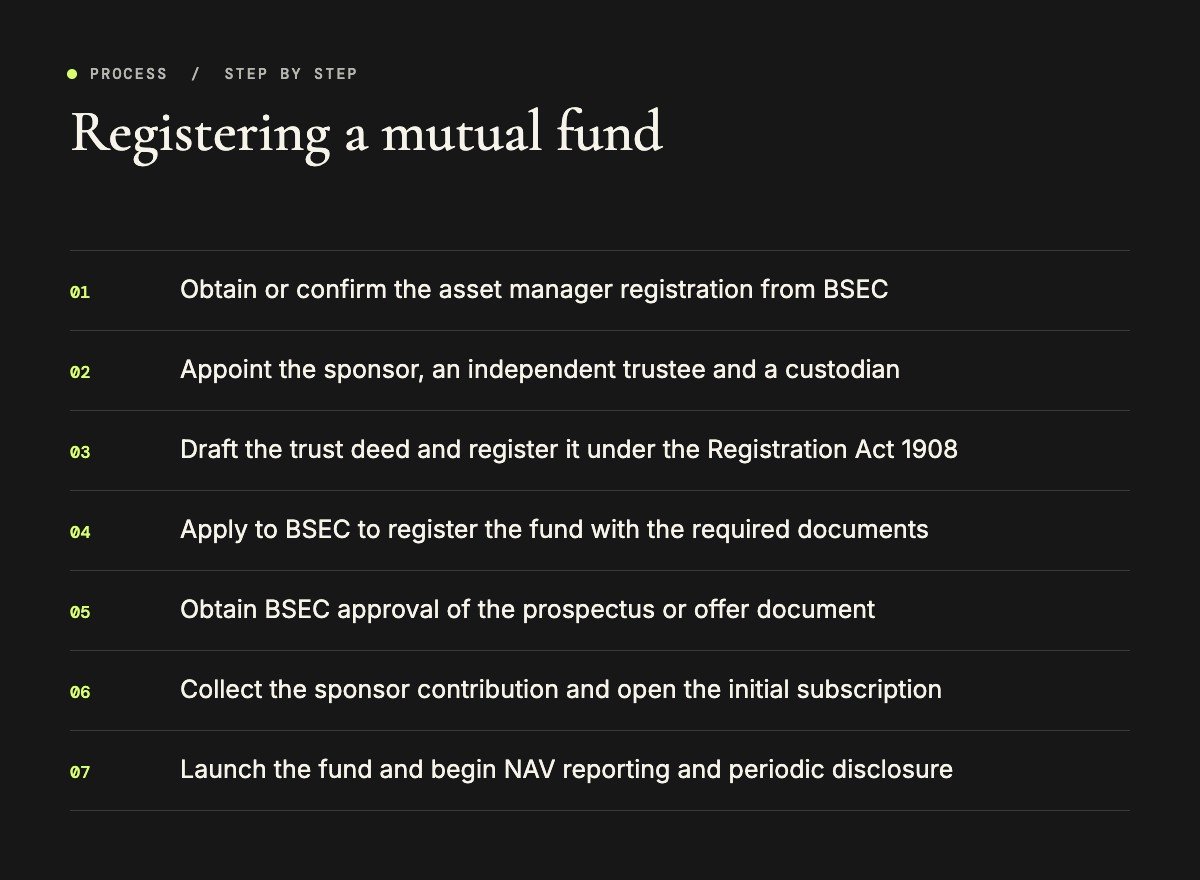
The sequence below reflects how mutual fund registration in Bangladesh works in practice for a new open-end scheme. Timelines depend heavily on the quality of the first submission and the volume of BSEC queries, so build in time for at least one round of comments.
- Confirm the asset manager's licence. Make sure the manager's BSEC registration is current and that its capital, staff and systems meet the 2025 Regulations.
- Appoint the other parties. Sign engagement terms with the sponsor, an independent trustee, a licensed custodian and an auditor, and document their consents.
- Draft the trust deed. Set out the fund's objective, investment policy, fees, valuation method, unit pricing, redemption rules and the powers of each party, consistent with the Regulations.
- Register the trust deed. Execute and register the deed under the Registration Act 1908, paying the applicable stamp duty under the current schedule.
- Apply to BSEC. File the registration application with the trust deed, investment management agreement, custodial agreement, parties' licences, board resolutions and the prescribed fee.
- Clear the prospectus. Submit the draft prospectus, respond to the Commission's comments and obtain approval and the registration certificate for the scheme.
- Fund and launch. Deposit the sponsor's contribution, open subscription through the manager and selling agents, and publish the opening NAV.
- Start ongoing reporting. Begin periodic NAV disclosure, portfolio statements and filings with BSEC and, where relevant, the stock exchanges.
Fees for registration and the prospectus are set by BSEC's current fee schedule. We do not quote them here because they are revised from time to time; check the latest figures on the BSEC website before filing.
Documents BSEC expects to see
A complete file for mutual fund registration in Bangladesh usually includes the registered trust deed, the investment management agreement, the custodial agreement, licences of the manager, trustee and custodian, sponsor documents and financial statements, the draft prospectus, the valuation policy, and a declaration of due diligence by the manager. Gaps in any of these are the most common reason for a query letter.
Why open-end funds are now the standard
An open-end fund issues and redeems units continuously. Investors buy units from the manager or a selling agent and surrender them back at a price linked to the NAV, so the fund grows and shrinks with demand. There is no fixed term and units are not normally listed.
BSEC's view, expressed throughout the 2025 reform, is that open-end funds give investors fairer value and better liquidity because they never trade at a market discount to NAV. That reasoning explains the most visible change in the new rules: the Commission has said it will not approve any new closed-end scheme.
Pricing and redemption
The trust deed must set out how sale and repurchase prices are calculated, how often they are published, the cut-off time for orders, and how quickly redemption proceeds are paid. BSEC reviews these terms carefully during mutual fund registration in Bangladesh, because they are where unitholder complaints most often arise.
Closed-end funds after the 2025 regulations
Bangladesh still has a significant number of listed closed-end funds, most with terms expiring by 2032. The 2025 Regulations introduced a discount test for them. As reported in December 2025, if a closed-end fund's average trading price stays more than 25% below the higher of its issue price or its fair-value NAV for six months, the trustee must call an extraordinary general meeting of unitholders.
The trustee must fix a record date within 30 days after the six-month period and give at least 21 days' notice of the meeting. Unitholders vote by secret ballot on converting the fund into an open-end scheme or liquidating it, subject to BSEC approval, and on whether the existing trustee and manager remain. Press accounts of the voting majority differ, so confirm the exact threshold in the gazette text.
Managers of existing closed-end funds should monitor the discount every trading day and prepare conversion documents early. A conversion still needs a revised trust deed, a new prospectus and BSEC approval, which is effectively a fresh registration exercise.
Investment limits, valuation and fees
A registered fund may only invest within the limits in the Regulations and its own trust deed. These include concentration limits on any single issuer or sector, limits on unlisted and illiquid securities, restrictions on investing in companies connected with the sponsor or manager, and rules on holding cash and government securities. We do not reproduce the percentages here; take them from the current gazette text.
Valuation drives everything else. The 2025 reform followed years of criticism that some funds held unlisted assets at stale or inflated values. A written valuation policy, approved by the trustee and applied consistently, is now central to mutual fund registration in Bangladesh and to every NAV the fund publishes afterwards.
Management and other fees
Management, trustee and custodian fees must be disclosed in the prospectus and charged only as the trust deed allows. Under the new regime the custodian checks the manager's fee claim before paying it. Any fee arrangement that is not transparent to unitholders is likely to be challenged.
Private funds and alternative investment funds
Not every pooled vehicle is a mutual fund. Private equity, venture capital and impact funds that raise money only from qualified investors fall under the Bangladesh Securities and Exchange Commission (Alternative Investment) Rules 2015. Those funds are also trusts with a registered fund manager, trustee and custodian, but they cannot be offered to the general public.
If your strategy involves concentrated stakes in unlisted companies, long lock-ups or a small group of institutional investors, an alternative investment fund is usually the better route than mutual fund registration in Bangladesh. We discuss that market in our private equity practice.
Foreign sponsors, managers and investors
Foreign groups can own Bangladeshi asset managers and sponsor funds, subject to BSEC approval of the people and structure. The investment should be registered with the Bangladesh Investment Development Authority, and capital, dividends and sale proceeds must move through authorised dealer banks under the foreign exchange rules of Bangladesh Bank.
Non-resident investors buying units in a fund that has completed mutual fund registration in Bangladesh should use the designated investment accounts available under Bangladesh Bank's rules for portfolio investment, so that their investment and returns can be repatriated. For a wider view of inbound investment, see our page on foreign direct investment.
Ongoing compliance after mutual fund registration in Bangladesh
Mutual fund registration in Bangladesh is the beginning, not the end. A fund must keep audited annual accounts, publish its NAV at the intervals set by the rules (in practice weekly for most funds), issue portfolio statements, hold unitholder meetings where required, and report material events to BSEC and, for listed units, to the stock exchanges.
BSEC inspects asset managers and has, in 2025 and 2026, cancelled the management appointments of some poorly performing managers. Breaches can lead to fines, suspension of the manager's registration, appointment of a replacement manager, or action under the 1969 Ordinance. Disclosure failures and valuation errors are the areas regulators scrutinise most.
Changes that need fresh approval
Material changes, such as a new investment objective, a change of trustee, custodian or manager, a fee increase, or conversion or merger of schemes, normally need trustee consent, BSEC approval and in some cases a unitholder vote. Plan these as formal projects with their own timetable.
Common mistakes to avoid
- Licensing late. Starting the fund documents before the manager's own BSEC registration and capital are secure.
- Weak trustee independence. Proposing a trustee with close ties to the sponsor or manager.
- Template trust deeds. Reusing a deed drafted under the 2001 Rules without updating it for the 2025 Regulations.
- Vague valuation policy. No clear method for unlisted or thinly traded securities.
- Unclear redemption terms. Cut-off times and payment periods that do not match operational reality.
- Ignoring tax. Assuming the treatment of fund income and distributions without checking the current Finance Act.
Frequently asked questions about mutual fund registration in Bangladesh
Which authority handles mutual fund registration in Bangladesh?
The Bangladesh Securities and Exchange Commission. It registers the asset manager, trustee and custodian, registers each scheme and approves its prospectus. Trust deeds are separately registered with the sub-registry under the Registration Act 1908.
Can a new closed-end fund still be launched?
No. BSEC has stated that, under the Mutual Fund Regulations 2025, no new closed-end funds will be approved. New public schemes are open-end funds.
Does the asset manager need to be a separate company?
Yes. The manager must be a company registered with RJSC and holding its own BSEC registration as an asset manager, with its own capital, staff and compliance function.
How long does registration take?
It depends on the completeness of the file and the number of BSEC queries. Where the manager is already licensed and the parties are lined up, the main variable is the review of the trust deed and prospectus. Plan for several months rather than weeks.
Can foreign investors buy units of Bangladeshi funds?
Yes, provided they invest through the accounts and banking channels allowed by Bangladesh Bank's foreign exchange rules, which also govern repatriation of returns.
Is a private equity fund a mutual fund?
No. Private equity and venture capital funds for qualified investors are regulated under the Alternative Investment Rules 2015, which have their own registration process.
How we can help
We advise sponsors, asset managers, trustees and investors on mutual fund registration in Bangladesh, from licensing the manager and drafting the trust deed to responding to BSEC queries and converting existing closed-end schemes. We also act on regulatory investigations and unitholder disputes before the Commission. Learn more about our investment funds practice and our work on capital markets.
Planning a new fund or a conversion?
We map the licensing, documents and BSEC approvals for your scheme and manage the process through to launch.
Book a consultationInvestment funds practicePrimary sources: the Bangladesh Securities and Exchange Commission Act 1993, the Trust Act 1882 and the Registration Act 1908 on the Laws of Bangladesh portal; the BSEC (Mutual Fund) Regulations 2025 and the Alternative Investment Rules 2015 from the Bangladesh Securities and Exchange Commission; market data from the Dhaka Stock Exchange; investment registration through BIDA.
This article is general information about Bangladeshi law as of 2026 and is not legal advice. Fees, forms and procedures change; confirm current requirements with BSEC or a qualified lawyer before acting.



0 Comments