
The Dhaka Judge Court is what most people call the cluster of district-level civil and criminal courts in Old Dhaka, from the District Judge and Metropolitan Sessions Judge to the magistrates and special tribunals nearby. Knowing which court actually hears your matter, and how it runs, saves months.
- "Judge court" is an umbrella term: civil suits, criminal trials, magistrates' work and special tribunals all sit in separate courts with different rules.
- In civil matters the value of the suit decides the court: since 2021 an Assistant Judge hears suits up to Tk 15 lakh, a Senior Assistant Judge up to Tk 25 lakh, and a Joint District Judge above that.
- Inside the Dhaka Metropolitan area, criminal cases start with the Chief Metropolitan Magistrate; the rest of Dhaka district falls under the Chief Judicial Magistrate.
- 2025 amendments to the Code of Criminal Procedure added arrest safeguards, a 15-day cap on police remand and online bail bonds.
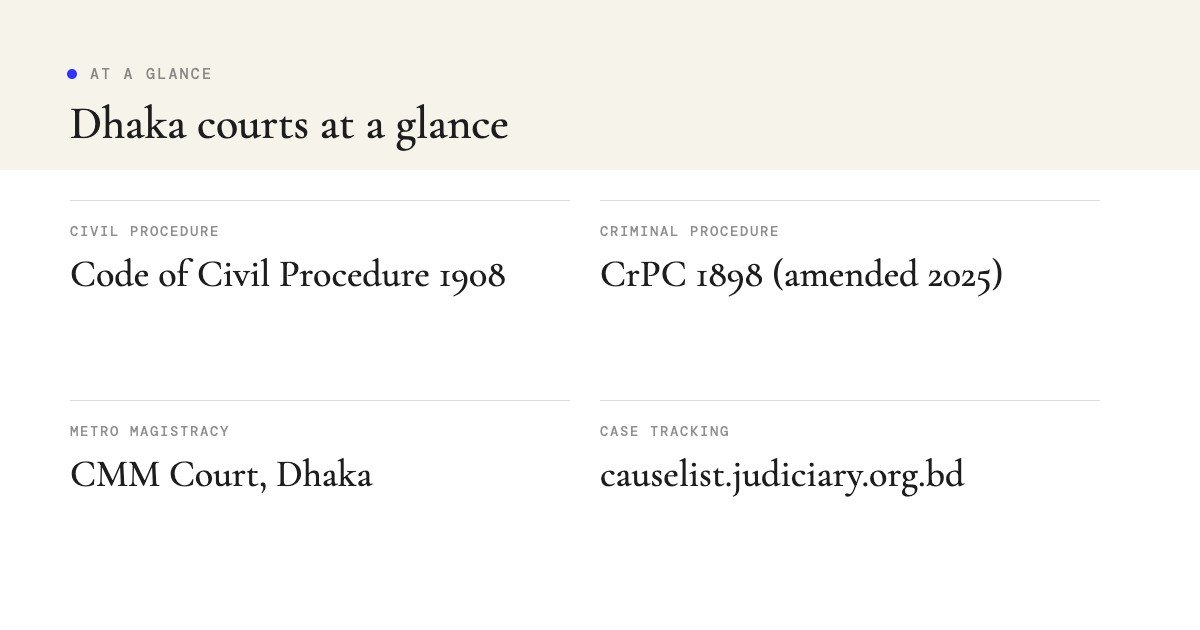
- You can check the next date and latest order of a lower-court case on causelist.judiciary.org.bd or the Amar Adalat app.
What people mean by the Dhaka Judge Court
Ask a rickshaw driver for the "judge court" and you will end up in the court area of Old Dhaka, around Court House Street, Johnson Road and Bahadur Shah Park. That neighbourhood houses most of the subordinate courts for Dhaka district and the Dhaka Metropolitan area, along with the lawyers' chambers, bar association buildings, stamp vendors and copying sections that serve them.
Legally, there is no single court called the Dhaka Judge Court. The name covers several distinct institutions: the civil courts headed by the District Judge, the criminal courts headed by the Sessions Judge and the Metropolitan Sessions Judge, the magistracy, and a range of special courts and tribunals. Each has its own jurisdiction, registry and cause list.
The Supreme Court, with its High Court Division and Appellate Division, sits separately near Ramna. It supervises all subordinate courts and hears appeals, revisions and writ petitions. We explain that structure in our guide to the structure of the Supreme Court of Bangladesh.
Civil courts at the Dhaka Judge Court
Civil courts are established under the Civil Courts Act 1887. In ascending order they are the Assistant Judge, the Senior Assistant Judge, the Joint District Judge, the Additional District Judge and the District Judge. All of them apply the Code of Civil Procedure 1908.
Which court hears a suit depends mainly on its pecuniary value. Under the Civil Courts (Amendment) Act 2021, passed in January 2021, an Assistant Judge may try suits valued up to Tk 15 lakh, a Senior Assistant Judge up to Tk 25 lakh, and a Joint District Judge has unlimited original jurisdiction above that. The same amendment raised the District Judge's appellate jurisdiction to Tk 5 crore; appeals above that go to the High Court Division.
| Court | Original civil jurisdiction | Typical matters |
|---|---|---|
| Assistant Judge | Up to Tk 15 lakh | Partition, declaration, injunction, family court cases |
| Senior Assistant Judge | Up to Tk 25 lakh | Higher-value title and money suits |
| Joint District Judge | Above Tk 25 lakh, no upper limit | Commercial and high-value property suits; Artha Rin Adalat work where assigned |
| District Judge / Additional District Judge | Appeals up to Tk 5 crore; special statutes | Civil appeals, probate, succession and statutory appeals |
Family, money loan and other specialised civil courts
Several specialised courts are staffed by the same civil judiciary. Assistant Judges sit as Family Courts under the Family Courts Act 2023, hearing dower, maintenance, custody and divorce-related claims. Artha Rin Adalats under the Artha Rin Adalat Ain 2003 hear recovery suits by banks and financial institutions. Small causes and rent matters have their own procedure.
Commercial disputes are in transition. The Commercial Court Ordinance 2026, issued around 1 January 2026, provides for district commercial courts and pre-suit mediation, but we have not been able to confirm whether Parliament has re-enacted it after April 2026. Check its status before choosing a forum for a commercial claim.

Criminal courts in Dhaka
Criminal jurisdiction in Dhaka is split along geographical lines. The Dhaka Metropolitan area, policed by the Dhaka Metropolitan Police, has its own metropolitan courts. The rest of Dhaka district, including upazilas such as Savar, Keraniganj, Dhamrai, Dohar and Nawabganj, falls under the ordinary district courts.
Inside the metropolitan area, the Chief Metropolitan Magistrate (CMM) Court and its Metropolitan Magistrates receive police cases and complaints, deal with bail and remand, and try less serious offences. Serious offences are tried by the Metropolitan Sessions Judge, Additional and Joint Metropolitan Sessions Judges. Outside the metropolitan area, the same roles are played by the Chief Judicial Magistrate (CJM) Court and the District and Sessions Judge.
Special tribunals and courts
Much serious criminal work in Dhaka goes to special forums: Nari-o-Shishu Nirjatan Daman Tribunals for offences against women and children, Special Judge courts for corruption cases brought by the Anti-Corruption Commission, Speedy Trial Tribunals, and the tribunal designated under the cyber security law. Cheque dishonour cases under section 138 of the Negotiable Instruments Act 1881 start as complaints before the magistrate but, under section 141, are tried by a court of sessions.
Filing in the wrong court is the most common avoidable delay at the Dhaka Judge Court. Before drafting, confirm three things: the value of the claim, the police station or area where the cause of action arose, and whether a special statute sends the matter to a tribunal.
How to file a civil suit at the Dhaka Judge Court
A civil suit begins with a plaint drafted under Order VII of the Code of Civil Procedure. It must state the facts, the cause of action, the date it arose, the valuation of the suit and the relief claimed, and it must be signed and verified by the plaintiff. Documents relied on are filed with it.
Court fees are paid under the Court-fees Act 1870, usually as an ad valorem fee on the value of the relief. Rates have been revised by Finance Acts, so the exact figure should be worked out against the current schedule when the plaint is ready. Undervaluing a suit to save fees invites an objection and can send the case to a different court.
- Check limitation and forum. Confirm the suit is within time under the Limitation Act 1908 and identify the right court by value and territory.
- Draft and value the plaint. Prepare the plaint, verification, list of documents and valuation, and calculate the court fee.
- File and register. Present the plaint at the court's registry; once accepted it receives a suit number and a first date.
- Serve summons. The court issues summons, served through the Nazarat department, by post and, increasingly, electronically.
- Written statement and mediation. The defendant files a written statement; the court then considers referring the dispute to mediation under section 89A of the Code.
- Issues and evidence. The court frames issues, the parties file affidavits or give oral evidence, and witnesses are cross-examined.
- Arguments and decree. After final arguments the court gives judgment and draws up a decree, which can then be executed or appealed.
Temporary injunctions and urgent relief
Where property is about to be sold, demolished or encumbered, a plaintiff can apply with the plaint for a temporary injunction under Order XXXIX, or an order maintaining the status quo. The court must be shown a prima facie case, balance of convenience and irreparable loss. Urgent applications at the Dhaka Judge Court are often heard on the day of filing if the papers are complete.
How a criminal case starts in Dhaka
There are two routes into the criminal courts. The first is a First Information Report (FIR) at the police station with jurisdiction over the place of the offence. The police record it, investigate and send a report to the magistrate: a charge sheet if there is evidence, or a final report if not.
The second route is a complaint petition filed directly before the CMM or CJM. The magistrate examines the complainant on oath under section 200 of the Code of Criminal Procedure, and may take cognizance and issue summons or warrant, dismiss the complaint, or direct an inquiry or investigation under section 202. Many cheque, fraud and family-related complaints at the Dhaka Judge Court take this route.
Changes to criminal procedure in 2025
By ordinance in 2025, the Code of Criminal Procedure was amended to add arrest safeguards. Officers must identify themselves and prepare a written arrest memo attested by a family member or local witness; the arrested person must be allowed to contact relatives and a lawyer; and medical examination is required before and after police custody.
Total police remand is capped at 15 days, investigation reports must be submitted within 60 working days with limited extensions, and online bail bonds and electronic summons are recognised. These changes were made by ordinance; check whether Parliament has since re-enacted them in the same form.
Bail, hearings and adjournments
For bailable offences, bail is a right. For non-bailable offences, the magistrate or sessions court decides on the facts, the seriousness of the charge and the risk of absconding. If bail is refused by the magistrate, the application can be renewed before the Metropolitan Sessions Judge or Sessions Judge, and from there to the High Court Division.
Hearings at the Dhaka Judge Court are listed in a daily cause list and called in order, but a busy court may not reach every matter. Adjournments are common, especially when witnesses do not appear. Under the Code of Civil Procedure the court can impose costs for unnecessary adjournments, and a well-prepared party should press for them.
What to expect on a hearing day
- Arrive early. Courts generally sit in the morning; your lawyer needs time to check the cause list and the case file.
- Carry identification and copies. Bring your national ID and copies of key documents.
- Respect dress and decorum. Stand when the judge enters; speak only through your lawyer unless asked.
- Keep the next date. Note the next date and the purpose of the hearing before leaving.
Finding and tracking cases at the Dhaka Judge Court
Since 2022 the judiciary has published an online cause list for the lower courts at causelist.judiciary.org.bd, launched with UNDP support together with the Amar Adalat (MyCourt) mobile app. You select the division, district and court, then search by case number to see the latest order, the next date and the status. For anyone following a matter at the Dhaka Judge Court from abroad, this is the single most useful tool.
The online list is a guide, not a substitute for the court file. Orders are sometimes uploaded late, and the record of what actually happened at a hearing is the order sheet. Certified copies of orders, judgments and depositions are obtained by application to the court's copying section, and these are what you need for any appeal or revision.
Digital services expanding in 2026
According to the Ministry of Law in April 2026, e-bail bond management was running in nine districts, e-family courts in two districts, and information and service centres had been set up at all Chief Judicial Magistrate courts. A wider "e-Judiciary" project to move filing and records onto one platform was still under review. Confirm which services are live at the Dhaka Judge Court before relying on them.
Mediation and settlement before and during a case
Mediation is now part of ordinary civil practice. Section 89A of the Code of Civil Procedure allows the court to refer a suit to mediation after the written statement, and a settlement reached there is recorded as a decree. Appeals can also be referred to mediation.
Separately, the Legal Aid (Amendment) Act 2026, building on a 2025 ordinance, introduced mandatory pre-case mediation at District Legal Aid Offices for family, rent control, partition, pre-emption, parental maintenance and dowry matters. As of July 2026 it applied in about 30 districts, and Dhaka was not yet on the published lists, though the government said it planned to extend it nationwide. Check whether it now applies in Dhaka before filing those kinds of cases. See also our guide to mediation and ADR.
Appeals, revisions and execution
Winning a decree at the Dhaka Judge Court is not the end of the matter. A party can appeal to the District Judge or the High Court Division depending on value, or apply for revision on a jurisdictional error. Limitation for appeals is short, so obtain certified copies of the judgment and decree without delay.
Execution of a money decree or a decree for possession requires a separate execution case under Order XXI. Execution is where many litigants lose momentum. Identifying the judgment debtor's assets early, and applying for attachment before judgment where the law allows, makes a real difference.
Criminal appeals
Convictions by a magistrate at the Dhaka Judge Court are appealed to the Sessions Judge or Metropolitan Sessions Judge. Convictions by a court of sessions go to the High Court Division. Revision lies against interlocutory orders in limited circumstances.
Practical tips for litigants and businesses
Most of our clients at the Dhaka Judge Court are businesses, landowners and families living abroad. The same practical points come up again and again:
- Keep originals safe. File certified or attested copies and produce originals only when the court calls for them.
- Use a power of attorney if you live abroad. A properly authenticated power of attorney lets a representative instruct lawyers and give evidence on formal matters; see our guide to the power of attorney in Bangladesh.
- Do not ignore summons. An ex parte decree or a warrant is far harder to undo than to prevent.
- Pay fees only through official channels. Court fees are paid by stamps or treasury challan; ask for receipts for everything.
- Track every date. Combine the online cause list with regular reports from your lawyer.
Touts operate around the court area offering to "manage" dates or orders. Paying anyone to influence a court is a criminal offence and can destroy an otherwise good case. Deal only with your enrolled advocate and the court's official counters.
Frequently asked questions about the Dhaka Judge Court
Where is the Dhaka Judge Court?
The main subordinate court complex is in Old Dhaka, around Court House Street, Johnson Road and Bahadur Shah Park. Civil courts, metropolitan and district criminal courts, magistrates and many tribunals sit in that area, in separate buildings.
Which court should I file a civil suit in?
It depends on the value of the suit and where the cause of action arose. Since 2021, suits up to Tk 15 lakh go to an Assistant Judge, up to Tk 25 lakh to a Senior Assistant Judge, and above that to a Joint District Judge.
How do I check my case date online?
Visit causelist.judiciary.org.bd or use the Amar Adalat (MyCourt) app, choose the district and court, and search by case number to see the next date and latest order.
What is the difference between the CMM and CJM courts?
The Chief Metropolitan Magistrate covers the Dhaka Metropolitan Police area. The Chief Judicial Magistrate covers the rest of Dhaka district. Both handle police cases, complaints, bail and remand at the first stage.
Can I follow a case from abroad?
Yes. With an authenticated power of attorney and an engaged lawyer, many steps can proceed without you, though you may need to attend in person to give evidence on disputed facts.
How long does a case take?
It varies widely with the court's workload, the number of witnesses and adjournments. Simple matters may finish within a year or two; contested civil suits often take longer. Mediation can shorten this considerably.
How we can help
We appear in the civil and criminal courts of Dhaka, from first filing and bail to trial, appeal and execution, and we act for clients living abroad through authenticated powers of attorney. If you have a case at the Dhaka Judge Court, or need to bring one, we can assess the right forum and strategy. Learn more about our Dhaka practice.
Have a case in the Dhaka courts?
We review your papers, identify the correct court and plan each step, whether you are in Dhaka or overseas.
Book a consultationDhaka practicePrimary sources: the Code of Civil Procedure 1908, the Code of Criminal Procedure 1898 as amended in 2025, the Civil Courts Act 1887 and the Court-fees Act 1870 on the Laws of Bangladesh portal; court information from the Supreme Court of Bangladesh; legal aid and mediation from the National Legal Aid Services Organization.
This article is general information about Bangladeshi law as of 2026 and is not legal advice. Court structures, fees and procedures change; confirm current requirements with the relevant court or a qualified lawyer before acting.


0 Comments