
Millions of Bangladeshis living abroad invest in land and flats at home, for family, retirement or income. An NRI property purchase in Bangladesh is legally straightforward for Bangladeshi citizens, but buying from a distance increases the risk of fraud, title defects and disputes with relatives or developers. Careful due diligence, a reliable attorney and properly documented payments are essential.
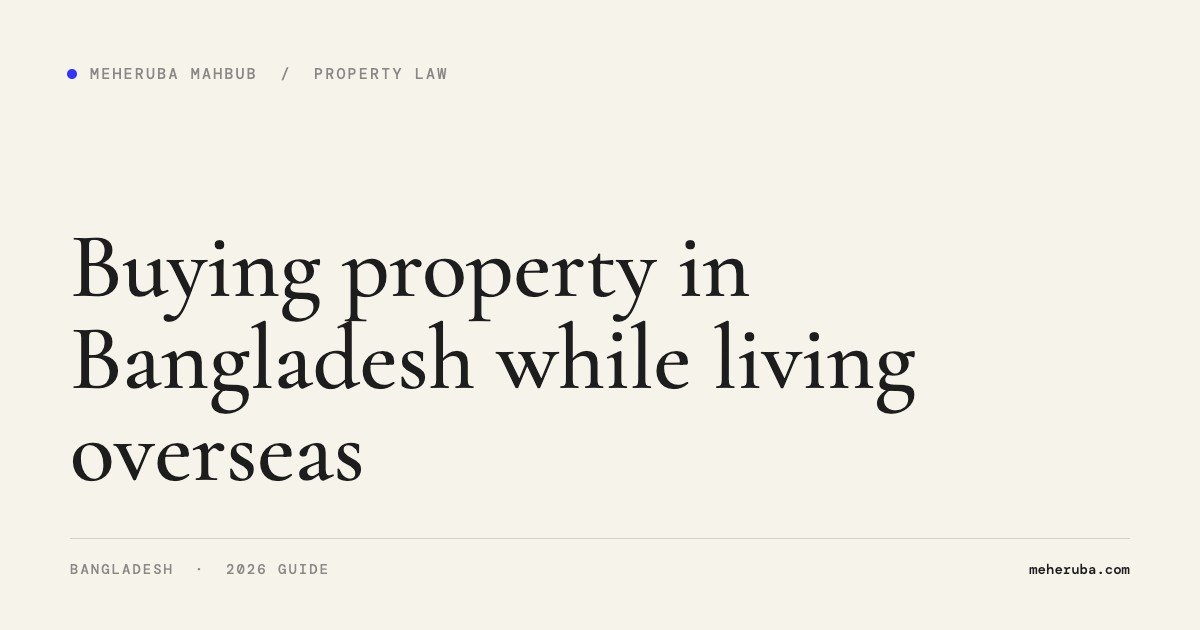
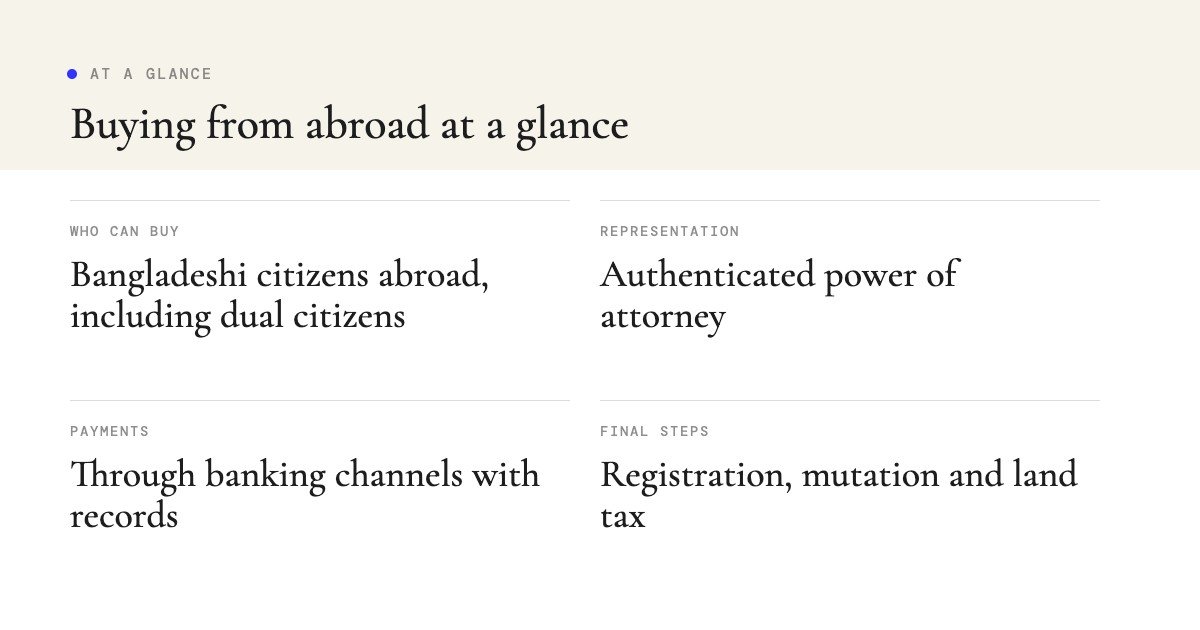
- Bangladeshi citizens living abroad, including those with dual citizenship, can buy land and flats in Bangladesh on the same footing as residents.
- Foreign nationals without Bangladeshi citizenship face restrictions on owning land directly and usually invest through companies.
- A power of attorney executed abroad must be authenticated by a Bangladesh mission and processed in Bangladesh under the Power of Attorney Act 2012.
- Payments should be made through banking channels, with records supporting remittances and later tax filings.
- Title verification, mutation and payment of land taxes protect the buyer’s ownership.
Who can make an NRI property purchase in Bangladesh
Bangladeshi citizens living overseas, often called non-resident Bangladeshis, can buy agricultural and non-agricultural land, flats, commercial space and plots in housing projects, subject to the same laws as residents, such as land ceiling rules for agricultural land. Dual citizens holding a Bangladeshi dual citizenship certificate are treated as citizens. Foreign nationals without Bangladeshi citizenship generally cannot own land directly but may hold property through a Bangladeshi company or lease arrangements. For an NRI property purchase in Bangladesh, confirming citizenship status at the outset avoids problems at registration.
Our real estate practice acts for overseas buyers across Bangladesh.
Risks in an NRI property purchase in Bangladesh
| Risk | How it happens | Protection |
|---|---|---|
| Fake or defective title | Forged deeds, missing heirs, unresolved inheritance | Independent title search and record verification |
| Double sale | Seller sells the same property to several buyers | Registered agreement, prompt registration |
| Attorney misuse | Representative misuses power of attorney | Limited, specific power of attorney and monitoring |
| Developer delay | Flats not delivered or not as promised | Developer due diligence and strong agreements |
| Unrecorded payments | Cash payments without receipts | Bank transfers and written receipts |

Buying from abroad step by step
- Plan. Set budget, location and type of property.
- Appoint representatives. Engage an independent lawyer and a trusted attorney in Bangladesh.
- Due diligence. Verify title documents, khatians, mutation, land tax and approvals.
- Agreement. Sign a written, preferably registered, agreement for sale.
- Payments. Remit funds through banks and keep evidence of each payment.
- Registration. Execute and register the sale deed, paying stamp duty, fees and taxes.
- Mutation and possession. Mutate the land records, pay land tax and secure possession.
Do not rely solely on photocopies sent by the seller or a relative. Ask your lawyer to obtain certified copies directly from the sub-registry and land offices and to inspect the site.
Power of attorney from abroad
Most overseas buyers act through an attorney in Bangladesh. Under the Power of Attorney Act 2012 and related rules, a power of attorney executed abroad must be signed before and authenticated by the Bangladesh embassy or high commission, and then submitted in Bangladesh within the prescribed period for verification and payment of stamp duty, after which it can be used. A power of attorney relating to sale or transfer of immovable property must meet registration requirements. For an NRI property purchase in Bangladesh, the power should be specific to the transaction, naming the property and limiting the attorney’s authority to what is necessary.
Our guide on powers of attorney explains the process in detail.
Title checks for an NRI property purchase in Bangladesh
Title checks should cover the chain of deeds for at least the statutory search period and ideally longer, the CS, SA, RS and city survey khatians, mutation records, land development tax receipts, absence of mortgages and litigation, and compliance with acquisition notices. For flats, check the developer’s registration, the land title, the registered joint venture agreement with the landowner, RAJUK or other approvals and the allocation of the flat to the developer’s share. Independent verification by your own lawyer, rather than relying on the seller’s agent, is essential.
Paying for an NRI property purchase in Bangladesh
Funds for the purchase should be remitted through formal banking channels, either to the buyer’s own account in Bangladesh or directly to the seller’s account, with clear references. Avoid informal hundi transfers, which are illegal and leave no trace. Bank records support the buyer’s source of funds, help with income tax filings and protect against disputes over whether payment was made. Some banks offer non-resident foreign currency deposit accounts that can be used for property purchases.
Registration and taxes on an NRI property purchase in Bangladesh
The sale deed must be registered at the sub-registry office with jurisdiction over the property, with payment of stamp duty, registration fees, local government tax and source tax under the Income Tax Act 2023, calculated on the deed value and location. The buyer or attorney must provide identification, TIN or proof of return submission where required, and photographs. After registration, the buyer receives a receipt and later the registered deed. Mutation should follow promptly.
Buying flats from developers
Many overseas buyers purchase flats off-plan from developers. Before paying, check that the developer is registered under the Real Estate Development and Management Act 2010, verify the land title and the joint venture agreement with the landowner, confirm RAJUK or other building approvals, and visit completed projects. The allotment agreement should specify the flat, price, payment schedule, completion date, delay compensation, specifications, parking and handover conditions. Payments should be linked to construction milestones. A careful approach greatly reduces the risk of delays and disputes in an NRI property purchase in Bangladesh.
Family arrangements and trust
Overseas buyers often rely on relatives to find, inspect and manage property. While family support is valuable, disputes frequently arise when property is bought in a relative’s name for convenience, or when relatives use a power of attorney beyond its purpose. Buying in your own name, using a limited power of attorney, and keeping documents in your own possession protect your interests. Benami arrangements, where property is held in another’s name, create serious legal risk.
Managing and renting the property
After purchase, non-resident owners need someone to manage the property, collect rent, pay holding tax and land development tax, and handle maintenance. A written management agreement or limited power of attorney for these purposes is advisable. Rental income is taxable in Bangladesh, and tenants who are companies may deduct tax at source. Keeping accounts and tax records current avoids problems when selling or remitting proceeds abroad.
Selling after an NRI property purchase in Bangladesh
When non-residents sell property, they pay applicable taxes at registration and may need to report the gain. Repatriating sale proceeds abroad is subject to Bangladesh Bank foreign exchange rules, which may allow repatriation of amounts originally brought in through banking channels and impose conditions on other proceeds. Keeping records of the original remittance is therefore important for future flexibility.
Home loans for non-residents
Several Bangladeshi banks offer home loans to non-resident Bangladeshis, sometimes in partnership with remittance programmes, subject to income verification, debt-to-income limits, a down payment and security over the property. Loan terms, interest rates and documentation requirements vary. Overseas buyers should compare offers, check whether loans can be repaid from abroad through banking channels, and ensure that the property has clean title and approvals, as banks will not lend against defective property.
Inherited property and family land
Many overseas Bangladeshis own inherited land rather than purchased property. Securing such property requires obtaining heirship or succession documents, completing mutation in the heirs’ names, partitioning shares where appropriate and paying land taxes. Absent owners are particularly vulnerable to encroachment and fraudulent transfers, so regular monitoring of land records and site visits by a trusted representative are advisable.
Disputes after an NRI property purchase in Bangladesh
If a seller fails to complete, a developer delays, or a relative misuses a power of attorney, overseas buyers have remedies including specific performance suits, damages claims, revocation of the power of attorney, criminal complaints for fraud, and complaints under the Real Estate Development and Management Act 2010. Acting promptly is important because limitation periods apply and evidence can be lost. Appointing a lawyer in Bangladesh who can act quickly protects the buyer’s position.
Dual citizens and foreign spouses
Bangladeshi-origin people who have acquired foreign citizenship should obtain a dual citizenship certificate if they wish to buy land as citizens; dual citizenship applications have been fully online since 2025. Without it, they may be treated as foreigners for land ownership purposes. Foreign spouses of Bangladeshi citizens generally cannot own land directly in their own names, so couples should structure ownership carefully, typically in the Bangladeshi spouse’s name, and consider wills or other arrangements to protect the foreign spouse’s interests.
Holders of No Visa Required endorsements should note that NVR is a travel facility and does not by itself confer citizenship rights to own land.
Practical checklist
Confirm citizenship status; appoint an independent lawyer; execute a specific, authenticated power of attorney; verify title and approvals through certified records; sign a written agreement; pay through banks only; register promptly and pay taxes; complete mutation and pay land tax; keep originals safe; and monitor the property regularly. Following this checklist makes an NRI property purchase in Bangladesh secure even when you cannot be there in person.
Visiting before you buy
Where possible, plan a visit to Bangladesh before finalising a major purchase. Seeing the property, meeting the seller or developer, visiting the sub-registry and land offices with your lawyer, and speaking to neighbours can reveal issues that documents do not show, such as boundary disputes, occupation by others or construction quality problems. If a visit is not possible, video inspections and independent surveyors can help reduce the risk.
Combining a visit with the signing of key documents can also speed up the transaction considerably.
Frequently asked questions about nri property purchase in bangladesh
Can Bangladeshis abroad buy property?
Yes, citizens abroad, including dual citizens, can buy property like residents.
Do I need to be present for registration?
No, an attorney under a properly authenticated power of attorney can act for you.
How should I pay?
Through banking channels, keeping records of every payment.
Can foreigners buy land?
Foreign nationals generally cannot own land directly but may invest through companies.
Do I need a TIN?
Property registration above certain values requires a TIN or proof of return submission.
Can I get a home loan?
Some banks offer home loans to non-resident Bangladeshis, subject to their policies.
How we can help
We manage every stage of an NRI property purchase in Bangladesh, from title verification and agreements to registration, mutation and disputes. See our real estate practice, our guide to making a power of attorney and our guide to buying a house in Bangladesh.
Buying property from abroad?
We protect your investment on the ground.
Book a consultationReal estatePrimary sources: the Registration Act 1908, the Transfer of Property Act 1882 and the Power of Attorney Act 2012 on Laws of Bangladesh; land records from the Ministry of Land; consular services from the Ministry of Foreign Affairs.
This article is general information about Bangladeshi property law as of October 2026 and is not legal advice. Requirements for powers of attorney and registration change; confirm current procedures.




0 Comments