
A clear will can prevent bitter family disputes and ensure that property goes where you intend. Will registration in Bangladesh is optional under the Registration Act 1908, but registering or depositing a will provides strong evidence of its authenticity. The rules on what a will can do depend on personal law: Muslims face the one-third limit on bequests, while Hindus and Christians follow the formalities of the Succession Act 1925.

- Under Muslim law, a person can generally bequeath up to one-third of the net estate after debts and funeral expenses; bequests beyond that, or to heirs, need consent of the other heirs.
- Hindu and Christian wills must comply with the Succession Act 1925, including writing, signature and attestation by two witnesses.
- Registration of wills is optional under the Registration Act 1908, but registered wills are harder to challenge.
- A sealed will can also be deposited with the Registrar for safe keeping.
- Probate or letters of administration may be required before an executor can deal with the estate.
Why will registration in Bangladesh matters
Unregistered wills are often challenged as forged, made under undue influence, or revoked. Registration creates an official record that the testator appeared before the sub-registrar and acknowledged the will, which helps defeat later allegations. It also reduces the risk of the will being lost or destroyed. While a valid unregistered will can still take effect, the evidential advantages of registration make it worthwhile, particularly where significant land or family tensions are involved.
Our family and property team, part of the practice described on our about page, helps clients draft, register and implement wills.
Muslim wills (wasiyat) and will registration in Bangladesh
Under Muslim personal law, a will (wasiyat) can be oral or written, though writing is strongly advisable. A Muslim can bequeath up to one-third of the net estate to non-heirs without anyone’s consent. A bequest to an heir, or of more than one-third, takes effect only if the other heirs consent after the testator’s death. The remaining two-thirds pass according to the fixed shares of Islamic inheritance. Bequests are commonly used to benefit grandchildren whose parent died earlier, charities, adopted children or others outside the line of heirs. Note that the Muslim Family Laws Ordinance 1961 already gives orphaned grandchildren a share in certain cases.
Will registration in Bangladesh: rules by community
| Community | Main law | Key limits and formalities |
|---|---|---|
| Muslims | Muslim personal law | One-third limit; bequests to heirs need heirs’ consent; writing advisable |
| Hindus | Hindu law and Succession Act 1925 | Writing, signature, two attesting witnesses; probate may be needed |
| Christians | Succession Act 1925 | Writing, signature, two attesting witnesses; probate or letters of administration |
| Buddhists and others | Personal law and applicable statutes | Formalities depend on applicable law; take advice |
Statutes are available on Laws of Bangladesh.
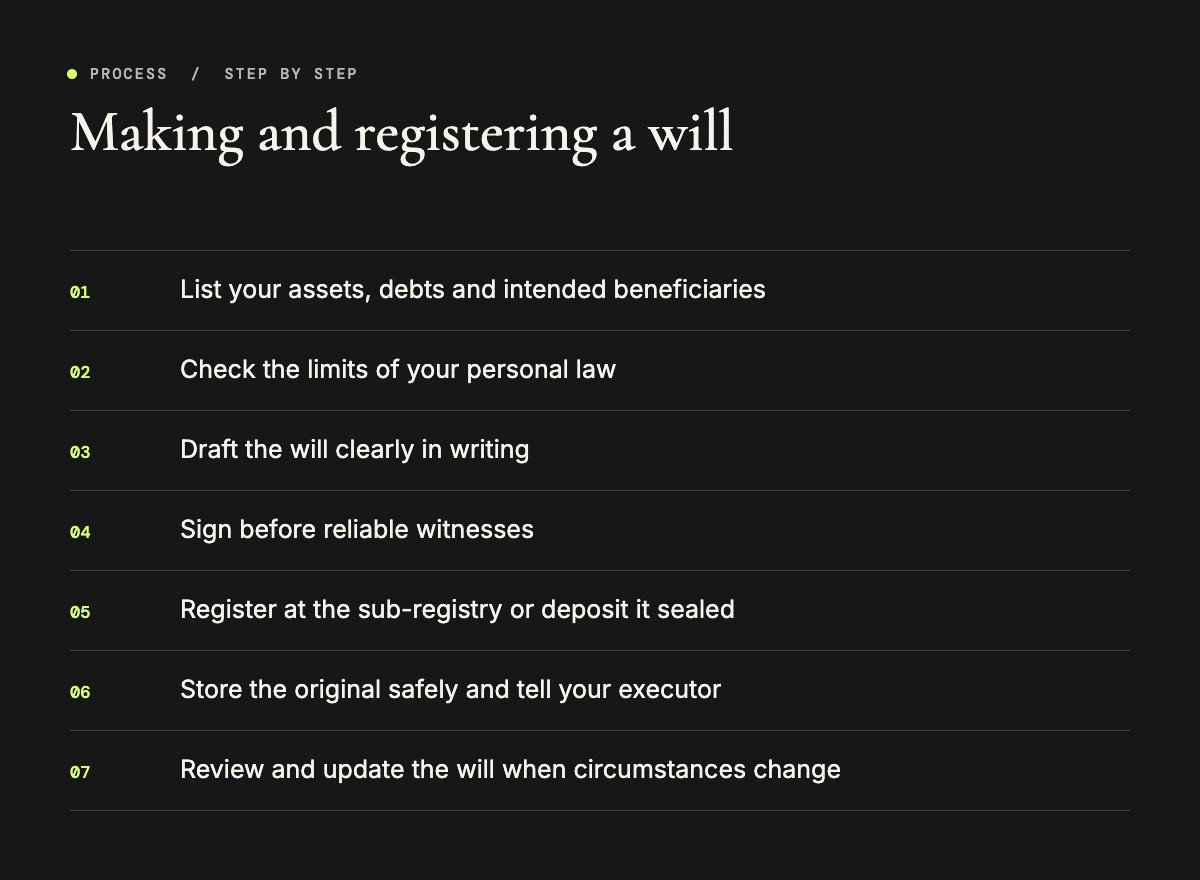
Making and registering a will
- Inventory. List assets, debts and the people or causes you wish to benefit.
- Check limits. Confirm what your personal law allows you to bequeath.
- Draft. Prepare a clear written will identifying property and beneficiaries.
- Sign and witness. Sign before at least two independent witnesses who also sign.
- Register or deposit. Register at the sub-registry office or deposit a sealed will with the Registrar.
- Store safely. Keep the original secure and inform your executor.
- Review. Update the will after marriage, divorce, births, deaths or major property changes.
Avoid using beneficiaries or their spouses as witnesses. Independent witnesses, such as colleagues or professionals, give much stronger evidence if the will is challenged.
How will registration in Bangladesh works
To register a will, the testator appears in person before the sub-registrar, presents the signed will with identification, and acknowledges it as their own. The sub-registrar records the will in the appropriate register and returns it endorsed with registration details. Fees are modest compared with property transfer registration. Alternatively, the testator may deposit a sealed envelope containing the will with the Registrar, to be opened after death on application. Either route strengthens will registration in Bangladesh as a protection against later disputes.
A registered will can still be revoked or replaced by a later will, so registration does not lock the testator in.
Probate after will registration in Bangladesh
Probate is a court’s certification of a will and the executor’s authority to administer the estate. Under the Succession Act 1925, probate is required for wills of certain communities and in certain circumstances before an executor can establish rights in court, while in other cases it is not compulsory but may be practically required by banks or registries. Where there is no executor, a beneficiary may seek letters of administration with the will annexed. Muslim wills generally do not require probate, but heirs may still need succession certificates for debts and securities.
Capacity and undue influence
A valid will requires that the testator be of sound mind, understand the nature of the act, the extent of their property and the claims of those who might expect to benefit, and act freely. Wills made during serious illness, or that benefit a carer or relative who controlled the testator, are often challenged for lack of capacity or undue influence. Medical evidence, independent witnesses and a lawyer’s involvement help defend such challenges.
Executors and will registration in Bangladesh
An executor collects the deceased’s assets, pays debts and expenses and distributes property according to the will. Choosing a trustworthy, organised executor, and naming an alternate, is important. Professionals can serve as executors in complex estates. The executor should know where the original will is kept and have access to key documents such as deeds, bank details and share certificates.
Gifts during life versus wills
Many people in Bangladesh prefer lifetime gifts (heba under Muslim law, or registered gift deeds generally) to wills, because gifts take effect immediately and, for Muslims, are not subject to the one-third limit if made validly during life with delivery of possession. However, gifts are irrevocable in many cases and must comply with formalities, including registration for immovable property and payment of applicable duties. A gift made during the donor’s final illness (marz-ul-maut) is treated like a bequest under Muslim law. Combining lifetime gifts with a carefully drafted will, supported by will registration in Bangladesh, can achieve flexible estate planning.
Common mistakes in will registration in Bangladesh
Frequent mistakes include vague descriptions of property, ignoring personal law limits, using interested witnesses, failing to sign every page, leaving the will in a place where it can be destroyed, failing to update after major life events, and not appointing an executor. Each can lead to disputes or partial invalidity. Professional drafting and registration prevent most of these problems.

Wills for overseas Bangladeshis
Bangladeshis living abroad with property at home should consider making a will that complies with Bangladeshi requirements for their Bangladeshi assets, in addition to any will in their country of residence. Coordination between wills avoids conflicts and accidental revocation. A will executed abroad may need authentication for use in Bangladesh, and registration may require personal appearance or special procedures. Advice in both jurisdictions is recommended.
Challenging a will after will registration in Bangladesh
Heirs or others may challenge a will on grounds such as forgery, lack of capacity, undue influence, improper execution, revocation or breach of personal law limits. Challenges are usually raised in probate proceedings or civil suits. Evidence such as medical records, witness testimony, handwriting analysis and registration records is central. Limitation periods apply, so anyone considering a challenge should act promptly.
What to include before will registration in Bangladesh
A well-drafted will identifies the testator with full details, revokes earlier wills, appoints an executor and alternate, describes property precisely with deed numbers, khatian details or account numbers, names beneficiaries with their relationships, specifies what happens if a beneficiary dies first, and addresses debts and expenses. Muslim testators should state that bequests are within the one-third limit or record the intention to seek heirs’ consent. The will should be dated and signed on each page, with witnesses’ full details. Clear drafting reduces the scope for disputes and makes implementation straightforward.
Attaching a schedule of assets that can be updated, while keeping the main dispositions in the will, is a practical approach for people whose holdings change over time.
Charitable bequests and waqf
Muslims often leave part of their estate to charity, mosques, madrasas or educational causes within the one-third limit. Creating a waqf, a permanent religious or charitable endowment, follows separate rules under waqf law and registration with the Waqf Administrator. Testators should be clear whether they intend a one-time gift or a permanent endowment, and identify the managing trustees or institution.
Keeping the will up to date
Life changes can make a will outdated: marriage, divorce, the birth of children or grandchildren, the death of a beneficiary, or buying and selling property. Review the will every few years and after any major event. A new will should expressly revoke earlier ones, and the new will should also be registered or deposited. Destroying old copies, while keeping a record of what was done, reduces confusion. Informing the executor about the latest will ensures that the right document is used.
Talking to the family
Many disputes arise not because a will is invalid but because family members are surprised by its contents. Where appropriate, explaining your intentions to key family members during your lifetime, or leaving a letter of wishes explaining the reasons for particular gifts, can reduce resentment and the likelihood of challenges. For Muslims, discussing bequests that require heirs’ consent can also confirm whether that consent is likely to be given after death, or whether a lifetime gift would be a better route.
Open communication, combined with a properly executed and registered will, is the most effective way to protect both the estate and family relationships.
Keep a note of where the original will, title deeds and bank details are stored, so the executor can act quickly.
Frequently asked questions about will registration in bangladesh
Is registration of a will compulsory?
No, it is optional under the Registration Act 1908, but highly advisable.
How much can a Muslim bequeath?
Generally up to one-third of the net estate, unless heirs consent to more.
Can a Muslim leave property to an heir by will?
Only with the consent of the other heirs after the testator’s death.
How many witnesses are needed?
For wills under the Succession Act, at least two attesting witnesses.
Can a will be revoked?
Yes, a testator can revoke or change a will at any time while competent.
What is probate?
A court certificate confirming the will and the executor’s authority, required in some cases.
How we can help
We draft, register and implement wills and advise on will registration in Bangladesh, probate, succession certificates and estate disputes. Learn more about our practice, our guide to succession certificates and our real estate team.
Planning your estate?
We help you make a will that protects your family.
Book a consultationAbout usPrimary sources: the Registration Act 1908, the Succession Act 1925 and the Muslim Family Laws Ordinance 1961 on Laws of Bangladesh; land records from the Ministry of Land; courts information from the Supreme Court of Bangladesh.
This article is general information about Bangladeshi succession law as of October 2026 and is not legal advice. Personal law rules are complex; take advice before making a will.




0 Comments