
Not every criminal case deserves a trial. When a case is filed to harass, to pressure someone in a civil dispute, or where the allegations disclose no offence at all, the accused can ask the High Court Division to end it. Quashing proceedings in Bangladesh relies mainly on section 561A of the Code of Criminal Procedure 1898, which preserves the inherent power of the High Court Division to prevent abuse of the process of any court or otherwise to secure the ends of justice.
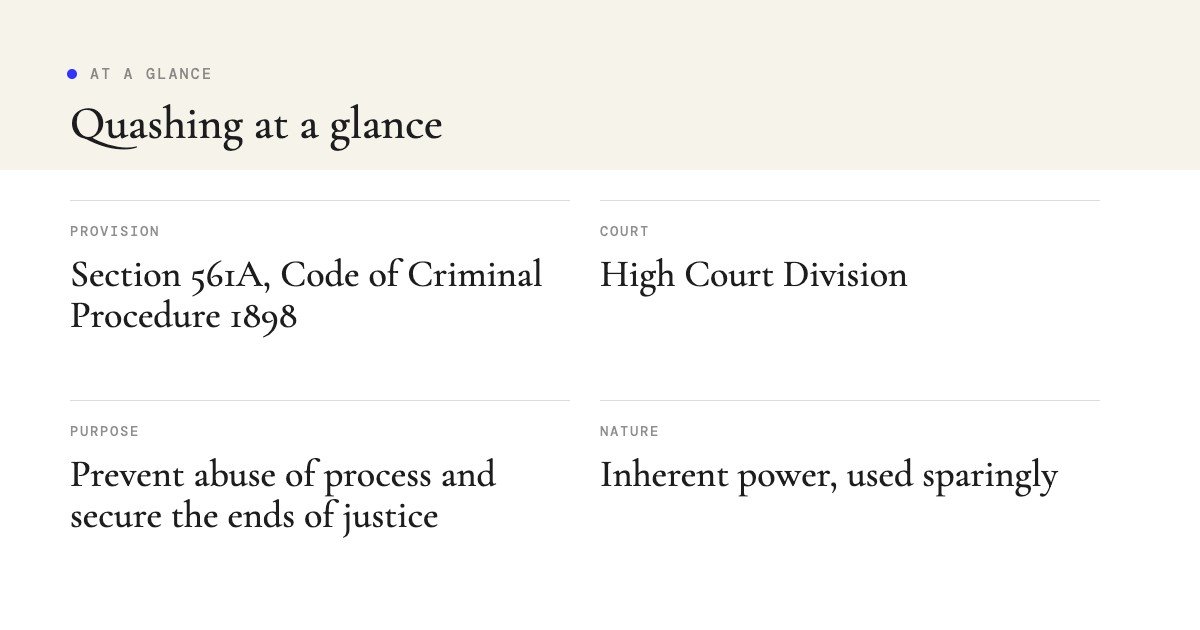
- Section 561A preserves the High Court Division’s inherent power to make orders necessary to prevent abuse of process or secure the ends of justice.
- The superior courts have recognised broad categories where quashing is appropriate, such as when the allegations disclose no offence or there is a legal bar.
- Purely civil or commercial disputes dressed up as criminal cases are a frequent ground for quashing.
- The court does not weigh disputed evidence at this stage; it takes the allegations as they stand.
- Discharge before the trial court and criminal revision are alternative or prior remedies to consider.
What quashing proceedings in Bangladesh means
Quashing means the High Court Division sets aside a criminal proceeding, so that the case ends without trial. Section 561A of the Code of Criminal Procedure states that nothing in the Code limits or affects the inherent power of the High Court Division to make such orders as may be necessary to give effect to any order under the Code, to prevent abuse of the process of any court, or otherwise to secure the ends of justice. The Code is available on Laws of Bangladesh.
The power is extraordinary and used sparingly. The Appellate Division has repeatedly cautioned that it should not be used to stifle legitimate prosecutions, but equally that a person should not be forced through the ordeal of trial where the case is plainly unsustainable.
Our criminal litigation team, described on our about page and our Supreme Court practice page, regularly moves 561A applications in the High Court Division.
Recognised grounds for quashing proceedings in Bangladesh
| Ground | Illustration |
|---|---|
| No offence disclosed | Even taking the FIR or complaint as true, its facts do not make out any offence |
| Legal bar | Prosecution barred by statute, lack of required sanction, or prior acquittal on the same facts |
| Abuse of process | Case filed to harass or to pressure in a civil or family dispute |
| No evidence | After investigation, the materials clearly fail to support the charge |
| Civil dispute | Breach of contract or money dispute without dishonest intention at the outset |
These categories are illustrative rather than exhaustive. The question in each case is whether allowing the proceeding to continue would be an abuse of process or would defeat the ends of justice.
Civil disputes and quashing proceedings in Bangladesh
A large proportion of 561A applications concern cases that arise from business, land or family disputes. A seller who failed to deliver goods because of market problems, a partner who disputes accounts, or a borrower who defaulted on a loan may face cheating or breach of trust cases. The High Court Division examines whether the complaint shows dishonest intention from the outset or only a broken promise. Where the dispute is essentially civil and the criminal case is being used as a recovery tool, the court is likely to quash.
The existence of a pending civil suit on the same facts does not automatically mean the criminal case must be quashed, but it is an important indicator, particularly where the complainant filed the criminal case only after civil negotiations failed.
Seeking quashing proceedings in Bangladesh step by step
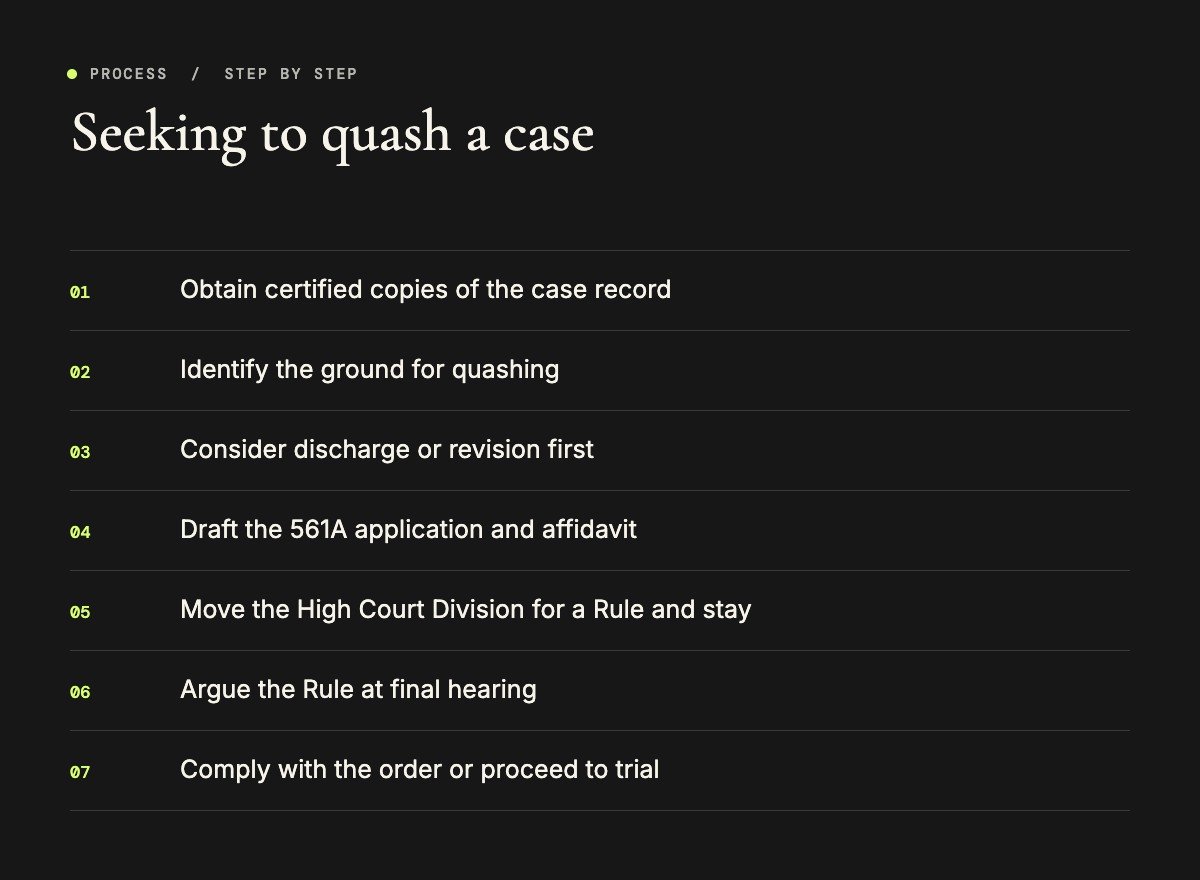
- Record. Obtain certified copies of the FIR or complaint, charge sheet, cognisance order and charge.
- Ground. Identify which recognised ground applies and gather supporting documents.
- Alternatives. Consider whether discharge before the trial court or revision should come first.
- Application. Draft the 561A application with an affidavit and annexures.
- Rule and stay. Move the bench for a Rule and an interim stay of proceedings.
- Hearing. Argue the Rule after the state and complainant have had an opportunity to respond.
- Outcome. If the Rule is made absolute, the case ends; if discharged, proceed to trial.
Base the application on the prosecution’s own documents. Courts are reluctant to examine the accused’s version of disputed facts in a 561A application, but they will act where the FIR, complaint or charge sheet itself fails to show an offence.
Timing of quashing proceedings in Bangladesh
A 561A application can be made at various stages: after the FIR, after cognisance, after the charge sheet, after framing of charge, or even during trial. Courts are generally more willing to intervene after cognisance and charge, when the materials relied on by the prosecution are known. Applications made very early, while investigation is ongoing, may be refused as premature, unless the FIR itself shows no offence.
Discharge and revision as alternatives
Before framing charge, the trial court can discharge the accused if it finds the charge groundless, under sections 241A and 265C of the Code for Magistrate and Sessions trials respectively. The High Court Division often expects the accused to seek discharge first. Where the trial court refuses discharge or frames charge, the accused may challenge that order in revision. The availability of these remedies does not exclude 561A, but courts consider whether the alternative route is adequate.
Stays pending quashing proceedings in Bangladesh
When the High Court Division issues a Rule on a 561A application, it often stays further proceedings in the trial court for a period, sometimes subject to conditions. The stay protects the accused from trial while the application is heard. The complainant or state can apply to vacate the stay, and stays are sometimes limited in time to avoid long delays in serious cases.
Quashing proceedings in Bangladesh after compromise
Where the parties have settled, particularly in offences that are compoundable or that arise from private disputes, the High Court Division may quash proceedings to give effect to the compromise. In serious non-compoundable offences affecting society, courts are more cautious, because the state’s interest in prosecution does not disappear simply because the victim has settled.
Special laws, sanction and quashing proceedings in Bangladesh
Some prosecutions require prior sanction or a complaint by a specified authority. For example, certain offences relating to public servants require government sanction, and some statutory offences can only be prosecuted on complaint by the relevant regulator. Where the required sanction or complaint is missing, the proceeding is legally barred and may be quashed. Cases under special laws, such as anti-corruption, narcotics or women and children repression statutes, are examined carefully against the specific procedural requirements in those laws.
Drafting a strong application
A strong 561A application tells a short, clear story: what the dispute really is, what the prosecution alleges, why those allegations do not make out an offence or are an abuse, and what documents prove it. It annexes the FIR, complaint, charge sheet, relevant orders and key documents such as contracts or civil suit papers. Overloading the application with disputed facts or long arguments on evidence tends to weaken it.
Appeal to the Appellate Division
A party aggrieved by the High Court Division’s decision can seek leave to appeal to the Appellate Division. Leave is granted only where substantial questions of law or serious errors are shown.
Cheque dishonour cases
Cases under section 138 of the Negotiable Instruments Act 1881 are a frequent subject of 561A applications. Common arguments include that the statutory notice was not served properly, that the complaint was filed outside the time allowed, that the cheque was not issued for a legally enforceable debt, or that the complainant lacked standing. Because the section 138 procedure is strictly statutory, defects in notice or timing can be fatal and may justify quashing. Our guide to cheque dishonour explains the requirements.
Family and dowry cases
Criminal cases arising from matrimonial disputes, including dowry allegations, are sometimes filed against the husband’s entire family, including relatives who live elsewhere. The High Court Division has quashed proceedings against relatives where the complaint makes only general, omnibus allegations without specific acts. At the same time, courts are careful not to dismiss genuine complaints of violence, so each case turns on the specificity of the allegations.
Defamation and speech cases
Criminal defamation complaints and speech-related cases under cyber laws have also been challenged under 561A, particularly where the statements were fair comment, made in good faith, or fall within the exceptions to section 499 of the Penal Code. Recent legal reforms have narrowed some speech offences, and courts consider whether the prosecution complies with the law in force. See our guide to defamation remedies.
What happens after quashing proceedings in Bangladesh
When the Rule is made absolute, the criminal proceeding ends and the accused is released from bail bonds. The complainant’s civil remedies, if any, remain available. If the High Court Division discharges the Rule, the stay ends and the trial resumes, though the accused can still raise their defences at trial.
Costs and timelines
A 561A application involves drafting, filing, a motion hearing and, after the Rule is issued, a final hearing that may take months or longer depending on the bench’s list. Interim stays usually protect the accused in the meantime. Costs depend on complexity, but they are often far lower than the cost of a full trial, especially where the case would otherwise involve many witnesses and years of hearings.
Applicants should keep their bail in place and attend the trial court as required until a stay is granted, because failure to appear can lead to warrants that complicate the application.
Role of the complainant and the state
The Attorney General’s office represents the state in 561A applications, and the complainant is usually made a party and served. Both may file affidavits in opposition explaining why the case should continue. A complainant who can show specific acts, documents and dishonest intention is in a strong position to resist quashing, while a vague complaint is vulnerable.
Frequently asked questions about quashing proceedings in bangladesh
Which court can quash a criminal case?
The High Court Division under section 561A of the Code of Criminal Procedure.
What are the main grounds?
No offence disclosed, legal bar, abuse of process, absence of evidence and purely civil disputes.
Will the court examine my evidence?
Generally no; it focuses on the prosecution’s own materials.
Can I get a stay?
Yes, the court often stays proceedings when issuing a Rule.
Should I seek discharge first?
Often yes; the High Court Division may expect it.
Can a settled case be quashed?
Often, for private disputes, but courts are cautious in serious offences.
How we can help
We assess cases for quashing proceedings in Bangladesh, draft and argue 561A applications, seek stays, and handle discharge applications, revisions and appeals. Learn more about our practice and our guides to the structure of the Supreme Court and writ cases.
Primary sources: the Code of Criminal Procedure 1898 and the Penal Code 1860 on Laws of Bangladesh; court information from the Supreme Court of Bangladesh.
This article is general information about Bangladeshi criminal procedure as of October 2026 and is not legal advice. Take advice on your circumstances.

0 Comments