
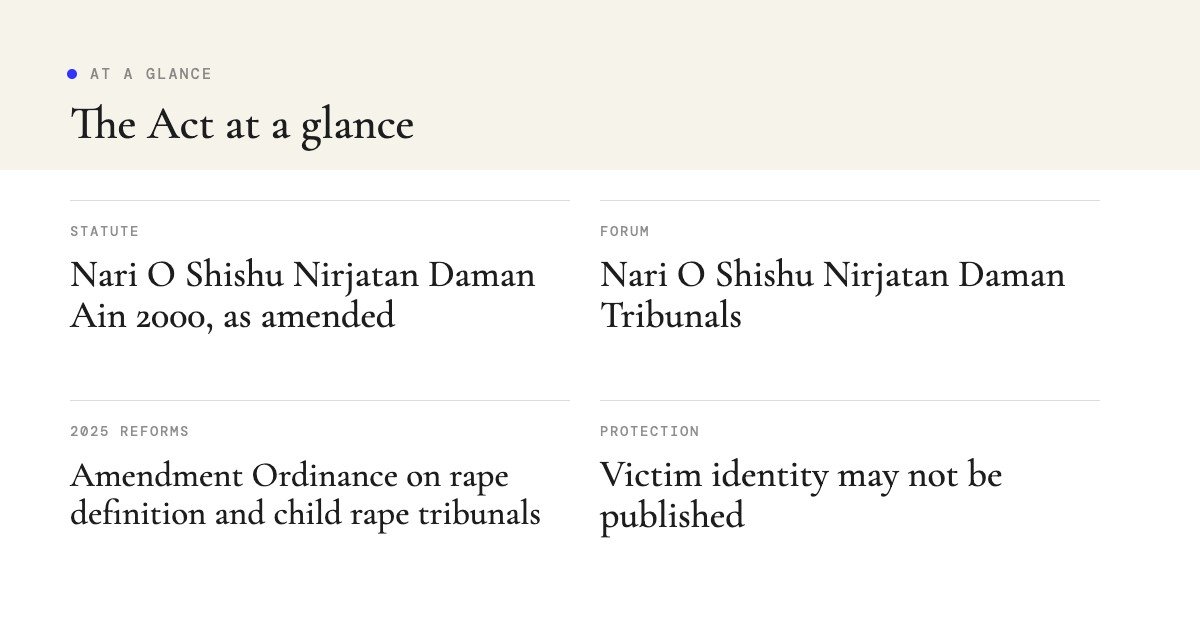
Serious violence against women and children in Bangladesh, including rape, acid violence, trafficking, abduction and dowry-related violence, is prosecuted under a special statute. A women and children repression act case is brought under the Nari O Shishu Nirjatan Daman Ain 2000 and tried by special tribunals with their own procedure, time limits and bail rules. The law has been amended several times, most recently by a 2025 Amendment Ordinance that changed the definition of rape and created separate child rape tribunals.
- The Nari O Shishu Nirjatan Daman Ain 2000 covers serious offences against women and children, including rape, sexual assault, trafficking, abduction, acid-related offences and dowry violence.
- Cases are tried by Nari O Shishu Nirjatan Daman Tribunals, with separate child rape tribunals introduced by the 2025 Amendment Ordinance.
- A case can start with an FIR at a police station or, where police do not act, a complaint directly to the tribunal.
- The Act sets time limits for investigation and trial and restricts bail in serious offences.
- Filing a false case under the Act is itself punishable.
What a women and children repression act case covers
The Act targets the gravest forms of violence. It covers rape and death caused by rape, gang rape, attempted rape, sexual assault and sexual harassment, causing death or grievous hurt for dowry, trafficking of women and children, abduction, keeping a woman or child in unlawful confinement for ransom, maiming children for begging, and certain offences involving corrosive substances. The Acid Crime Control Act 2002 separately deals with many acid offences. The Act and its amendments are available on Laws of Bangladesh.
Our criminal law team, described on our about page, represents victims and accused persons before the tribunals and the High Court Division.
Amendments affecting a women and children repression act case
| Amendment | Key change |
|---|---|
| 2003 amendments | Broad revision of offences and procedure |
| 2020 amendment | Death penalty introduced as a punishment for rape |
| 2025 Amendment Ordinance | Revised definition of rape, new offence for sexual intercourse on a deceptive promise of marriage, separate child rape tribunals, faster timelines reported |
Because the 2025 changes were made by ordinance during the interim period, check how they have been carried forward by Parliament after April 2026 before relying on them in a particular case. The law in force at the time of the offence generally governs the charge.
Filing a women and children repression act case step by step
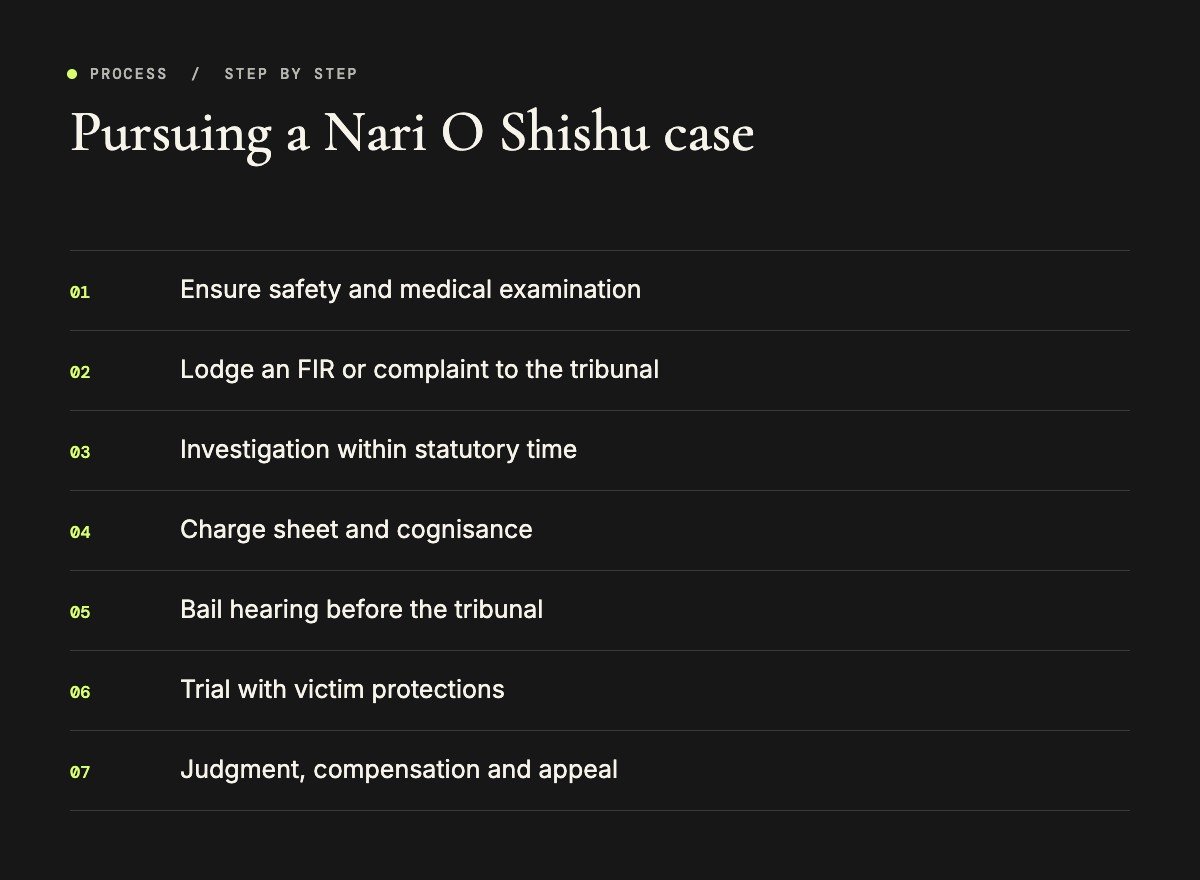
- Safety and medical care. Reach safety, call 999, and obtain a medical examination at a government hospital or One-Stop Crisis Centre.
- FIR or complaint. Lodge an FIR at the police station or, where police refuse, file a complaint directly before the tribunal.
- Investigation. Police investigate within the time fixed by the Act and may arrest the accused.
- Charge sheet. The tribunal takes cognisance on the police report or complaint.
- Bail. The tribunal decides bail applying the Act’s restrictions.
- Trial. The victim gives evidence with protections such as in-camera hearings.
- Judgment and appeal. The tribunal convicts or acquits; appeals lie to the High Court Division.
Medical evidence is time-sensitive. In sexual offence cases, examination should take place as early as possible and clothing should be preserved. Delay in examination is one of the most common weaknesses defence lawyers exploit at trial.
Tribunals hearing a women and children repression act case
Nari O Shishu Nirjatan Daman Tribunals are presided over by District and Sessions Judges or Additional District and Sessions Judges designated for the purpose. They try offences under the Act exclusively. The 2025 Amendment Ordinance provided for separate tribunals for child rape cases to speed up those trials. Tribunals have powers to hold hearings in camera, protect the identity of victims, and order compensation from the offender’s property.
Starting a women and children repression act case by direct complaint
Where the police refuse to record a case, the Act allows the victim or another person to file a complaint directly before the tribunal. The tribunal examines the complainant and may direct an inquiry or investigation, or take cognisance if satisfied. This route is an important safeguard where the accused is influential or where police are reluctant to act.
Investigation and trial time limits
The Act sets time limits for completing investigation and for concluding the trial, and the 2025 Amendment Ordinance was reported to shorten some of these, particularly for rape cases. In practice, delays still occur, but the time limits give victims and courts a basis for pressing investigators and for prioritising cases. Where investigation exceeds the limit, the tribunal can call for explanations or transfer investigation.
Bail in a women and children repression act case
The Act restricts bail for serious offences. The tribunal must give the prosecution an opportunity to be heard and must be satisfied of specific matters, such as that there are reasonable grounds to believe the accused may not be found guilty, before granting bail. Women, children and sick or infirm accused may receive special consideration. Bail decisions can be challenged before the High Court Division.
Protection of victims
The Act prohibits publication of the identity of victims of offences under it, with criminal penalties for breach. Hearings may be held in camera, and victims can be placed in safe custody where needed, though the law emphasises that safe custody should be consistent with the victim’s wishes. Victims are entitled to legal aid, and support is available through the national helpline 109 and One-Stop Crisis Centres.
A false women and children repression act case
Section 17 of the Act penalises filing a case under the Act with intent to cause harm, knowing there is no just or lawful ground. The tribunal can take cognisance of a false case complaint and punish the person responsible. This provision is meant to deter misuse, which courts have noted in matrimonial and land disputes, while protecting genuine victims.
Dowry-related violence
Causing death, attempting to cause death, or causing grievous or simple hurt for dowry are offences under the Act carrying severe punishments. Demanding dowry itself is an offence under the Dowry Prohibition Act 2018. Victims of dowry violence can also seek protection, residence and compensation orders under the Domestic Violence (Prevention and Protection) Act 2010, which provides civil remedies alongside the criminal case.
Compensation for victims
Many offences under the Act carry fines in addition to imprisonment, and the tribunal can direct that the fine be paid to the victim or their family as compensation. Where the fine cannot be recovered immediately, it can be realised from the offender’s present or future property. Victims should ask the prosecutor to seek compensation expressly.
Evidence and witnesses
Besides medical reports, important evidence includes the victim’s statement recorded before a Magistrate under section 164 of the Code, forensic and DNA reports, witness statements, CCTV and phone records. The Evidence Act was amended in 2022 to restrict questions about a rape victim’s character, strengthening protection during cross-examination.
Child victims
Where the victim is a child, additional safeguards apply under both the Act and the Children Act 2013. Statements should be recorded in a child-friendly setting, preferably with a parent, guardian or social worker present, and the child should not be confronted with the accused during evidence where this can be avoided. Child Affairs Police Desks and probation officers play a role in supporting the child. Separate child rape tribunals created by the 2025 reforms aim to reduce delays that can retraumatise child victims.
Sexual harassment
The Act penalises sexual harassment, including unwanted physical contact and indecent gestures with intent to outrage modesty. In workplaces and educational institutions, the High Court Division’s guidelines on sexual harassment require complaint committees, giving victims an internal route in addition to criminal proceedings. Victims can pursue both, and an internal finding does not prevent prosecution.
Trafficking and abduction
Trafficking of women and children is covered by both this Act and the Prevention and Suppression of Human Trafficking Act 2012, which has its own tribunals. The choice of statute depends on the facts, and prosecutors must avoid charging the same conduct under two laws inconsistently. Abduction for marriage, unlawful sexual purposes or ransom remains a core offence under the Act.
Defending a women and children repression act case
Accused persons are entitled to a fair trial and to challenge the evidence. Defences often concern identity, consent where the victim is an adult, the timing and reliability of medical evidence, inconsistencies between the FIR and later statements, and motive for false accusation in family or land disputes. Where the case is plainly unsustainable on the prosecution’s own materials, an application to quash under section 561A of the Code may be appropriate.
Settlement in a women and children repression act case
Most offences under the Act are serious and not compoundable, so a private settlement does not end the case. Courts have expressed concern about pressure on victims to compromise, particularly in rape cases. Victims who face threats to withdraw should inform the tribunal and the police.
Appeals
A person convicted by the tribunal can appeal to the High Court Division within the time allowed. Death sentences require confirmation by the High Court Division through a death reference, and further appeal lies to the Appellate Division. The state and the victim may also challenge acquittals in appropriate cases.
Practical support
Victims should keep copies of the FIR, medical reports and every court order, note hearing dates, and stay in contact with the public prosecutor. A private lawyer can assist the prosecutor and protect the victim’s interests throughout.
Role of the public prosecutor
Special public prosecutors conduct cases before the tribunals. Victims can meet the prosecutor before hearings, share evidence and identify witnesses, and a privately engaged lawyer may assist the prosecution with the tribunal’s permission, which helps keep the case organised and on schedule.
Frequently asked questions about women and children repression act case
Which court tries these cases?
The Nari O Shishu Nirjatan Daman Tribunals, with separate child rape tribunals after the 2025 reforms.
Can I go directly to the tribunal?
Yes, where police refuse to record the case, a complaint can be filed before the tribunal.
Is bail easily granted?
No, the Act restricts bail in serious offences.
Will the victim’s identity be published?
No, publication is prohibited and punishable.
What if the case is false?
Filing a false case is punishable under section 17.
Where do appeals go?
To the High Court Division.
How we can help
We act in every stage of a women and children repression act case, helping victims lodge cases and secure protection, and representing accused persons on bail, trial, 561A applications and appeals. Learn more about our practice, our Supreme Court practice and our guide to the Muslim Family Laws Ordinance.
Need urgent help?
Confidential support for victims and the accused.
Book a consultationAbout usPrimary sources: the Nari O Shishu Nirjatan Daman Ain 2000 and its amendments, the Acid Crime Control Act 2002 and the Code of Criminal Procedure 1898 on Laws of Bangladesh; free legal aid via NLASO.
This article is general information about Bangladeshi criminal law as of October 2026 and is not legal advice. In an emergency, call 999 or 109.


0 Comments