
For foreign investors, repatriation of profit in Bangladesh is often the deciding factor in whether an investment works. The law guarantees the right to remit dividends and capital, and authorised dealer banks can process most dividend remittances without prior Bangladesh Bank approval, provided the paperwork is complete. Problems usually arise from missing investment records, unpaid taxes or informal structures, not from the law itself.

- The Foreign Private Investment (Promotion and Protection) Act 1980 protects foreign investors' right to repatriate capital and profits, subject to foreign exchange law.
- Bangladesh Bank's Guidelines for Foreign Exchange Transactions allow authorised dealer banks to remit dividends to non-resident shareholders on submission of prescribed documents.
- Dividends must come from audited, taxed profits, and withholding tax must be deducted unless a treaty reduces it.
- Capital repatriation on sale or liquidation requires evidence that the investment entered through banking channels and, in some cases, Bangladesh Bank approval of the valuation.
- Royalties, technical fees and service payments follow separate rules and limits.
The legal framework
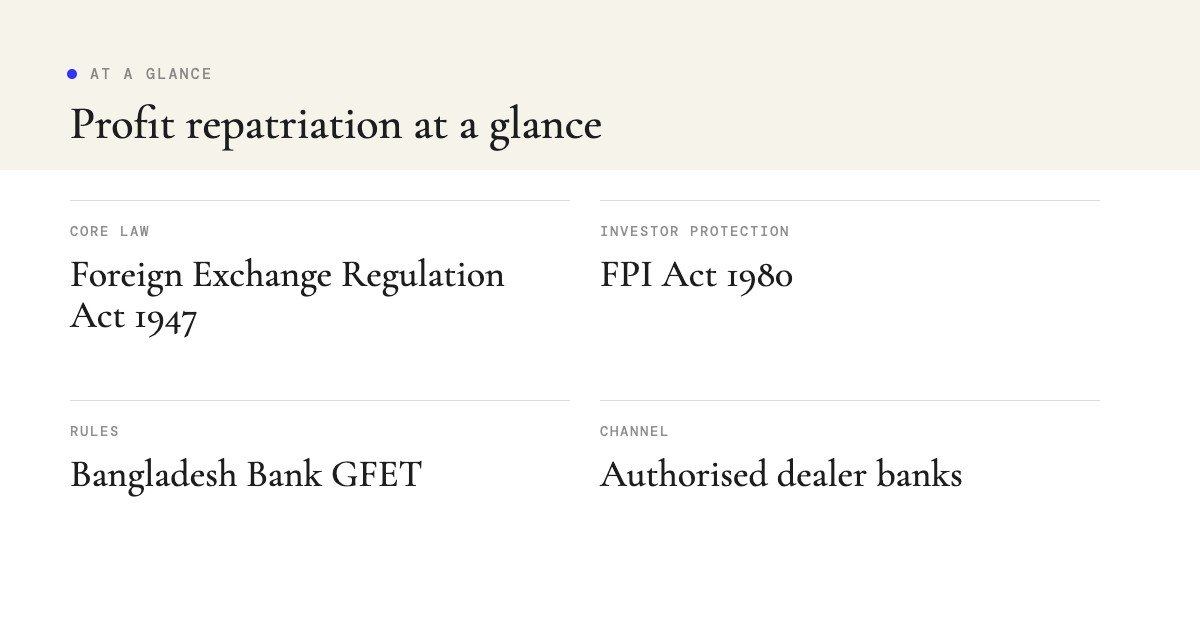
Repatriation of profit in Bangladesh rests on two pillars. The Foreign Private Investment (Promotion and Protection) Act 1980 guarantees fair treatment and the right to transfer capital and returns. The Foreign Exchange Regulation Act 1947 and Bangladesh Bank's Guidelines for Foreign Exchange Transactions (GFET), with later circulars, set the procedures that banks follow. Investment registration and facilitation is handled by Invest Bangladesh (formerly BIDA), BEPZA for EPZ enterprises and the economic zones authority, as applicable.
Our foreign direct investment practice helps investors structure entry and exit so that remittances run smoothly.
What can be remitted
| Payment | Usual route | Key documents |
|---|---|---|
| Dividends | AD bank under GFET | Audited accounts, board and AGM resolutions, tax certificates, auditor's certificate |
| Sale proceeds of shares | AD bank, with Bangladesh Bank approval in some cases | Share transfer documents, valuation, proof of original inflow, tax clearance |
| Liquidation proceeds | AD bank after liquidation | Liquidator's accounts, tax clearance, court or RJSC documents |
| Loan principal and interest | AD bank per approved terms | Loan approval or registration, repayment schedule |
| Royalty and technical fees | AD bank within limits, approval above limits | Agreement, invoices, tax deduction certificates |
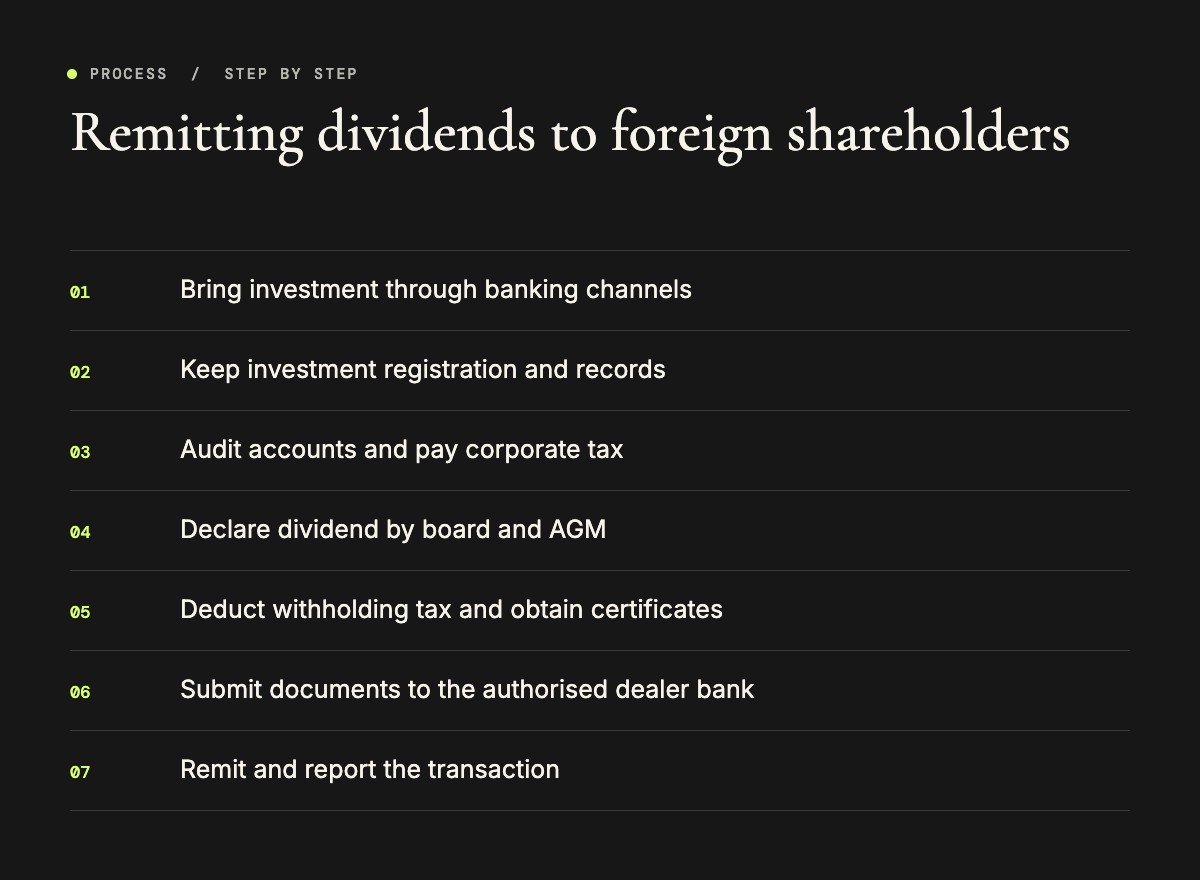
Dividend remittance step by step
- Proper inflow. Ensure the original investment came through banking channels and was reported, so the shareholder is recognised as a foreign investor.
- Audited accounts. Have the financial statements audited by a registered auditor.
- Tax payment. Pay corporate income tax and keep evidence.
- Declaration. The board recommends and the AGM approves the dividend under the Companies Act 1994.
- Withholding tax. Deduct tax at the applicable rate, considering any double tax treaty, and deposit it.
- Bank submission. Submit the application with documents to the company's AD bank.
- Remittance and reporting. The bank remits the net dividend and reports to Bangladesh Bank.
When these steps are followed, repatriation of profit in Bangladesh is usually routine. Interim dividends can also be remitted with appropriate documentation.
Keep a permanent file of every investment inflow: bank encashment certificates, share allotment records and registration letters. Missing inflow evidence is the most common reason banks hesitate to remit dividends or exit proceeds.
Withholding tax and treaties
Tax affects the net amount of every repatriation of profit in Bangladesh. Dividends paid to non-resident shareholders are subject to withholding tax under the Income Tax Act 2023. Bangladesh has double taxation agreements with many countries, which can reduce the rate if the shareholder provides a tax residence certificate and meets treaty conditions. The company should obtain treaty documentation before payment and issue tax deduction certificates so that the shareholder can claim credit at home. Tax planning is therefore part of repatriation of profit in Bangladesh.
Capital repatriation on exit
Exit is the last stage of repatriation of profit in Bangladesh. When a foreign investor sells shares to a resident or another non-resident, or the company is liquidated, the investor will want to remit the proceeds. For shares of unlisted companies, the GFET requires transfers to be at a fair value supported by valuation, and Bangladesh Bank approval may be required for remittance of sale proceeds, depending on the transaction. Listed shares bought and sold through the stock exchange using a non-resident investor taka account can generally be repatriated through the bank. Capital gains tax and documentary evidence of the original investment are central.
In March 2026, Bangladesh Bank issued a master circular (FEID Circular No. 01, dated 8 March 2026) consolidating the rules on share transfers and repatriation of sale proceeds by non-residents in unlisted companies. It gives authorised dealer banks more autonomy, raises transaction thresholds and simplifies valuation and reporting, so many exits that once needed central bank approval can now be handled by the bank. Check the circular for the thresholds that apply to your transaction.
Royalties, fees and intra-group payments
Repatriation of profit in Bangladesh also happens through fees. Payments for technical know-how, royalties, management fees and IT services to foreign group companies are common ways of returning value. Bangladesh Bank rules allow banks to remit such payments within limits linked to sales or project cost, with supporting agreements and tax deduction. Payments above limits may need approval, historically through BIDA and now through Invest Bangladesh (formerly BIDA) or Bangladesh Bank. Transfer pricing rules under the Income Tax Act require arm's length pricing for related-party payments.
Foreign exchange pressure and delays
Market conditions also matter for repatriation of profit in Bangladesh. During the foreign currency shortage of 2022 to 2024, many companies faced delays in remittances as banks prioritised imports and managed dollar liquidity. Conditions have since improved, and Bangladesh Bank has taken steps to ease remittance of dividends and other payments, but timing can still depend on a bank's foreign currency position. Maintaining good relationships with AD banks and submitting complete documents early helps repatriation of profit in Bangladesh proceed on schedule.
Branch offices and project offices
Foreign companies operating through a branch office in Bangladesh, rather than a subsidiary, remit profits differently. A branch can remit its after-tax profits to the head office with Bangladesh Bank's permission or under the GFET procedures, supported by audited accounts and tax clearance. Liaison offices cannot earn income and therefore have no profits to remit. Project offices under specific contracts follow conditions set in their permission. Understanding these rules is important for repatriation of profit in Bangladesh by foreign contractors and service providers.
EPZ and economic zone enterprises
Enterprises in export processing zones under BEPZA and in economic zones enjoy special facilitation, including simplified foreign exchange procedures, foreign currency accounts and incentives. Repatriation of profit in Bangladesh from these zones is generally smoother, but documentation and tax rules still apply. Investors should follow the zone authority's guidance alongside Bangladesh Bank requirements.
Structuring for smooth repatriation
Good planning at the time of entry makes later remittances easier. Investors should bring equity as share capital through banking channels, document every inflow, register the investment with the appropriate authority, and choose the holding jurisdiction considering double tax treaties. Shareholder loans can be used, subject to Bangladesh Bank rules on foreign borrowing and interest rates, and repayments of principal are not taxed as dividends. Intra-group service and royalty agreements should be documented and priced at arm's length. Each of these choices affects repatriation of profit in Bangladesh for years to come.
Retained earnings and stock dividends
Some companies keep profits in Bangladesh for reinvestment, which may be encouraged by tax incentives or business needs. Stock dividends, where shareholders receive bonus shares rather than cash, increase the investor's capital and can later be repatriated on exit. Tax law has at times imposed additional tax on retained earnings or stock dividends to encourage cash distribution, so the current position should be checked before deciding. Dividend policy is a strategic part of repatriation of profit in Bangladesh.
Common reasons for delays
- Investment inflow not documented or not reported correctly.
- Shares issued to foreign investors without proper allotment filings.
- Tax assessments pending or withholding tax not deposited.
- Board and AGM resolutions not matching the dividend amount.
- Bank's foreign currency liquidity constraints.
- Royalty payments exceeding limits without approval.
Most of these problems can be fixed with careful preparation. Addressing them in advance makes repatriation of profit in Bangladesh predictable.
Disputes and remedies
If a bank refuses or delays a remittance without good reason, investors can escalate to the bank's senior management and to Bangladesh Bank's foreign exchange department, supported by legal advice. Bilateral investment treaties between Bangladesh and many countries also protect the free transfer of investment-related payments, and in serious cases investors may consider treaty remedies. In practice, a well-documented application and constructive engagement resolve most issues relating to repatriation of profit in Bangladesh.
Reinvestment and additional capital
Investors who reinvest dividends in the same or another Bangladeshi company should document the reinvestment as a fresh foreign investment, so that the reinvested amount is also recognised for future repatriation of profit in Bangladesh. Simply leaving funds in local accounts and later capitalising them without proper reporting can create confusion about how much capital the investor is entitled to repatriate.
Checklist for finance teams
- Maintain an investment register with every inflow and share allotment.
- Close audits and tax filings on time each year.
- Obtain treaty residence certificates before paying dividends.
- Prepare board and AGM resolutions carefully and consistently.
- Agree a remittance timetable with the AD bank in advance.
- Review royalty and service agreements against current limits.
A disciplined finance team turns repatriation of profit in Bangladesh into a routine annual process rather than a recurring problem.
Foreign loans and interest remittances
Many foreign-owned companies fund their Bangladeshi operations partly through shareholder or external loans. Foreign borrowing by private sector companies is regulated by Bangladesh Bank, which sets rules on eligibility, interest rate ceilings, tenor and reporting, and in some cases requires prior approval or registration. Once a loan is properly approved or registered, the AD bank can remit interest and principal according to the agreed schedule. Withholding tax applies to interest paid to non-residents, subject to treaty relief. Loans that were not approved or reported can be very difficult to repay legally, so the approval step should never be skipped. Properly structured debt is a useful complement to dividends in repatriation of profit in Bangladesh.
Frequently asked questions about repatriation of profit in bangladesh
Do I need Bangladesh Bank approval to remit dividends?
Generally no. Authorised dealer banks can remit dividends under the GFET on submission of the required documents.
What documents are needed?
Audited accounts, board and AGM resolutions, tax payment and withholding certificates, an auditor's certificate and proof of the investment inflow.
Is tax deducted on dividends?
Yes, withholding tax applies, subject to any reduction under a double taxation agreement.
Can I repatriate sale proceeds?
Yes, with evidence of the original investment, fair valuation, tax clearance and Bangladesh Bank approval where required.
Are royalties remittable?
Yes, within Bangladesh Bank limits and with supporting agreements; approval is needed above limits.
Why do remittances get delayed?
Usually due to incomplete documents, missing inflow evidence, tax issues or a bank's foreign currency position.
How we can help
We advise foreign investors and their Bangladeshi subsidiaries on repatriation of profit in Bangladesh: investment structuring and registration, dividend and fee remittances, Bangladesh Bank approvals, exit transactions, valuation, tax coordination and disputes with banks. Learn more about our foreign direct investment practice.
Facing delays remitting dividends or exit proceeds?
We check your records, fix documentation gaps and work with banks and regulators to move your funds.
Book a consultationFDI practicePrimary sources: the Foreign Private Investment (Promotion and Protection) Act 1980, Foreign Exchange Regulation Act 1947 and Income Tax Act 2023 on the Laws of Bangladesh portal; foreign exchange guidelines of Bangladesh Bank; investment registration through Invest Bangladesh.
This article is general information about Bangladeshi foreign exchange regulation as of October 2026 and is not legal or tax advice. Rules, limits and tax rates change; confirm the current position with your bank, tax adviser or a qualified lawyer.



0 Comments