
Falling orders, automation or restructuring can force employers to reduce their workforce. Retrenchment in Bangladesh is permitted on the ground of redundancy, but the Bangladesh Labour Act 2006 sets strict conditions on notice, selection and compensation. Employers who cut corners face labour court claims, reinstatement orders and reputational damage, while workers who know their rights can ensure they receive everything they are owed.
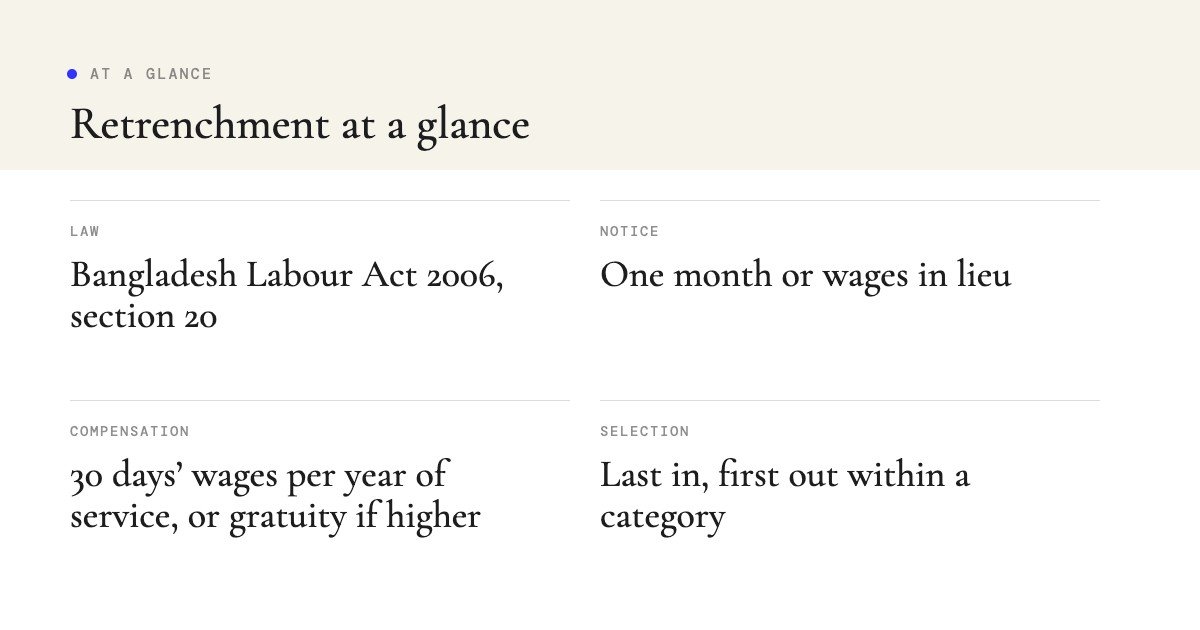
- Section 20 of the Bangladesh Labour Act 2006 allows retrenchment of workers on the ground of redundancy.
- A worker with at least one year of continuous service must receive one month’s written notice, or wages in lieu, stating the reasons.
- A copy of the notice must be sent to the Chief Inspector or designated officer and to the collective bargaining agent, if any.
- Compensation is 30 days’ wages for every completed year of service, or gratuity if higher.
- Employers must generally retrench the most recently employed worker in the affected category first, and give retrenched workers priority in re-employment.
What retrenchment in Bangladesh means
Retrenchment is termination of a worker’s employment because the job has become redundant, for example due to reduced business, closure of a section, reorganisation or introduction of new technology. It is different from dismissal for misconduct, termination simpliciter by notice under section 26, discharge for incapacity, or lay-off, which is a temporary inability to give work. Because retrenchment carries specific statutory compensation, correctly labelling the termination matters.
Our employment and labour practice advises employers and employees on workforce reductions.
Who is covered by retrenchment in Bangladesh rules
The Labour Act applies to "workers", generally employees doing skilled, unskilled, manual, technical, clerical or similar work, but not those employed mainly in managerial or administrative capacities. Managers and senior staff are governed mainly by their contracts and service rules, although employers often apply similar principles. Workers in export processing zones are governed by the Bangladesh EPZ Labour Act 2019, which has its own provisions. The Labour Act text is available on Laws of Bangladesh.
Statutory requirements for retrenchment in Bangladesh
| Requirement | Detail |
|---|---|
| Eligibility for statutory protections | Worker with at least one year of continuous service |
| Notice | One month’s written notice stating reasons, or wages for the notice period |
| Copies | To the Chief Inspector or designated officer and the collective bargaining agent |
| Compensation | 30 days’ wages per completed year of service, or gratuity if higher |
| Selection | Last employed in the category retrenched first, unless reasons are recorded |
| Re-employment | Retrenched workers have priority if the employer hires again |
The Labour Act has been amended several times, including the Labour (Amendment) Act 2026, so employers should confirm the current text before acting.
Retrenchment process
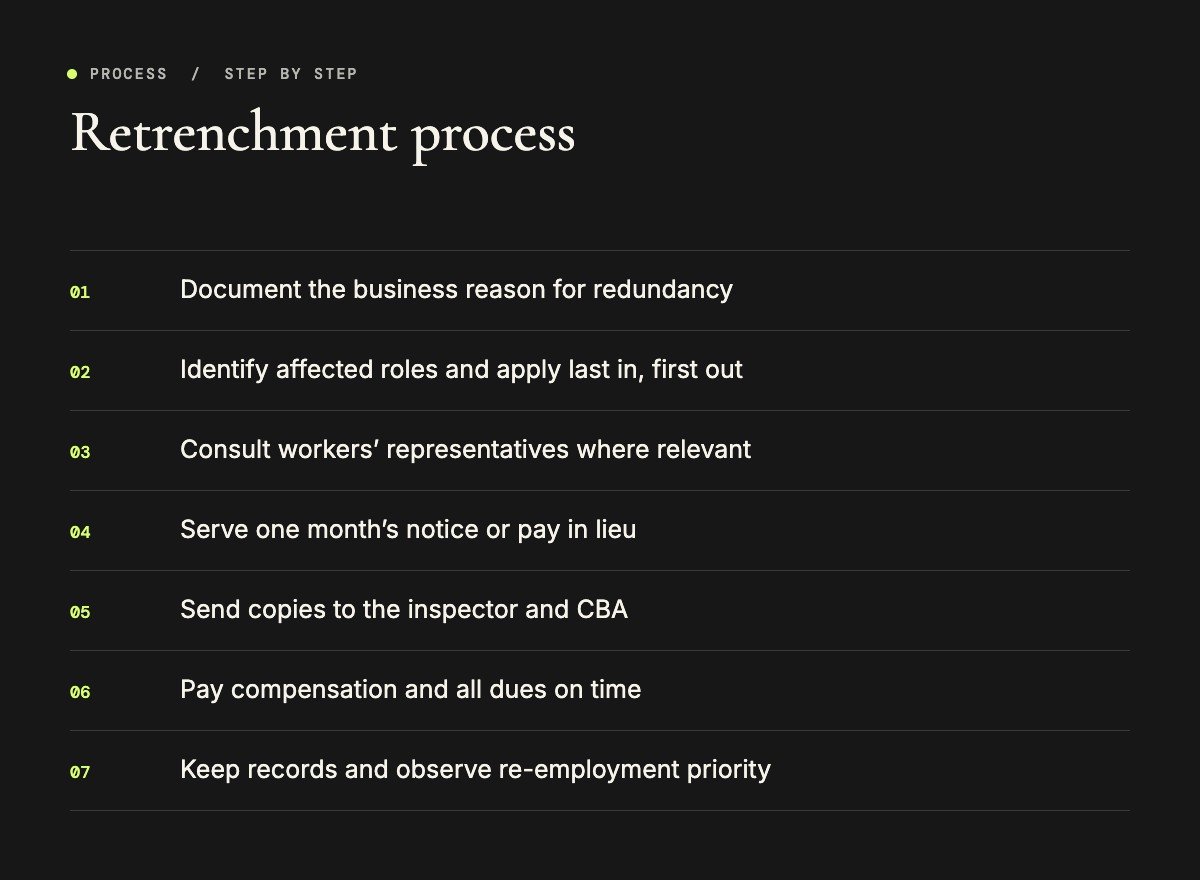
- Document the reason. Record the business need for reducing positions.
- Select fairly. Identify affected categories and apply last in, first out.
- Consult. Engage with the collective bargaining agent or participation committee where applicable.
- Serve notice. Give one month’s written notice with reasons, or pay wages in lieu.
- Notify authorities. Send copies to the inspector and CBA.
- Pay dues. Pay compensation, unpaid wages, leave encashment and other benefits on time.
- Maintain records. Keep documentation and honour re-employment priority.
Labour courts examine whether redundancy is genuine. Hiring new staff for the same roles shortly after retrenchment, or selecting union activists, invites findings of unfair termination.
Calculating compensation for retrenchment in Bangladesh
Compensation is based on wages, which under the Labour Act generally means basic wage plus dearness allowance and ad hoc or interim wages, if any, but not every allowance. For a worker with eight completed years of service, compensation would be 240 days’ basic wages, plus one month’s notice pay if notice is not given. If the company’s gratuity scheme or service rules provide a higher amount, the worker receives the higher figure. Employers should also pay outstanding wages, earned leave encashment, provident fund dues and workers participation fund entitlements. Accurate calculation is a common source of disputes in retrenchment in Bangladesh.
Retrenchment in Bangladesh versus other forms of termination
Employers sometimes use termination simpliciter under section 26, which allows termination of permanent workers by longer notice periods and payment of statutory compensation based on length of service. Dismissal for misconduct under section 23 requires a proper inquiry and offers limited compensation. Closure of an establishment and lay-off have their own rules. Choosing the right route, and documenting it, avoids claims that a retrenchment was in substance an unfair dismissal.
Collective retrenchment and closure
Large-scale reductions or closure of a factory raise additional issues, including negotiation with trade unions, possible industrial unrest, and scrutiny from buyers and authorities in export industries. Employers should plan communication carefully, consider alternatives such as voluntary separation schemes, redeployment or reduced hours, and coordinate with the Department of Inspection for Factories and Establishments. Paying dues promptly is essential to avoid protests and legal action.
Voluntary separation as an alternative to retrenchment in Bangladesh
Many employers offer voluntary retirement or separation packages that exceed statutory compensation, inviting workers to leave in exchange for enhanced payments. Such schemes can reduce conflict, but acceptance must be genuinely voluntary and documented, and payments should at least match statutory entitlements. Releases signed by workers should be clear and in Bengali.
Remedies for workers
A worker who believes a retrenchment was unlawful, or that dues were not paid, must usually first raise a written grievance with the employer within the period set by the Labour Act, and if not resolved, file a complaint in the Labour Court within the statutory time. The court may order reinstatement with back wages or compensation, and payment of unpaid dues. Workers should keep copies of their appointment letter, payslips, notice and any settlement documents. Legal aid is available for workers who cannot afford a lawyer.
Employer risks and penalties
Failure to follow section 20 can make the retrenchment unlawful, exposing the employer to reinstatement orders, back wages and compensation, as well as penalties for non-payment of dues. Labour inspectors can investigate complaints, and in export industries buyers’ codes of conduct and audits add commercial pressure. Well-documented, fair retrenchment in Bangladesh protects the employer’s reputation and relationships with remaining staff.
Practical checklist for employers
Confirm the business case in board or management minutes; map affected roles and seniority lists; check worker status and service length; prepare individual calculations; draft Bengali notices with reasons; send copies to the inspector and CBA; arrange payment by bank transfer on or before the last working day; obtain acknowledgements; update records and payroll; and track re-employment priority. Following this checklist makes retrenchment in Bangladesh defensible if challenged.
Communication and wellbeing
How a retrenchment is communicated affects morale, productivity and the risk of disputes. Meeting affected workers individually, explaining the reasons and entitlements clearly, offering support such as references or job placement assistance, and keeping remaining staff informed all help. Avoid surprises: workers learning of retrenchment through rumours or notices on gates often leads to unrest.
Temporary, probationary and casual workers
The statutory retrenchment provisions focus on workers with at least one year of continuous service. Temporary, casual, badli and probationary workers have different rights, and contracts for a fixed period or project may end on completion. However, labelling long-serving workers as temporary to avoid obligations is risky, because courts look at the reality of the relationship, including how long the worker has actually been employed. Employers should review the status of every affected worker before deciding who qualifies for retrenchment compensation.
Continuous service
Continuous service is defined in the Labour Act and includes service interrupted by authorised leave, lay-off, sickness, accident and certain strikes or lockouts. A worker who has actually worked the required number of days in the preceding twelve months may be treated as having completed a year. Breaks engineered to avoid continuity may be disregarded. Accurate attendance records help establish service length and entitlements.
Restructuring, mergers and retrenchment in Bangladesh
When businesses merge, are sold or restructure, workers’ rights depend on the transaction structure. In a share sale, the employer does not change and service continues. In an asset sale or transfer of an undertaking, workers may be transferred with continuity of service, or their employment may end with dues paid. Buyers should assess retrenchment costs during due diligence, as they can be significant in labour-intensive businesses.
Taxes on retrenchment payments
Payments received on retrenchment, such as compensation and gratuity, may enjoy specific tax treatment under the Income Tax Act 2023, with some amounts exempt up to limits and others taxable. Employers must deduct tax at source where required and issue certificates. Workers should report the payments correctly in their returns. Because Finance Acts can change these rules, both sides should check the current position before finalising settlements.
Women workers and special protections
Retrenchment must not be used to discriminate against women, for example by targeting pregnant workers or those on maternity leave, which the Labour Act protects. The Labour (Amendment) Act 2026 extended maternity leave and strengthened protections, and employers should ensure that selection criteria do not disproportionately affect women or workers with disabilities. Discriminatory retrenchment in Bangladesh can lead to findings of unfair termination and reputational damage with buyers and investors.
Settlement agreements
Employers often ask departing workers to sign a settlement confirming receipt of all dues. A settlement does not prevent a worker from claiming statutory entitlements that were not actually paid, and courts scrutinise documents signed under pressure or without understanding. Settlements should list each payment, be written in Bengali, and be signed voluntarily, ideally with the worker given time to review it. Payment should be made by bank transfer or mobile financial service to create a clear record.
Where workers are illiterate, the terms should be read aloud in the presence of a witness, and the employer should keep a record that this was done. Union or participation committee representatives can also be invited to witness collective settlements.
Such safeguards make settlements far more likely to withstand a later challenge.
Frequently asked questions about retrenchment in bangladesh
How much notice is required?
One month’s written notice or wages in lieu for workers with at least one year of service.
How is compensation calculated?
30 days’ wages for each completed year of service, or gratuity if higher.
Who must be retrenched first?
Generally the most recently employed worker in the affected category.
Must the government be informed?
Yes, a copy of the notice goes to the Chief Inspector or designated officer, and to the CBA if any.
Can managers be retrenched under the Act?
Managers outside the definition of worker are governed mainly by their contracts.
What if dues are not paid?
Workers can file a grievance and then a claim in the Labour Court.
How we can help
We plan and implement retrenchment in Bangladesh for employers, and represent workers and employers in resulting disputes. See our employment and labour practice, our guide on termination of employment and our restructuring team.
Planning a workforce reduction?
We help you do it lawfully and humanely.
Book a consultationEmployment and labourPrimary sources: the Bangladesh Labour Act 2006 and the Bangladesh Labour Rules 2015 on Laws of Bangladesh; inspection information from the Department of Inspection for Factories and Establishments; policy from the Ministry of Labour and Employment.
This article is general information about Bangladeshi labour law as of October 2026 and is not legal advice. The Labour Act was amended in 2026; confirm current provisions.




0 Comments