
Banks license core banking platforms, manufacturers license ERP systems, and local developers license apps to clients at home and abroad. A software licensing agreement in Bangladesh determines who owns the code, what the customer may do with it, what it costs, and what happens when things go wrong. With Bangladesh’s Copyright Act 2023 and new data protection rules, getting the agreement right matters more than ever.

- Software is protected in Bangladesh as a copyright work under the Copyright Act 2023, and copyright registration with the Copyright Office provides useful evidence.
- A licence grants permission to use software without transferring ownership; an assignment transfers ownership and should be in writing.
- Key terms include scope of use, fees, support, warranties, liability limits, data protection, source code access and termination.
- Payments to foreign licensors attract withholding tax and may involve VAT, and remittances must follow Bangladesh Bank rules.
- Arbitration clauses are common in cross-border licences and are enforceable in Bangladesh.
Copyright protection for software
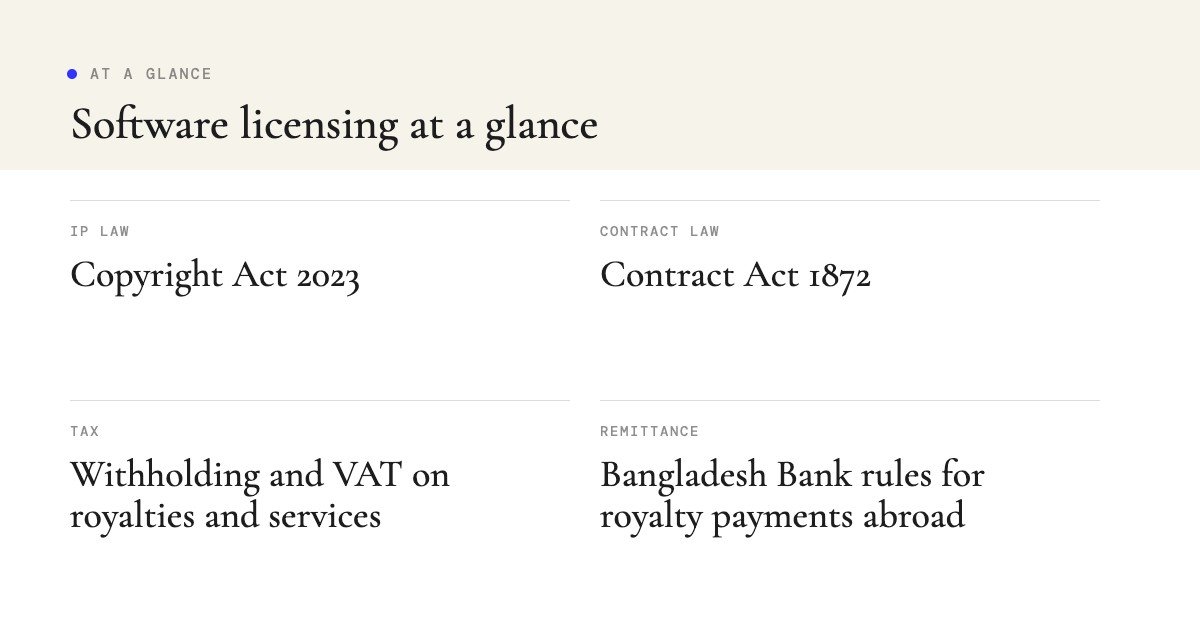
The Copyright Act 2023 replaced the Copyright Act 2000 and protects computer programs as literary works, along with databases and other digital content. Copyright arises automatically on creation, but registration with the Copyright Office creates a public record and helps in enforcement. The author is generally the first owner, but works created by employees in the course of employment usually belong to the employer unless agreed otherwise, and commissioned works depend on the contract. Clear IP clauses avoid disputes about ownership before any software licensing agreement in Bangladesh is signed.
Copyright registration information is available from the Copyright Office, and our intellectual property practice advises on software protection.
Types of software licensing agreement in Bangladesh
| Model | Key features |
|---|---|
| Perpetual on-premise licence | One-time fee, installed on customer systems, separate maintenance fees |
| Subscription or SaaS | Recurring fees, hosted by provider, access-based rights |
| Enterprise licence | Site-wide or group-wide use, negotiated terms and pricing |
| OEM and distribution licences | Rights to bundle or resell software to end users |
| Open source | Use under public licences with conditions such as attribution or source disclosure |
Essential clauses in a software licensing agreement in Bangladesh
- Grant of licence: scope, territory, users, devices, purpose and exclusivity.
- Restrictions: no copying, reverse engineering, sublicensing or modification except as permitted.
- Fees: licence, subscription, implementation and support fees, payment terms and price changes.
- Support and service levels: response times, uptime commitments and remedies.
- Updates and upgrades: what is included and on what terms.
- Warranties: conformity with specifications, non-infringement and virus-free delivery.
- Liability: caps, exclusions and indemnities for IP infringement and data breaches.
- Data protection and confidentiality obligations.
- Term, termination, transition assistance and data return.
Putting a licence in place
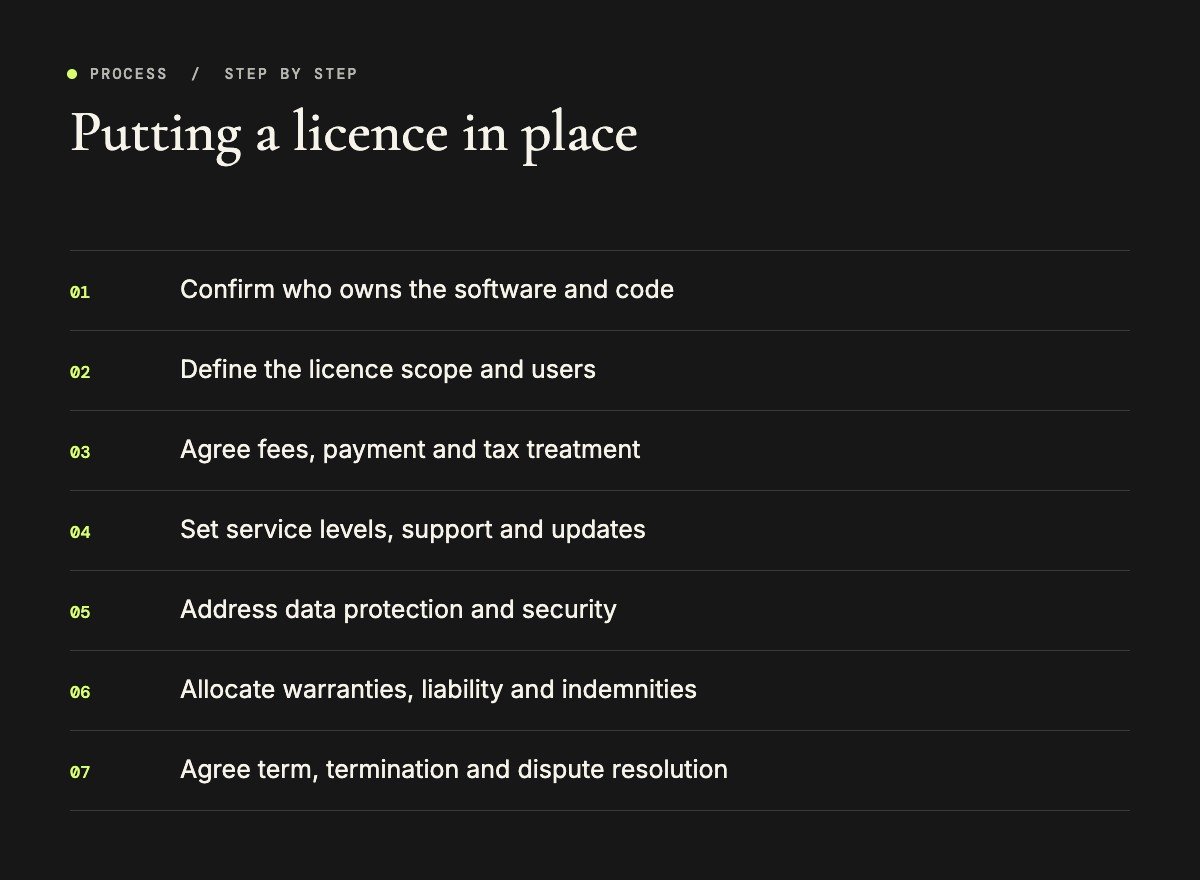
- Confirm ownership. Ensure the licensor owns or can license all code, including third-party and open source components.
- Define scope. Specify users, sites, modules and permitted uses.
- Agree fees and tax. Allocate VAT and withholding responsibility clearly.
- Service levels. Set support, maintenance and uptime obligations.
- Data and security. Address personal data, hosting location and security standards.
- Risk allocation. Negotiate warranties, caps and indemnities.
- Exit and disputes. Agree termination rights, transition support and dispute resolution.
For mission-critical systems, negotiate source code escrow so that the customer can maintain the software if the vendor fails or stops supporting it.
Tax treatment of a software licensing agreement in Bangladesh
Payments for software licences and related services can be characterised as royalties, fees for technical services or payments for goods, each with different tax consequences. Payments to foreign licensors are generally subject to withholding tax under the Income Tax Act 2023, which may be reduced under a double taxation treaty. VAT may apply to services imported from abroad through the reverse charge mechanism, while some software and IT services have enjoyed VAT exemptions. The agreement should state whether fees are inclusive or exclusive of taxes and who bears them, so a software licensing agreement in Bangladesh does not lead to disputes over gross-up.
Remittance of royalties
Bangladeshi licensees paying foreign licensors must follow Bangladesh Bank foreign exchange rules. Authorised dealer banks require documents such as the agreement, invoices and tax deduction certificates, and some royalty and technical fee arrangements above prescribed limits may need registration or approval with Invest Bangladesh. Building these requirements into payment terms avoids late payment disputes caused by banking delays.
Data protection in a software licensing agreement in Bangladesh
Software that processes personal data must comply with the Personal Data Protection Act 2026 and sector rules. SaaS agreements should specify where data is hosted, security measures, breach notification, sub-processors, access by the provider, and data return or deletion at the end. Banks and financial institutions face Bangladesh Bank rules on outsourcing and cloud use, which may require data to be held in Bangladesh or regulator approval for overseas hosting.
Open source and the software licensing agreement in Bangladesh
Most modern software includes open source components. Licensors should identify these components and ensure compliance with their licences, especially copyleft licences that may require disclosure of source code when software is distributed. Licensees should ask for an open source disclosure and warranty. Ignoring open source obligations can lead to infringement claims and forced disclosure of proprietary code.
Warranties and liability
Licensors typically warrant that the software will perform materially in accordance with its documentation for a limited period, that it does not infringe third-party rights, and that it is free of malicious code. Remedies are often limited to repair, replacement or refund. Liability caps, commonly linked to fees paid over a period, and exclusions of indirect and consequential loss are standard but must be reasonable and clearly drafted to be enforceable under the Contract Act 1872. Customers should seek uncapped or higher-capped indemnities for IP infringement and data breaches in any software licensing agreement in Bangladesh involving critical systems.
Implementation and customisation
Large deployments involve implementation projects with milestones, acceptance testing and change control. The agreement should define deliverables, acceptance criteria, timelines, delay remedies and who owns customisations. Customers often want ownership of bespoke developments, while licensors want to reuse generic improvements. A clear allocation of ownership and licence rights in customised code prevents later disputes.
Distribution and reseller licences
Bangladeshi companies acting as distributors or resellers for foreign software need agreements covering territory, exclusivity, targets, pricing, marketing, support obligations, use of trademarks and termination. Local laws on agency and distribution, competition rules and tax on margins and commissions apply. Distributors should negotiate reasonable notice and compensation for termination, since investment in building the market can be lost if the principal ends the relationship abruptly.
Enforcement against piracy
Unauthorised copying and use of software remains common. The Copyright Act 2023 provides civil remedies, including injunctions and damages, and criminal penalties for infringement. Licensors can include audit rights in their agreements to verify compliance and charge for excess use. Enforcement may involve the Copyright Office, police and courts. A well-drafted software licensing agreement in Bangladesh, with clear usage metrics and audit clauses, makes enforcement against licensees much easier.
Governing law and dispute resolution
Cross-border licences often choose foreign governing law and arbitration in Singapore or London, while domestic licences usually choose Bangladeshi law and courts or arbitration in Dhaka. Bangladeshi courts generally respect choice of law and arbitration clauses, and foreign arbitral awards are enforceable under the New York Convention. Licensors seeking urgent relief against misuse of software in Bangladesh may still need local court orders, so the clause should preserve the right to seek interim relief locally.
Term and termination of a software licensing agreement in Bangladesh
Subscription agreements typically renew automatically unless notice is given, while perpetual licences continue subject to compliance. Termination rights for breach, insolvency and change of control should be clear, along with the consequences: cessation of use, return or deletion of software and data, final payments and survival of confidentiality and liability provisions. Customers should negotiate transition assistance to move to a new provider without disruption.
Government and public procurement
Software licences for government bodies are often procured under the Public Procurement Act 2006 and Rules 2025, with standard tender documents and contract forms. Vendors must comply with eligibility, tax and documentation requirements, and negotiate within the limits of procurement rules. Data location and security requirements may be stricter for public sector systems.
Confidentiality and trade secrets
Source code, algorithms and product roadmaps are valuable trade secrets. Licences, development contracts and employment agreements should include strong confidentiality obligations, limits on access to source code, and obligations to return or destroy confidential material. Bangladesh does not have a standalone trade secrets statute, so protection relies largely on contract and general law, making well-drafted confidentiality clauses particularly important.
Technical measures such as access controls, code repositories with audit logs and licence keys complement contractual protection.
Practical negotiation tips
Licensees should prepare a clear list of business requirements before negotiating, compare total cost of ownership rather than headline fees, and insist on clear service levels with meaningful remedies. Licensors should standardise their terms, define usage metrics precisely, and protect their IP with audit and termination rights. Both sides benefit from plain-language schedules describing the software, services and fees, which reduce misunderstandings. Involving legal, IT, finance and procurement teams early produces a better software licensing agreement in Bangladesh and fewer disputes after signing.
Keep a signed copy, all amendments and key correspondence in a central repository so that renewal and compliance decisions are based on the actual terms.
Language and stamp duty
Commercial software agreements are usually drafted in English, which is accepted in Bangladesh, though Bengali translations may be needed for court proceedings. Agreements executed in Bangladesh may attract stamp duty under the Stamp Act 1899, and unstamped documents can face difficulties as evidence until duty and penalties are paid. Parties should check stamp requirements at signing.
Electronic signatures are recognised under the Information and Communication Technology Act 2006 for many purposes, which helps when parties sign remotely across borders.
Frequently asked questions about software licensing agreement in bangladesh
Is software protected by copyright in Bangladesh?
Yes, as a literary work under the Copyright Act 2023.
Who owns software written by employees?
Generally the employer, if created in the course of employment, unless otherwise agreed.
Is a licence the same as an assignment?
No, a licence grants rights to use; an assignment transfers ownership.
What taxes apply to licence fees paid abroad?
Withholding tax applies and VAT may be payable under reverse charge, subject to treaty and exemption rules.
Can royalties be remitted abroad?
Yes, subject to Bangladesh Bank rules and supporting documents.
Is open source free of obligations?
No, open source licences carry conditions that must be followed.
How we can help
We draft and negotiate every kind of software licensing agreement in Bangladesh, from SaaS subscriptions to enterprise and distribution deals, and handle IP registration and disputes. See our intellectual property practice, our technology and digital team and our data protection practice.
Licensing software in or out?
We protect your code, revenue and data.
Book a consultationIntellectual propertyPrimary sources: the Copyright Act 2023 and the Contract Act 1872 on Laws of Bangladesh; registration from the Copyright Office; foreign exchange rules from Bangladesh Bank.
This article is general information about Bangladeshi law as of October 2026 and is not legal advice. Tax and data protection rules change; take advice on your agreement.




0 Comments