
A share purchase agreement in Bangladesh decides what a buyer really gets when it acquires a company: which risks stay with the seller, how the price can move, and what must happen on the day the shares change hands. The warranties, indemnities and completion mechanics are where most value is won or lost.
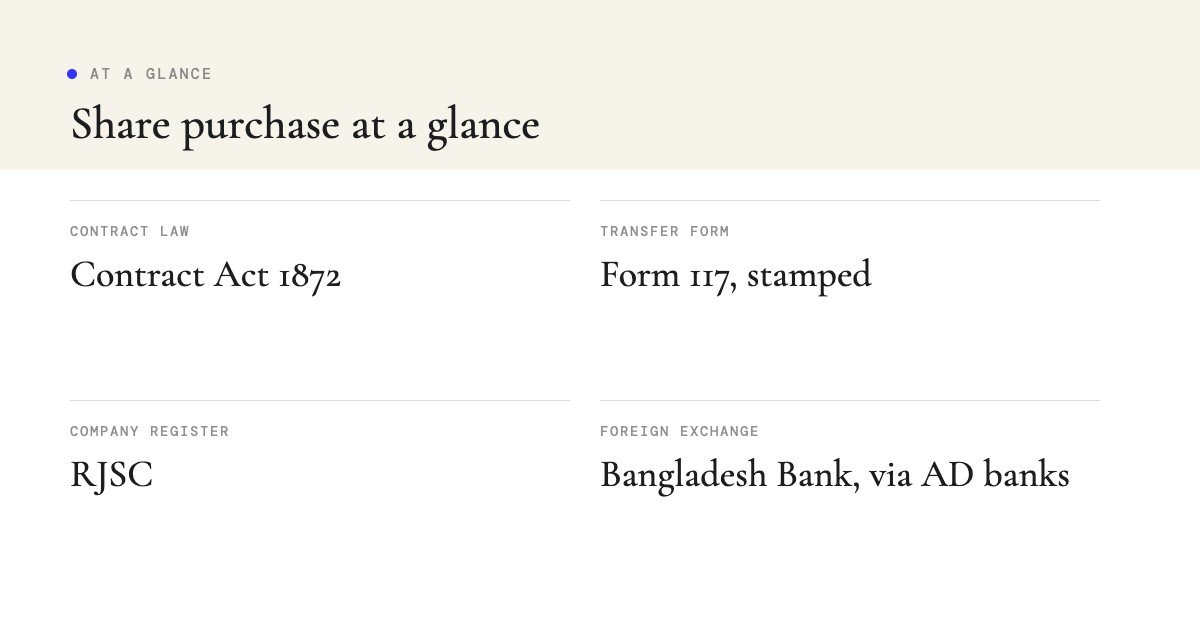
- The SPA is a contract governed by the Contract Act 1872; legal title to shares still passes only through a stamped instrument of transfer registered by the company.
- Warranties allocate unknown risks; specific indemnities deal with risks the buyer already knows about from due diligence. Both need clear limits.
- Section 124 of the Contract Act defines indemnity narrowly, so a Bangladeshi SPA should set out its indemnity mechanics expressly.
- Foreign buyers and sellers must route money through authorised dealer banks; Bangladesh Bank's FEID Circular No. 01 of 8 March 2026 updated the share-transfer and repatriation rules for unlisted companies.
- Completion should be a scripted exchange of documents and payment, followed promptly by board registration of the transfer and RJSC filings.
What a share purchase agreement in Bangladesh does
In a share deal, the buyer acquires the shares of the company that owns the business, rather than the business assets themselves. The company keeps its licences, contracts, employees, land and liabilities. Only its owners change. That continuity is the main attraction of a share acquisition, and also its main risk.
The share purchase agreement in Bangladesh is the contract that governs that sale. It is a private agreement under the Contract Act 1872 and is enforceable like any other commercial contract. It records the price, the conditions, the promises each side makes and the remedies if those promises prove false.
What the SPA does not do is transfer legal title by itself. Under the Companies Act 1994, shares in a Bangladeshi company move through a proper instrument of transfer, in practice the prescribed Form 117, which must be stamped and lodged with the company and registered by its board. The SPA obliges the parties to complete those steps; it does not replace them.
Share deal or asset deal?
Buyers sometimes ask whether an asset purchase would be safer. An asset deal lets the buyer pick assets and leave liabilities behind, but in Bangladesh it usually means re-applying for licences, re-registering land, novating contracts and transferring employees, with stamp duty and registration costs on each asset. For an operating business with valuable permits, a share deal is usually more practical, provided the SPA protects the buyer properly.
Due diligence and the term sheet come first
A good share purchase agreement in Bangladesh is built on good due diligence. The buyer's lawyers and accountants review the target so that the warranties and indemnities address real risks rather than generic ones.
- Corporate. RJSC file, memorandum and articles, Schedule X returns, share register, previous transfers and any pre-emption rights.
- Charges and debt. Mortgages and charges registered with RJSC, facility agreements and change-of-control clauses.
- Tax. Income tax assessments, VAT records under the VAT and Supplementary Duty Act 2012, withholding compliance and open audits.
- Property. Title chain, mutation, land development tax and lease terms for any land the company owns or occupies.
- Regulatory. Trade licence, sector licences, environmental clearance, Invest Bangladesh (formerly BIDA) registration and work permits.
- Employment and disputes. Contracts, provident and gratuity liabilities under the Bangladesh Labour Act 2006, and pending litigation.
The findings feed into a term sheet that fixes the price basis, key conditions, exclusivity and the headline protections. A clear term sheet shortens the drafting of the share purchase agreement in Bangladesh considerably.
The structure of a share purchase agreement in Bangladesh
Most SPAs used for Bangladeshi targets follow an international structure adapted to local law, and a well-drafted share purchase agreement in Bangladesh is no exception. The table below shows the core clauses and what each one decides.
| Clause | What it decides | Key local point |
|---|---|---|
| Sale and purchase | Which shares are sold, free of encumbrances | Match share numbers to the register and Schedule X |
| Price and adjustment | Headline price, locked box or completion accounts, earn-out | Foreign currency flows must go through AD banks |
| Conditions precedent | Approvals and consents needed before completion | Bangladesh Bank, sector regulators, articles waivers |
| Pre-completion conduct | What the seller may not do between signing and completion | Protects against leakage and asset stripping |
| Completion | Documents delivered and payment made on completion day | Stamped Form 117, board resolutions, RJSC filings |
| Warranties | Statements of fact about the company and the seller | Qualified by a disclosure letter |
| Indemnities | Pound-for-pound cover for specific known risks | Draft expressly; do not rely on section 124 alone |
| Limitations | Caps, thresholds and time limits on claims | Fit within the Limitation Act 1908 |
| Restrictive covenants | Non-compete and non-solicit by the seller | Section 27 Contract Act and its goodwill exception |
| Governing law and disputes | Courts or arbitration, seat and rules | Arbitration Act 2001 and New York Convention |
Price mechanics and payment
There are two common ways to fix the price. Under a locked box, the price is based on a balance sheet at a date before signing, and the seller promises that no value has leaked out of the company since then, except permitted leakage such as agreed salaries. Under completion accounts, the parties agree a base price and adjust it after completion for actual cash, debt and working capital on the completion date.
Locked box deals are faster and give price certainty, but they need reliable accounts and a strong leakage covenant. Completion accounts suit targets whose financial statements are less mature, which is common among Bangladeshi family companies. Either way, the share purchase agreement in Bangladesh should define accounting policies precisely and name an independent accountant to resolve disputes.
Deferred consideration, escrow and earn-outs
Buyers often hold back part of the price in escrow with a bank to secure warranty and indemnity claims, or pay an earn-out linked to future performance. Escrow arrangements with Bangladeshi banks are workable but need careful drafting of release instructions. Earn-outs need clear accounting rules and protection against the buyer running the business in a way that defeats the target.
Cross-border payments
Where the buyer is non-resident, the purchase price must come into Bangladesh through an authorised dealer bank, and the resulting shareholding is reported under foreign exchange rules. Where a non-resident sells, repatriation of the sale proceeds is handled by the AD bank. Bangladesh Bank's FEID Circular No. 01, issued on 8 March 2026, consolidated the 2018 and 2020 instructions for unlisted companies, gave AD banks more autonomy and raised the thresholds.
According to reports of that circular, proceeds of up to Tk 100 crore can be repatriated without prior Bangladesh Bank approval where an independent valuer fixes fair value by approved methods; transfers at or below net asset value can be processed regardless of amount; and very small transfers need no independent valuation. Read the circular itself on the Bangladesh Bank website before pricing a cross-border share purchase agreement in Bangladesh, because the valuation method directly affects the price you can agree.
Warranties in a share purchase agreement in Bangladesh
Warranties are statements of fact about the seller and the company, given at signing and usually repeated at completion. If a warranty is untrue and the buyer suffers loss, the buyer can claim damages for breach of contract under the Contract Act 1872.
Fundamental and business warranties
Fundamental warranties cover the seller's capacity and authority, its title to the shares, the absence of encumbrances, and the company's issued share capital. These go to the heart of the deal and are usually subject to a cap equal to the full price and a longer claim period.
Business warranties cover accounts, assets, material contracts, employees, litigation, licences, compliance and tax. They are negotiated more heavily and carry lower caps. In Bangladesh, buyers should pay special attention to warranties on land title, VAT compliance, environmental clearance and labour liabilities, because these are where hidden liabilities most often sit.
The disclosure letter
The seller qualifies its warranties by disclosing exceptions in a disclosure letter. A fair disclosure defeats a warranty claim about the disclosed matter. In a share purchase agreement in Bangladesh, buyers should insist that disclosures are specific, with enough detail to identify the nature and scope of the issue, and resist general disclosure of the entire data room.
Warranties versus representations
Under the Contract Act 1872, a misrepresentation or fraud that induces a contract can make it voidable at the option of the misled party. Sellers usually exclude rescission after completion and limit the buyer to damages under the warranty regime. A carve-out for fraud is standard and, in any event, a seller cannot contract out of liability for its own fraud.
Knowledge qualifiers such as "so far as the seller is aware" shift risk to the buyer. If they are accepted, define whose knowledge counts, typically named managers, and deem them to have made due enquiry. Otherwise the qualifier rewards the seller for not asking.
Indemnities and limitation of liability
An indemnity is a promise to reimburse a specific loss in full, regardless of whether the warranty regime would cover it. Buyers use indemnities for risks they found in due diligence and do not want to price, such as an open tax assessment, a pending labour case or a land title defect.
Why express drafting matters in Bangladesh
Section 124 of the Contract Act 1872 defines a contract of indemnity as a promise to save another from loss caused by the conduct of the promisor or of any other person. Courts may read that statutory concept narrowly. A share purchase agreement in Bangladesh should therefore define the indemnified losses, include costs and taxes, say when a claim arises, and set out the conduct of third-party claims, including who controls the defence and settlement.
Standard limitations
- De minimis. Individual claims below a small amount are ignored.
- Basket or threshold. Claims are payable only once their total exceeds an agreed figure, either from the first taka or only the excess.
- Cap. Total liability is capped, often at a percentage of the price for business warranties and at the full price for title.
- Time limits. Claims must be notified within an agreed period, commonly longer for tax claims. Contractual time limits operate within the general rules of the Limitation Act 1908.
- No double recovery. The buyer cannot recover the same loss twice under different clauses.
Warranty and indemnity insurance is common in international deals but less established for Bangladeshi targets. Where it is unavailable, escrow or a parent company guarantee from the seller is the practical substitute in a share purchase agreement in Bangladesh.
Conditions precedent and regulatory approvals
When signing and completion are separated, the share purchase agreement in Bangladesh lists conditions that must be satisfied before the parties are obliged to complete. Typical conditions for a Bangladeshi target include the following.
- Internal approvals. Board approval of the transfer and waivers of any pre-emption or first refusal rights in the articles or a shareholders agreement.
- Foreign exchange. Valuation and AD bank processing under the current Bangladesh Bank instructions, and Bangladesh Bank approval where the deal falls outside the delegated limits.
- Sector regulators. Consent where the target is a bank, finance company under the Finance Company Act 2023, insurer, telecom operator or other licensed business.
- Listed companies. Where shares are listed, the Bangladesh Securities and Exchange Commission's takeover rules and disclosure requirements apply, and the deal is no longer a simple private SPA.
- Third-party consents. Lenders, landlords and key customers whose contracts contain change-of-control clauses.
Competition law
The Competition Act 2012 prohibits combinations that substantially reduce competition, and the Bangladesh Competition Commission has power to review them. As of late 2025, the detailed combination regulations were still described as draft, so there is no settled mandatory pre-notification regime of the kind seen in other jurisdictions. Larger deals should still assess the competition position and monitor whether final regulations are issued.
Completion mechanics for a share purchase agreement in Bangladesh
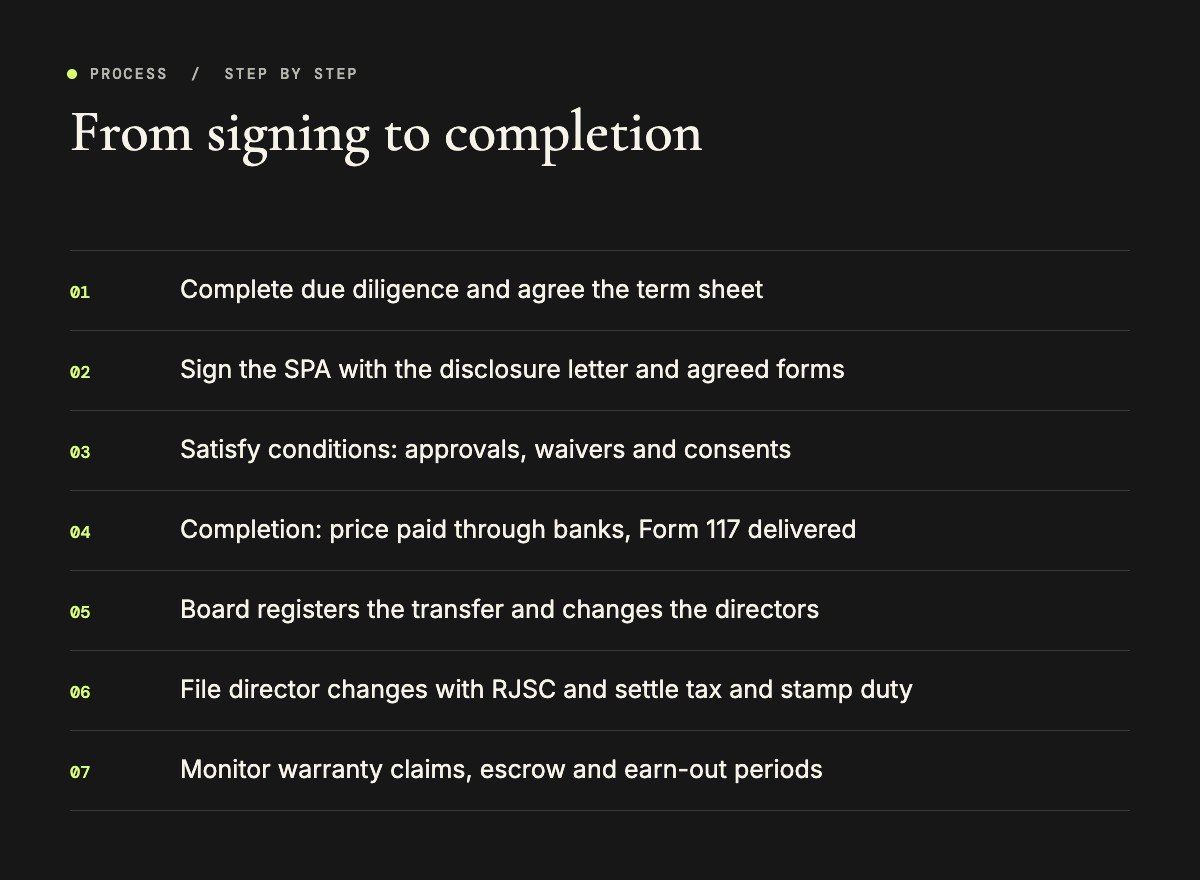
Completion should be boring. Every document should be agreed in advance, signed into escrow where useful, and released at a single meeting against payment. A completion checklist attached to the share purchase agreement in Bangladesh avoids last-minute surprises.
- Confirm the conditions. Each party confirms in writing that its conditions are satisfied or waived, and the seller confirms no leakage or breach since signing.
- Exchange transfer documents. The seller delivers duly executed and stamped Form 117 instruments of transfer and the original share certificates.
- Pay the price. The buyer pays through banking channels to the seller's account, with any escrow amount paid to the escrow agent.
- Hold the board meeting. The target's board approves registration of the transfer, enters the buyer in the register of members and issues new share certificates.
- Change the board. Outgoing directors resign with confirmations that they have no claims, and the buyer's nominees are appointed.
- Update bank mandates. Signatories on the company's bank accounts are changed the same day to prevent unauthorised payments.
- File and pay. Notify director changes to RJSC on Form XII, settle stamp duty and any tax due on the transfer, and make foreign exchange reporting through the AD bank.
Our guide to company share transfer in Bangladesh covers the transfer instrument and board registration in more detail, and our guide to the board resolution process explains how completion resolutions should be minuted.
Stamp duty, tax and post-completion filings
Stamp duty is payable on the instrument of transfer under the Stamp Act 1899, as amended by successive Finance Acts. An unstamped or under-stamped instrument cannot safely be relied on. The rate changes from time to time, so confirm the current schedule before completion and say in the share purchase agreement in Bangladesh which party bears it.
A seller's gain on the sale of shares is taxable under the Income Tax Act 2023, and for transfers of unlisted shares the tax is generally paid before the transfer is registered, with proof forming part of the transfer file. Rates differ by residence and holding period and were changed by recent Finance Acts, so the SPA should allocate responsibility and require evidence of payment rather than fix a figure.
After completion, the new shareholding appears in the company's next annual return to RJSC. Foreign buyers should also update their investment records with Invest Bangladesh (formerly BIDA) where relevant, particularly if they will apply for work permits for expatriate managers.
Restrictive covenants and seller protections
Buyers pay for goodwill, so they want the seller not to compete or poach staff after completion. Section 27 of the Contract Act 1872 makes agreements in restraint of trade void, but it contains an exception for a person who sells the goodwill of a business: the seller may agree not to carry on a similar business within specified local limits, so long as the buyer carries on a like business and the limits are reasonable.
Draft the non-compete by reference to the target's actual business, territory and a defined period. Overbroad covenants in a share purchase agreement in Bangladesh risk being struck down entirely. Sellers, in turn, should seek protections of their own: a cap on liability, a clear end date for claims, release from personal guarantees given for the company's debts, and an obligation on the buyer to replace those guarantees at completion.
Governing law and dispute resolution
Where both parties are Bangladeshi, Bangladeshi law and local courts or domestic arbitration are usual. Where the buyer is foreign, parties often choose arbitration seated in Singapore or London, or domestic arbitration under the Arbitration Act 2001. Bangladesh is a party to the New York Convention, so foreign awards can be enforced locally, though the process takes time.
Even where a share purchase agreement in Bangladesh is governed by foreign law, the transfer of shares, the company's register and regulatory approvals remain governed by Bangladeshi law. Our guide to the arbitration process in Bangladesh explains the local framework.
Frequently asked questions about a share purchase agreement in Bangladesh
Does signing the SPA transfer the shares?
No. The SPA creates contractual obligations. Legal title passes when a stamped instrument of transfer is lodged and the company's board registers the buyer in the register of members.
What is the difference between a warranty and an indemnity?
A warranty is a statement of fact; if it is false, the buyer must prove loss to recover damages. An indemnity is a promise to reimburse a specified loss in full, usually for a known risk found in due diligence.
Can a foreign buyer pay in US dollars?
The money must come into Bangladesh through an authorised dealer bank, and the shares are priced and reported under Bangladesh Bank rules. Valuation under the current FEID instructions matters, especially for later repatriation.
Is Competition Commission approval required?
The Competition Act 2012 covers anti-competitive combinations, but detailed combination regulations were still in draft as of late 2025. Larger deals should assess the position at the time of signing.
Can the seller be bound by a non-compete?
Yes, within limits. Section 27 of the Contract Act 1872 allows a seller of goodwill to agree not to carry on a similar business within reasonable specified local limits.
How long do warranty claims last?
As long as the SPA says, within the Limitation Act 1908. Typical periods are shorter for business warranties and longer for title and tax claims.
How we can help
We act for buyers, sellers and investors on Bangladeshi share acquisitions: due diligence, drafting and negotiating the SPA and disclosure letter, regulatory and foreign exchange approvals, and running completion through to RJSC filings. Learn more about our mergers and acquisitions practice.
Buying or selling a Bangladeshi company?
We draft and negotiate share purchase agreements that match Bangladeshi law, Bangladesh Bank rules and your commercial deal.
Book a consultationM&A practicePrimary sources: the Contract Act 1872, Companies Act 1994, Stamp Act 1899, Limitation Act 1908, Arbitration Act 2001 and Competition Act 2012 on the Laws of Bangladesh portal; FEID Circular No. 01 of 8 March 2026 from Bangladesh Bank; transfer filings with the RJSC.
This article is general information about Bangladeshi law as of 2026 and is not legal advice. Fees, forms and procedures change; confirm current requirements with the relevant authority or a qualified lawyer before acting.

0 Comments