
A Singapore holding company for Bangladesh can simplify regional ownership, financing and exits, but its tax value is narrower than many investors assume. The 1980 treaty caps Bangladeshi withholding, Singapore exempts most foreign dividends, and Bangladesh Bank rules decide how money moves. This guide explains where the structure helps and where it does not.
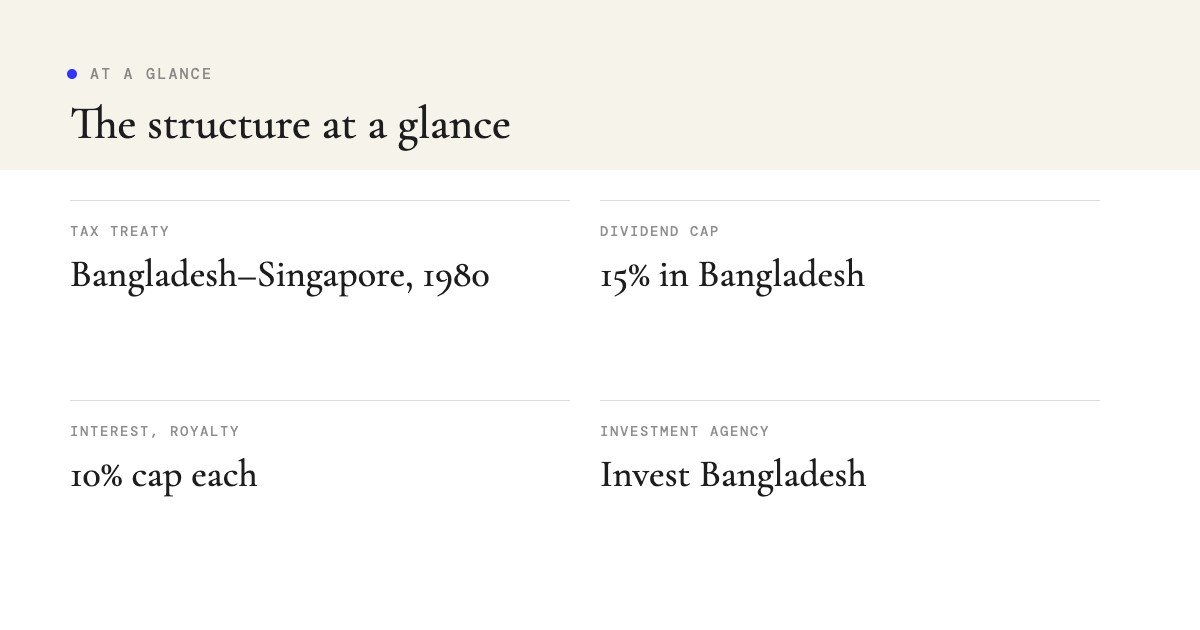
- The Bangladesh–Singapore tax treaty, signed on 19 December 1980, caps Bangladeshi tax at 15% on dividends and 10% on interest and royalties paid to a Singapore resident beneficial owner.
- The treaty has no reduced dividend rate for large shareholdings, so a Singapore parent may pay more Bangladeshi tax on dividends than a direct Japanese or Indian parent holding 25% or more.
- Singapore does not tax dividends it pays onwards and generally exempts foreign dividends that meet its subject-to-tax and 15% headline-rate tests.
- Bangladesh Bank does not require prior approval to issue shares to a non-resident or for most unlisted share transfers, but each step must be reported through an authorised dealer bank.
- Treaty benefits depend on real substance in Singapore: board control, a resident director and a certificate of residence from IRAS.
Why investors use a Singapore holding company for Bangladesh
Most foreign groups that set up a Singapore holding company for Bangladesh do so for practical rather than purely tax reasons. Singapore offers a stable common law system, English-language courts, efficient banking and a deep pool of regional advisers. A single Singapore company can hold subsidiaries in Bangladesh, India, Vietnam and Indonesia under one board.
That regional hub role is often the real benefit. Dividends from several countries can be pooled, intra-group financing can be run from one treasury, and a future sale can be made at the Singapore level instead of country by country. Private equity funds also like Singapore because co-investors are comfortable with its company and insolvency law.
What the structure does not do
A Singapore holding company for Bangladesh does not remove Bangladeshi corporate tax on the subsidiary's profits, does not avoid Bangladesh Bank's foreign exchange controls and does not change the sector rules that apply to foreign ownership. It changes how cash leaving Bangladesh is taxed, and how the group is governed and sold.
The Bangladesh–Singapore tax treaty in practice
The Agreement between Bangladesh and Singapore for the avoidance of double taxation was signed in Singapore on 19 December 1980, gazetted in Bangladesh in 1982 and applies to years of assessment from 1980. It is one of Bangladesh's oldest treaties and has not been replaced by a modern text, which shapes both its strengths and its gaps.
For a Singapore holding company for Bangladesh, the treaty leaves Bangladesh free to tax income arising in Bangladesh, but the rate is capped when the recipient is a Singapore resident and the beneficial owner of the income. The table below compares the main caps with the domestic position and with two other common investor treaties.
| Payment from Bangladesh | Singapore treaty cap | Japan treaty cap | India treaty cap |
|---|---|---|---|
| Dividends to a company holding 25% or more | 15% | 10% (holding for six months) | 10% |
| Other dividends | 15% | 15% | 15% |
| Interest | 10% | 10% | 10% |
| Royalties | 10% | 10% | 10% |
| Technical service fees | No separate article | No separate article | No separate article |
Treaty caps are taken from the treaty texts and the PwC worldwide tax summary for Bangladesh reviewed in July 2026. Domestic withholding on dividends paid to a non-resident company is 20% under the Income Tax Act 2023 according to that summary; confirm the current rate under the latest Finance Act before relying on it.
The dividend point most investors miss
Because the 1980 text has a single 15% dividend cap with no participation threshold, a Singapore holding company for Bangladesh does not obtain the 10% rate that Japanese or Indian parents can claim on substantial holdings. If dividends are the main return, a direct holding from Japan or India may cost less in Bangladesh. The Singapore advantage lies elsewhere: onward distribution, pooling and exits.
How Singapore taxes the income it receives
Singapore's corporate tax rate is 17%, but a well-run Singapore holding company for Bangladesh often pays little tax on its Bangladeshi income. Two Singapore rules do the work. First, Singapore operates a one-tier system and does not withhold tax on dividends a Singapore company pays to its shareholders, wherever they live. Second, foreign-sourced dividends received in Singapore are exempt under section 13(8) of the Singapore Income Tax Act if three conditions are met.
- The income was subject to tax in the country it came from (Bangladeshi withholding tax or tax on the underlying profits normally satisfies this).
- The headline corporate tax rate in that country is at least 15%; Bangladesh's standard company rates are well above this.
- The Singapore tax authority is satisfied that the exemption benefits the Singapore resident.
Where the Bangladeshi subsidiary enjoys a full tax holiday, for example in an economic zone, check the subject-to-tax condition with Singapore advisers before assuming the exemption applies.
Gains on selling foreign shares
Since 1 January 2024, section 10L of the Singapore Income Tax Act taxes gains from selling foreign assets, including shares, received in Singapore by entities of a multinational group that lack adequate economic substance in Singapore. A pure shell holding company is exposed. Singapore also has a safe harbour that treats gains on disposals of ordinary shares as non-taxable where at least 20% was held for 24 months; confirm that the safe harbour still applies to your timeline.
Large groups with consolidated revenue of EUR 750 million or more should also model Singapore's domestic top-up tax under the global minimum tax rules, in force from 2025. It can change the arithmetic of low-taxed holding income, so involve group tax early.
Setting up a Singapore holding company for Bangladesh
The order of steps matters when forming a Singapore holding company for Bangladesh, because Bangladesh Bank and RJSC look at how the shares were paid for, and the tax authority looks at whether the Singapore company is genuinely resident. A clean sequence avoids having to restructure later.
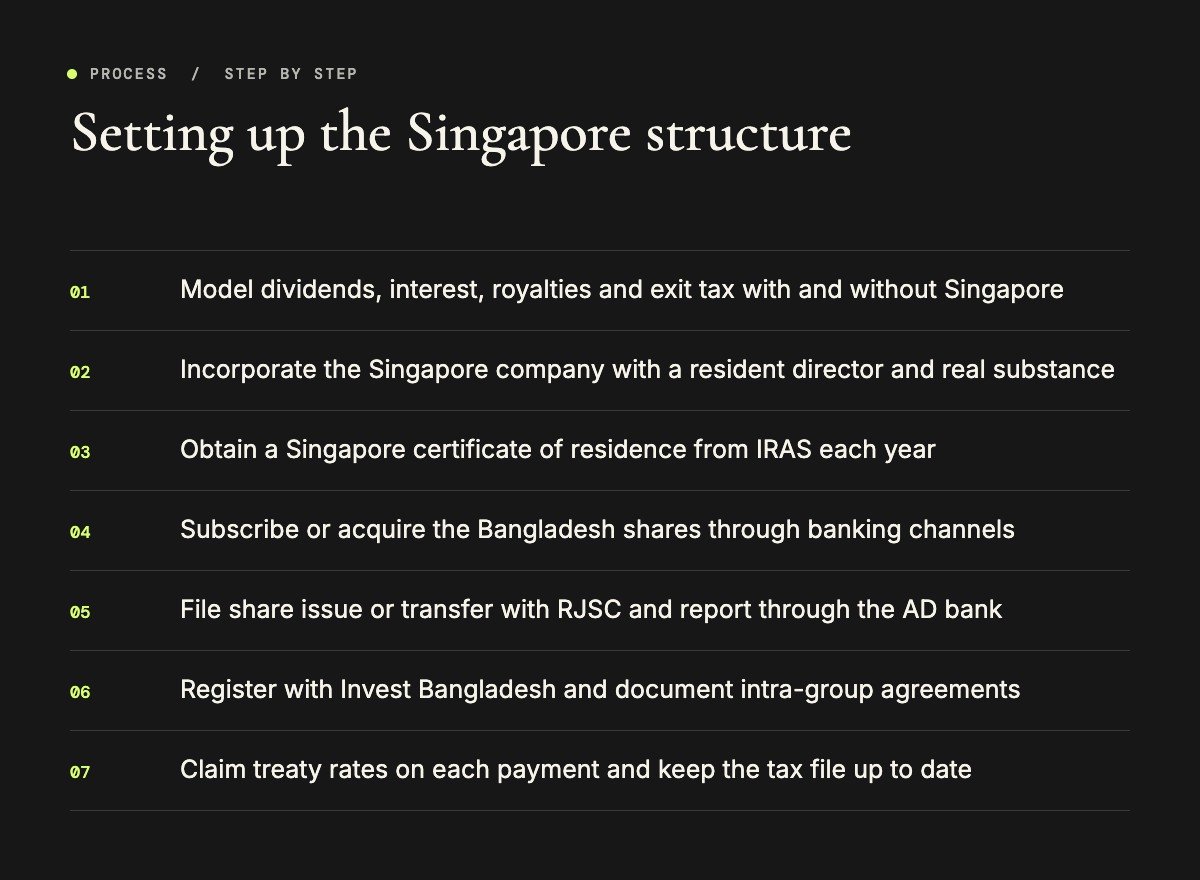
- Model the cash flows. Compare dividends, interest, royalties and a future exit with and without Singapore, using the treaty caps and Singapore rules above. If dividends dominate, test a direct holding as well.
- Incorporate in Singapore. Register the company with ACRA. Singapore requires at least one director who is ordinarily resident in Singapore and a company secretary appointed within six months.
- Build substance. Hold board meetings in Singapore, keep records there and give the local director real authority. Singapore residence for tax depends on where the business is controlled and managed.
- Obtain a certificate of residence. Apply to IRAS for a certificate of residence for each relevant year. Bangladeshi payers and banks will ask for it before applying treaty rates.
- Invest through banking channels. Remit share capital through an authorised dealer bank in Bangladesh, or import capital machinery as equity, so that the investment is recorded as foreign direct investment.
- Complete the Bangladesh filings. File the share allotment or transfer with RJSC, have the bank report it to Bangladesh Bank's foreign exchange investment department, and register the project with Invest Bangladesh where required.
- Document intra-group dealings. Put loans, licences and service agreements in writing at arm's length prices before money moves.
Documents RJSC will expect from the Singapore shareholder
When a company becomes a shareholder in a Bangladeshi company, RJSC and the bank usually want its certificate of incorporation, constitution, a board resolution approving the investment and naming an authorised representative, and passport copies of that representative. Documents signed in Singapore are normally notarised and then attested by the Bangladesh High Commission in Singapore. Allow time for this; it is the most common cause of delay.
Bangladesh Bank rules on shares, dividends and exits
Bangladesh still operates exchange controls under the Foreign Exchange Regulation Act 1947 and Bangladesh Bank's Guidelines for Foreign Exchange Transactions. For a Singapore holding company for Bangladesh, the good news is that ordinary equity transactions no longer need case-by-case approval, provided they are reported correctly.
| Transaction | Prior Bangladesh Bank approval? | Key condition |
|---|---|---|
| Issue of new shares to the Singapore company | No | Funds received through an AD bank before allotment; bank reports the issue |
| Transfer from a resident seller to the Singapore company | No | Valuation report if above Tk 10 lakh; encashment certificate for the seller |
| Transfer from one non-resident to another | No | Stamp duty and any capital gains tax brought in from abroad |
| Dividend remittance to Singapore | No | Share issue or transfer previously reported; tax deducted |
| Sale by the Singapore company to a resident above Tk 10 crore | Yes | Bangladesh Bank fixes fair value |
These points follow Bangladesh Bank's published procedures for foreign investment and repatriation of share sale proceeds, as shown on its investment portal in 2026. Sale proceeds below the Tk 10 crore threshold can generally be remitted by the bank, with a valuation report where the price exceeds net asset value above Tk 1 crore. Bangladesh Bank updates these procedures by circular, so confirm the current version with your bank before signing.
Share money deposits
Money remitted as share money deposit must be converted into shares within 360 days, or Bangladesh Bank will not treat it as equity. Groups that park funds for months while documents are prepared sometimes miss this deadline and then struggle to repatriate dividends on those shares.
Financing the Bangladeshi subsidiary from Singapore
Many groups use a Singapore holding company for Bangladesh as the treasury for the whole region. Interest paid from Bangladesh to a Singapore resident lender is capped at 10% under the treaty, and Singapore taxes the interest income, so the net benefit depends on spread and substance rather than on a rate gap.
A shareholder loan from Singapore is foreign borrowing for Bangladeshi purposes. Long-term foreign loans to private companies are scrutinised by Invest Bangladesh (formerly BIDA) and Bangladesh Bank, which look at the all-in cost, tenor and purpose. Bangladesh Bank consolidated its foreign loan instructions in a 2025 foreign exchange circular, and short-term and economic zone borrowing follow separate rules. Settle the approval route before drawing any money.
Equity or debt?
Equity is simpler to bring in and to repatriate as dividends, but cannot easily be returned before a liquidation or capital reduction. Debt gives a predictable repayment route but needs approval and is tested for arm's length pricing. A mix, decided up front, usually works best.
Royalties, service fees and transfer pricing
A Singapore holding company for Bangladesh often also owns brands or provides regional management services. Royalties paid from Bangladesh are capped at 10% under the treaty. The treaty has no separate article for technical or management fees, so these are generally business profits that Bangladesh can tax only if the Singapore company has a permanent establishment there, although payments for know-how may fall within the royalty definition.
In practice, Bangladeshi payers withhold tax at source and banks examine the agreement before remitting. Remittances of royalty and technical assistance fees are subject to limits and conditions in Bangladesh Bank's guidelines, with Invest Bangladesh involvement above them.
The Income Tax Act 2023 contains transfer pricing rules for international transactions between associated enterprises. Prices for loans, licences and services between the Bangladeshi subsidiary and its Singapore parent must be at arm's length and supported by documentation. Our tax law practice prepares that documentation alongside the agreements.
A service fee charged by a Singapore company with no staff, for services nobody can describe, is the classic transfer pricing target. Keep evidence of who provided what, when and at what cost.
Exit planning with a Singapore holding company for Bangladesh
Exit planning is where a Singapore holding company for Bangladesh can earn its keep, but only if it is designed in from the start. There are two basic routes: the Singapore company sells its shares in the Bangladeshi subsidiary, or the group sells the Singapore company itself.
Selling the Bangladeshi shares
Bangladeshi domestic law taxes capital gains on transfers of shares in Bangladeshi companies by non-residents, with withholding of 15% according to the PwC summary, and RJSC will not register the transfer until the tax position is cleared. The treaty's capital gains article generally gives the right to tax gains on ordinary shares to the seller's state of residence, unless the company's assets consist mainly of immovable property. Claiming that relief requires the IRAS certificate of residence and early engagement with the tax office, so build in time.
Selling the Singapore company
A sale at the Singapore level avoids a Bangladeshi share transfer and RJSC filing for the subsidiary itself. However, Bangladeshi law has moved toward taxing offshore transfers that derive value from Bangladeshi assets, and buyers' advisers will ask about it. Whether a particular sale is caught depends on the current provisions of the Income Tax Act 2023, so obtain specific advice before marketing the business.
For the mechanics of transfers at the Bangladeshi level, see our guide to company share transfer in Bangladesh.
Substance, beneficial ownership and anti-abuse risk
The 1980 treaty does not contain a modern limitation-on-benefits clause, but that does not make a letterbox company safe. The dividend, interest and royalty caps apply only to a beneficial owner, and tax authorities on both sides now look at where decisions are made and whether the company bears real risk.
Practical substance for a Singapore holding company for Bangladesh means a resident director who understands the business, board meetings in Singapore with minutes that record real decisions, a Singapore bank account through which income flows, and costs in Singapore consistent with the activity. Groups that already run a regional office in Singapore meet these tests easily; a newly formed company with nominee services may not.
Bangladesh also requires disclosure of ultimate beneficial owners to banks under the Money Laundering Prevention Act 2012 framework, so the structure will be visible to the authorities in any case.
Invest Bangladesh, sector rules and economic zones
From 23 August 2026, the Invest Bangladesh Act 2026 merged BIDA, BEZA and the Public-Private Partnership Authority into one agency, Invest Bangladesh, under the Prime Minister's Office. Existing investment services, including registration, work permits and approvals of foreign loans and remittances, continue through Invest Bangladesh, and the BanglaBiz platform remains the digital one-stop service. BEPZA continues to administer export processing zones.
A Singapore holding company for Bangladesh does not change sector rules. Telecommunications, banking, insurance, media and some trading activities have licensing or ownership limits that apply whoever the foreign shareholder is. Check the sector position first, because it may decide whether the structure is worth building at all. Our overview of foreign direct investment in Bangladesh covers these entry rules.
Is a Singapore holding company for Bangladesh right for you?
It usually makes sense where the group has several Asian subsidiaries, a Singapore management team, outside investors who want a Singapore top company, or a planned exit to a buyer who prefers Singapore. It makes less sense where a single Bangladeshi factory will pay large dividends to a parent in Japan or India.
Frequently asked questions about a Singapore holding company for Bangladesh
Does a Singapore holding company reduce Bangladeshi tax on dividends?
Usually only from the domestic rate to the treaty cap of 15%. It does not reach the 10% rate that some other treaties give to substantial corporate shareholders.
Will Singapore tax the dividends it receives from Bangladesh?
Generally not, if the section 13(8) conditions are met: the income was subject to tax in Bangladesh and Bangladesh's headline corporate rate is at least 15%. Check the position where the subsidiary has a tax holiday.
Is Bangladesh Bank approval needed to bring in a Singapore shareholder?
Not for issuing new shares or for most unlisted share transfers, but the authorised dealer bank must report the transaction, and transfers above Tk 10 lakh need a valuation report.
Can we move an existing direct holding into Singapore?
Yes. A transfer from one non-resident to another needs no prior approval, but stamp duty and any capital gains tax must be funded from abroad and the transfer must be filed with RJSC and reported by the bank.
Does the Invest Bangladesh merger change anything for existing companies?
Registrations and approvals granted by BIDA or BEZA continue, and services now run through Invest Bangladesh. Update correspondence addresses and watch for new forms on BanglaBiz.
What substance does the Singapore company need?
At least a resident director with real authority, board meetings and records in Singapore, a local bank account and a certificate of residence from IRAS for each year in which treaty rates are claimed.
How we can help
We advise foreign groups and funds on whether a Singapore holding company for Bangladesh suits their plans, and on share subscriptions and transfers, Bangladesh Bank reporting, treaty claims, intra-group agreements and exits, working with Singapore counsel where needed. Learn more about our Singapore investor desk.
Planning to hold Bangladesh through Singapore?
We review the structure against the 1980 treaty, Bangladesh Bank rules and your exit plans before you commit capital.
Book a consultationSingapore deskPrimary sources: the Bangladesh–Singapore double taxation agreement (1980) and Income Tax Act 2023 via the National Board of Revenue; foreign investment procedures from Bangladesh Bank; investment services from Invest Bangladesh; share filings at RJSC; PwC Worldwide Tax Summaries (Bangladesh, reviewed July 2026).
This article is general information about Bangladeshi law as of 2026 and is not legal or tax advice. Treaty application, tax rates and Bangladesh Bank procedures change; confirm the current position with the NBR, Bangladesh Bank, Singapore advisers or a qualified lawyer before acting.

0 Comments