
A UAE company setup in Bangladesh usually means a Dubai, Abu Dhabi or Ras Al Khaimah entity owning a Bangladeshi subsidiary, joint venture or branch. The route is well established, but getting the vehicle, the paperwork from the UAE and the foreign exchange steps right at the start decides whether profits and capital can later leave Bangladesh smoothly.
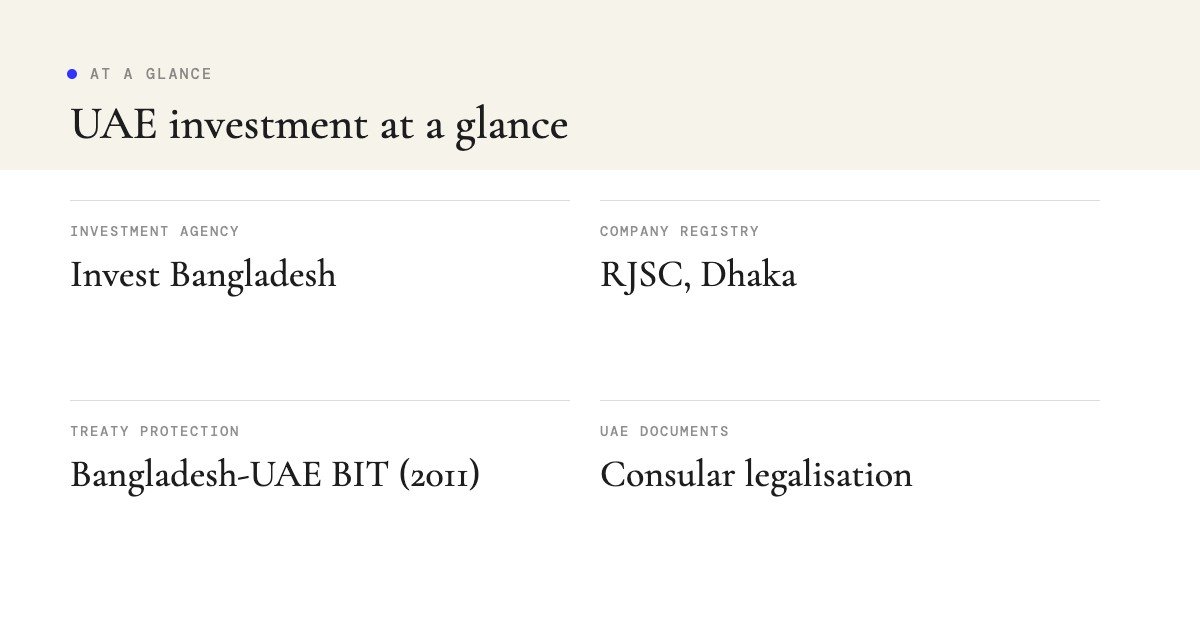
- Most UAE investors use a private limited company incorporated with RJSC under the Companies Act 1994, wholly owned or in a joint venture with a Bangladeshi partner.
- Invest Bangladesh, the single agency that merged BIDA, BEZA and the PPP Authority from 23 August 2026, handles investment registration and related services, with BanglaBiz as the online one-stop platform.
- The UAE is not a party to the Apostille Convention, so UAE corporate documents still need notarisation, UAE ministry attestation and Bangladesh mission attestation.
- Share capital must come in through banking channels so that dividends and sale proceeds can later be repatriated under Bangladesh Bank rules.
- The Bangladesh–UAE bilateral investment treaty, signed in 2011 and in force since 5 May 2013, offers treaty protection; a comprehensive economic partnership agreement is still being negotiated.
Why UAE investors are looking at Bangladesh in 2026
The UAE is one of Bangladesh's most important economic partners, as a source of remittances, a trading hub and an increasingly active investor. Ports and logistics lead the way: in 2026 DP World holds a 15-year concession to operate and modernise the New Mooring Container Terminal at Chittagong Port, and on 8 October 2026 the Prime Minister met DP World's chairman to discuss free trade zones and a rail-based inland container depot, as reported by the Dhaka Tribune.
Beyond ports, UAE groups are active or exploring opportunities in energy, real estate, hospitality, pharmaceuticals, aviation services, trading and Islamic finance. In February 2026 the two governments discussed speeding up negotiations on a Comprehensive Economic Partnership Agreement (CEPA), and in September 2026 reports described those talks as on track but not concluded.
For the investor, the practical question is how to structure a UAE company setup in Bangladesh so that it is quick to establish, compliant from day one, and easy to exit. That is what this guide covers. Our UAE desk works with investors on both ends of the corridor.
The legal framework for UAE company setup in Bangladesh
Several laws work together in any UAE company setup in Bangladesh. The Companies Act 1994 governs incorporation, management and winding up of companies, administered by the Registrar of Joint Stock Companies and Firms (RJSC). The Foreign Private Investment (Promotion and Protection) Act 1980 guarantees fair treatment of foreign investment, protection against expropriation without compensation, and repatriation of capital and returns.
The Invest Bangladesh Act 2026 created Invest Bangladesh under the Prime Minister's Office, merging the former Bangladesh Investment Development Authority, the Bangladesh Economic Zones Authority and the PPP Authority. It began work on 23 August 2026, and existing services such as investment registration, work permits and branch office approvals continue through it. Export processing zones remain under the Bangladesh Export Processing Zones Authority (BEPZA).
Money flows are governed by the Foreign Exchange Regulation Act 1947 and Bangladesh Bank's foreign exchange guidelines and circulars. Tax is governed by the Income Tax Act 2023 and the VAT and Supplementary Duty Act 2012. Disputes are governed by the Arbitration Act 2001 and, at treaty level, the bilateral investment treaty.
Is any sector closed to UAE investors?
Most sectors are open to 100% foreign ownership. A small number are reserved for the state or need prior approval or a licence from a sector regulator, for example banking, insurance, telecoms, power, pharmaceuticals and certain security-sensitive activities. Check the current list published by Invest Bangladesh before committing to a structure.
Choosing the right vehicle
The choice of vehicle is the first and most important decision in any UAE company setup in Bangladesh. Each option has a different set of approvals and a different tax and exit profile.
| Vehicle | Best for | Key points |
|---|---|---|
| Private limited company (subsidiary) | Most operating businesses | Separate legal entity; can be 100% foreign-owned; minimum two shareholders; incorporated with RJSC |
| Joint venture company | Local market access, licences, land | Shareholders agreement and articles must align; deadlock and exit planning essential |
| Branch office | Project work, specific contracts | Needs Invest Bangladesh permission; part of the UAE company; activities limited to those approved |
| Liaison office | Market research, coordination | Cannot earn income in Bangladesh; expenses funded from abroad |
| Zone enterprise | Export manufacturing, logistics | Set up in an export processing zone or economic zone with zone-specific approvals and incentives |
| PPP project company | Infrastructure and utilities | Formed under a PPP contract with a government agency; project finance structures |
A one person company is not usually suitable, because the Companies Act limits that form to natural persons. For a subsidiary, the UAE parent can hold most shares and a second shareholder, often an affiliate or nominee, holds the rest. See our guide on setting up a private limited company for the incorporation detail.
Structuring from the UAE: holding entity, tax and treaty
For a UAE company setup in Bangladesh, investors can hold the Bangladeshi company through a mainland company, a free zone company (for example in JAFZA, DMCC or RAK ICC), or an entity in a financial free zone such as DIFC or ADGM. The choice affects three things.
Treaty protection
The Bangladesh–UAE bilateral investment treaty was signed on 17 January 2011 and entered into force on 5 May 2013, according to UNCTAD's treaty database. Like most such treaties, it protects "investors" of each state as defined in the text. Before relying on it, confirm that your chosen UAE entity falls within that definition, which may involve incorporation and, in some cases, real business activity in the UAE.
Tax on dividends and other payments
Dividends, royalties, technical fees and interest paid from Bangladesh to a UAE company are subject to Bangladeshi withholding tax under the Income Tax Act 2023. The National Board of Revenue's list of double taxation avoidance agreements includes a Bangladesh–UAE agreement, published on the NBR website in April 2026. Check its entry-into-force date and the dividend, royalty and fee articles before modelling returns, and keep a UAE tax residence certificate ready to claim treaty rates. Rates change with each Finance Act, so model them on the current law.
Substance and transparency
Bangladeshi banks apply strict know-your-customer checks to foreign shareholders and will ask for the ultimate beneficial owners behind a UAE holding company. A structure with clear ownership documents and real management in the UAE is processed faster than a chain of shell entities.
Step-by-step UAE company setup in Bangladesh
The order below is the one we use for a typical UAE-owned subsidiary. Some steps can run in parallel, but the money and the documents must be right before registration.
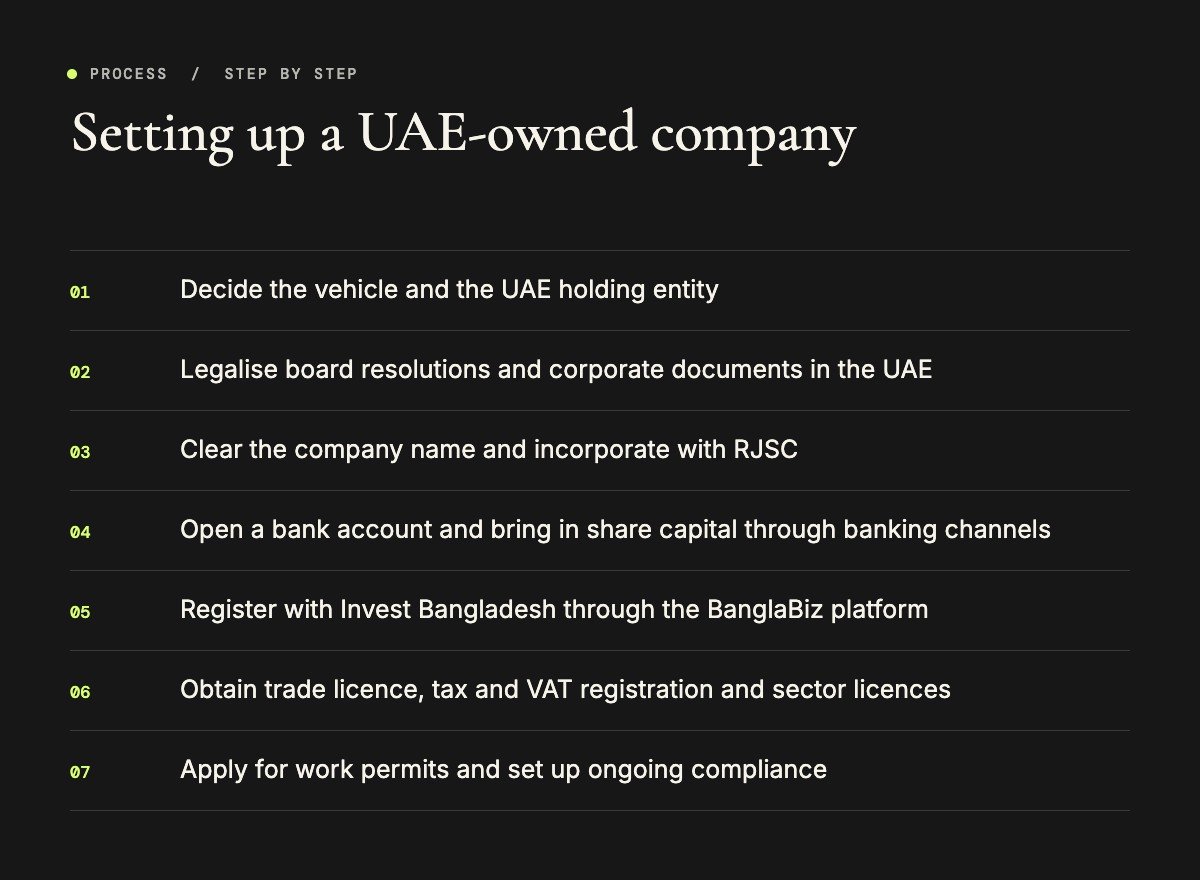
- Agree the structure. Decide the vehicle, shareholders, share capital, board composition and the UAE holding entity, and settle a term sheet if there is a local partner.
- Prepare and legalise UAE documents. Board resolution of the UAE shareholder, certificate of incorporation, memorandum and articles, and any power of attorney, legalised for use in Bangladesh.
- Clear the name and incorporate. Obtain name clearance from RJSC, file the memorandum, articles and incorporation forms online, and pay stamp duty and fees.
- Open the bank account and remit capital. Open an account with a Bangladeshi bank and bring in the share capital from abroad through banking channels; obtain the encashment certificate.
- Register the investment. Register with Invest Bangladesh through the BanglaBiz one-stop platform, which supports later services such as work permits.
- Licences and tax. Obtain a trade licence from the city corporation, an e-TIN, VAT registration (BIN), and any sector licences such as environmental clearance or a regulator's approval.
- People and compliance. Apply for work permits and visas for UAE staff, appoint auditors, and set up statutory registers and a compliance calendar.
A straightforward UAE company setup in Bangladesh with complete documents can be incorporated within a few weeks; sector licences and work permits often take longer. Delays almost always trace back to documents from abroad or capital that arrived through the wrong channel.
Legalising UAE documents for use in Bangladesh
Bangladesh joined the Hague Apostille Convention with effect from 30 March 2025, but the UAE has not acceded to it. Documents issued or signed in the UAE therefore still need full consular legalisation before Bangladeshi authorities and banks will rely on them.
For a UAE company setup in Bangladesh, the usual chain is: notarisation or attestation by the competent UAE authority (for example a notary public or the relevant chamber of commerce), attestation by the UAE Ministry of Foreign Affairs, and then attestation by the Embassy of Bangladesh in Abu Dhabi or the Consulate General in Dubai. On arrival in Bangladesh, documents such as powers of attorney must also be stamped within the period set by the Stamp Act 1899.
Prepare one master pack of legalised documents: shareholder resolution, constitutional documents, good standing certificate, passport copies of directors and a power of attorney for the local representative. Make several certified copies before sending. RJSC, the bank and Invest Bangladesh will each want originals or certified copies, and re-legalising from the UAE costs weeks.
Directors and signatories
Foreign nationals can be directors of a Bangladeshi company, which is common in a UAE company setup in Bangladesh. Directors who will live and work in Bangladesh need the appropriate visa and a work permit; directors who stay in the UAE can sign documents abroad, provided the signatures are executed and legalised correctly.
Bringing in capital and getting money out
Foreign exchange compliance is where a UAE company setup in Bangladesh succeeds or fails over the long term. Under Bangladesh Bank's foreign exchange rules, share capital from a non-resident must be remitted through banking channels into the company's account. The bank issues an encashment certificate, and the issue of shares to the non-resident is reported through the bank to Bangladesh Bank.
Capital that arrives as cash, through informal channels or by a related party paying expenses directly, may not count as foreign investment. That can block later repatriation of dividends and sale proceeds.
Dividends, fees and loans
Dividends from post-tax profits can be remitted to the UAE shareholder through the company's bank after withholding tax, with supporting board resolutions and audited accounts. Royalties, technical fees and management fees are subject to separate Bangladesh Bank rules and limits, and may require approval. Foreign loans from a UAE parent go through the regulatory scrutiny that applies to private sector foreign borrowing; short-term and long-term loans follow different rules.
Exit and disinvestment
When a UAE investor sells its shares in a non-listed Bangladeshi company, remitting the sale proceeds generally involves Bangladesh Bank review under its foreign exchange guidelines, including a valuation of the shares. Build valuation methods and repatriation cooperation into the shareholders agreement from day one. Current circulars are on the Bangladesh Bank website.
Sector approvals, zones and PPP projects
Many projects need more than a company and a trade licence, so plan sector approvals as part of the UAE company setup in Bangladesh. Manufacturing usually needs environmental clearance under the Environment Conservation Rules 2023, factory approvals and fire licences. Regulated sectors need their regulator's licence: Bangladesh Bank for banking and finance, BTRC for telecoms, BERC for energy, DGDA for pharmaceuticals, and so on.
Export-oriented manufacturers can locate in export processing zones under BEPZA or in economic zones now administered by Invest Bangladesh, each with zone-specific approvals and incentives. Infrastructure investors may enter through the public-private partnership process, now also housed in Invest Bangladesh after the August 2026 merger. Visit Invest Bangladesh for current services and forms.
Because the merger is recent, some forms, fee schedules and portals may still carry BIDA or BEZA branding. Existing approvals remain valid; ask the agency in writing if it is unclear which office handles your application.
Ongoing compliance after setup
A UAE company setup in Bangladesh is the start of a compliance cycle, not the end. The main recurring obligations are:
- RJSC filings: annual general meeting, annual return and audited accounts, plus filings for changes in directors, shares and registered office.
- Tax: corporate income tax return, withholding tax deductions and returns, and monthly VAT returns.
- Foreign exchange reporting: reporting of foreign investment, loans and remittances through the company's bank.
- People: renewal of work permits and visas, and compliance with the Bangladesh Labour Act 2006 as amended in 2026.
- Licences: annual renewal of trade licence, fire licence and sector licences.
For a UAE company setup in Bangladesh, missed filings lead to fines, but the bigger risk is practical: banks and Bangladesh Bank may delay dividend remittances if the company's records are not current.
Protecting the investment: contracts, disputes and the treaty
Good contracts prevent most disputes after a UAE company setup in Bangladesh. Shareholders agreements, supply and offtake contracts and PPP agreements should include clear governing law and dispute resolution clauses. Arbitration is the usual choice for cross-border deals. Bangladesh and the UAE are both parties to the New York Convention, and the Arbitration Act 2001 provides for enforcement of foreign arbitral awards in Bangladesh.
Seats such as Singapore, London or Dubai are common for high-value contracts, while Dhaka-seated arbitration under the Arbitration Act 2001 can work well for local disputes. Our guide to the arbitration process in Bangladesh explains the domestic framework.
If the dispute is with the state, for example over expropriation or a sudden regulatory change, the bilateral investment treaty may give a UAE investor an additional route to international arbitration. Treaty claims have strict preconditions, so take advice as soon as a dispute with a government body appears.
Common mistakes in UAE company setup in Bangladesh
- Unlegalised documents. Sending UAE board resolutions with only a notary stamp, which RJSC and banks will not accept.
- Informal capital. Bringing in money through exchange houses or relatives, so it never counts as foreign investment.
- Wrong vehicle. Opening a liaison office that then starts earning income, or a branch for a business that needs a subsidiary.
- Weak joint venture terms. No deadlock mechanism or valuation formula, so exit becomes a dispute.
- Ignoring sector licences. Starting operations before the regulator's approval.
- Treaty assumptions. Assuming any UAE entity qualifies for treaty protection without checking the definition.
Frequently asked questions about uae company setup in bangladesh
Can a UAE company own 100% of a Bangladeshi company?
Yes, in most sectors. A private limited company needs at least two shareholders, so a UAE parent usually holds almost all shares with an affiliate holding the rest. Some regulated sectors limit foreign ownership or require approval.
Is there a minimum capital requirement?
The Companies Act 1994 sets no general minimum for a private company, but sector regulators, work permit rules and banks may expect a certain level of paid-up capital. Plan capital around the business and those requirements.
Do UAE documents need an apostille?
No apostille is available, because the UAE is not a party to the Apostille Convention. UAE documents need notarisation, UAE Ministry of Foreign Affairs attestation and attestation by the Bangladesh Embassy or Consulate in the UAE.
How long does a UAE company setup in Bangladesh take?
Incorporation can be completed within a few weeks once documents are ready. Bank account opening, investment registration, licences and work permits add further time depending on the sector.
Can profits be sent back to the UAE?
Yes. Dividends from post-tax profits can be remitted through the company's bank, provided the original capital came in through banking channels and the company's filings are up to date.
How we can help
We advise UAE investors on structure, prepare and coordinate legalisation of documents, incorporate companies with RJSC, register investments with Invest Bangladesh, and handle foreign exchange, tax and licensing compliance. For a coordinated UAE company setup in Bangladesh, see our UAE investor desk and our foreign direct investment practice.
Planning to invest from the UAE?
Tell us about your business and holding structure. We will recommend the right vehicle, map the approvals and set a realistic timetable for your Bangladeshi entity.
Book a consultationUAE deskPrimary sources: the Companies Act 1994 and filings through the RJSC; the Foreign Private Investment (Promotion and Protection) Act 1980, Income Tax Act 2023 and Arbitration Act 2001 on the Laws of Bangladesh portal; services of Invest Bangladesh; foreign exchange rules of Bangladesh Bank; tax treaties listed by the National Board of Revenue; UNCTAD investment treaty database; Dhaka Tribune (8 October 2026).
This article is general information about Bangladeshi law as of 2026 and is not legal advice. Investment rules, foreign exchange circulars and tax rates change; confirm current requirements with Invest Bangladesh, Bangladesh Bank or a qualified lawyer before acting.

0 Comments