
Multinational groups with Bangladeshi subsidiaries routinely buy raw materials, pay royalties, share services and lend money within the group. Transfer pricing in Bangladesh requires these related-party transactions to be priced as if the parties were independent. The National Board of Revenue has increasingly focused on transfer pricing audits, so documentation and defensible pricing are essential.
- Transfer pricing rules were first introduced in 2014 under the Income Tax Ordinance 1984 and are now contained in the Income Tax Act 2023.
- International transactions between associated enterprises must follow the arm's length principle.
- Recognised methods include comparable uncontrolled price, resale price, cost plus, profit split and transactional net margin methods.
- Taxpayers must keep documentation and file a statement of international transactions, with an accountant's report where thresholds are met.
- Penalties apply for failures to keep documentation, file statements or comply with notices, and adjustments can lead to significant additional tax.
What transfer pricing means
Transfer pricing refers to the prices charged in transactions between related entities, such as a parent and subsidiary or two subsidiaries of the same group. Because related parties are not negotiating at arm's length, prices could be set to shift profits to low-tax jurisdictions. Tax authorities therefore require that such prices match what independent parties would agree in comparable circumstances.
Transfer pricing in Bangladesh matters particularly for garment manufacturers buying inputs from group suppliers, pharmaceutical and FMCG companies paying royalties and technical fees, telecom and technology firms receiving shared services, and companies borrowing from foreign affiliates. Our tax practice advises on policies, documentation and disputes.
The legal framework for transfer pricing in Bangladesh
Bangladesh introduced transfer pricing provisions through the Finance Act 2014, inserting a dedicated chapter into the Income Tax Ordinance 1984. When the Income Tax Act 2023 replaced the Ordinance from the 2023-24 tax year, the transfer pricing provisions were carried into the new Act with updates. Rules and guidance issued by the National Board of Revenue supplement the statutory provisions.
Because the annual Finance Act can change thresholds, penalties and procedures, taxpayers should check the current text of the Act and any NBR guidance each year when preparing their transfer pricing in Bangladesh compliance.
Associated enterprises and international transactions
The rules apply to international transactions between associated enterprises. Enterprises are generally associated where one participates directly or indirectly in the management, control or capital of the other, or the same persons participate in both, with detailed tests based on shareholding, board control, loans, guarantees and dependence on intellectual property or supplies.
International transactions include purchases and sales of goods, provision of services, licensing of intangibles, loans and guarantees, cost-sharing arrangements and business restructurings involving a non-resident associated enterprise.
Methods for transfer pricing in Bangladesh
| Method | Typical use |
|---|---|
| Comparable uncontrolled price | Commodities and standard goods with market prices |
| Resale price method | Distributors that resell without significant value addition |
| Cost plus method | Contract manufacturers and service providers |
| Profit split method | Highly integrated operations or unique intangibles on both sides |
| Transactional net margin method | Most common in practice, comparing net margins with comparable companies |
The taxpayer must select the most appropriate method for each transaction, considering the availability of reliable comparables and the functions performed, assets used and risks assumed by each party. Transfer pricing in Bangladesh follows broadly the same method hierarchy and principles as the OECD Guidelines, although local rules and practice govern.
Documentation for transfer pricing in Bangladesh
Taxpayers with international transactions must keep information and documents describing the group structure, the business, the transactions, functional analysis, the method selected, comparables and the calculation of the arm's length price. Documentation should be prepared contemporaneously, not reconstructed after an audit begins.
A statement of international transactions must be filed with the return, and an accountant's report is required where the value of international transactions exceeds the statutory threshold. Documentation must be produced within the time allowed when the Deputy Commissioner of Taxes or transfer pricing officer requests it.
Building a compliant approach
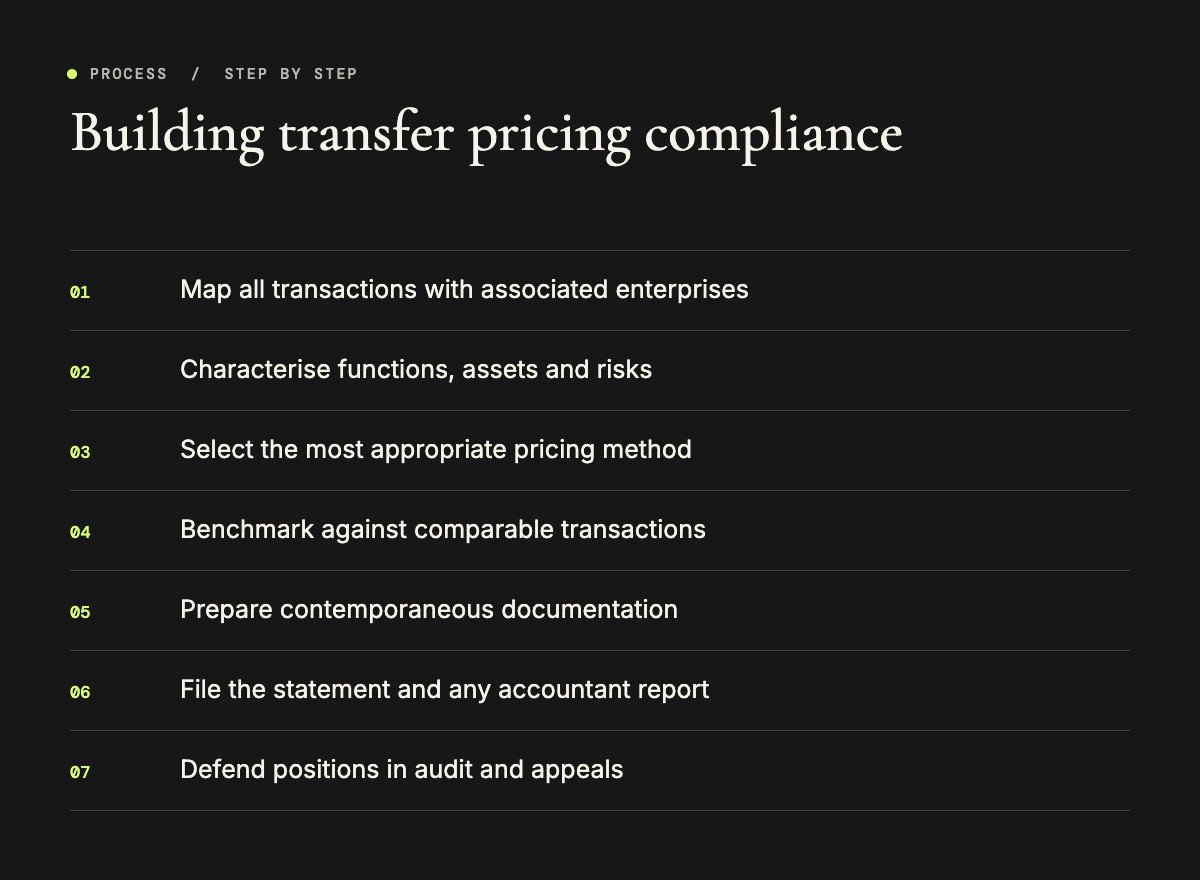
- Map transactions. List every transaction with associated enterprises and its value.
- Functional analysis. Identify functions, assets and risks of each party.
- Select methods. Choose the most appropriate method for each category.
- Benchmark. Search for comparable companies or transactions and analyse results.
- Document. Prepare a local file explaining the analysis and conclusions.
- File. Submit the statement of international transactions and any accountant's report.
- Review annually. Update policies and documentation as the business changes.
Comparable data for Bangladeshi companies is limited. Benchmarking studies often rely on regional databases, which tax officers may challenge. Explain clearly why the chosen comparables are reasonable, and make adjustments for differences in working capital and risk where appropriate.
Audits and adjustments
The NBR has established specialised transfer pricing capacity and refers selected cases for detailed examination. Where the officer concludes that a price is not at arm's length, the income is adjusted, increasing tax payable, and interest and penalties may follow. Adjustments can affect several years at once.
Taxpayers can appeal adjustments through the Commissioner of Taxes (Appeals), the Taxes Appellate Tribunal and the High Court Division on questions of law. A well-documented file is the strongest defence in any transfer pricing in Bangladesh dispute.
Penalties under transfer pricing in Bangladesh
The Act imposes penalties for failing to keep information and documents, failing to furnish them on request, failing to file the statement of international transactions and failing to obtain the accountant's report where required. Penalties are often calculated as a percentage of the value of the transactions, which can produce large amounts for groups with substantial intra-group trade.
Royalties, technical fees and management charges
Payments for brands, technology and head office services attract close scrutiny. Tax officers ask whether services were actually rendered, whether they benefit the Bangladeshi company, whether they duplicate local functions and whether the charge is reasonable. For transfer pricing in Bangladesh, taxpayers should keep evidence such as service agreements, time records, reports, emails and invoices showing the nature and benefit of the services.
Royalty and technical fee payments abroad also involve foreign exchange approvals and withholding tax, and some expenses may be subject to deduction limits under the Income Tax Act. Coordinating transfer pricing, foreign exchange and withholding compliance avoids conflicting positions.
Intra-group loans and guarantees
Interest on loans from foreign affiliates must be at arm's length, considering the borrower's credit standing, currency, tenor and security. Bangladesh Bank rules on foreign borrowing also limit costs and require approvals, so pricing must satisfy both regimes. Guarantees provided by a parent for a subsidiary's bank borrowing may require an arm's length guarantee fee, or alternatively the absence of a fee must be justified.
Thin capitalisation concerns and limits on interest deductibility may also apply under the Income Tax Act, making financial transactions a key area for transfer pricing in Bangladesh.
Advance pricing and dispute avoidance
Many countries offer advance pricing agreements, allowing taxpayers to agree methods with the tax authority in advance. Taxpayers should check whether the current Bangladeshi framework provides such a mechanism. Where double taxation arises from adjustments in two countries, the mutual agreement procedure under applicable tax treaties may help resolve it, although treaty procedures can take time.

Garment and export sector issues
Bangladesh's export-oriented garment sector raises distinctive questions for transfer pricing in Bangladesh. Many factories operate as contract manufacturers for group buyers, earning a cost-plus return, while fabrics and accessories are sourced from group companies abroad. Tax officers examine whether the manufacturing margin is adequate given the risks borne, and whether input prices from related suppliers are inflated.
Exporters benefiting from reduced tax rates or export incentives should not assume transfer pricing is irrelevant. Shifting profit through pricing can still be challenged, and documentation of the contract manufacturing model, with benchmarked margins, is the best protection for transfer pricing in Bangladesh in this sector.
Business restructurings
When a group converts a full-fledged Bangladeshi distributor into a limited-risk distributor, or moves intangibles, functions or contracts abroad, tax officers may argue that something of value has been transferred and should be compensated. Such restructurings require careful analysis under transfer pricing in Bangladesh rules, including the commercial rationale, the realistic alternatives available to the local entity and any exit payment.
Practical tips
- Adopt a written group transfer pricing policy and apply it consistently.
- Prepare documentation before filing the return, not after an audit notice.
- Align intercompany agreements, invoices and accounting entries.
- Check foreign exchange approvals for royalties, fees and interest.
- Monitor margins during the year and make adjustments before year end where permitted.
These steps make transfer pricing in Bangladesh a manageable compliance process rather than a source of unexpected assessments. Consistency between what the documents say and what actually happens in the business is the single most persuasive factor in an audit.
Customs valuation and transfer pricing
Import prices between related parties matter for both income tax and customs. Customs authorities may argue that a related-party import price is too low, increasing duty, while tax officers may argue it is too high, reducing taxable profit. The two authorities apply different rules and do not always coordinate. Importers should prepare consistent explanations for both, supported by the same functional analysis and benchmarking, so that a position taken with customs does not undermine the income tax file. Where customs makes an adjustment, consider whether it affects the income tax position and document the reasons for any difference.
Board oversight
Directors of Bangladeshi subsidiaries are responsible for the company's tax compliance. Boards should receive regular reports on intra-group transactions, approve intercompany agreements and confirm that documentation is in place before returns are filed. This oversight demonstrates good governance and reduces the risk of penalties for the company and its officers.
Country-by-country and global documentation
Large multinational groups prepare master files and country-by-country reports under OECD BEPS standards in other jurisdictions. Even if Bangladeshi law does not require the same filings in every case, keeping the group master file available helps explain the global value chain and supports the local analysis. Consistency between global and local documentation is important, because inconsistencies are easily spotted by tax officers.
Frequently asked questions about transfer pricing in bangladesh
Which law contains the transfer pricing rules?
The Income Tax Act 2023, which carried forward rules first introduced in 2014.
Do the rules apply to domestic transactions?
The core rules target international transactions with associated enterprises; check the current Act for any extension.
Which methods are accepted?
CUP, resale price, cost plus, profit split, TNMM and other methods allowed by the rules.
What must be filed?
A statement of international transactions with the return, and an accountant's report above the threshold.
What happens in an audit?
The officer may adjust prices, leading to additional tax, interest and penalties, which can be appealed.
Are royalties scrutinised?
Yes, royalties and technical fees are frequent audit targets, along with foreign exchange rules on remittance.
How we can help
We advise multinational groups on transfer pricing in Bangladesh, including policy design, documentation, audits and appeals. Learn more about our tax practice, our foreign investment team and our guide to company tax returns.
Facing a transfer pricing review?
We build documentation that stands up to NBR scrutiny.
Book a consultationTax practicePrimary sources: the Income Tax Act 2023 on the Laws of Bangladesh portal; guidance and forms from the National Board of Revenue.
This article is general information about Bangladeshi tax law as of October 2026 and is not legal advice. Thresholds and penalties change through the Finance Act; check current rules.



0 Comments