
Legal due diligence in Bangladesh is the structured review a buyer, investor or lender carries out before committing money to a Bangladeshi company or asset. Done well, it tells you what you are really buying, what could go wrong, and how the price and contract should change to reflect it.
- Public records at RJSC, land offices and courts are incomplete, so document review must be paired with targeted questions and independent searches.
- Most serious problems in Bangladeshi deals sit in four areas: title to shares, title to land, licences and permits, and tax.
- Foreign buyers must also check foreign exchange compliance, because past remittance gaps can block future dividends and exit proceeds.
- A red flag rarely kills a deal on its own; it is usually priced, cured before closing, or covered by a specific indemnity.
- A well-organised data room and a clear request list shorten the exercise more than any other step.
Under the Invest Bangladesh Act 2026, effective 23 August 2026, the Bangladesh Investment Development Authority (BIDA), the Bangladesh Economic Zones Authority (BEZA) and the PPP Authority were merged into a single body, Invest Bangladesh. References below to BIDA, BEZA or the PPP Authority should be read as references to Invest Bangladesh. BEPZA continues as a separate authority.
Bangladesh’s cyber security law has changed several times: the Cyber Security Ordinance 2025 replaced the Cyber Security Act 2023 and was itself replaced by a new cyber security law passed by Parliament in April 2026. The law in force when conduct occurred generally governs it.
Parliament passed the Personal Data Protection Act 2026 in April 2026, repealing the Personal Data Protection Ordinance 2025. References below to the Ordinance should be read in light of the 2026 Act.
What legal due diligence in Bangladesh involves
Legal due diligence is an investigation of a target's legal position. The buyer's lawyers examine the company's constitution, ownership, contracts, property, licences, employees, disputes and regulatory standing, and report on anything that affects value or the ability to complete the transaction.
In Bangladesh the exercise has a particular character. Company records are filed with the Registrar of Joint Stock Companies and Firms (RJSC), land records are spread across several offices, and there is no single searchable database of litigation. Good legal due diligence in Bangladesh therefore combines a document review with physical and online searches and direct questioning of management.
Who commissions it
The usual clients are strategic buyers acquiring shares or a business, private equity and venture investors subscribing for new shares, banks and development finance institutions lending against a company or project, and joint venture partners. Sellers increasingly commission vendor due diligence too, so that problems are fixed before buyers find them.
Legal, financial and technical reviews
Legal review is only one strand. Accountants carry out financial and tax due diligence, and engineers or environmental consultants may review plant and sites. The strands overlap, especially on tax and environment, so agree early who covers what to avoid gaps and duplicated cost.
Setting the scope of legal due diligence in Bangladesh
Scope drives cost and time. A full review of a manufacturing group with factories on several plots is a very different job from a review of a three-year-old technology company. Before any documents arrive, agree the following points in writing.
- Deal structure. A share purchase transfers the company with all its history; an asset purchase lets the buyer pick assets but needs each one transferred separately.
- Materiality threshold. Set a value below which contracts and claims are not reviewed individually.
- Look-back period. Three to five years is common for compliance and disputes; title to land and shares must be traced further.
- Report format. A red-flag report lists only significant issues; a full report describes every area reviewed.
- Group coverage. Decide whether subsidiaries, sister concerns and related-party entities are in or out.
Family-owned groups in Bangladesh often run one business through several companies and proprietorships that share land, staff and bank facilities. If the scope covers only the target company, the review may miss that its factory sits on land owned by a sister concern or that its loans are cross-guaranteed.
Corporate records and share title
Every exercise of legal due diligence in Bangladesh starts with the company itself. The aim is to confirm that the target exists, is properly constituted, and that the sellers actually own the shares they are selling, free from claims.
RJSC searches
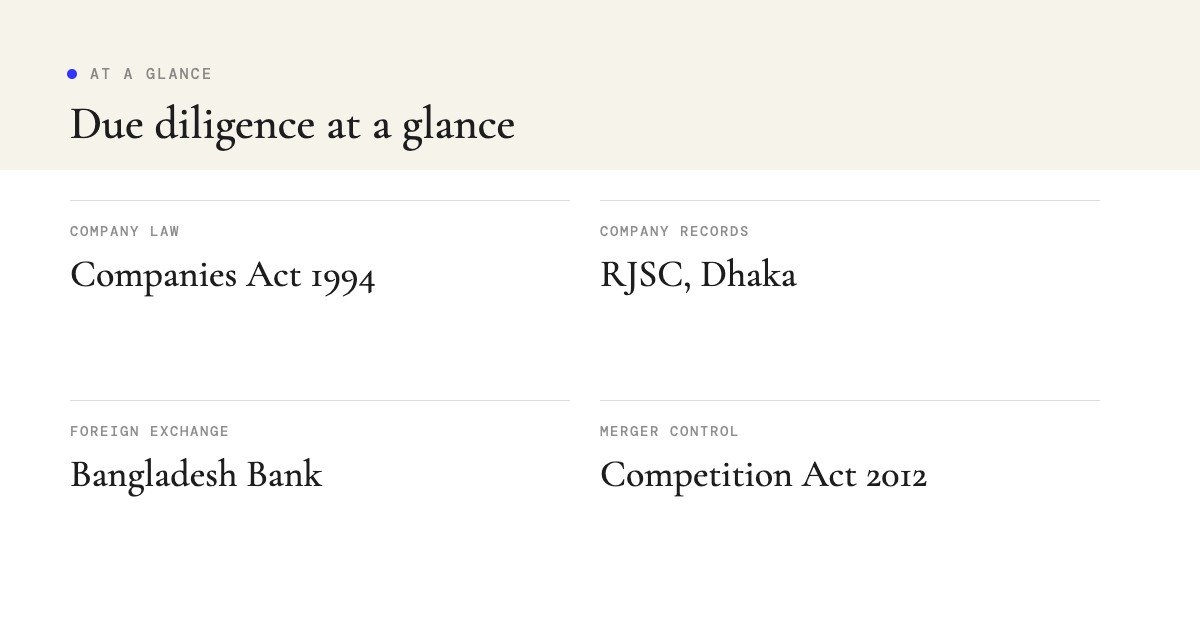
The RJSC file should contain the certificate of incorporation, memorandum and articles of association, returns of directors, annual returns, filings for changes in capital and registered charges. Obtain certified copies through the RJSC rather than relying on copies supplied by the seller. Compare the filed documents with the company's own statutory registers, minute books and share certificates.
Mismatches are common. Share transfers may have been signed but never filed, allotments made without board resolutions, or directors appointed without the required returns. Each gap is a question about who really owns and controls the company. Our guide to share transfer in Bangladesh explains how a transfer should be documented and filed.
Constitution and approvals
Read the articles for transfer restrictions, pre-emption rights, investor vetoes and quorum rules. A sale made in breach of a right of first refusal can be challenged by the shareholder who was bypassed. Check also whether any existing shareholders agreement gives a third party tag-along, drag-along or consent rights over the deal.
Land and property: the heart of legal due diligence in Bangladesh
For any business that owns or leases land, property review is usually the largest and riskiest part of legal due diligence in Bangladesh. Title depends on a chain of registered deeds and on the record of rights, and the two do not always agree.
Chain of title
Trace ownership through registered deeds under the Registration Act 1908 and the Transfer of Property Act 1882, ideally back through several transfers. Check each deed against the successive survey records of rights (khatian), including the CS, SA, RS and, where available, BS records, as well as the current mutation (namjari) in the seller's name and up-to-date land development tax receipts.
Where land came to the seller by inheritance, confirm that every heir's share has been accounted for. Missing heirs are one of the most frequent sources of later claims. Our land registration guide covers deeds and registration in more detail.
Encumbrances and government interests
Search the sub-registry for mortgages and other registered encumbrances, and ask the bank lenders directly for their security documents. Check whether the land is khas land, vested or abandoned property, or subject to acquisition or requisition proceedings. Confirm that the land use and any building approval match what is actually on the site.
Leases
For leased premises, confirm the lease is in writing, registered where registration is required, stamped correctly, and that the landlord has title. Check whether a change of control of the tenant triggers termination or consent rights.
Licences, permits and regulatory approvals
A Bangladeshi business operates under a stack of licences, and checking them is a core part of legal due diligence in Bangladesh. Losing one can halt operations, and many are personal to the holder or need consent on a change of ownership. A licence register is one of the most useful outputs of the exercise.
| Licence or approval | Typical issuing body | What to check |
|---|---|---|
| Trade licence | City corporation or local authority | Valid for the current year and correct address |
| Investment registration | BIDA, BEPZA or BEZA | Matches the actual business and shareholding |
| Import and export registration | Office of the CCI&E | Current renewal and correct category |
| Environmental clearance | Department of Environment | Category of project and renewal status |
| Factory licence and fire licence | DIFE and Fire Service | Covers each site and current capacity |
| Sector licences | BTRC, DGDA, Bangladesh Bank, BSEC and others | Change-of-control consent and conditions |
| Tax and VAT registration | NBR | Valid TIN and BIN, returns filed |
Sector regulators matter most. Banks, financial institutions, insurers, telecoms operators, pharmaceutical manufacturers and listed companies all need regulatory approval or notification for a change in significant shareholding. Build the timing of those approvals into the deal timetable from day one.
Contracts, finance and security
In legal due diligence in Bangladesh, contract review identifies obligations that will bind the buyer and rights that may disappear on the deal. Focus on the contracts that generate most revenue or would be hardest to replace.
Clauses to look for
- Change of control. Rights for a counterparty to terminate or renegotiate if ownership changes.
- Exclusivity and non-compete. Restrictions that could bind the buyer's wider group after closing.
- Assignment. In an asset deal, whether the contract can be assigned without consent.
- Governing law and disputes. Foreign law and arbitration clauses, and whether they are workable in practice.
- Stamping. Instruments that are not properly stamped under the Stamp Act 1899 may face problems being admitted in evidence until duty and any penalty are paid.
Related-party arrangements
In owner-managed businesses, key services, premises, brands or distribution often run through companies owned by the sellers. Identify every related-party arrangement, decide which must continue after closing, and put them on arm's-length written terms before completion.
Finance, security and guarantees
Lending terms are a frequent source of surprises in legal due diligence in Bangladesh. Review every loan, overdraft, letter of credit facility and lease finance arrangement. Bangladeshi bank facilities commonly include negative pledges, restrictions on changes in shareholding and management, and personal guarantees from sponsor directors. A share sale may need lender consent, and lenders may insist on replacing the sellers' personal guarantees with the buyer's.
Check registered charges at RJSC against the security documents. An unregistered charge may be void against a liquidator and creditors, but that does not help a buyer who simply wants a clean company. With the target's written consent, a credit information report from the Bangladesh Bank credit information bureau can confirm the classification status of its loans. A classified loan can restrict further borrowing and expose the company to recovery suits under the Artha Rin Adalat Ain 2003.
Employment, tax and foreign exchange
Employment and labour issues
Employment review checks compliance with the Bangladesh Labour Act 2006 and the Bangladesh Labour Rules 2015, as amended by the Labour (Amendment) Ordinance 2025 and the Labour (Amendment) Act 2026, which changed the rules on trade unions, maternity leave and several employee benefits. Recalculate accrued employee liabilities under the amended provisions. Confirm that appointment letters, service rules, working hours, leave and wage payments are compliant, and that any trade union or participation committee is properly recognised.
Labour exposure is easy to underestimate during legal due diligence in Bangladesh. Look closely at accrued liabilities: gratuity or provident fund obligations, unpaid overtime, end-of-service benefits, and, for companies within its scope, the workers' profit participation fund. These can be large and are often not fully provided for in the accounts. Senior management contracts should be checked for change-of-control payments.
Tax position
Detailed tax review usually belongs to the accountants, but the legal team should confirm the position under the Income Tax Act 2023 and the VAT and Supplementary Duty Act 2012: returns filed, assessments open, demands under appeal and any withholding tax failures. Tax demands survive a share sale and stay with the company.
Foreign exchange compliance for foreign investors
Where the target already has foreign shareholders, or the buyer is non-resident, foreign exchange compliance is critical. Confirm that past equity was brought in through banking channels with encashment certificates, that share issues and transfers to non-residents were reported as the Foreign Exchange Regulation Act 1947 and Bangladesh Bank guidelines require, and that the valuation basis for any transfer to a non-resident is documented.
Gaps here are not academic. Without a clean record, banks may refuse to remit dividends or sale proceeds abroad. Our foreign direct investment practice regularly helps investors regularise these issues before closing.
Disputes, compliance and red flags
Litigation is hard to map because there is no central register, so legal due diligence in Bangladesh relies on disclosure backed by searches. Ask for a schedule of all current, threatened and recently settled disputes, and verify it independently where possible through court cause lists and searches of the relevant courts. Check for criminal complaints against directors, cheque dishonour cases under the Negotiable Instruments Act 1881, and regulatory investigations.
Anti-corruption and anti-money laundering review is now standard, especially for foreign buyers subject to their home country's laws. Examine dealings with government officials, agents and intermediaries, and the target's controls under the Money Laundering Prevention Act 2012. On data, the Cyber Security Ordinance 2025 and the Personal Data Protection Ordinance 2025 reshaped the framework, and Parliament has since been re-enacting or reviewing the interim government's ordinances, including a new cyber security law in 2026. Confirm which instruments are in force on the expected closing date before assessing the target's data compliance.
Red flags that most often change a deal
- Share transfers or allotments not filed with RJSC.
- Factory land held by a sponsor or sister concern rather than the target.
- Gaps in the chain of title or unrecorded heirs.
- Expired environmental clearance or factory licence.
- Classified bank loans or undisclosed guarantees.
- Large tax demands under appeal.
- Foreign investment brought in outside banking channels.
- Key contracts with change-of-control termination rights.
- Unprovided gratuity and workers' fund liabilities.
The legal due diligence in Bangladesh process, step by step
Most mid-sized transactions follow a similar rhythm when it comes to legal due diligence in Bangladesh. A typical review takes three to six weeks once the data room is populated, longer where there is significant land or many group companies.
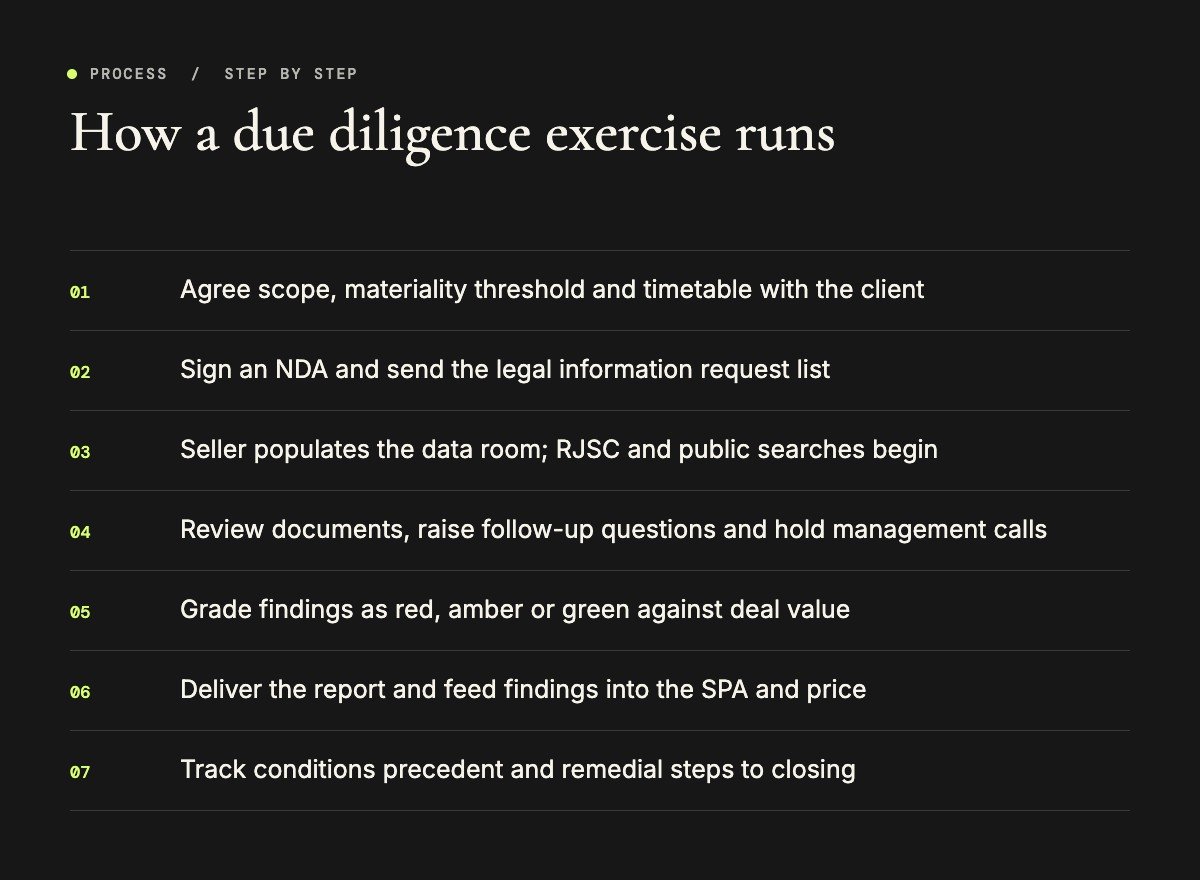
- Agree scope and timetable. Settle structure, materiality, look-back period, report format and deadlines with the client and other advisers.
- Issue the request list. After a non-disclosure agreement is signed, send a tailored legal information request list to the seller.
- Open the data room and start searches. The seller uploads documents while the legal team begins RJSC, land and court searches in parallel.
- Review and question. Lawyers review each document, log issues and send supplementary requests and questions to management.
- Grade the findings. Classify each issue as red, amber or green based on its effect on value, closing and ongoing operations.
- Report and negotiate. Deliver the report and translate findings into price adjustments, conditions, warranties and indemnities.
- Manage to closing. Track conditions precedent and remedial steps, and run a bring-down check just before completion.
Data-room checklist for legal due diligence in Bangladesh
A seller that prepares the data room properly saves time and signals a well-run business. Use this checklist as a starting point and tailor it to the sector.
Corporate
- Certificate of incorporation, memorandum and articles, all amendments
- Certified RJSC filings, statutory registers, share certificates and transfer deeds
- Board and general meeting minutes for the look-back period
- Shareholders, joint venture and investment agreements
Property and assets
- Title deeds, khatian, mutation records and land development tax receipts
- Leases, building approvals and occupancy documents
- Registers of plant, vehicles and intellectual property, including trademark certificates
Regulatory, finance and people
- All licences, registrations and renewals, with conditions
- Loan, security and guarantee documents and bank correspondence
- Tax returns, assessments, VAT returns and pending appeals
- Employee lists, service rules, standard contracts and benefit schemes
- Schedule of litigation, notices and regulatory correspondence
Uploading scanned land documents in Bangla without an index slows every reviewer down. Name files clearly, group them by plot, and add a short schedule linking each plot to its deeds, khatian and mutation. Reviewers can then focus on gaps rather than sorting paper.
Turning findings into deal protection
A report on legal due diligence in Bangladesh is only useful if its findings reach the transaction documents. Each issue should lead to one of four responses: walk away, adjust the price, require a fix before closing, or allocate the risk in the contract.
Conditions, warranties and indemnities
Fixable problems, such as unfiled RJSC returns or missing licence renewals, become conditions precedent. Known risks that cannot be fixed in time, such as a pending tax appeal, are best covered by a specific indemnity, sometimes backed by an escrow or retention from the price. General warranties then cover the unknown, and the disclosure letter records what the buyer was told.
Enforcement matters too. An indemnity from an individual seller with no assets outside the target is worth little. Consider retention, deferred consideration or a guarantee. The approach we take on structuring is explained on our mergers and acquisitions page.
Competition clearance
The Competition Act 2012 regulates combinations that may harm competition, and the Bangladesh Competition Commission has been developing combination regulations, which were still described as a draft in late 2025. Notification thresholds and filing practice are therefore not fully settled, so confirm the current position early whenever both parties have meaningful activity in Bangladesh.
Frequently asked questions about legal due diligence in Bangladesh
How long does legal due diligence in Bangladesh take?
For a single operating company with a ready data room, three to six weeks is realistic. Groups with several companies, factories and plots of land can take two months or more, mostly because land and court searches take time.
Is legal due diligence required by law?
Generally no. It is a commercial protection, not a statutory requirement. However, lenders, regulators and investment committees routinely require it, and directors of a buyer may be criticised for proceeding without it.
Can we rely on RJSC records alone?
No. RJSC records show only what has been filed. Transfers, allotments and charges are sometimes not filed, so the company's own registers and documents must be compared with the public record.
What is vendor due diligence?
Vendor due diligence is a review commissioned by the seller before marketing the business. It identifies and fixes problems early and gives buyers a starting report, which can shorten the sale process.
Who pays for legal due diligence in Bangladesh?
Each side normally pays its own advisers. The buyer pays for its review, and the seller pays for vendor due diligence and for preparing the data room.
How we can help
We carry out legal due diligence in Bangladesh for acquirers, investors and lenders, from red-flag reviews of start-ups to full reviews of manufacturing groups with extensive land holdings. We also prepare sellers for a sale and turn our findings into share purchase agreements that reflect them. Learn more about our mergers and acquisitions practice.
Planning an acquisition or investment?
We scope the review, run RJSC, land and court searches, and deliver a clear report graded by risk and tied to your deal documents.
Book a consultationM&A practicePrimary sources: statutes on the Laws of Bangladesh portal; company filings at the Registrar of Joint Stock Companies and Firms; foreign exchange rules from Bangladesh Bank; investment registration through BIDA.
This article is general information about Bangladeshi law as of 2026 and is not legal advice. Laws, fees and procedures change; confirm current requirements with the relevant authority or a qualified lawyer before acting.


0 Comments