
In commercial disputes, the damage often happens long before judgment. A temporary injunction in Bangladesh lets the court freeze the position while the suit is pending, stopping the sale of disputed property, the breach of a restrictive covenant or the misuse of a trademark. Order 39 of the Code of Civil Procedure 1908 sets out when and how the court will grant this relief.

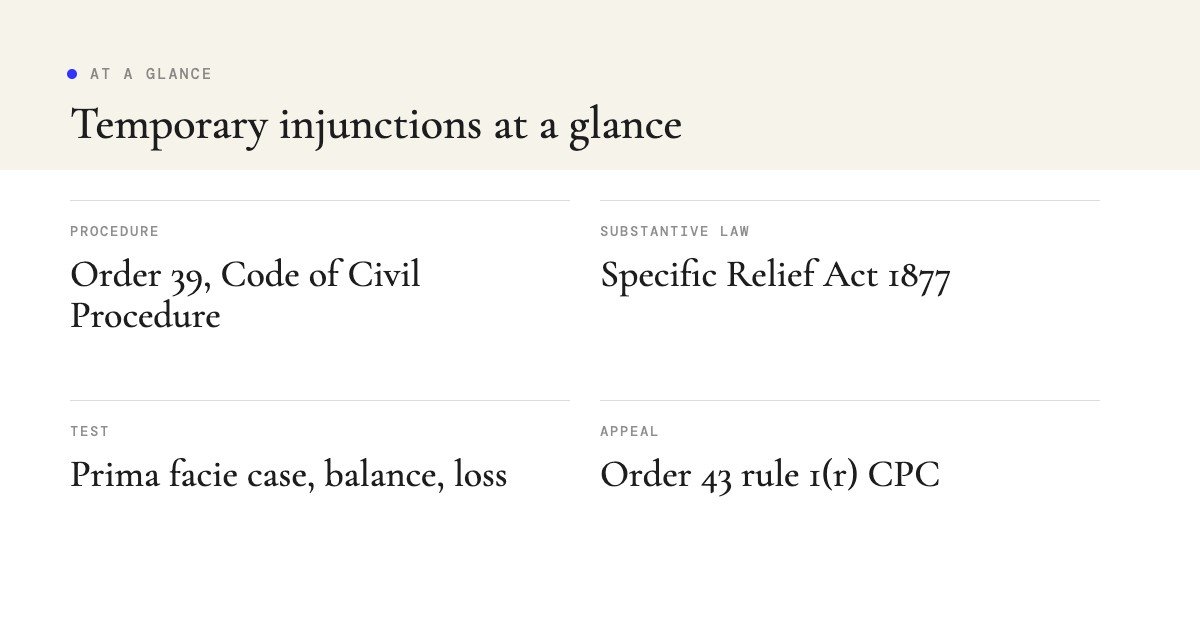
- Temporary injunctions are governed by section 53 of the Specific Relief Act 1877 and Order 39 of the Code of Civil Procedure 1908.
- The court must be satisfied of a prima facie case, a balance of convenience in the applicant's favour and irreparable loss.
- Ad interim orders can be granted before notice in urgent cases, but the court must record reasons.
- Orders under Order 39 rules 1, 2 and 4 are appealable under Order 43 rule 1(r).
- Disobedience can lead to attachment of property and civil detention under Order 39 rule 2A.
What a temporary injunction in Bangladesh does
A temporary injunction is an order that requires a party to refrain from doing something, or occasionally to do something, until the suit is decided or the court orders otherwise. It is different from a perpetual injunction, which is granted by decree at the end of the trial under section 54 of the Specific Relief Act 1877.
The purpose of a temporary injunction in Bangladesh is to preserve the subject matter of the suit and prevent the final decree from becoming meaningless. Our commercial litigation practice files and defends injunction applications in the District Courts and the High Court Division.
The legal framework
| Provision | Effect |
|---|---|
| Section 53, Specific Relief Act 1877 | Temporary injunctions are regulated by the Code of Civil Procedure |
| Section 56, Specific Relief Act 1877 | Lists situations where injunctions cannot be granted |
| Order 39 rule 1 CPC | Injunctions where property is in danger of waste, alienation or removal |
| Order 39 rule 2 CPC | Injunctions to restrain breach of contract or other injury |
| Order 39 rule 3 CPC | Notice to the opposite party, and ex parte orders in urgent cases |
| Order 39 rule 4 CPC | Discharge, variation or setting aside |
| Section 151 CPC | Inherent power where the rules do not cover the situation |

The three-part test
Courts consistently apply three tests before granting a temporary injunction in Bangladesh, and all three must be satisfied.
- Prima facie case. The applicant must show a serious question to be tried, not a certainty of success. The court looks at documents and pleadings without deciding the merits.
- Balance of convenience. The court compares the inconvenience to each side if the injunction is granted or refused and leans toward the lesser injustice.
- Irreparable loss. The applicant must show that money damages would not adequately compensate it if the injunction were refused and it later won.
Courts also consider the applicant's conduct. A party that delayed, came to court with unclean hands or concealed material facts may be refused relief even where the three tests are met.
When injunctions will be refused
Section 56 of the Specific Relief Act 1877 bars injunctions in several situations, including to stay proceedings in a court not subordinate to the court granting it, to prevent breach of a contract that could not be specifically enforced, and where equally efficacious relief can be obtained by another usual mode of proceeding. Courts also hesitate to restrain public bodies from performing statutory functions.
Understanding these limits early avoids wasted applications and helps shape the plaint so that a temporary injunction in Bangladesh remains available.
Ad interim and ex parte orders
Order 39 rule 3 requires the court to give notice to the opposite party before granting an injunction, unless the object of the injunction would be defeated by delay. Where the court grants an order without notice, it must record its reasons.
In practice, courts often grant an ad interim order of status quo or restraint for a short period, issue notice to show cause, and then hear both sides. The applicant must serve the order and the papers promptly, and the respondent can apply to vacate the order under Order 39 rule 4.
When seeking an ad interim temporary injunction in Bangladesh, prepare a short, clear chronology and attach the key documents. Judges hearing urgent matters have little time, and a well-organised file often makes the difference.
Temporary injunction in Bangladesh commercial cases
In commercial disputes, injunctions are commonly sought to restrain:
- Transfer or encumbrance of shares pending a shareholder dispute.
- Termination of a distribution or agency agreement where damages would be inadequate.
- Breach of confidentiality or non-compete covenants, subject to section 27 of the Contract Act 1872.
- Use of a registered trademark or passing off.
- Encashment of bank guarantees, which courts restrain only for fraud or special equities.
- Holding of company meetings or implementation of resolutions alleged to be unlawful.
Each scenario raises different considerations. For example, courts are cautious about restraining termination of a contract that is by nature determinable, because section 21 and section 56 of the Specific Relief Act limit specific enforcement of such contracts.
Injunctions in land and property disputes
Land disputes account for a large share of injunction applications. Plaintiffs commonly seek orders restraining dispossession, construction or transfer of disputed land. The court examines title documents, record of rights, mutation and possession evidence to decide whether a prima facie case exists.
Where possession is disputed, the court may order the parties to maintain the status quo or appoint a commissioner to report on the position on the ground. A temporary injunction in Bangladesh against transfer of land is often combined with a request that the sub-registry be informed.
Step by step
- File the suit. An injunction is ancillary to a suit, so the plaint must disclose a cause of action and seek final relief.
- Draft the application. Cite the correct rule of Order 39 and the specific acts to be restrained.
- Prepare the affidavit. Verify facts and attach contracts, title documents and correspondence.
- Request ad interim relief. Explain why the matter cannot wait for notice.
- Serve notice. Serve the defendant promptly with the order and papers.
- Argue the hearing. Address each element of the three-part test.
- Enforce or appeal. Seek enforcement for disobedience or file a miscellaneous appeal.
Appeals and revision
An order granting or refusing a temporary injunction in Bangladesh under Order 39 rules 1, 2 or 4 is appealable as a miscellaneous appeal under Order 43 rule 1(r) of the Code. Appeals from the Joint District Judge or Senior Assistant Judge typically go to the District Judge, and from the District Judge to the High Court Division, depending on valuation and the court that made the order.
Parties may also seek interim relief from the appellate court pending the appeal. In some situations a civil revision under section 115 may be the appropriate route; the choice should be checked carefully.
Disobedience and contempt
Under Order 39 rule 2A, where a person disobeys an injunction, the court may order attachment of their property and detention in civil prison for up to six months, unless the court directs release. If the disobedience continues for a year, the attached property may be sold and compensation paid to the injured party.
Strong enforcement tools make a temporary injunction in Bangladesh effective in practice, but the applicant must prove disobedience with evidence such as photographs, commissioner reports or documents.
Defending an injunction application
A respondent should file a written objection promptly, challenging each element of the test. Useful arguments include delay by the applicant, adequacy of damages, the existence of an arbitration clause, the bar under section 56 and suppression of material facts.
The respondent can also offer an undertaking or security in place of an injunction, which courts sometimes accept as a fair middle ground in commercial cases. A respondent facing a temporary injunction in Bangladesh should act within days, not weeks, because an unchallenged ad interim order tends to be extended.
Arbitration clauses and injunctions
Where the contract contains an arbitration clause, the defendant may apply under section 10 of the Arbitration Act 2001 to refer the dispute to arbitration. The court may then decline to continue the suit, but interim relief can still be sought under section 7A of that Act. Choosing the correct route at the outset avoids procedural objections. A party that files a suit purely to obtain a temporary injunction in Bangladesh, despite an arbitration clause, risks having the suit stayed and the order discharged.
Mandatory injunctions at the interim stage
Most orders restrain conduct, but courts occasionally grant a mandatory temporary injunction in Bangladesh requiring a party to restore the position, for example to reconnect a utility or return goods taken unlawfully just before the suit. Because such orders effectively grant final relief early, courts require a strong case, usually where the defendant acted hastily to pre-empt the court.
Applicants seeking a mandatory temporary injunction in Bangladesh should show clearly that the status quo was disturbed recently and that restoring it causes the defendant little unfair prejudice.
Drafting tips that make a difference
- Describe the acts to be restrained precisely, so the order is clear and enforceable.
- Identify property by schedule, including mouza, khatian and dag numbers for land.
- Explain the urgency in the first page of the application.
- Address delay openly and give reasons for any gap.
- Offer an undertaking in damages where appropriate.
A focused application for a temporary injunction in Bangladesh is easier for the court to grant and harder for the other side to challenge on appeal.
How long an injunction lasts
A temporary injunction in Bangladesh normally lasts until the disposal of the suit or until further order. Courts can vary or vacate it if circumstances change, and an ad interim order lapses if the court does not extend it at the hearing. Parties should diarise hearing dates carefully, because failing to appear can lead to the order being vacated.
Because suits can take years, the respondent may later apply to vary a temporary injunction in Bangladesh on the ground that the position has changed, for example where the disputed property has been valued and security can be offered instead.
Frequently asked questions about temporary injunction in bangladesh
What law governs temporary injunctions?
Section 53 of the Specific Relief Act 1877 and Order 39 of the Code of Civil Procedure 1908.
Can an injunction be granted without hearing the other side?
Yes, in urgent cases under Order 39 rule 3, with reasons recorded.
What test does the court apply?
Prima facie case, balance of convenience and irreparable loss.
Can I appeal an injunction order?
Yes, as a miscellaneous appeal under Order 43 rule 1(r).
What happens if the order is disobeyed?
Attachment of property and civil detention of up to six months under Order 39 rule 2A.
Can I get an injunction without filing a suit?
Generally no. A temporary injunction is ancillary to a pending suit, except under special statutes such as the Arbitration Act.
How we can help
We obtain and resist temporary injunction in Bangladesh applications in commercial, corporate, intellectual property and land disputes. Learn more about our commercial litigation practice, our guide to types of civil cases and our Supreme Court practice.
Need urgent protection?
We prepare injunction applications quickly and appear for urgent hearings.
Book a consultationLitigation practicePrimary sources: the Code of Civil Procedure 1908 and the Specific Relief Act 1877 on the Laws of Bangladesh portal; case law from the Supreme Court of Bangladesh.
This article is general information about Bangladeshi civil procedure as of October 2026 and is not legal advice. Injunctions are discretionary and depend on the facts.

0 Comments