
An arbitration award is only as valuable as the assets left to satisfy it. Interim measures in arbitration let a party freeze assets, preserve evidence or stop a breach while the dispute is being decided. Under the Arbitration Act 2001, both the courts and the arbitral tribunal can grant interim relief, and choosing the right forum, at the right time, often decides whether the final award can actually be enforced.
- Section 7A of the Arbitration Act 2001 empowers the court to grant interim measures in arbitration before or during the proceedings.
- Section 21 lets the arbitral tribunal order a party to take interim measures of protection once it is constituted.
- For international commercial arbitration the competent court is the High Court Division; for domestic arbitration it is the District Judge's court.
- Courts apply familiar injunction principles: a prima facie case, balance of convenience and irreparable loss.
- Tribunal orders bind the parties, but court support is often needed against third parties such as banks.
Why interim measures in arbitration matter
Commercial disputes rarely pause while the parties argue. A counterparty may move funds offshore, sell the goods in dispute, encash a bank guarantee or destroy records. Arbitration in Bangladesh can take a year or more from notice to award, and enforcement adds further time.
Interim measures in arbitration fill that gap. They protect the subject matter of the dispute and the claimant's ability to recover. Without them, a party may win the case and still recover nothing. Our international arbitration practice regularly advises on urgent applications at the start of a dispute.
The court's power under section 7A
Section 7A, inserted into the Arbitration Act 2001 by the 2004 amendment, allows a party to apply to the court for interim orders before or during arbitral proceedings. The court may make orders for the appointment of a guardian for a minor or person of unsound mind, the preservation, interim custody or sale of goods, securing the amount in dispute, detention, preservation or inspection of property, interim injunctions and the appointment of a receiver.
The court decides interim measures in arbitration using the same principles that guide temporary injunctions under the Code of Civil Procedure 1908. The applicant must show a prima facie case, that the balance of convenience favours relief and that it would suffer irreparable loss without it. Applicants should also show they intend to pursue arbitration promptly.
Which court has jurisdiction
| Type of arbitration | Competent court |
|---|---|
| Domestic arbitration seated in Bangladesh | Court of the District Judge with jurisdiction |
| International commercial arbitration seated in Bangladesh | High Court Division |
| Arbitration seated outside Bangladesh | Court relief is generally available in support; take advice on the forum |
Following the 2004 amendment, interim relief under section 7A is generally understood to be available in support of foreign-seated arbitrations where assets are located in Bangladesh. Courts look at the facts closely, so the application should explain why relief is needed here and why the foreign tribunal cannot provide effective protection.
The tribunal's power under section 21
Once the arbitral tribunal is constituted, it can order a party to take interim measures of protection in respect of the subject matter of the dispute, unless the parties have agreed otherwise. The tribunal may also require security in connection with such a measure.
Tribunal-ordered interim measures in arbitration are often faster and more flexible than court relief, and the tribunal already understands the dispute. Their weakness is enforcement: a tribunal cannot bind a bank or other third party, and a party that ignores the order may need to be brought before the court.
Choosing between court and tribunal
| Factor | Court under section 7A | Tribunal under section 21 |
|---|---|---|
| Available before tribunal formed | Yes | No (unless emergency arbitrator rules apply) |
| Binds third parties | Yes | No |
| Ex parte relief | Possible in urgent cases | Depends on rules |
| Confidentiality | Public court record | Private |
| Coercive enforcement | Contempt and court process | Requires court assistance |
In practice, many parties seek interim measures in arbitration from the court first, because the tribunal has not yet been formed, and then ask the tribunal to continue or vary the protection once it is in place.
Emergency arbitrators and institutional rules
Institutional rules such as those of the ICC, SIAC and the Bangladesh International Arbitration Centre provide procedures for urgent relief. Emergency arbitrator provisions in international rules allow a party to obtain interim measures before the full tribunal is constituted.
The Arbitration Act 2001 does not expressly address emergency arbitrators, so enforcing such orders in Bangladesh is uncertain. Parties who need protection over assets in Bangladesh usually combine an emergency arbitrator application with a court application under section 7A.
Common types of interim relief
- Freezing or attachment. Restraining a party from dealing with bank accounts, shares or property up to the value of the claim.
- Injunctions against bank guarantee encashment. Courts grant these sparingly, usually only for fraud or special equities.
- Preservation of goods. Orders to store, inspect or sell perishable goods.
- Receivers. Appointment of a receiver to manage property or a business.
- Status quo orders. Preventing termination of a contract or transfer of shares pending the award.
Preparing a strong application
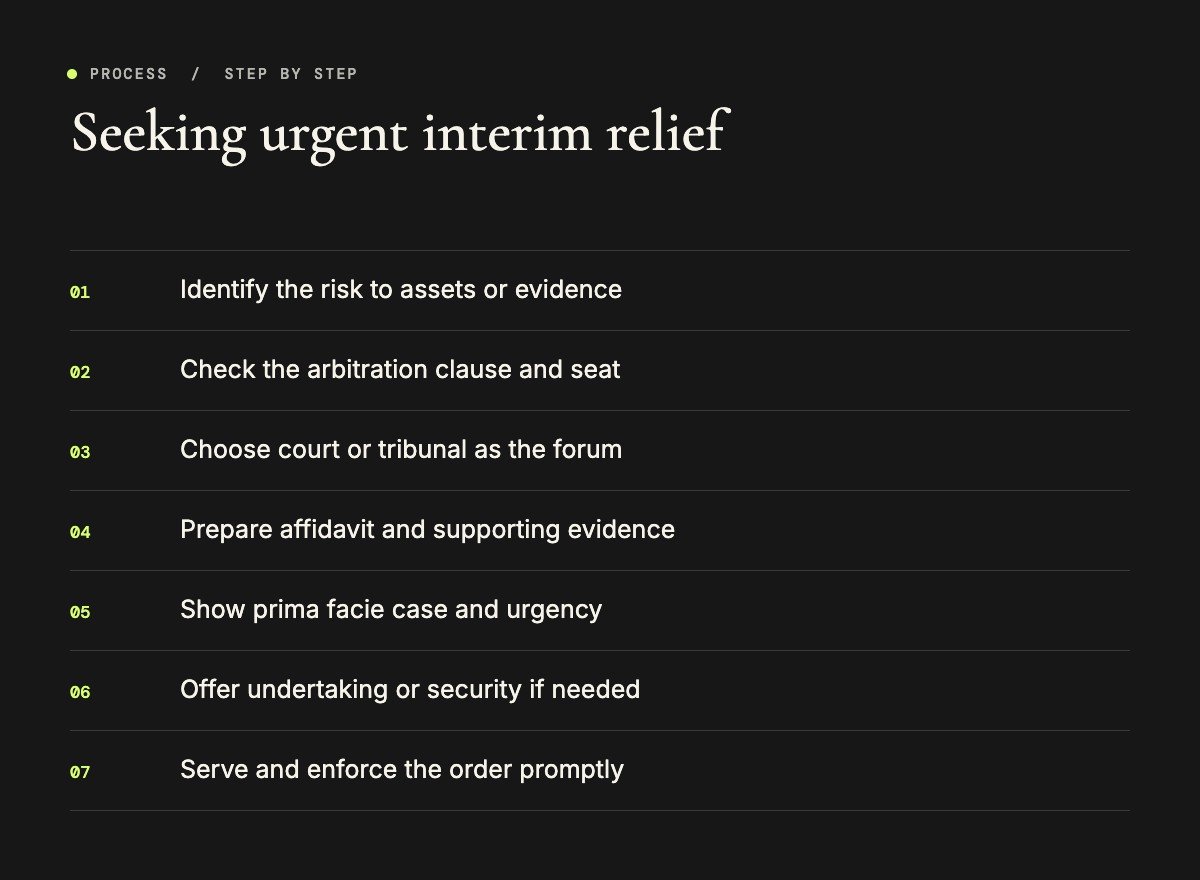
- Identify the risk. Gather evidence that assets are being moved or evidence is at risk.
- Check the clause. Confirm the arbitration agreement, seat and governing rules.
- Choose the forum. Decide between the court and the tribunal, or both.
- Draft the affidavit. Set out the facts, the contract and the urgency clearly.
- Show the legal test. Address prima facie case, balance of convenience and irreparable loss.
- Offer security. Be prepared to give an undertaking in damages.
- Serve and monitor. Serve the order on the party and any bank or registry promptly.
Delay is the most common reason applications for interim measures in arbitration fail. If you wait months after learning of the risk, the court may conclude there is no real urgency. Move quickly and explain any gap in the affidavit.
Bank guarantees and letters of credit
Many disputes involve performance guarantees. Bangladeshi courts treat a bank guarantee as an independent obligation and are reluctant to restrain encashment. An injunction is normally granted only where there is established fraud of which the bank has notice, or special equities such as irretrievable injustice.
Parties seeking interim measures in arbitration against guarantee encashment should prepare strong documentary evidence and expect close scrutiny.
Interim measures in arbitration and foreign tribunals
Foreign investors with SIAC, ICC or LCIA clauses frequently need protection over assets in Bangladesh. An order from a foreign tribunal is not directly enforceable as a decree, so local court support is essential.
The application should attach the arbitration agreement and the notice of arbitration, and explain the link between the foreign proceedings and the assets here. See our guide to enforcement of arbitral awards for what happens after the award.

Costs, undertakings and wrongful orders
An applicant may be asked to give an undertaking to compensate the respondent if the order turns out to be wrongly granted. Tribunals can also require security.
A party that obtains interim measures in arbitration without full and frank disclosure risks having the order discharged and paying costs. Careful, honest drafting is therefore not only ethical but practical.
Evidence the court expects to see
Judges deciding interim measures in arbitration want documents, not assertions. A strong affidavit attaches the contract and arbitration clause, the correspondence showing the dispute, invoices or statements proving the amount claimed, and specific evidence of the risk, such as board resolutions to sell assets, notices to close accounts or reports of goods being moved.
Where the risk is dissipation of assets, the applicant should identify the assets as precisely as possible: the bank and branch, the land by mouza and plot, or the shares by company. Broad requests to freeze "all assets" are less likely to succeed and harder to enforce.
Ex parte applications and notice
In genuinely urgent cases, the court may grant an ad interim order without hearing the other side, usually for a short period until a full hearing. The applicant must show that giving notice would defeat the purpose of the order, for example because funds would be moved overnight.
An ex parte order for interim measures in arbitration carries a heavy duty of candour. The applicant must disclose facts that favour the respondent, including any defences raised in correspondence. Failing to do so is a common ground for discharging the order at the return hearing.
Duration, variation and discharge
Court orders under section 7A usually continue until the award or further order, but the respondent can apply to vary or discharge them. Courts may substitute security for a freezing order, for example by allowing the respondent to provide a bank guarantee for the claimed amount and resume normal trading.
Once the tribunal is constituted, it can take over the management of interim measures in arbitration. Many courts are content to let the tribunal decide whether protection should continue, provided the order remains effective in the meantime.
Drafting arbitration clauses with interim relief in mind
Careful drafting at the contract stage makes urgent protection easier later. A well-drafted clause names the seat clearly, chooses institutional rules that include emergency arbitrator provisions, and expressly preserves each party's right to seek court relief.
Parties negotiating contracts with Bangladeshi counterparties should consider whether assets are likely to be in Bangladesh, and if so how interim measures in arbitration would be obtained. Our guide to the arbitration process in Bangladesh explains the wider procedure.
Practical timing
Applications to the High Court Division can be listed quickly where urgency is shown, while District Judge's courts vary in their listing practices. Preparing the papers, sworn affidavit and certified documents typically takes several days, so clients should instruct lawyers as soon as the risk appears.
Planning ahead is the single most effective way to secure interim measures in arbitration before assets disappear.
Frequently asked questions about interim measures in arbitration
Can a court in Bangladesh grant interim relief before arbitration starts?
Yes. Section 7A allows applications before or during the arbitral proceedings.
Which court hears applications in international arbitration?
The High Court Division hears applications in international commercial arbitration.
Can the arbitral tribunal order interim measures?
Yes. Under section 21 the tribunal can order interim measures of protection unless the parties agreed otherwise.
Are tribunal orders binding on banks?
No. Tribunal orders bind the parties; court orders are needed against third parties.
Is relief available for foreign-seated arbitration?
Courts generally consider such applications where assets are in Bangladesh; advice on the forum is essential.
What test does the court apply?
A prima facie case, balance of convenience and irreparable loss, as for temporary injunctions.
How we can help
We advise on interim measures in arbitration for domestic and foreign clients, from urgent applications in the High Court Division to tribunal applications and enforcement against banks and registries. Learn more about our international arbitration practice and our commercial litigation team.
Assets at risk in a dispute?
We prepare and file urgent applications quickly to protect your position.
Book a consultationArbitration practicePrimary sources: the Arbitration Act 2001 and the Code of Civil Procedure 1908 on the Laws of Bangladesh portal; judgments from the Supreme Court of Bangladesh.
This article is general information about Bangladeshi arbitration law as of October 2026 and is not legal advice. Outcomes depend on the facts and the court's discretion.




0 Comments