
A renewable energy project in Bangladesh today usually means solar: utility-scale plants selling power to the grid, rooftop systems on factories, and solar irrigation. Government targets for clean power have risen, but projects succeed only when land, licensing, the power purchase agreement and the tariff are all bankable.
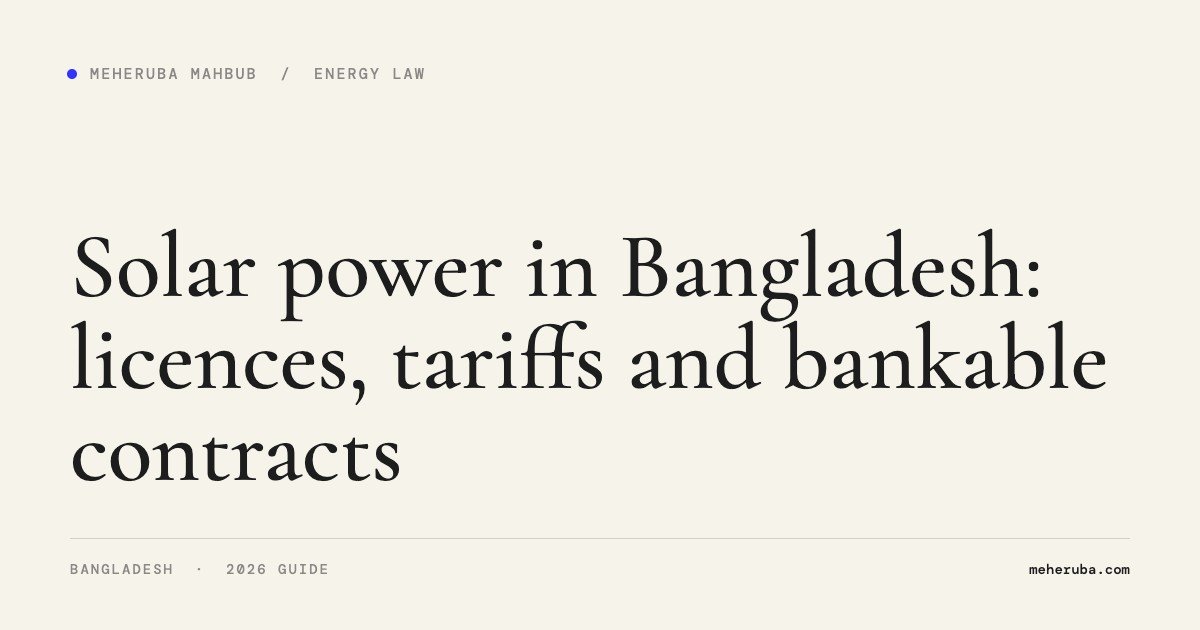
- Utility-scale solar IPPs normally sell power to the Bangladesh Power Development Board (BPDB) under a long-term power purchase agreement, with government support through an implementation agreement.
- Since 2024, the government has moved to competitive tendering for new projects after repealing the Quick Enhancement of Electricity and Energy Supply (Special Provisions) Act 2010.
- Generation licences are issued by the Bangladesh Energy Regulatory Commission under the Bangladesh Energy Regulatory Commission Act 2003.
- Land is the hardest constraint: solar needs large contiguous sites, and the law and policy discourage use of fertile agricultural land.
- Rooftop solar for factories and buildings can be connected under the net metering guidelines, which are simpler than an IPP route.
Under the Invest Bangladesh Act 2026, effective 23 August 2026, the Bangladesh Investment Development Authority (BIDA), the Bangladesh Economic Zones Authority (BEZA) and the PPP Authority were merged into a single body, Invest Bangladesh. References below to BIDA, BEZA or the PPP Authority should be read as references to Invest Bangladesh. BEPZA continues as a separate authority.
Why a renewable energy project in Bangladesh is mostly solar
Bangladesh has limited hydropower potential and modest wind resources in most areas, although coastal wind is being studied. Solar irradiation is good across the country, and the cost of solar modules has fallen sharply. As a result, nearly every new renewable energy project in Bangladesh is a solar project, either grid-connected or behind the meter.
The Sustainable and Renewable Energy Development Authority (SREDA), established under the Sustainable and Renewable Energy Development Authority Act 2012, coordinates renewable energy policy and promotion. The Power Division of the Ministry of Power, Energy and Mineral Resources sets procurement policy, BPDB buys power, and BERC licenses and regulates. A renewable energy policy sets national targets; newer policy instruments have been issued in recent years, so check the current version before relying on any target figure.
Main project types
| Project type | Typical buyer | Main legal route |
|---|---|---|
| Utility-scale solar IPP | BPDB | Tender, PPA, implementation agreement, BERC licence |
| Rooftop solar (net metering) | Own use, surplus to distribution utility | Net metering guidelines and distribution utility approval |
| Rooftop solar for third parties (RESCO) | Factory or building owner | Private power or lease agreement, licensing check |
| Solar irrigation and mini-grids | Farmers and rural consumers | Programme rules, often with IDCOL financing |
| Floating or canal-top solar | BPDB or utility | As for IPPs, plus water body permissions |
Procurement: how solar IPPs are awarded
For years, many power projects, including more than one renewable energy project in Bangladesh, were awarded through unsolicited proposals and direct negotiation under the Quick Enhancement of Electricity and Energy Supply (Special Provisions) Act 2010, which limited challenges to award decisions. That law was repealed in late 2024, and the government has since reviewed contracts signed under it and moved towards open, competitive tendering for new solar capacity.
In current practice, the Power Division or BPDB issues requests for proposals for specified capacity, sometimes on government-identified land, and bidders compete mainly on tariff. A renewable energy project in Bangladesh may also be procured as a public-private partnership under the Bangladesh Public-Private Partnership Act 2015 with the PPP Authority's involvement. The Public Procurement Act 2006 and its rules apply to procurement by public entities.
Procurement rules in the power sector have changed quickly since 2024. Before investing in development costs, confirm whether the project will be tendered, which agency runs it, whether land is provided, and what bid security and performance security will be required. Treat any older guidance on unsolicited proposals with caution.
Bid requirements
For a renewable energy project in Bangladesh, requests for proposals typically ask for evidence of technical experience, financial capacity, a credible land and grid connection plan, a bid security and a tariff offer. Consortium bidders should agree a consortium agreement early, covering roles, equity shares and what happens if the bid succeeds. The successful bidder normally forms a Bangladeshi project company to sign the project agreements.

Licensing a renewable energy project in Bangladesh
Under the Bangladesh Energy Regulatory Commission Act 2003, generation of electricity above the thresholds set by BERC requires a licence from the Commission. For a renewable energy project in Bangladesh, the project company applies with corporate documents, technical details, the PPA or letter of intent, land documents and environmental clearance, and pays the licence fee set by BERC regulations. Licences are subject to conditions and must be renewed.
Environmental clearance
The Environment Conservation Act 1995 and the Environment Conservation Rules require environmental clearance from the Department of Environment. Projects are categorised by environmental risk, and the category decides whether an initial environmental examination, an environmental impact assessment or both are required. The Environment Conservation Rules were replaced in 2023, so applicants should check the current categorisation. Our guide on how to get an environment licence in Bangladesh explains the process.
Other permits
Depending on the site, a renewable energy project in Bangladesh may also need investment registration with BIDA (or BEZA for zone projects), a trade licence, approvals from local government, permission for use of water bodies for floating solar, and grid connection approval from the transmission or distribution utility. Lenders will treat each of these as a condition precedent.
Land for a renewable energy project in Bangladesh
A utility-scale plant needs several acres for each megawatt of capacity, and contiguous parcels are hard to assemble in a densely populated country with fragmented ownership. Government policy discourages using fertile agricultural land for solar and favours unused, low-productivity or government-identified land, char land, or rooftops.
Developers usually buy land, lease it long-term from private owners, or lease government khas or authority land. Each route requires careful title work: chain of title through CS, SA, RS and BS khatians, mutation records, land development tax receipts, and checks for vested property or acquisition proceedings. Lease terms should match the PPA term plus construction and decommissioning. Our land registration guide covers the registration side.
Land use and acquisition risks
Changing land use classification may need approval, and conversion of agricultural land is restricted by policy. Where the government provides land, the developer's rights depend on the lease or allotment terms. Disputes with local communities over access, drainage and compensation can delay construction, so engagement and fair compensation are both a legal and a practical safeguard.
PPA and tariffs for a renewable energy project in Bangladesh
The power purchase agreement is the revenue foundation of any grid-connected renewable energy project in Bangladesh, and lenders read it first. Solar PPAs with BPDB have typically been for around twenty years from commercial operation, with a single tariff per kilowatt-hour for energy delivered. Tariffs have been expressed in US dollars or linked to the dollar, and paid in taka at the prevailing exchange rate, which shifts exchange rate risk to the offtaker.
Key PPA terms
- Tariff and indexation. Whether the tariff is fixed for the whole term or escalates, and the currency basis.
- Must-run and curtailment. Whether BPDB must take all energy produced and whether the project is compensated for grid curtailment.
- Deemed energy. Payment when the plant is available but cannot deliver because of grid failure.
- Payment security. Letters of credit or government guarantees supporting BPDB's payment obligations.
- Termination payments. Compensation on default or political force majeure, ideally covering senior debt.
- Change in law and tax. Pass-through of new taxes or duties affecting the project.
Tariff trends matter for investors. Competitive tendering has put downward pressure on solar tariffs compared with earlier negotiated deals. Because tariff outcomes depend on each tender, we do not quote figures here; refer to published tender results and BERC or Power Division announcements.
Implementation agreement
Alongside the PPA, the government usually signs an implementation agreement with the project company. It may provide a government guarantee of BPDB's payment obligations, foreign exchange convertibility assurances, protection against discriminatory change in law, and buy-out obligations on termination. These protections are central to bankability for foreign lenders.
EPC and O&M contracts for a renewable energy project in Bangladesh
A solar renewable energy project in Bangladesh is technically simpler than a thermal plant, but the construction contract still carries most of the risk before commercial operation. Developers usually appoint an EPC contractor on a turnkey basis, sometimes splitting the supply of modules and inverters from the local construction and installation work to manage customs, tax and permanent establishment issues. Split contracts need a wrap or interface agreement so that no gap in responsibility is left with the project company.
Lenders look for a fixed price, a guaranteed completion date, delay liquidated damages sized to cover lost revenue and debt service, and performance guarantees measured by a performance ratio test at completion. Module and inverter warranties from manufacturers should be assignable to the project company and to lenders. Many contracts are based on FIDIC forms adapted to Bangladeshi law; see our EPC and O&M contracts practice for the key amendments.
Operation and maintenance
After commercial operation, an O&M contractor maintains the plant, cleans modules (a significant issue in dusty and monsoon conditions), replaces failed equipment and reports to the offtaker. Availability guarantees and performance bonuses or penalties align the operator with the PPA. Spare parts, security of the site and insurance for flood and cyclone risk deserve particular attention in Bangladesh.
Import, customs and VAT
Modules, inverters and mounting structures are generally imported. Customs duty, VAT under the VAT and Supplementary Duty Act 2012 and advance income tax at import stage can all affect project cost, and concessions available for renewable equipment depend on the current customs schedule and statutory regulatory orders. Confirm the treatment of each equipment category before fixing the EPC price, and allocate the risk of later changes in the contract.
Net metering and rooftop solar
Not every renewable energy project in Bangladesh needs an IPP structure. Factories, commercial buildings and homes can install rooftop solar under the net metering guidelines, exporting surplus electricity to the distribution utility and receiving a credit against their bill. The guidelines set capacity limits relative to the sanctioned load, technical standards and the application process with the distribution company, such as DPDC, DESCO, REB or the relevant power distribution company.
Export-oriented manufacturers are making rooftop systems their first renewable energy project in Bangladesh because international buyers increasingly ask for renewable energy use. Third-party ownership models, where a solar company owns the system and sells power or leases equipment to the building owner, are growing, but the licensing position of such sales should be checked case by case.
Steps to develop a renewable energy project in Bangladesh
- Screen the opportunity. Confirm the procurement route, capacity, site options and grid connection point.
- Secure the land. Complete title due diligence and sign purchase or lease agreements, or confirm the government site terms.
- Submit the bid. Prepare the technical and financial proposal, bid security and consortium documents.
- Form the project company. Incorporate with RJSC and register the investment with BIDA or BEZA.
- Sign the project agreements. Negotiate and sign the PPA, implementation agreement and grid connection agreement.
- Obtain licences and clearances. Apply for the BERC generation licence, environmental clearance and local permits.
- Close financing. Sign facility and security documents, the EPC contract and insurances, and satisfy conditions precedent.
- Build and commission. Construct, test, connect and achieve commercial operation under the PPA.
Financing and incentives
A utility-scale renewable energy project in Bangladesh is typically financed on a project finance basis, with lenders looking to PPA revenues and taking security over the project company's assets, contracts and shares. Infrastructure Development Company Limited (IDCOL), a state-owned financier, has long supported renewable energy, including solar home systems, irrigation and mini-grids. Development finance institutions and green bonds are also used. See our guide to project finance for the security package in detail.
Incentives have included income tax exemptions for private power generation companies for defined periods and duty concessions on solar equipment. These change with each Finance Act and depend on the commercial operation date, so model incentives on the law in force when the project will begin operation and include a change-in-law clause in the PPA. Bangladesh Bank has also run refinancing schemes for green investment through banks.
Foreign investment considerations
Foreign sponsors of a renewable energy project in Bangladesh bring equity through banking channels and register with BIDA. Foreign loans need approval under foreign exchange rules. Because revenues are paid in taka, availability of dollars to service foreign debt and pay dividends is an important risk, and lenders will look at the convertibility assurances in the implementation agreement.
Disputes, change in law and decommissioning
Disputes in a renewable energy project in Bangladesh usually concern payment delays by the offtaker, curtailment compensation, change-in-law claims and delays in grid connection. PPAs and implementation agreements typically provide for negotiation, expert determination for technical issues, and arbitration. The seat and rules vary; some agreements use Dhaka-seated arbitration under the Arbitration Act 2001 and others international institutions. Bangladesh is a party to the New York Convention, which supports enforcement of foreign awards.
Recent reviews of power contracts signed under the repealed special law show that contract terms can come under political and legal scrutiny long after signing. Investors should keep complete records of the procurement process, approvals and tariff justification, and should consider political risk insurance or development finance participation for larger projects.
End of term and decommissioning
The PPA and land documents should say what happens at the end of the term: whether the plant transfers to the government, whether the PPA can be extended, and who is responsible for removing equipment and restoring land. Disposal of modules and batteries raises environmental questions under the Environment Conservation Act 1995 and hazardous waste rules, so decommissioning obligations and a reserve for their cost belong in the financial model from the start.
Common mistakes in solar development
- Weak land title. Signing leases with owners whose title has gaps or co-sharer claims.
- Grid assumptions. Assuming a substation can absorb the plant's output without confirming capacity and timing.
- Old procurement models. Spending on unsolicited proposals without confirming the current procurement route.
- Curtailment exposure. PPAs that do not compensate for grid unavailability.
- Misaligned EPC terms. Delay and performance guarantees in the EPC contract that do not match PPA obligations.
- Ignoring community issues. Inadequate engagement with landowners and local communities, leading to construction delays.
Frequently asked questions about renewable energy project in Bangladesh
Who buys power from a renewable energy project in Bangladesh?
For utility-scale projects, BPDB is the usual single buyer under a long-term PPA. Rooftop projects mainly serve the building owner, with surplus exported under net metering.
Is a BERC licence required for solar?
Generation above the thresholds set by BERC requires a licence under the Bangladesh Energy Regulatory Commission Act 2003. Small rooftop systems for own use follow the net metering rules instead.
Can unsolicited proposals still be submitted?
The special law that facilitated directly negotiated power deals was repealed in 2024, and new capacity is being procured mainly by tender. Confirm the current policy before investing in an unsolicited proposal.
Can foreign companies own a solar IPP?
Yes. Foreign sponsors commonly own solar project companies, subject to BIDA registration, foreign exchange rules and the terms of the tender.
What tariff can a solar IPP expect?
Tariffs are set through competitive bidding for each tender. Check published results and the tender documents rather than relying on figures from earlier negotiated projects.
How we can help
We advise developers, investors, lenders and EPC contractors on every renewable energy project in Bangladesh, from bids and land due diligence to PPAs, licensing and financing. Learn more about our infrastructure and energy practice.
Developing solar in Bangladesh?
We review tenders and PPAs, run land title diligence, and manage licensing and financing documents so your project reaches commercial operation.
Book a consultationInfrastructure and energy practicePrimary sources: the Bangladesh Energy Regulatory Commission Act 2003 and Environment Conservation Act 1995 on the Laws of Bangladesh portal; licensing from BERC; procurement and offtake from BPDB; environmental clearance from the Department of Environment.
This article is general information about Bangladeshi law as of 2026 and is not legal advice. Energy policy, tariffs, incentives and procurement rules change; confirm the current position with the relevant authority or a qualified lawyer before acting.


0 Comments