
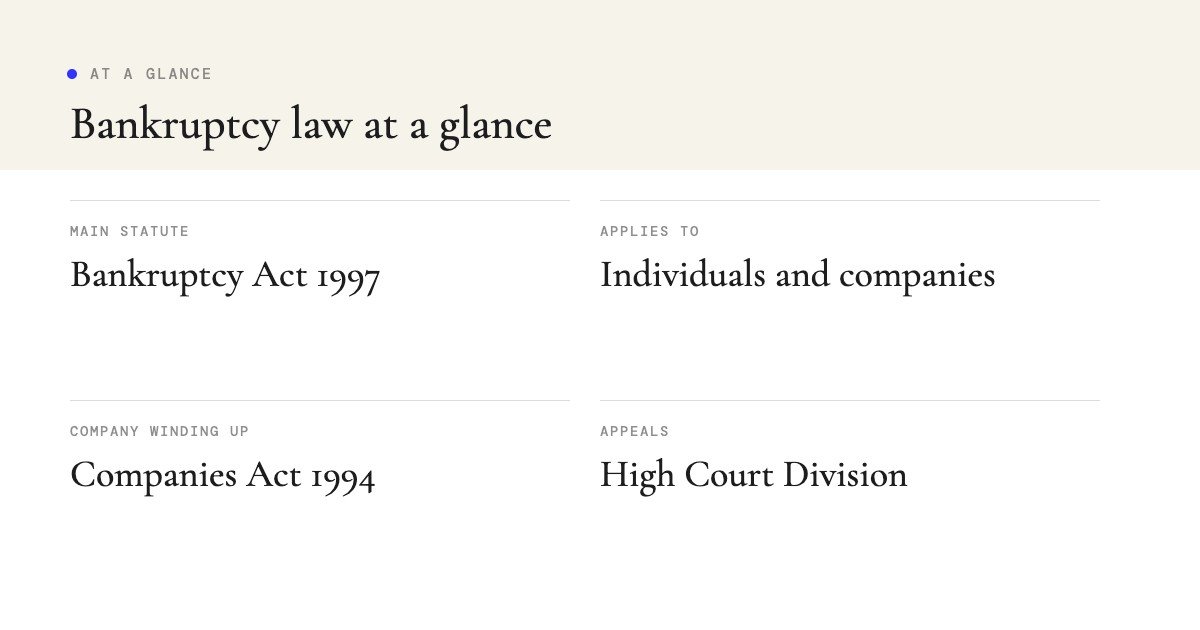
Insolvency law in Bangladesh rests mainly on the Bankruptcy Act 1997, supported by the winding-up provisions of the Companies Act 1994 and the Artha Rin Adalat Ain 2003. The framework is old and slow, but used well it still gives creditors real leverage and gives honest debtors a route to a fresh start.
- The Bankruptcy Act 1997 covers both individuals and companies, and replaced the colonial-era Presidency Towns Insolvency Act 1909 and Provincial Insolvency Act 1920.
- A creditor can petition only for an unsecured, due debt above the statutory threshold, generally Tk 5 lakh under the Act as enacted, and must show an act of bankruptcy.
- Companies are more often wound up under the Companies Act 1994 before the company bench of the High Court Division.
- Banks usually recover through the Artha Rin Adalat first; bankruptcy is a second-stage tool.
- A unified, rescue-focused insolvency code has been proposed; check whether it has been enacted before relying on the 1997 regime.
Why insolvency law in Bangladesh matters
Every business eventually meets a counterparty that cannot pay. For a supplier, a lender or an investor, what happens next depends on insolvency law in Bangladesh: how quickly assets can be frozen, who gets paid first, and whether the business can be rescued or must be liquidated.
For debtors, the same law decides whether an honest failure ends in a fresh start or years of litigation. Directors of a struggling company also need to understand it, because conduct in the months before collapse can later be examined by a receiver or liquidator.
In practice, insolvency law in Bangladesh is used far less than in many other jurisdictions. Commentators have long noted that bankruptcy orders were frequently challenged in revision before the High Court Division and stayed, and that banks prefer the Artha Rin Adalat. Even so, the threat of a bankruptcy petition remains a powerful negotiating tool when it is used correctly.
The legal framework of insolvency law in Bangladesh
There is no single insolvency code. Instead, insolvency law in Bangladesh is spread across several statutes, each designed for a different situation.
| Statute | What it covers | Forum |
|---|---|---|
| Bankruptcy Act 1997 | Bankruptcy of individuals, firms and companies; receivers, distribution and discharge | Bankruptcy court, with appeal to the High Court Division |
| Companies Act 1994 | Winding up of companies by the court, voluntary winding up, schemes of arrangement | Company bench of the High Court Division |
| Artha Rin Adalat Ain 2003 | Recovery of dues by banks and financial institutions | Artha Rin Adalat (money loan court) |
| Bank Resolution Ordinance 2025 | Resolution of failing banks by Bangladesh Bank | Administrative, led by Bangladesh Bank |
| Public Demands Recovery Act 1913 | Recovery of certain public dues as arrears | Certificate officers |
The Bankruptcy Act 1997
The 1997 Act consolidated the old insolvency statutes and, for the first time, made clear that companies and other legal entities can be adjudged bankrupt as well as individuals. It was also intended as a recovery tool in response to the loan default problem of the 1990s, which explains its creditor-friendly features.
The Companies Act 1994
For companies, the winding-up provisions of the Companies Act 1994 are the more familiar route. A creditor who is owed money and serves a statutory demand that goes unpaid can petition the High Court Division to wind up the company on the ground that it cannot pay its debts. Our guide to winding-up cases under company law covers that route in detail.
Recovery laws and bankruptcy
The Artha Rin Adalat Ain 2003 is the main recovery law for banks and financial institutions. Where a decree from the money loan court remains unsatisfied, the decree-holder may in some circumstances move on to bankruptcy proceedings against the judgment debtor. The two regimes therefore work in sequence rather than in competition.
Who can start a case under insolvency law in Bangladesh
Under the Bankruptcy Act 1997, the main pillar of insolvency law in Bangladesh, proceedings can be started either by a creditor or by the debtor. The conditions for each are different, and getting them wrong is the commonest reason a plaint is rejected at the outset.
Creditor petitions
A creditor may file a bankruptcy plaint where the debtor owes an unsecured debt that is due and payable and meets the statutory minimum, generally stated as Tk 5 lakh under the Act as enacted, and where the debtor has committed an act of bankruptcy within the period the Act prescribes. Thresholds can be amended, so confirm the current figure on the official text before filing.
Secured creditors are in a different position under insolvency law in Bangladesh. Because they can rely on their security, they generally stand outside the bankruptcy for that secured debt. A secured creditor who wants to prove in the bankruptcy usually has to value or surrender the security and prove only for any shortfall.
Debtor petitions
A debtor who cannot pay debts may file his own plaint. The Act sets a minimum level of debt for a voluntary petition and allows filing where the debtor has been arrested or his property attached in execution of a decree. Published commentaries differ on the threshold figure, so check the current text of the Act rather than relying on a secondary source.
A debtor petition is not a shortcut to avoid creditors. The court and the receiver will examine the debtor's conduct, and transfers made to defeat creditors can be set aside. Take advice before filing, especially if assets were moved in the run-up to the petition.
Acts of bankruptcy
A creditor petition depends on proving an act of bankruptcy, a concept central to insolvency law in Bangladesh. The idea is inherited from older statutes: specific conduct that the law treats as evidence that the debtor cannot or will not pay.
Typical acts of bankruptcy under insolvency law in Bangladesh include transferring property to defeat or delay creditors, making a fraudulent preference in favour of one creditor, departing from or remaining outside the country to avoid creditors, having property sold in execution of a decree, and giving notice of suspending payment of debts. The Act also treats failure to satisfy a formal written demand for a qualifying unsecured debt within the prescribed period as an act of bankruptcy.
That demand-based ground is the most practical one for commercial creditors. It turns an ordinary unpaid invoice into a potential bankruptcy case, provided the demand is properly drafted, served and documented.
Drafting the demand
The demand should identify the debt precisely, attach the supporting documents, state the amount due, and expressly call on the debtor to pay within the statutory period. Serve it in a way you can prove, such as registered post with acknowledgment and by hand against receipt. A defective demand will usually be the first thing the debtor attacks.
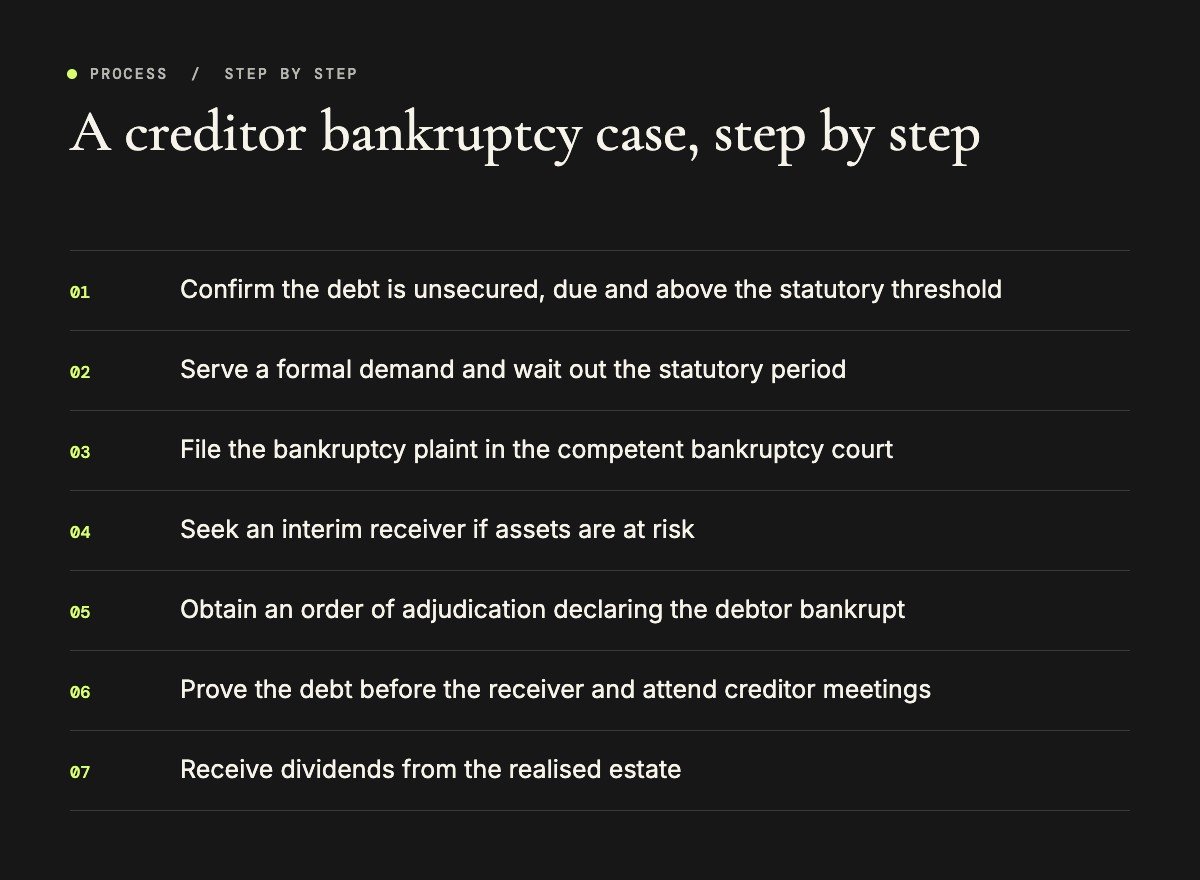
The bankruptcy process step by step
Once the conditions are met, a creditor case under insolvency law in Bangladesh follows a recognisable path. Timelines vary widely between courts, so build realistic expectations with your lawyer before you start.
- Check eligibility. Confirm the debt is unsecured, due, above the threshold and not genuinely disputed, and identify the act of bankruptcy you will rely on.
- Serve the demand. Where relying on non-payment, serve a formal written demand and let the statutory period expire.
- File the plaint. File in the court having jurisdiction where the debtor resides or carries on business, with the documents proving the debt and the act of bankruptcy.
- Protect the assets. If assets may disappear, apply for an interim receiver or other interim orders at the earliest stage.
- Obtain adjudication. After hearing, the court may pass an order of adjudication declaring the debtor bankrupt, and the estate then vests for administration.
- Prove the debt. Lodge a proof of debt with the receiver and take part in creditor meetings and any creditors' committee.
- Receive distributions. The receiver realises assets and pays dividends in the statutory order of priority.
Which court hears the case
The 1997 Act created bankruptcy courts, and the court of the District Judge generally exercises that jurisdiction where no separate court is established. Appeals lie to the High Court Division. Check the current notification for the court in your district, as arrangements can differ.
The receiver and the bankrupt estate
The receiver is the central figure in insolvency law in Bangladesh once a debtor is adjudged bankrupt. The court appoints a receiver, commonly from an approved list, to take control of the estate.
The receiver's powers are broad. He may take possession of the debtor's property, collect debts owed to the bankrupt, sell non-exempt assets, examine the debtor and others about the debtor's dealings, compromise claims or refer them to arbitration with the court's sanction, and report possible offences to the court. With the court's help, the receiver can also obtain police assistance to recover property from unlawful occupiers.
Exempt property
Certain property is excluded from the estate so the debtor is not left destitute, such as basic tools of trade and household necessities, within limits set by the Act. The limits are monetary and dated, so confirm them against the current text.
Setting aside transactions
Insolvency law in Bangladesh allows the receiver to challenge transactions that unfairly strip the estate, including fraudulent transfers and preferences given to favoured creditors. Creditors who received suspicious payments shortly before the case may be asked to return them. Equally, creditors should tell the receiver about any transfer that looks designed to put assets beyond reach.
Priority of claims and distribution
When the receiver distributes the estate, creditors are not paid equally, and insolvency law in Bangladesh sets the ranking. The Act sets an order of priority that reflects the policy choices of the legislature.
- Costs of administration. The receiver's expenses and remuneration come first.
- Preferential debts. Certain government dues and limited employee wage claims rank ahead of ordinary creditors, subject to caps and look-back periods in the Act.
- Ordinary unsecured creditors. They share rateably in what is left.
- Deferred claims. Some claims, such as those of related parties in certain cases, are paid only after everyone else.
Secured creditors sit outside this waterfall to the extent of their security. That is why lenders insist on registered mortgages and charges filed with RJSC. A charge that was never filed may be void against the receiver or liquidator, turning a secured lender into an ordinary creditor.
Suppliers often assume a retention of title clause protects them. Whether it works depends on how the clause is drafted, whether the goods remain identifiable and how the court characterises the arrangement. Do not rely on it without advice.
Composition, reorganisation and discharge
Under insolvency law in Bangladesh, bankruptcy does not have to end in liquidation. The 1997 Act allows the debtor to propose a composition or scheme of arrangement to creditors, which becomes binding if accepted by the required majority and approved by the court. For corporate debtors, the Act also contemplates a reorganisation plan.
These tools are rarely used, largely because the process is slow and creditors distrust debtors once a case has started. A well-prepared proposal with independent financial information and a credible business plan stands a better chance.
Discharge of an individual bankrupt
An individual bankrupt may apply for discharge, which releases him from most provable debts. The court may refuse, suspend or attach conditions to discharge where the bankrupt traded knowing he was insolvent, gave undue preferences, failed to keep proper books or otherwise behaved improperly.
Some debts survive discharge, notably certain debts owed to the government, debts arising from fraud and maintenance obligations. An undischarged bankrupt faces disqualifications under the Act and elsewhere; for example, the Companies Act 1994 bars an undischarged insolvent from acting as a company director.
Insolvency law in Bangladesh for companies
For companies, the choice between bankruptcy and winding up is strategic. Under insolvency law in Bangladesh, a creditor of a company can use either route, but they lead to different courts and different outcomes.
Winding up under the Companies Act 1994 is heard by the company bench of the High Court Division. The court appoints an official liquidator, the directors' powers generally cease, and the liquidator realises assets and investigates officers' conduct. Once a petition has been presented, the court may restrain other proceedings against the company.
Bankruptcy under the 1997 Act is heard by the bankruptcy court. It may be quicker to file in some districts, but appeals and revisions to the High Court Division can slow it down. For large corporate debtors, schemes of arrangement under the Companies Act 1994 are often the more practical restructuring tool.
Directors of distressed companies
Directors should keep proper records, avoid paying connected creditors ahead of others, and take advice once insolvency looms. In a winding up, the court can examine past officers' conduct and order them to repay or compensate the company where they misapplied its money. Our corporate governance practice advises boards facing these decisions.
Reform of insolvency law in Bangladesh
There is broad agreement that insolvency law in Bangladesh needs modernising. Critics point to slow proceedings, low recovery rates, a bias towards liquidation over rescue, the lack of trained insolvency practitioners and the absence of a cross-border insolvency framework.
Since 2024, a unified insolvency and bankruptcy code has been proposed to replace the 1997 Act and the Companies Act winding-up provisions, with a stronger focus on reorganisation and cross-border cases. As far as we have been able to confirm, it had not been enacted at the time of writing. Check the official laws portal for the current position before starting any case.
Banks are a separate story. The Bank Resolution Ordinance 2025 gives Bangladesh Bank power to resolve failing banks outside the court system, and that regime is already being used.
Practical strategy for creditors
Insolvency proceedings are rarely the first step. In most commercial disputes, the threat of insolvency law in Bangladesh is more valuable than the proceedings themselves. A sensible escalation path looks like this:
- Send a lawyer's demand notice setting out the debt and the consequences of non-payment.
- Where cheques have been dishonoured, consider remedies under the Negotiable Instruments Act 1881, covered in our guide to cheque dishonour remedies.
- Serve a statutory demand that can found a winding-up petition or a bankruptcy plaint.
- Negotiate a settlement or rescheduling, backed by fresh security or guarantees.
- File proceedings only where you have checked the debtor's assets and the likely recovery.
Frequently asked questions about insolvency law in Bangladesh
Can a company be declared bankrupt in Bangladesh?
Yes. The Bankruptcy Act 1997 applies to companies and other entities as well as individuals. Companies can alternatively be wound up under the Companies Act 1994.
What is the minimum debt for a creditor bankruptcy case?
The Act as enacted sets a minimum unsecured debt for a creditor plaint, generally stated as Tk 5 lakh. Confirm the current figure in the official text before filing.
Do secured creditors need to file in the bankruptcy?
Generally no. Secured creditors can rely on their security, and prove in the bankruptcy only for any shortfall after valuing or realising it.
Can an individual get a fresh start after bankruptcy?
Yes, through discharge, which releases most provable debts. The court may refuse or limit discharge for misconduct, and some debts, such as certain government dues, survive.
Has the Bankruptcy Act 1997 been replaced?
A new unified insolvency law has been proposed, but at the time of writing we could not confirm enactment. Check the official laws portal for the current position.
How we can help
We act for creditors, debtors, directors and investors in bankruptcy, winding-up and restructuring matters, from statutory demands and petitions to schemes of arrangement and asset recovery. We assess the options under insolvency law in Bangladesh before you commit to proceedings. Learn more about our restructuring and insolvency practice.
Facing a debtor who will not pay?
We review your claim, the debtor's position and the best route under the Bankruptcy Act 1997 or the Companies Act 1994.
Book a consultationInsolvency practicePrimary sources: the Bankruptcy Act 1997, Companies Act 1994 and Artha Rin Adalat Ain 2003 on the Laws of Bangladesh portal; court information from the Supreme Court of Bangladesh; bank resolution notices from Bangladesh Bank.
This article is general information about Bangladeshi law as of 2026 and is not legal advice. Thresholds, courts and procedures change; confirm current requirements with a qualified lawyer before acting.


0 Comments