
Regulatory compliance in Bangladesh rarely fails because a company does not know the rules. It fails because a renewal date passes unnoticed, a monthly return is late, or nobody owns a filing. A well-built compliance calendar turns dozens of scattered obligations into a routine. Here is how to build one.

- Most companies face four layers of obligation: corporate filings with RJSC, tax and VAT with the NBR, sector licences and permits, and labour, safety and environmental duties.
- A compliance calendar should list every obligation with its legal source, regulator, trigger, due date, owner and evidence of completion.
- Monthly VAT and withholding cycles, quarterly advance tax and the annual AGM, audit and return sequence form the backbone of the calendar.
- Many deadlines are event-driven, such as director changes, share transfers or new hires, and need a trigger-based process, not just dates.
- Finance Acts and recent ordinances change dates and forms regularly, so the calendar needs a formal review at least once a year.
Under the Invest Bangladesh Act 2026, effective 23 August 2026, the Bangladesh Investment Development Authority (BIDA), the Bangladesh Economic Zones Authority (BEZA) and the PPP Authority were merged into a single body, Invest Bangladesh. References below to BIDA, BEZA or the PPP Authority should be read as references to Invest Bangladesh. BEPZA continues as a separate authority.
Why regulatory compliance in Bangladesh needs a calendar
A typical private limited company in Dhaka deals with the Registrar of Joint Stock Companies and Firms (RJSC), the National Board of Revenue (NBR), its city corporation, and often the Department of Inspection for Factories and Establishments, the Department of Environment, the fire service, BIDA and Bangladesh Bank. Each has its own forms, portals and deadlines.
Regulatory compliance in Bangladesh is therefore less about any single law and more about coordination. Penalties for late filing are usually modest in isolation, but they accumulate, and a lapsed licence can stop imports, block bank facilities, delay a share transfer or derail due diligence in a sale or fundraise.
A compliance calendar is the simplest tool that solves this. It is a single schedule, owned by a named person, that tells the business what is due, when, to whom, and who is responsible. Done well, it also becomes the evidence that the board has exercised proper oversight.
What changed recently
The past few years have brought frequent changes. The Income Tax Act 2023 replaced the 1984 Ordinance, the Environment Conservation Rules 2023 replaced the 1997 Rules, and several laws were amended by ordinance in 2024 and 2025, some of which Parliament has since converted into Acts. Withholding return cycles and filing dates have also been adjusted by recent Finance laws. A calendar built in 2022 is almost certainly out of date.
The four layers of regulatory compliance in Bangladesh
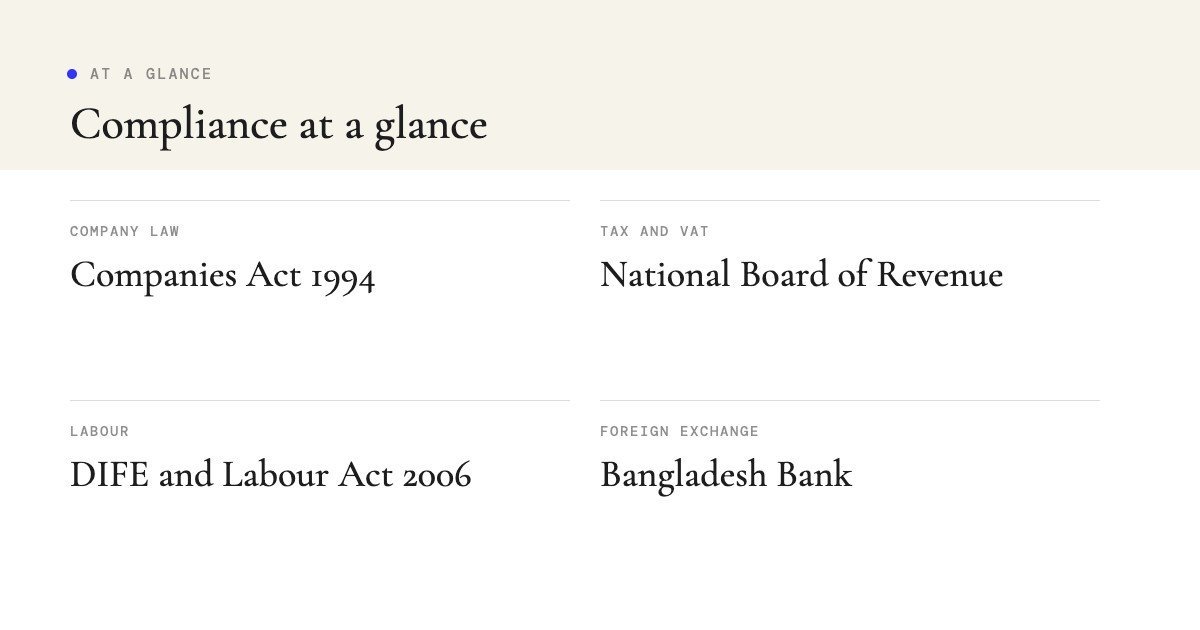
Before setting dates, map the obligations involved. We divide regulatory compliance in Bangladesh into four layers, which helps assign owners and spot gaps.
| Layer | Main laws | Regulator | Typical obligations |
|---|---|---|---|
| Corporate | Companies Act 1994 | RJSC | AGM, annual return, accounts, changes in directors, shares and registered office |
| Tax and VAT | Income Tax Act 2023; VAT and Supplementary Duty Act 2012 | NBR | Monthly VAT returns, withholding deposits and returns, advance tax, annual return |
| Licences and sector permits | Local government laws, Import and Export Control rules, sector statutes | City corporation, CCI&E, sector regulators | Trade licence, IRC and ERC, fire licence, sector licences |
| People, safety and environment | Bangladesh Labour Act 2006; Environment Conservation Act 1995 | DIFE, DoE, fire service, BIDA | Factory licence, committees, WPPF, environmental clearance, work permits |
Companies with foreign shareholders add a fifth strand: foreign exchange reporting to Bangladesh Bank and investment reporting to BIDA. Regulated sectors such as banking, insurance, telecoms, pharmaceuticals and capital markets add their own regulator's calendar on top.
Corporate filings with RJSC
The Companies Act 1994 sets the corporate rhythm of regulatory compliance in Bangladesh. A company must hold its first annual general meeting within eighteen months of incorporation, and after that at least once in every calendar year, with no more than fifteen months between meetings.
The AGM triggers a chain of filings. The audited financial statements are laid before the meeting, the auditor is appointed or reappointed, and the annual return, in the prescribed form showing shareholders and directors, must be filed with RJSC within the statutory period after the meeting. RJSC filings are now made online through the RJSC portal.
Event-driven RJSC filings
Some of the most frequently missed filings are not annual at all. Appointment or resignation of directors, changes in the registered office, allotment or transfer of shares, increase of authorised capital, creation of charges and special resolutions each carry their own short deadline, often counted in days from the event.
These belong in the calendar as triggers: whenever the board approves one of these events, the filing task and its deadline should be created automatically. Our guide to board resolutions in Bangladesh explains how to document these decisions so the filing is straightforward.
Many companies hold the AGM on paper but never file the annual return, or file returns that do not match the share register. When a bank, buyer or investor later searches RJSC records, the gap appears immediately and has to be regularised before the transaction can close.
Tax and VAT: the monthly backbone of regulatory compliance in Bangladesh
Tax and VAT obligations generate the most entries in any calendar, and they repeat every month. For most businesses this is where regulatory compliance in Bangladesh is won or lost.
VAT
A VAT-registered business must file its monthly VAT return by the fifteenth day of the following month under the VAT and Supplementary Duty Act 2012, through the online VAT system. Where the business is a withholding entity for VAT, amounts deducted at source must be deposited and certificates issued within the prescribed short periods. Turnover tax enlisted businesses follow a separate, simpler cycle.
Income tax withholding
Under the Income Tax Act 2023, tax deducted from salaries, contractor and supplier payments, rent, professional fees and payments to non-residents must be deposited with the government within the statutory period after deduction, and certificates issued to payees. Withholders must also file withholding tax returns. These were monthly under the Act as first enacted and were moved to a quarterly cycle by the Finance Ordinance 2025; confirm the current frequency and due date before setting reminders.
Advance tax and the annual return
Companies with estimated tax above the threshold pay advance tax in quarterly instalments, conventionally due on 15 September, 15 December, 15 March and 15 June for a July to June year. The annual company return is due on the company Tax Day, fixed by reference to the end of the income year, together with audited accounts. Our company tax return guide covers the filing itself.
Licences, renewals and permits
Licences are the second major source of missed deadlines in regulatory compliance in Bangladesh, because they renew once a year and nobody remembers the date. Regulatory compliance in Bangladesh depends on keeping a register of every licence with its issue date, expiry date and renewal requirements.
- Trade licence. Issued by the city corporation or municipality and valid for the financial year. It must be renewed annually, with surcharges for late renewal. See our trade licence guide.
- Import and export registration. Import registration certificates (IRC) and export registration certificates (ERC) issued by the Office of the Chief Controller of Imports and Exports require periodic renewal.
- Fire licence. Factories and many commercial premises need a fire licence from the fire service, renewable annually.
- Factory licence. Factories are licensed by DIFE and must renew on schedule.
- Environmental clearance. Industrial units and projects need an environmental clearance certificate from the Department of Environment, with validity and renewal rules depending on the category under the Environment Conservation Rules 2023.
- Chamber or association membership. Often a pre-condition for other renewals, such as IRC and ERC.
- Sector licences. Drug licences, telecoms licences, BSTI certification, food safety registration and similar permits each have their own terms.
Renewal chains
Renewals often depend on each other. An IRC renewal may require a current trade licence and chamber membership; an environmental clearance may require a valid trade licence and fire licence. Build these dependencies into the calendar so the prerequisite renewal is done first. For the DoE process, see our guide to getting an environment licence.
Labour, safety and people obligations
For regulatory compliance in Bangladesh, employment obligations generate both recurring and event-driven tasks. Wages must be paid within seven working days after the end of each wage period under the Bangladesh Labour Act 2006, and minimum wage notifications must be applied from their effective date.
Annual tasks include the workers' participation fund payment for companies that meet the statutory capital or asset thresholds, group insurance renewal where required, review of safety committee and harassment complaint committee composition, and updating statutory registers. The Labour (Amendment) Act 2026 added new committee and policy requirements, so these entries should be reviewed this year.
Expatriate staff
Foreign employees need work permits, which are issued for fixed periods and must be renewed before expiry, together with the matching visa. Missing a renewal can force the employee to stop work and leave. Build reminders at least two to three months before expiry, because renewal applications need supporting tax and corporate documents.
Foreign exchange and investment reporting
For foreign-owned businesses, regulatory compliance in Bangladesh also covers reporting. Companies with foreign shareholders or foreign loans have reporting duties to Bangladesh Bank under the Foreign Exchange Regulation Act 1947 and the Guidelines for Foreign Exchange Transactions, often submitted through their authorised dealer bank. These include reporting of inward investment, dividend remittances and foreign borrowing, some on a periodic basis.
Repatriation of dividends and royalties is far smoother when these reports, audited accounts, tax clearance and board approvals are complete and consistent. Regulatory compliance in Bangladesh for a foreign-owned company should therefore include the bank's documentation checklist as part of the annual cycle.
Conduct obligations that sit outside the calendar
Not every obligation has a date. Some of the most serious risks in regulatory compliance in Bangladesh come from conduct rules that apply continuously: anti-money laundering, anti-corruption, competition and data handling. These cannot be ticked off once a year, but the calendar can still prompt the periodic reviews, training and reporting that keep them under control.
Banks, financial institutions, insurers, capital market intermediaries, real estate developers and certain other businesses are reporting organisations under the Money Laundering Prevention Act 2012. They must maintain customer due diligence, appoint compliance officers and report suspicious and cash transactions to the Bangladesh Financial Intelligence Unit within the time limits set by its circulars. Other companies are not reporting organisations but still face criminal exposure if they facilitate laundering.
The Competition Act 2012 prohibits anti-competitive agreements and abuse of dominance, and the Bangladesh Competition Commission has become more active. Cyber security and personal data rules have been revised by ordinance since 2024, so check the current text before relying on older guidance. Add an annual policy review, staff training and a check of any new rules for each of these areas to your calendar.
How to build a compliance calendar for regulatory compliance in Bangladesh
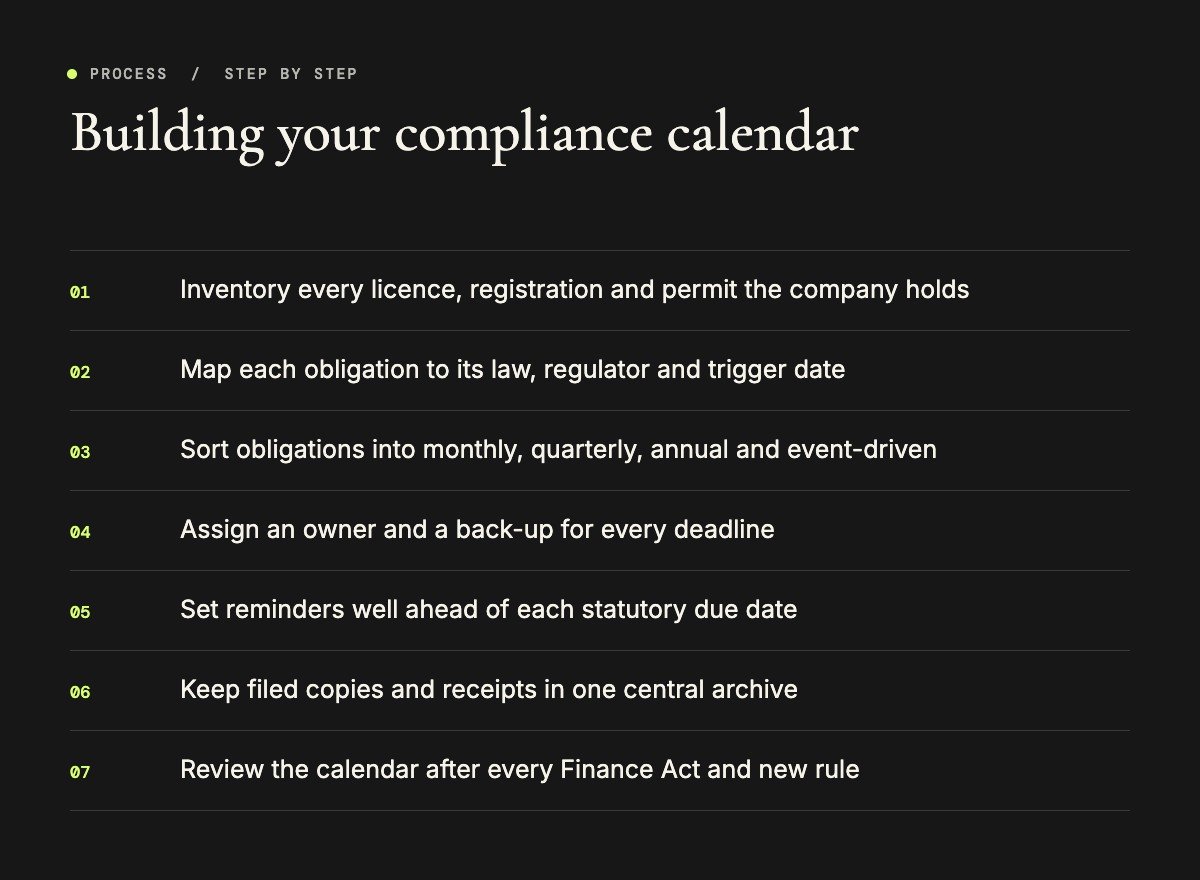
For regulatory compliance in Bangladesh, the method matters more than the software. A spreadsheet maintained with discipline beats an expensive system nobody updates. We use the following sequence when setting up a calendar for a client.
- Take an inventory. Collect every certificate, licence, registration, permit and approval the company holds, together with its issue and expiry dates.
- Identify the legal source. For each obligation, record the law or rule, the regulator, the form and the portal used.
- Classify the frequency. Sort entries into monthly, quarterly, annual, multi-year and event-driven obligations.
- Set internal deadlines. Put the internal due date well ahead of the statutory date, typically five to ten working days for monthly returns and sixty to ninety days for licence renewals.
- Assign owners. Give every entry a named owner and a back-up, and make sure external advisers know which items they handle.
- Record evidence. Store the filed return, acknowledgment, challan or renewed licence in a central archive linked to each entry.
- Report and review. Send a monthly status report to management and present an annual compliance certificate to the board.
Fields every calendar entry should have
At minimum, record the obligation, legal source, regulator, frequency, trigger or period, statutory due date, internal due date, owner, back-up, status, evidence link and notes on penalties. This structure makes regulatory compliance in Bangladesh auditable, which matters when a buyer, lender or regulator asks how the company manages its obligations.
A sample year: putting the calendar together
For a company with a July to June financial year, a calendar for regulatory compliance in Bangladesh typically looks like this. Exact dates must be checked against the current law each year.
- Every month. VAT return by the fifteenth; withholding deposits and certificates; payroll within the statutory period; VAT withholding deposits where applicable.
- Every quarter. Advance tax instalments; withholding tax returns under the current cycle; periodic Bangladesh Bank or BIDA reports where applicable.
- July to September. Trade licence renewal for the new financial year; closing the books for the year ended 30 June; start of the statutory audit.
- October to December. Board approval of audited accounts; AGM; annual return to RJSC within the statutory period; WPPF calculations based on audited profit.
- January to March. Company income tax return on the Tax Day; renewals of licences falling due in this period.
- April to June. Budget and Finance Bill review; planning for changes from 1 July; final advance tax instalment.
A company with a different year-end, or in a regulated sector, will shift several of these entries. That is why the inventory step, not a generic template, is the foundation of the calendar.
Governance: making regulatory compliance in Bangladesh stick
A calendar works only if someone is accountable for it. In smaller companies this is often the company secretary or finance head; in larger groups, a compliance officer reporting to the board or audit committee. Either way, the board should receive a periodic compliance report and minute its review.
Internal accountability also protects directors. Many statutes make directors and officers personally liable for company defaults, and a documented compliance system is the best evidence that they took reasonable steps. Regulatory compliance in Bangladesh is ultimately a governance issue, not merely an administrative one.
Keeping the calendar current
Schedule a formal review of your regulatory compliance in Bangladesh every July, after the Finance Act takes effect, and whenever a new ordinance, rule or circular affects the business. Subscribe to updates from the NBR, RJSC, Bangladesh Bank and the relevant sector regulator, and record each change in the calendar with its effective date.
Frequently asked questions about regulatory compliance in Bangladesh
What is the most common compliance failure for companies in Bangladesh?
In our experience, unfiled RJSC annual returns and lapsed licences, especially trade licences and IRCs, are the most common. Both are cheap to prevent and expensive to fix during a transaction.
Can a small company manage compliance without software?
Yes. A well-structured spreadsheet with owners, due dates and evidence links is enough for most small and mid-sized companies, provided someone reviews it every month.
How far ahead should licence renewals start?
Start sixty to ninety days before expiry. Many renewals need other current documents, such as a trade licence or tax certificate, which take time to obtain.
Are directors personally liable for missed filings?
Several laws impose fines on the company and on officers in default. A documented compliance system helps directors show that they acted responsibly.
Do foreign-owned companies have extra obligations?
Yes. They usually have foreign exchange reporting through their bank to Bangladesh Bank, BIDA-related obligations and work permit renewals for expatriate staff, in addition to the ordinary corporate and tax calendar.
How often should the calendar be updated?
At least once a year after the Finance Act, and whenever a new law, rule or circular affects the business. Event-driven entries should be added as events occur.
How we can help
We design compliance calendars, carry out compliance health checks and handle RJSC, licensing and regulatory filings for local and foreign-owned companies. If you want regulatory compliance in Bangladesh to run as a routine rather than a series of emergencies, see our regulatory compliance practice.
Need a compliance health check?
We review your licences, filings and registers, close the gaps and set up a calendar your team can run.
Book a consultationCompliance practicePrimary sources: corporate filings through the Registrar of Joint Stock Companies and Firms; tax and VAT guidance from the National Board of Revenue; import and export registration with the Office of the Chief Controller of Imports and Exports; environmental clearance from the Department of Environment.
This article is general information about Bangladeshi law as of 2026 and is not legal advice. Deadlines, forms and procedures change; confirm current requirements with the relevant regulator or a qualified lawyer before acting.




0 Comments