
The corporate governance code in Bangladesh for listed companies is the Corporate Governance Code issued by the Bangladesh Securities and Exchange Commission on 3 June 2018. It sets binding rules on board composition, independent directors, key officers, board committees, auditors and annual disclosure. This guide explains what each obligation requires in practice.
- The BSEC Corporate Governance Code 2018 applies to companies listed on the Dhaka and Chittagong stock exchanges and is enforced by BSEC.
- Boards must have five to twenty directors, with independent directors making up at least one-fifth of the board, subject to a minimum number.
- The chair and the managing director or CEO must be different people, and the CFO, company secretary and head of internal audit and compliance must be separate appointments.
- An audit committee and a nomination and remuneration committee, each chaired by an independent director, are mandatory.
- Compliance is verified each year by an independent professional's certificate and a detailed status report in the annual report. BSEC published draft Corporate Governance Rules in 2026, so watch for changes.
What the corporate governance code in Bangladesh is
Bangladesh does not have a single statute called a governance code. For listed companies, the governing instrument is the Corporate Governance Code issued by the Bangladesh Securities and Exchange Commission (BSEC) by notification dated 3 June 2018, under its power in the Securities and Exchange Ordinance 1969 to impose conditions on issuers in the interest of investors.
The 2018 Code replaced earlier BSEC governance guidelines and notifications dating back to 2006 and 2012. It moved away from a loose "comply or explain" approach: most conditions must simply be complied with, and the annual compliance report must state the status of each condition.
The corporate governance code in Bangladesh sits alongside, not in place of, the Companies Act 1994, the listing regulations of the stock exchanges and sector rules. Banks and financial institutions also follow Bangladesh Bank's governance requirements, and insurers follow those of the insurance regulator. Where rules overlap, the stricter requirement usually governs in practice.
Who must comply
The Code applies to companies listed on the Dhaka Stock Exchange and Chittagong Stock Exchange. Companies preparing for an IPO are expected to align their boards and committees with it before listing, and the prospectus review will test that alignment. Unlisted companies are not bound, but many use the corporate governance code in Bangladesh as a benchmark when investors or lenders ask for better governance.
Board composition under the corporate governance code in Bangladesh
The corporate governance code in Bangladesh requires a board of not fewer than five and not more than twenty directors. The size should reflect the scale and complexity of the business, but the limits are absolute.
Independent directors
Under the corporate governance code in Bangladesh, at least one-fifth of the directors must be independent, subject to a minimum number of independent directors, and any fraction is rounded up. The Code sets detailed independence tests. An independent director must not hold more than a minimal shareholding, must not be a sponsor or connected with sponsors or major shareholders, must not have a material business relationship with the company or its group, and must not have been an employee, auditor or adviser within a specified recent period.
Independent directors are appointed by the board and approved by shareholders at the general meeting. A vacancy must be filled within ninety days. The Code also limits how many listed companies a person may serve as an independent director at the same time.
Tenure and qualifications
The tenure of an independent director is three years, which may be extended for one further term. After two consecutive terms, a gap of one tenure is required before reappointment. Independent directors must be knowledgeable and have relevant experience; the Code identifies categories such as business leaders, senior corporate executives, former senior officials, academics and professionals, generally with at least ten years of relevant experience.
Independence tests apply to relatives and connected entities as well as to the individual. Before nominating a candidate, collect a written declaration covering shareholdings, family relationships, business dealings and past roles, and have it checked against the Code's criteria. Late discovery of a conflict forces a mid-term replacement and a disclosure.
The chair, the CEO and the key officers
A central principle of the corporate governance code in Bangladesh is the separation of leadership roles. The chair of the board and the managing director or chief executive officer must be different individuals. The chair must be elected from among the non-executive directors, and the board must clearly define the respective roles and responsibilities of the chair and the CEO.
The managing director or CEO of a listed company may not hold the same position in another listed company. This prevents one executive from running several listed businesses with competing interests.
CFO, company secretary and head of internal audit
The corporate governance code in Bangladesh requires the board to appoint a managing director or CEO, a chief financial officer, a company secretary and a head of internal audit and compliance (HIAC), and these must be different individuals. Their roles, responsibilities and duties must be defined by the board. They must not be removed from their positions without board approval, and removal must be disclosed promptly to BSEC and the stock exchanges.
The CFO and company secretary are expected to attend board meetings, except where their own matters are discussed. The HIAC reports functionally to the audit committee, which protects the internal audit function from management pressure.
Board committees: audit committee and NRC
The corporate governance code in Bangladesh requires two board committees. Both are sub-committees of the board, report to it and act under written terms of reference.
| Feature | Audit committee | Nomination and remuneration committee |
|---|---|---|
| Minimum size | Three members | Three members |
| Membership | All non-executive directors, including at least one independent director | Non-executive directors, including at least one independent director |
| Chair | An independent director | An independent director |
| Expertise | At least one member with an accounting or related financial management background | Knowledge of human resources and remuneration matters is expected |
| Core role | Financial reporting, internal control, internal audit, external auditors, related party transactions | Board diversity, director and senior executive criteria, remuneration policy, board evaluation |
| Reporting | Reports to the board; reports in the annual report | Reports to the board; policy disclosed in the annual report |
The audit committee in practice
The audit committee oversees the financial reporting process, monitors accounting policies, reviews internal control and risk management, oversees the internal audit function and the HIAC, and reviews the annual and quarterly financial statements before the board approves them. It also reviews related party transactions and the use of IPO proceeds where relevant.
Where the committee finds a conflict of interest, fraud, irregularity or material breach of law, it must report to the board, and if the board fails to act, the Code provides for reporting to BSEC. That escalation route gives the committee real teeth.
The nomination and remuneration committee
Under the corporate governance code in Bangladesh, the NRC formulates criteria for qualifications, positive attributes and independence of directors, recommends a remuneration policy for directors and top executives, develops a board diversity policy, identifies people qualified to be directors or top executives, and sets criteria for evaluating independent directors and the board. Its policy must be disclosed in the annual report.
Financial reporting and auditors
Under the corporate governance code in Bangladesh, the CEO and CFO must certify to the board that they have reviewed the financial statements, that the statements present a true and fair view and comply with applicable standards and laws, and that no transactions are fraudulent, illegal or in breach of the company's code of conduct. The certification is disclosed in the annual report.
The corporate governance code in Bangladesh also restricts the services an external auditor may provide. The statutory auditor may not provide services such as appraisal or valuation, financial information systems design, bookkeeping, broker-dealer services, actuarial services, internal audit or other services that the audit committee determines to be incompatible. Partners and employees of the audit firm may not hold shares in the client, and a representative of the auditor should attend the AGM to answer shareholders' questions.
Directors' report disclosures
Under the corporate governance code in Bangladesh, the directors' report must include a long list of statements, including on industry outlook, segment performance, risks, related party transactions, use of IPO proceeds, significant deviations between quarterly and annual results, directors' remuneration, the going-concern assessment, key operating and financial data, board meeting attendance and the shareholding pattern. These statements are where the board explains its stewardship, and analysts read them closely.
Subsidiaries and group governance
Under the corporate governance code in Bangladesh, listed holding companies must apply governance discipline to their subsidiaries. The Code requires that provisions on the composition of the holding company's board apply, as far as possible, to the subsidiary's board; that at least one independent director of the holding company sits on the subsidiary's board; that subsidiary board minutes are placed before the holding company's board; and that the holding company's audit committee reviews the subsidiary's financial statements, particularly its investments.
Group governance is an area where the corporate governance code in Bangladesh is often under-implemented. Intra-group loans, guarantees and transfers of assets are classic channels for value leakage, and the Code's subsidiary provisions exist to give independent directors visibility of them.
Compliance certificate and annual reporting
Each year, to evidence compliance with the corporate governance code in Bangladesh, the company must obtain a certificate from a practising professional, such as a chartered accountant, cost and management accountant or chartered secretary, confirming compliance with the Code. The professional is appointed by shareholders at the AGM and may not be the statutory auditor for the same year.
The certificate and a condition-by-condition status report in the format prescribed by the Code are published in the annual report. The directors' report must state whether the company has complied with each condition. Inaccurate or incomplete status reports attract BSEC scrutiny and, where conditions are breached, enforcement action.
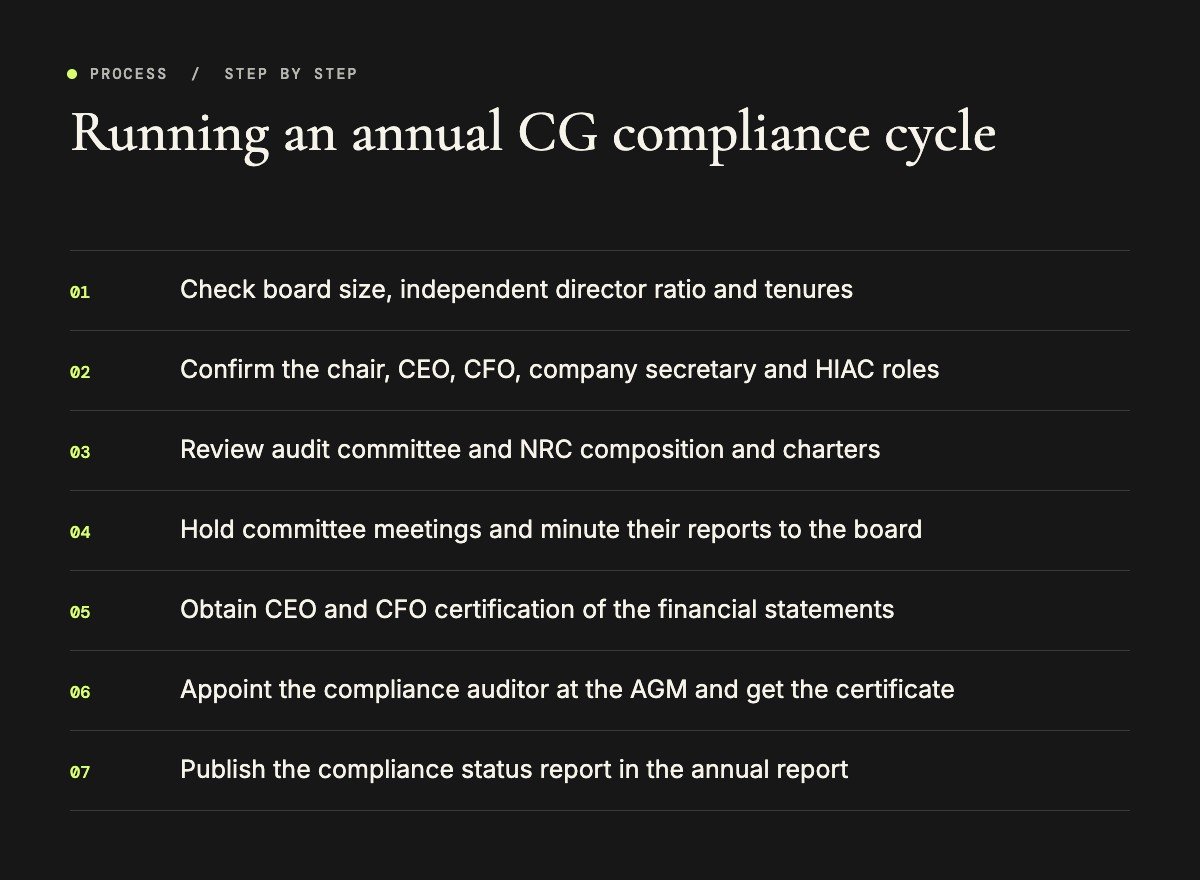
An annual CG compliance cycle
- Review the board. Check board size, the independent director ratio, tenures, vacancies and the independence declarations of each independent director.
- Confirm the officers. Verify that the chair, CEO, CFO, company secretary and HIAC roles are held by different people with board-approved terms of reference.
- Refresh the committees. Confirm audit committee and NRC composition, chairs and charters, and fill any gaps before the year starts.
- Run the meeting calendar. Schedule board and committee meetings around quarterly and annual results, and minute committee reports to the board.
- Certify the accounts. Obtain the CEO and CFO certification and the audit committee's review before board approval of the financial statements.
- Appoint the compliance auditor. Put the appointment of the governance compliance professional on the AGM agenda.
- Publish and disclose. Include the certificate, the status report and the required directors' report statements in the annual report.

Board processes and the code of conduct
The corporate governance code in Bangladesh regulates how the board works, not only who sits on it. Board meetings, the recording of minutes and the keeping of books must follow the Bangladesh Secretarial Standards adopted by the Institute of Chartered Secretaries of Bangladesh, as far as they do not conflict with other laws. In practice this means proper notice, circulated papers, a quorum, accurate minutes and a clear record of decisions and dissent.
The board must also lay down a code of conduct for the chair, the other directors and the managing director or CEO, based on the NRC's recommendation, and post it on the company's website. A good code covers confidentiality, conflicts of interest, insider trading, related party dealings, gifts, compliance with laws and the protection of company assets. Each director should confirm compliance annually.
Website and investor communication
Listed companies must maintain an official website linked to the websites of the stock exchanges and keep required disclosures on it, including the code of conduct and periodic financial statements. Investors, analysts and regulators increasingly check the website first, so out-of-date content is itself a governance signal. Under the corporate governance code in Bangladesh, the company secretary usually owns this task, working with investor relations.
Related party transactions deserve particular care. They must be reviewed by the audit committee and disclosed in the annual report, and price-sensitive transactions trigger separate disclosure duties under securities regulations. Documenting the commercial rationale and arm's-length terms at the time of approval is the best protection for directors.
Enforcement and consequences of non-compliance
Because the corporate governance code in Bangladesh is issued as a condition under securities law, a breach is a breach of BSEC requirements. BSEC can impose penalties on the company and its directors, issue directions, and in serious cases take further regulatory action. The stock exchanges may also act under their listing regulations.
The practical consequences are often larger than the formal penalty. A visible governance failure affects share price, makes fundraising harder and can trigger lender covenants. In disputes between shareholders, a failure to follow the corporate governance code in Bangladesh is frequently used as evidence that the board did not act properly.
Interaction with company law duties
Compliance with the Code does not discharge directors' duties under the Companies Act 1994 and general law. Directors must still act in good faith in the interests of the company, avoid conflicts and exercise due care. Board decisions should be properly documented; our guide to board resolutions covers the drafting and recording of decisions.
What may change: the draft 2026 Corporate Governance Rules
In May 2026, BSEC published draft Bangladesh Securities and Exchange Commission (Corporate Governance) Rules 2026 for public comment. According to press reports, the draft would put governance requirements into rules, tighten independent director experience and tenure conditions, require at least one woman on the board, strengthen audit committee expertise, impose stricter minute-keeping and disclosure duties, and expand oversight of subsidiaries and inter-company transactions.
At the time of writing we have not confirmed that the rules have been finalised. Until they are, the 2018 Code remains the operative corporate governance code in Bangladesh for listed companies. Boards should nonetheless start preparing, particularly on board diversity, independent director pipelines and committee expertise, because these changes take time to implement.
Preparing the board for change
We recommend that listed companies review their board skills matrix, map independent director tenures against the proposed limits, and begin documenting dissenting views in minutes now. These steps reflect good practice under the current corporate governance code in Bangladesh and will ease the transition to any new rules.
Frequently asked questions about corporate governance code in Bangladesh
Does the corporate governance code in Bangladesh apply to private companies?
No. The BSEC Code binds listed companies. Private and unlisted public companies are governed by the Companies Act 1994 and their articles, although many adopt parts of the Code voluntarily.
How many independent directors does a listed company need?
At least one-fifth of the board, subject to the Code's minimum number, with fractions rounded up. For a ten-member board, that means at least two independent directors.
Can the chair also be the managing director?
No. The chair and the managing director or CEO must be different individuals, and the chair must be a non-executive director.
Who issues the annual compliance certificate?
A practising chartered accountant, cost and management accountant or chartered secretary appointed by shareholders at the AGM, who is not the company's statutory auditor for that year.
Do banks follow a different governance regime?
Listed banks must comply with the BSEC Code and with Bangladesh Bank's governance requirements under banking law. Where the two differ, banks generally apply the stricter rule.
Has the 2018 Code been replaced?
BSEC published draft Corporate Governance Rules in 2026. Unless and until final rules are notified, the 2018 Code remains in force, so check BSEC's latest notifications.
How we can help
We advise listed companies, IPO candidates and their boards on the corporate governance code in Bangladesh, from board and committee design and independent director selection to charters, compliance reviews and BSEC enforcement matters. Learn more about our corporate governance practice and our work before the Bangladesh Securities and Exchange Commission.
Need a governance review?
We review your board, committees and disclosures against the BSEC Code and the draft 2026 rules, and help close the gaps before the next annual report.
Book a consultationGovernance practicePrimary sources: the Corporate Governance Code and notifications from the Bangladesh Securities and Exchange Commission; listing regulations of the Dhaka Stock Exchange and Chittagong Stock Exchange; the Companies Act 1994 on the Laws of Bangladesh portal.
This article is general information about Bangladeshi law as of 2026 and is not legal advice. BSEC requirements change by notification and draft rules were under consultation in 2026; confirm current requirements with BSEC or a qualified lawyer before acting.


0 Comments